
Le Partitif Talking about an indefinite quantity The
Le Partitif Talking about an indefinite quantity
The partitive • To say that you want part of or some of an item, use de with the definite article (le, la, l’, les) that goes with the item • Using de + the definite article is called the partitive

The Partitive • Make the following chart in your notes. Masculine Singular Feminine Singular before a vowel Plural DU DE LA DE L’ DES (de + le) Example Du bacon Example De la confiture Example De l’omelette (de + les) Example Des oeufs
The Partitive • EXAMPLES – Tu veux de l’ail? • Do you want some garlic? – Je veux du bacon. • I want some bacon. – Vous voulez de la banane? • Do you want some banana? – Do you want some croissants? • Tu veux des croissants?
The Partitive • In French, you always need to include the article, even though it is sometimes omitted in English • Example – Je prends des fruits et des legumes. • I’m having fruits and vegetables (some is omitted because it is implied).
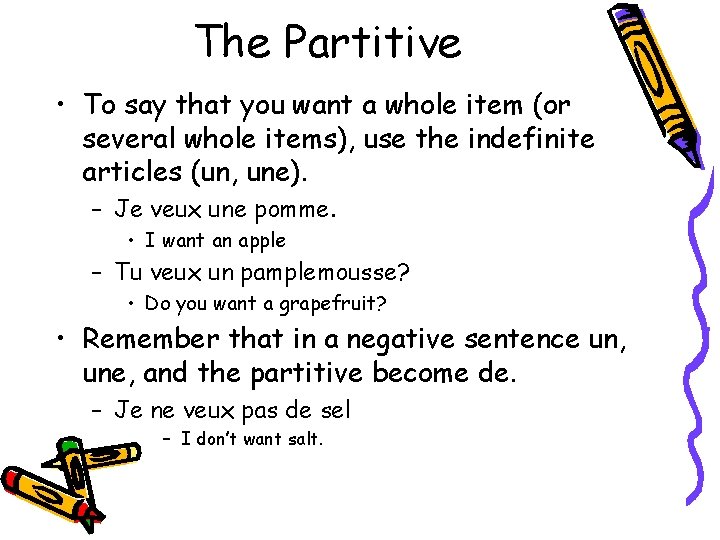
The Partitive • To say that you want a whole item (or several whole items), use the indefinite articles (un, une). – Je veux une pomme. • I want an apple – Tu veux un pamplemousse? • Do you want a grapefruit? • Remember that in a negative sentence un, une, and the partitive become de. – Je ne veux pas de sel – I don’t want salt.
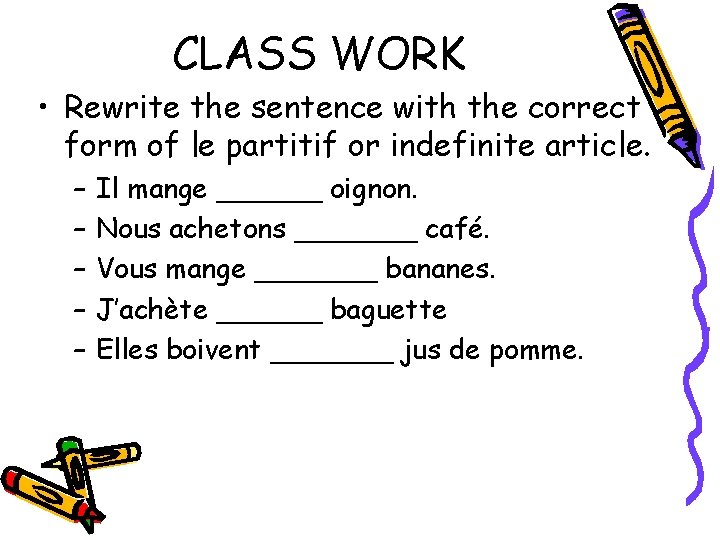
CLASS WORK • Rewrite the sentence with the correct form of le partitif or indefinite article. – – – Il mange ______ oignon. Nous achetons _______ café. Vous mange _______ bananes. J’achète ______ baguette Elles boivent _______ jus de pomme.
- Slides: 7