
Le conditionnel Conditionnel l used to express what
- Slides: 19
Le conditionnel
Conditionnel l used to express what you would, could or should do in certain circumstances (a possibility or an eventuality) “future in the past” (for the most part) can also be used as a more polite way to make a request or demand (particularly for verbs devoir, pouvoir et vouloir)
Endings l l l l We use the endings for the imparfait to conjugate the conditionnel JE – ais TU – ais IL/ELLE/ON – ait NOUS – ions VOUS – iez ILS/ELLES - aient
Conjugating the conditionnel l l To conjugate a verb in the conditionnel, you take the infinitive form (the –ER, -IR or RE) of the verb and add the endings on For –RE verbs, you must drop the “e” before adding the endings
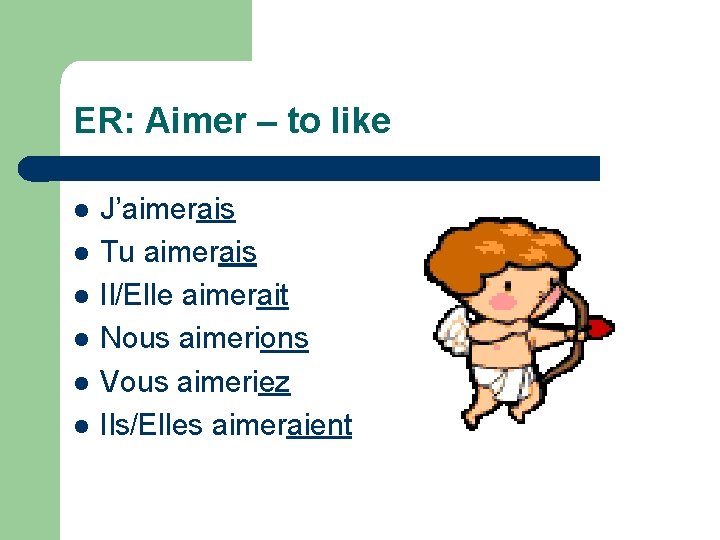
ER: Aimer – to like l l l J’aimerais Tu aimerais Il/Elle aimerait Nous aimerions Vous aimeriez Ils/Elles aimeraient
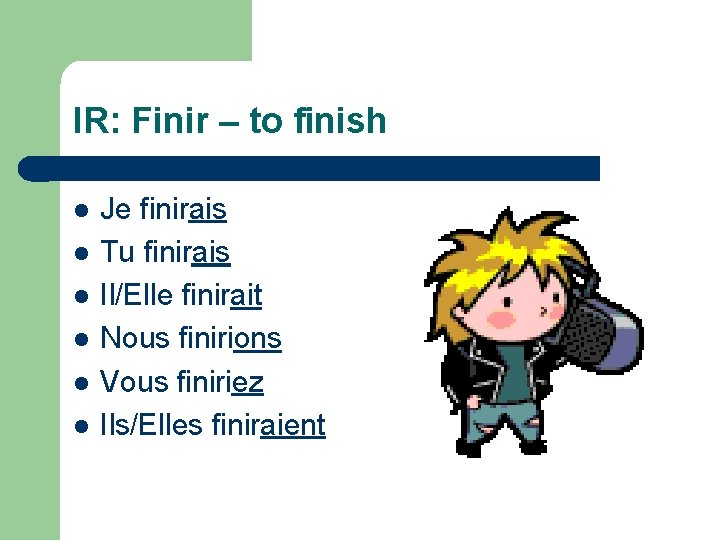
IR: Finir – to finish l l l Je finirais Tu finirais Il/Elle finirait Nous finirions Vous finiriez Ils/Elles finiraient
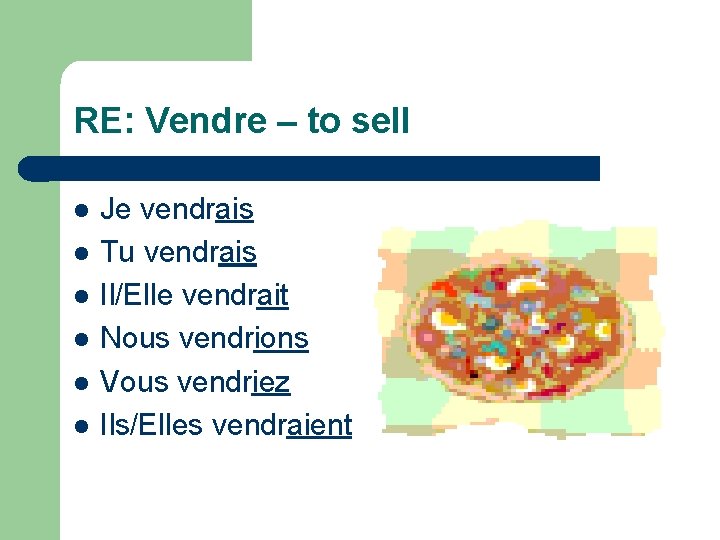
RE: Vendre – to sell l l l Je vendrais Tu vendrais Il/Elle vendrait Nous vendrions Vous vendriez Ils/Elles vendraient
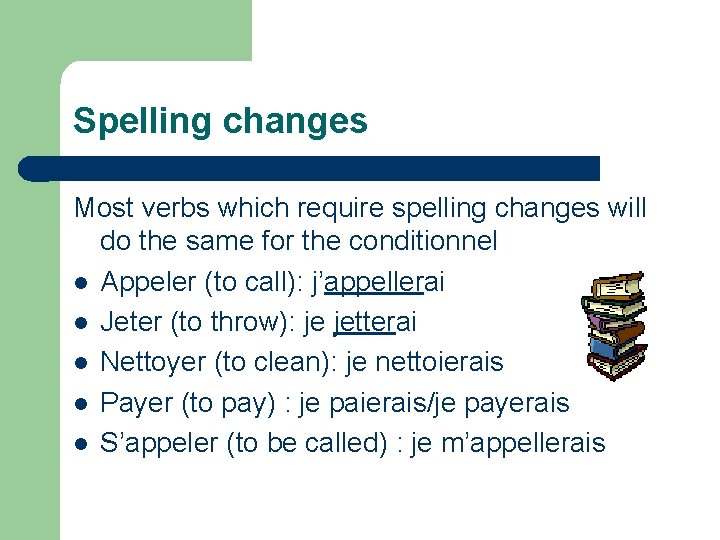
Spelling changes Most verbs which require spelling changes will do the same for the conditionnel l Appeler (to call): j’appellerai l Jeter (to throw): je jetterai l Nettoyer (to clean): je nettoierais l Payer (to pay) : je paierais/je payerais l S’appeler (to be called) : je m’appellerais
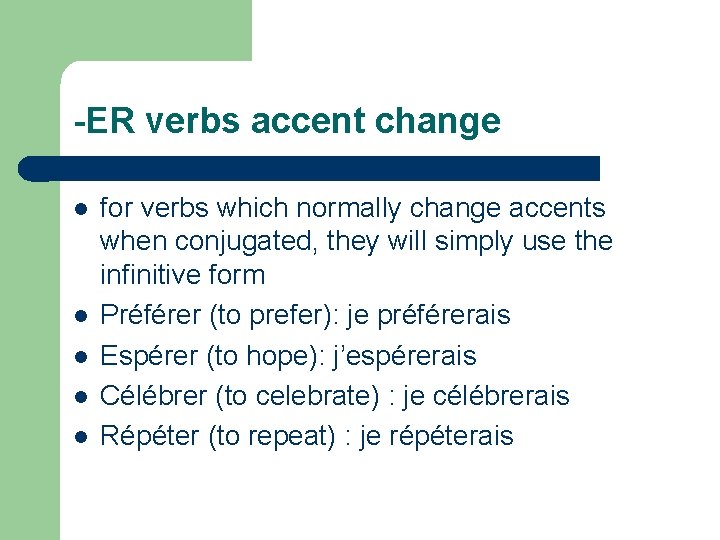
-ER verbs accent change l l l for verbs which normally change accents when conjugated, they will simply use the infinitive form Préférer (to prefer): je préférerais Espérer (to hope): j’espérerais Célébrer (to celebrate) : je célébrerais Répéter (to repeat) : je répéterais
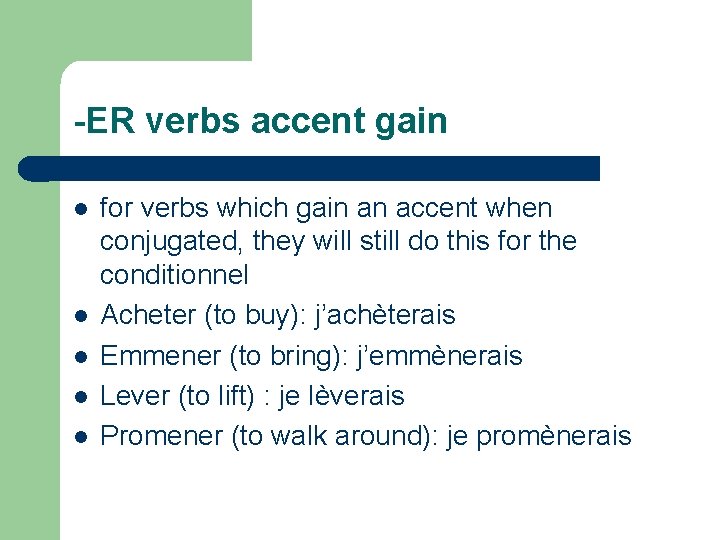
-ER verbs accent gain l l l for verbs which gain an accent when conjugated, they will still do this for the conditionnel Acheter (to buy): j’achèterais Emmener (to bring): j’emmènerais Lever (to lift) : je lèverais Promener (to walk around): je promènerais
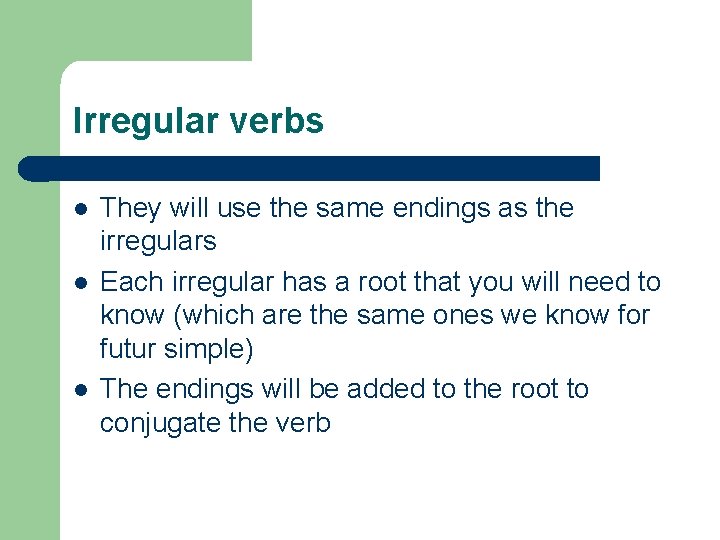
Irregular verbs l l l They will use the same endings as the irregulars Each irregular has a root that you will need to know (which are the same ones we know for futur simple) The endings will be added to the root to conjugate the verb
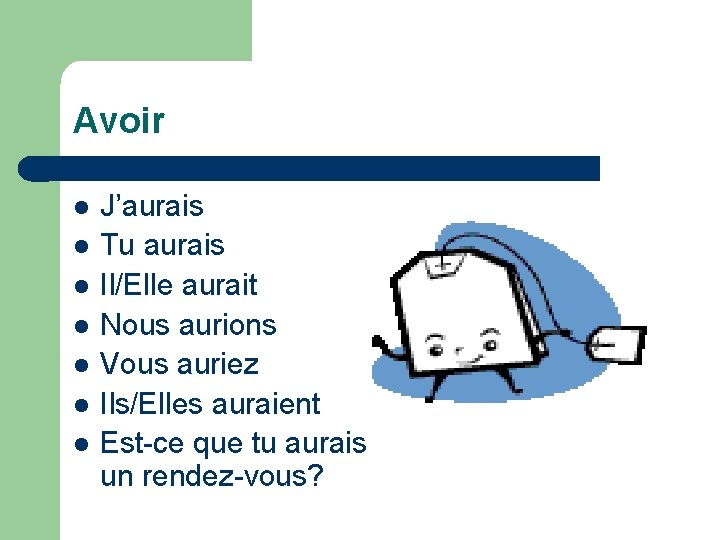
Avoir l l l l J’aurais Tu aurais Il/Elle aurait Nous aurions Vous auriez Ils/Elles auraient Est-ce que tu aurais un rendez-vous?
Être l l l l Je serais Tu serais Il/Elle serait Nous serions Vous seriez Ils/Elles seraient au concert de Eric Clapton
Faire l l l l Je ferais Tu ferais Il/Elle ferait Nous ferions Vous feriez Ils/Elles feraient Nous ferions du patinage avec la famille
Aller l l l l J’irais Tu irais Il/Elle irait Nous irions Vous iriez Ils/Elles iraient Vous iriez voir un film?
Other irregulars l l l l l Courir = je courrais Devoir = je devrais Mourir = je mourrais Pleuvoir = il pleuvrait Pouvoir = je pourrais Recevoir = je recevrais Savoir = je saurais Tenir = je tiendrais Venir = je viendrais Voir = je verrais
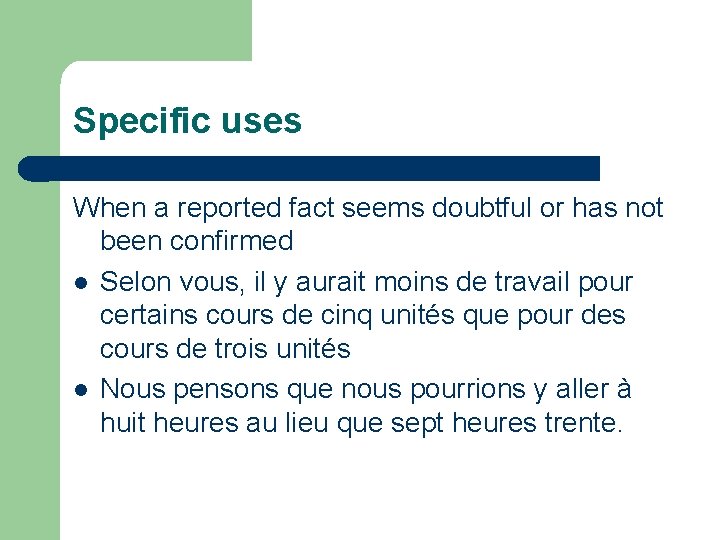
Specific uses When a reported fact seems doubtful or has not been confirmed l Selon vous, il y aurait moins de travail pour certains cours de cinq unités que pour des cours de trois unités l Nous pensons que nous pourrions y aller à huit heures au lieu que sept heures trente.
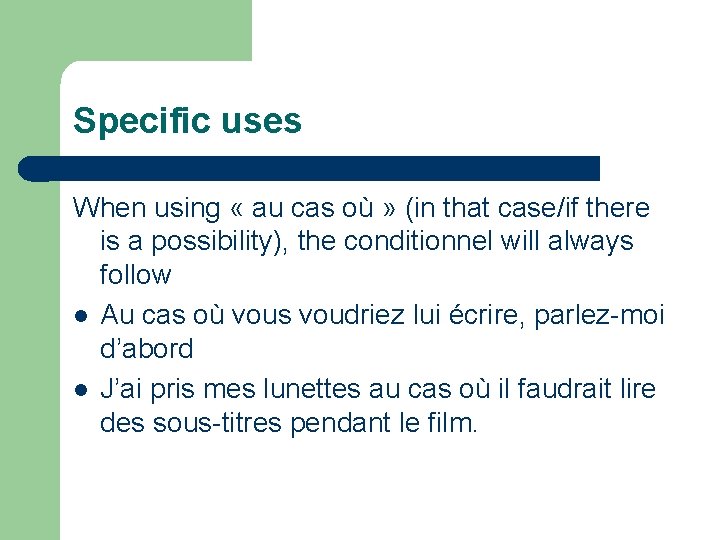
Specific uses When using « au cas où » (in that case/if there is a possibility), the conditionnel will always follow l Au cas où vous voudriez lui écrire, parlez-moi d’abord l J’ai pris mes lunettes au cas où il faudrait lire des sous-titres pendant le film.
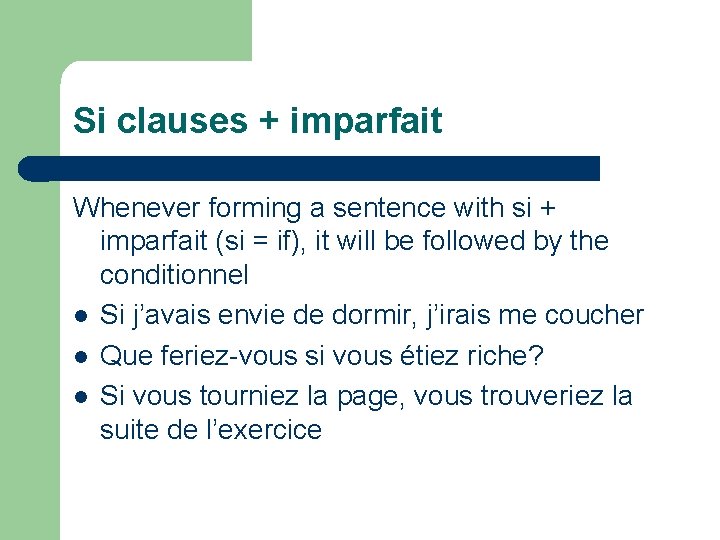
Si clauses + imparfait Whenever forming a sentence with si + imparfait (si = if), it will be followed by the conditionnel l Si j’avais envie de dormir, j’irais me coucher l Que feriez-vous si vous étiez riche? l Si vous tourniez la page, vous trouveriez la suite de l’exercice