
Le Chateliers Principle If a system at equilibrium
Le Chatelier’s Principle: “If a system at equilibrium is disturbed by a change in temperature, pressure, or concentration of a component, the system will shift its equilibrium position to counteract the effect of the disturbance. ” Henri Le Chatelier (1850– 1936)
(A) change in concentration N 2(g) + 3 H 2(g) Diagram shows what happens when we add H 2 to an equilibrium system… shift to est. new eq. 2 NH 3(g) H 2 NH 3 Suppose we remove N 2 NH 3. . . shift to est. new eq. industrial settings, the ammonia would be moved from the system applying high pressure nd low temperatures to induce liquefaction of the ammonia. orig. eq. H 2 added at this time new eq. system establishing new eq.
(B) change in pressure – for gaseous equilibrium systems only 2 NO 2(g) N 2 O 4(g) If we increase pressure, the SHIFT system “wants” to. . . get smaller to est. new eq. If we decrease pressure, the system “wants” to. . . get bigger For H 2(g) + I 2(g) 2 HI(g), pressure changes result in. . . NO SHIFT to est. new eq.
More specifically, if the partial pressures are affected, then there will be shifting. Otherwise. . . no. e. g. , 2 SO 2(g) + O 2(g) “Ne!” 2 SO 3(g) e! ” “Ne!” If we add neon into “N “N e! ” “Ne!” reaction vessel. . . Partial pressures of SO 2, and SO 3 are unchanged. NO SHIFT As long as temperature doesn’t change, K is. . . NOT affected by P-V changes.
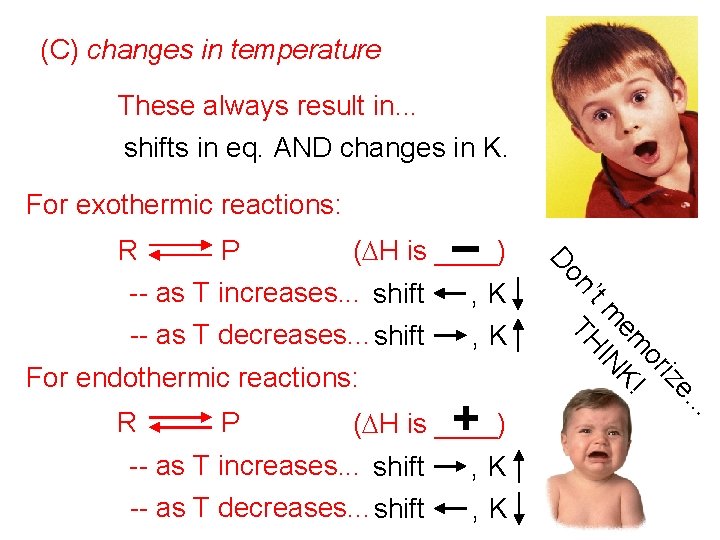
(C) changes in temperature These always result in. . . shifts in eq. AND changes in K. For exothermic reactions: – P + heat (DH is ____) P + (DH is ____) -- as T increases. . . shift -- as T decreases. . . shift , K … ize or em K! t m IN heat + R TH For endothermic reactions: , K n’ -- as T increases. . . shift -- as T decreases. . . shift Do R
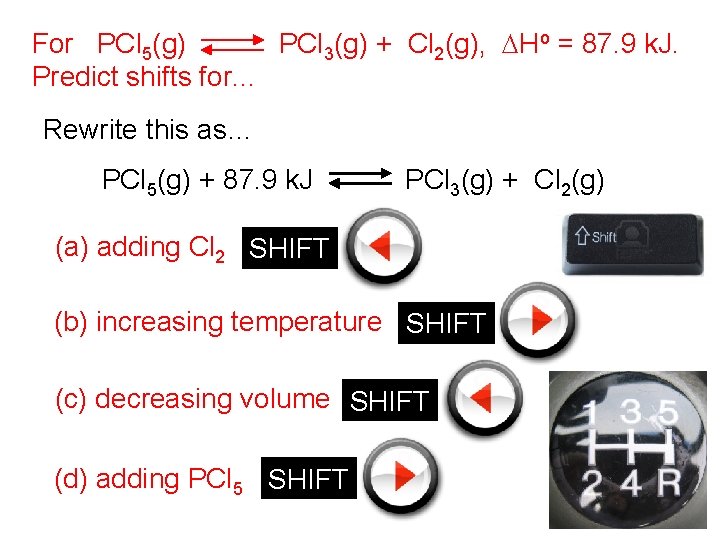
For PCl 5(g) PCl 3(g) + Cl 2(g), DHo = 87. 9 k. J. Predict shifts for. . . Rewrite this as… PCl 5(g) + 87. 9 k. J PCl 3(g) + Cl 2(g) (a) adding Cl 2 SHIFT (b) increasing temperature SHIFT (c) decreasing volume SHIFT (d) adding PCl 5 SHIFT
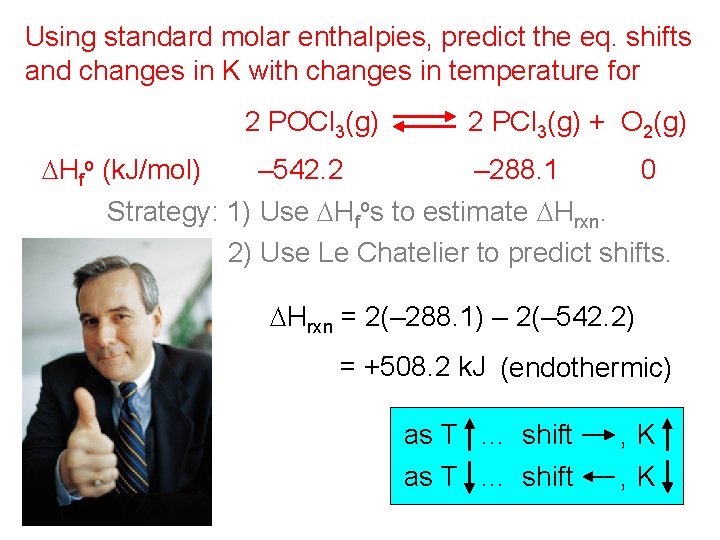
Using standard molar enthalpies, predict the eq. shifts and changes in K with changes in temperature for 2 POCl 3(g) 2 PCl 3(g) + O 2(g) DHfo (k. J/mol) – 542. 2 – 288. 1 0 Strategy: 1) Use DHfos to estimate DHrxn. 2) Use Le Chatelier to predict shifts. DHrxn = 2(– 288. 1) – 2(– 542. 2) = +508. 2 k. J (endothermic) as T. . . shift , K
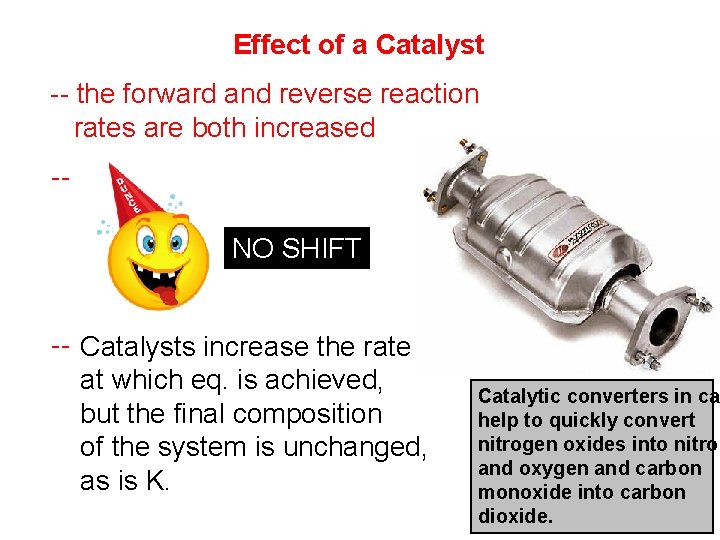
Effect of a Catalyst -- the forward and reverse reaction rates are both increased -NO SHIFT -- Catalysts increase the rate at which eq. is achieved, but the final composition of the system is unchanged, as is K. Catalytic converters in car help to quickly convert nitrogen oxides into nitrog and oxygen and carbon monoxide into carbon dioxide.
- Slides: 8