
LDTC Workshop Morphology and Syntax Morphology What is

![Constituent Order Question words: ENGLISH: WH-Noun Whom did you call [__]? MANDARIN: WH in](https://slidetodoc.com/presentation_image_h2/845ac4641748d4154c1fd43096f6745b/image-18.jpg "Constituent Order Question words: ENGLISH: WH-Noun Whom did you call [__]? MANDARIN: WH in")

- Slides: 23
LDTC Workshop Morphology and Syntax
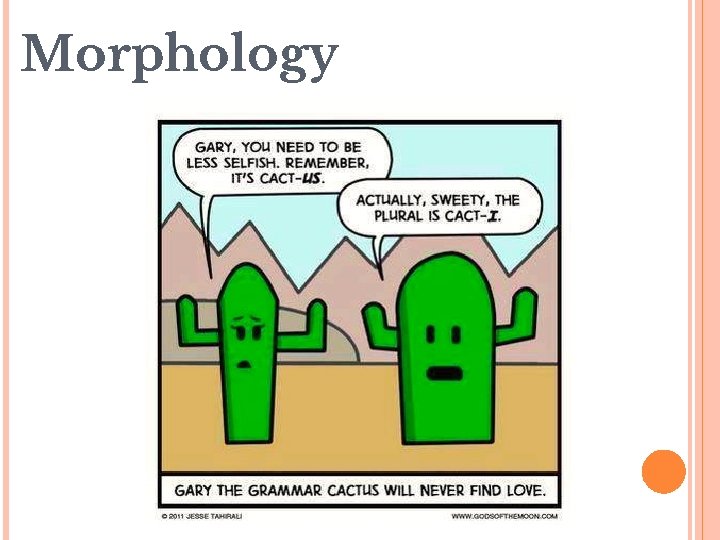
Morphology
What is morphology? • The study of words and word structure ●What is a word? What does a word look like? • It can vary from language to language ●It’s important to learn about morphology and word structure, so you can describe how your language works
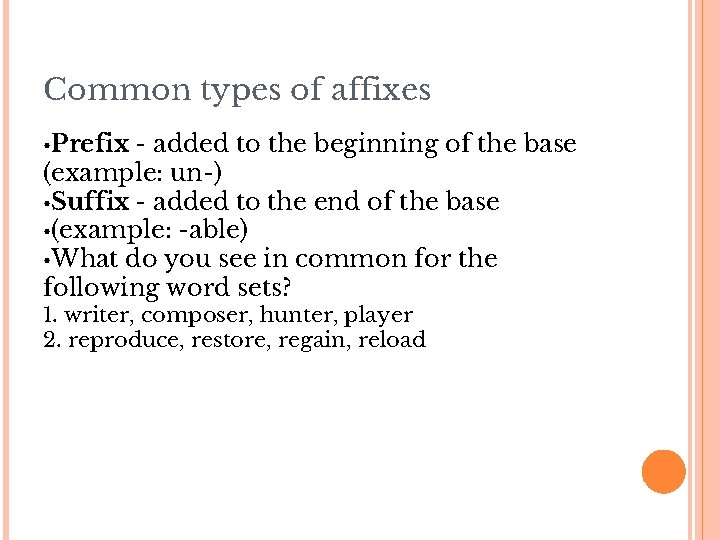
What is a word? • A word is a piece of language: something that you could say by itself, or that you could use as part of a phrase or sentence. • Words are divided into parts, called morphemes Root - the smallest part of a word that carries core meaning • Affix - a part of a word, added to the base, to change the meaning or offer additional information •
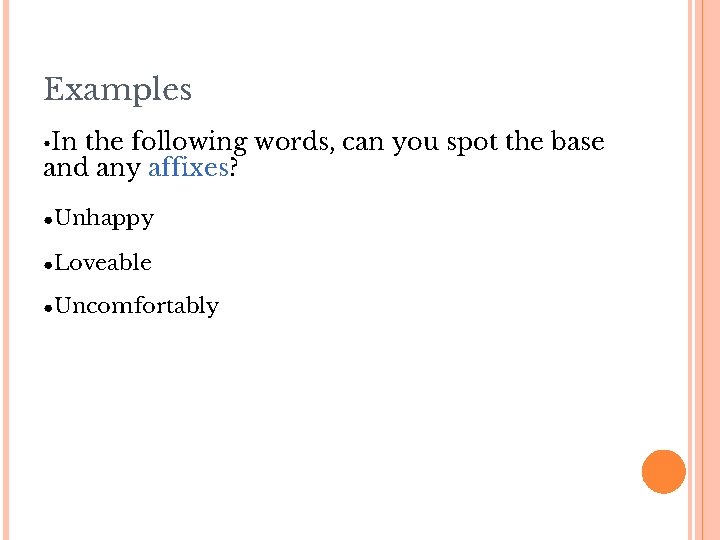
Examples • In the following words, can you spot the base and any affixes? ●Unhappy ●Loveable ●Uncomfortably
Common types of affixes • Prefix - added to the beginning of the base (example: un-) • Suffix - added to the end of the base • (example: -able) • What do you see in common for the following word sets? 1. writer, composer, hunter, player 2. reproduce, restore, regain, reload
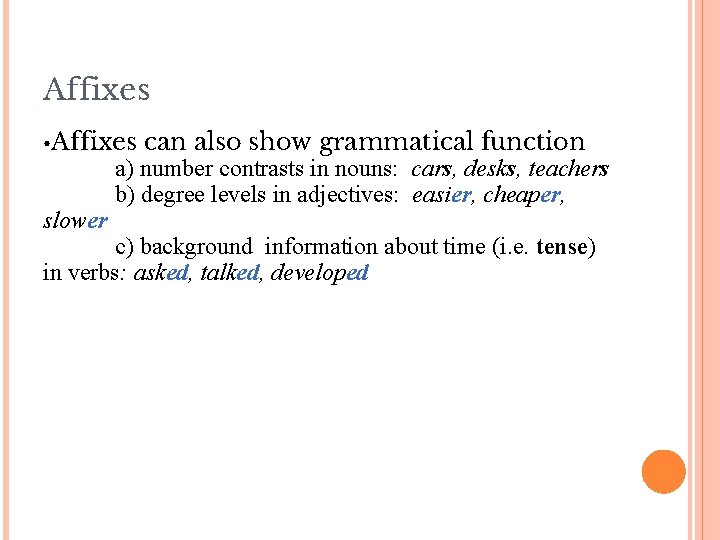
Affixes • Affixes slower can also show grammatical function a) number contrasts in nouns: cars, desks, teachers b) degree levels in adjectives: easier, cheaper, c) background information about time (i. e. tense) in verbs: asked, talked, developed
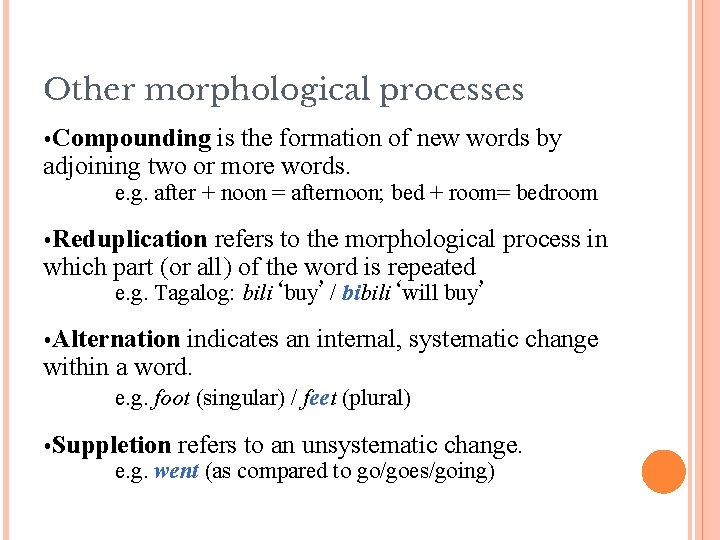
Other morphological processes • Compounding is the formation of new words by adjoining two or more words. e. g. after + noon = afternoon; bed + room= bedroom • Reduplication refers to the morphological process in which part (or all) of the word is repeated e. g. Tagalog: bili ‘buy’ / bibili ‘will buy’ • Alternation indicates an internal, systematic change within a word. e. g. foot (singular) / feet (plural) • Suppletion refers to an unsystematic change. e. g. went (as compared to go/goes/going)
Syntax
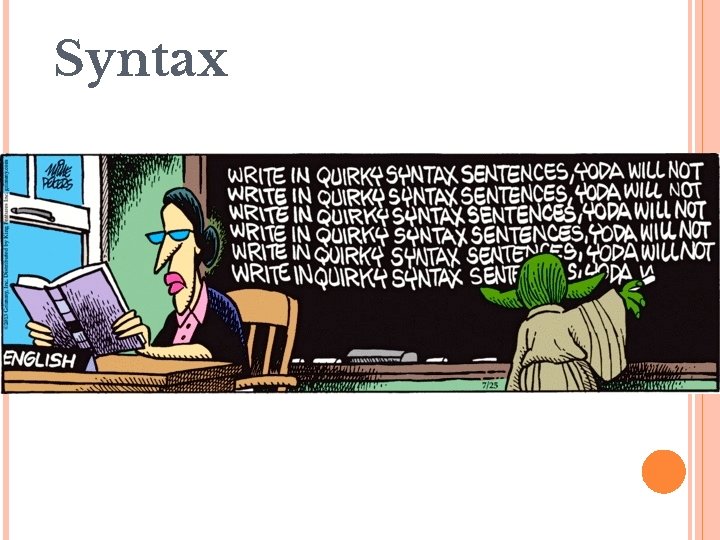
What is syntax? • The study of how sentences are put together. ➢What is a sentence? Subject & information about the subject • Smaller components: Nouns Adjectives Verbs Prepositions/Postpositions Adverbs Determiners. . . and many others
What is a noun? ●Nouns tend to be identifiable, like people, objects, time, events, etc. English: apple , man , love , LDTC , March • They function as subjects and objects • Can occur with determiners: words that provide information about specificity and definiteness. English: a, the , this , that , those
What is an adjective? ●Adjectives nouns. tend to describe properties of English: happy man , red apple , cold March ●Can be shown in different degrees by adding degree words English: very happy , extremely red , too cold
What is a verb? ● Verbs tend to describe actions, events and processes. ○ English: run , fall, win, jump , read, study, become ● A verb can occur with tense: • some kind of marking that indicates whether or not an action occurred in the past, nonpast, or future. ●English: the suffix –ed A verb can also occur with aspect: • this can indicate whether an action is habitual, continuous, or completed. ●English: the suffix –ing
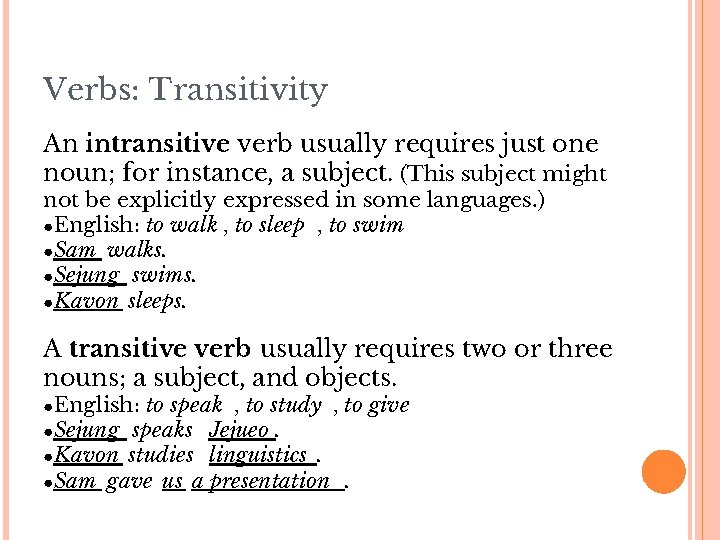
Verbs: Transitivity An intransitive verb usually requires just one noun; for instance, a subject. (This subject might not be explicitly expressed in some languages. ) ●English: to walk , to sleep , to swim ●Sam walks. ●Sejung swims. ●Kavon sleeps. A transitive verb usually requires two or three nouns; a subject, and objects. ●English: to speak , to study , ●Sejung speaks Jejueo. ●Kavon studies linguistics. ●Sam gave us a presentation to give.
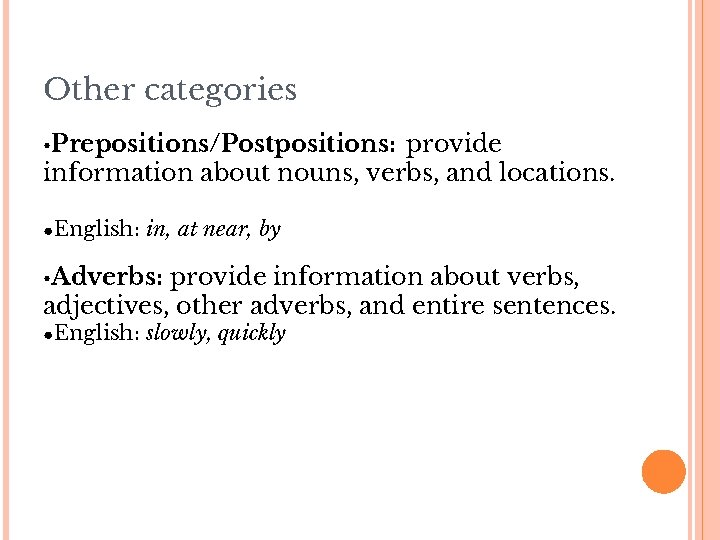
Other categories • Prepositions/Postpositions: provide information about nouns, verbs, and locations. ●English: in, at near, by • Adverbs: provide information about verbs, adjectives, other adverbs, and entire sentences. ●English: slowly, quickly
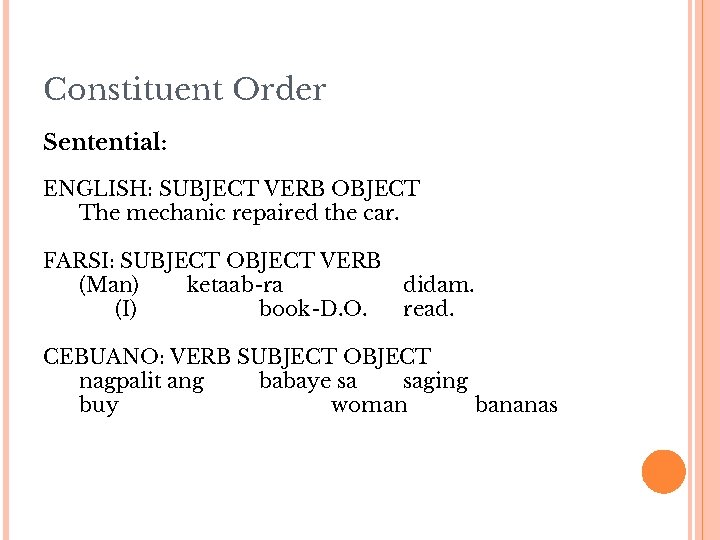
Constituent Order Sentential: ENGLISH: SUBJECT VERB OBJECT The mechanic repaired the car. FARSI: SUBJECT OBJECT VERB (Man) ketaab-ra (I) book-D. O. didam. read. CEBUANO: VERB SUBJECT OBJECT nagpalit ang babaye sa saging buy woman bananas
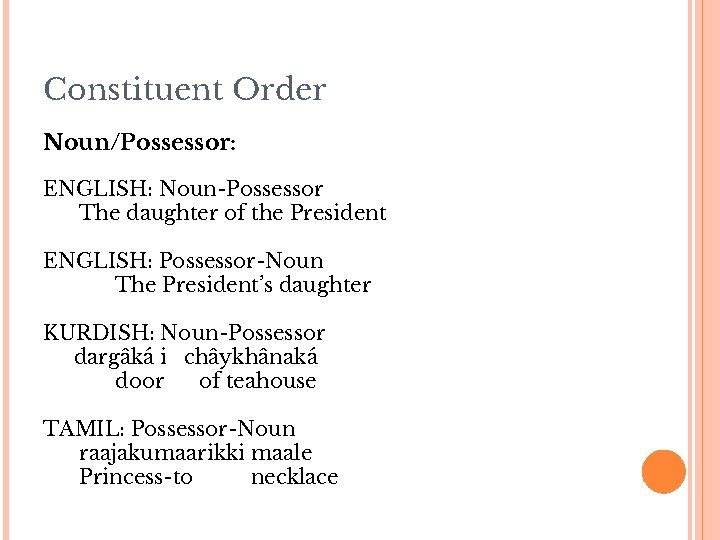
Constituent Order Noun/Possessor: ENGLISH: Noun-Possessor The daughter of the President ENGLISH: Possessor-Noun The President’s daughter KURDISH: Noun-Possessor dargâká i châykhânaká door of teahouse TAMIL: Possessor-Noun raajakumaarikki maale Princess-to necklace
Constituent Order Question words: ENGLISH: WH-Noun Whom did you call [__]? MANDARIN: WH in situ Hufei mai-le sheme Hufei buy-past what ‘What did Hufei buy? ’
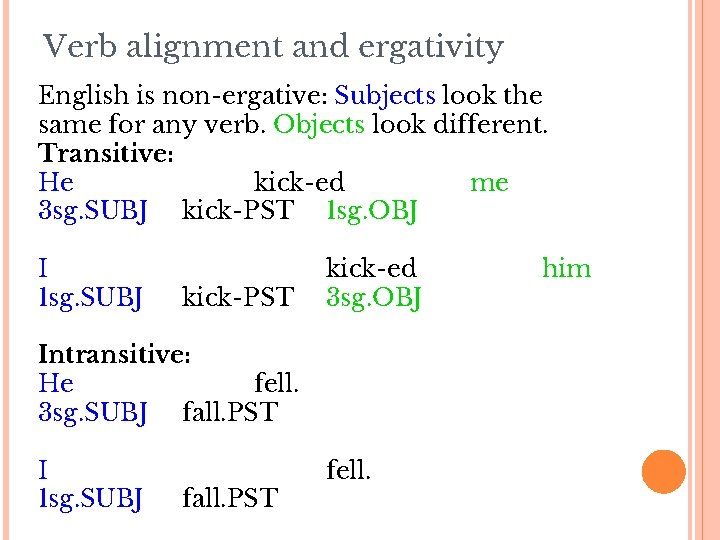
Verb alignment and ergativity English is non-ergative: Subjects look the same for any verb. Objects look different. Transitive: He kick-ed me 3 sg. SUBJ kick-PST 1 sg. OBJ I 1 sg. SUBJ kick-PST kick-ed 3 sg. OBJ Intransitive: He fell. 3 sg. SUBJ fall. PST I 1 sg. SUBJ fall. PST fell. him
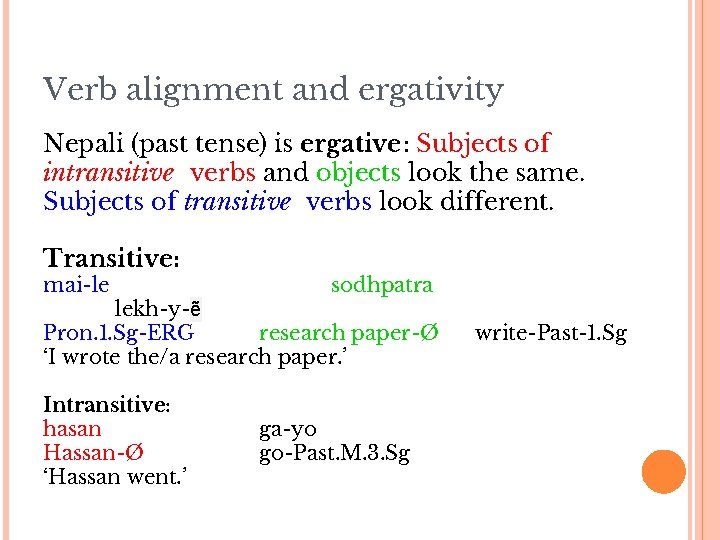
Verb alignment and ergativity Nepali (past tense) is ergative: Subjects of intransitive verbs and objects look the same. Subjects of transitive verbs look different. Transitive: mai-le sodhpatra lekh-y-ẽ Pron. 1. Sg-ERG research paper-Ø ‘I wrote the/a research paper. ’ Intransitive: hasan Hassan-Ø ‘Hassan went. ’ ga-yo go-Past. M. 3. Sg write-Past-1. Sg
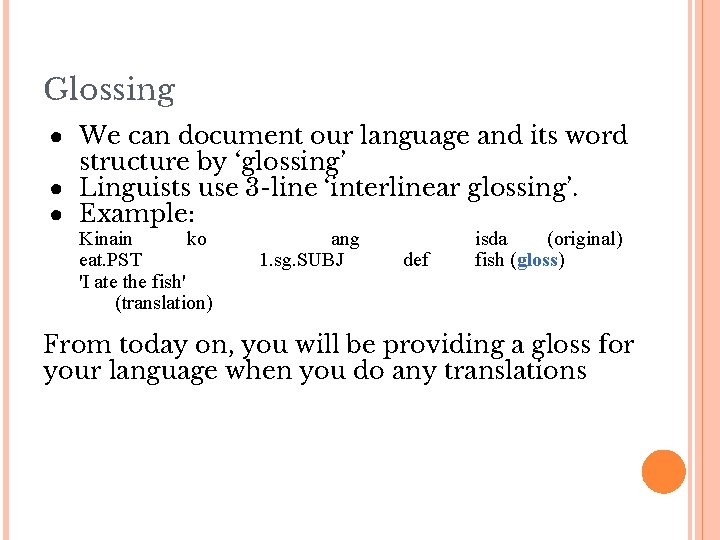
Glossing ● We can document our language and its word structure by ‘glossing’ ● Linguists use 3 -line ‘interlinear glossing’. ● Example: Kinain ko eat. PST 'I ate the fish' (translation) ang 1. sg. SUBJ def isda (original) fish (gloss) From today on, you will be providing a gloss for your language when you do any translations
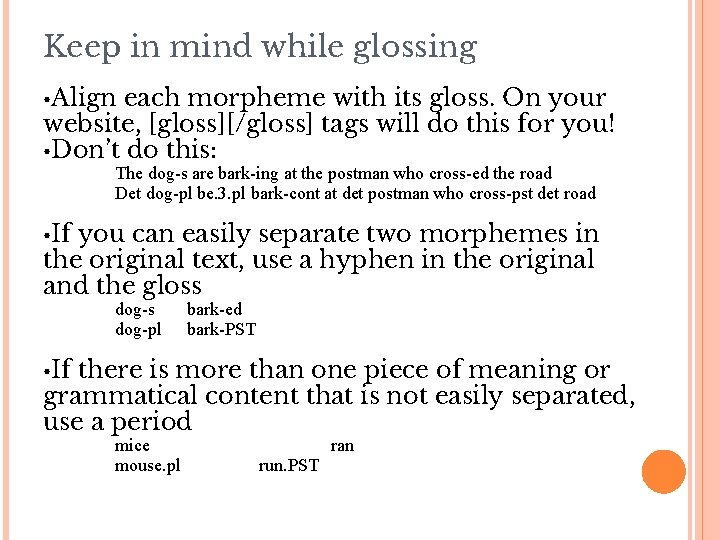
Keep in mind while glossing • Align each morpheme with its gloss. On your website, [gloss][/gloss] tags will do this for you! • Don’t do this: The dog-s are bark-ing at the postman who cross-ed the road Det dog-pl be. 3. pl bark-cont at det postman who cross-pst det road • If you can easily separate two morphemes in the original text, use a hyphen in the original and the gloss dog-pl bark-ed bark-PST • If there is more than one piece of meaning or grammatical content that is not easily separated, use a period mice mouse. pl run. PST ran
Your Turn! • Work with your mentor and see if you can 1) identify different affixes in your language. 2) observe other morphological processes in your language (e. g. compounding, reduplication, alternation, suppletion) 3) observe syntactic structure in your language 4) complete a three-line transcription of a sentence 5) Fill out the morphology and syntax templates • In addition, we would like you to share with us if you - encounter any difficulty in identifying the morphological processes in your language - find something you feel is extraordinarily amazing in your language related to today’s topic