
lcome to the world of urnalism where porters
- Slides: 27
lcome to the world of urnalism, where porters have been gging dirt, raking muck, king headlines and adlines for centuries w. It’s a history full of bloid trash, of slimy nsationalists, of runkards, deadbeats and mmers” (as a Harvard iversity president once scribed reporters). But it’s a history full of roes, too: men and men risking their lives tell stories of war and agedy, risking prisonment to defend ee speech. And as you n see here, reports have come beloved characters p culture, too, turning up movies, comics and TV ows as if guided by an cult hand. Every culture seeks effective ways to spread new information and gossip. In ancient times, news was written on clay tablets. In Caesar’s age, Romans read newsletters compiled by correspondents and handwritten by slaves. Wandering minstrels spread news (and the plague) in the Middle Ages. Them came ink on paper. Voices on airwaves. Newsreels, Web sites, And 24 -hour cable news networks. Thus when scholars analyze the rich history of journalism, some view it in terms of technological progress—for example, the dramatic impact of bigger, faster printing presses. Others see journalism as a specialized form literary expression, one that’s constantly evolving, reflecting and shaping its culture. Others see it as an inspiring quest for free speech, an endless power struggle between Authority (trying to control information) and the People (trying to learn the truth). Which brings to mind the words of A. J. Liefling: “Freedom of the press is guaranteed only to htose who own one. ” In the pages ahead, we’ll take a quick tour of 600 years of journalism history, from hieroglyphics to hypertext: the media, the message and the politics. Technical advances and brilliant ideas forged a new style of journalism. It was a century of change, and newspapers changed Inside Reporting Tim Harrower 7 Law and ethics dramatically. The typi newspaper of 1800 wa undisciplined mishma legislative proceeding long-winded essays a secondhand gossip. B 1900, a new breed of tor had emerged. Jour had become big busin Reporting was becom disciplined craft. And newspapers were bec more entertaining and essential than ever, w most of the features w expect today: Snappy headlines, Ads, Comic Sports pages. And an “inverted pyramid” sty writing that made stori tighter and newsier. Radio and television brought an end to newspapers’ media monopoly. Why? Well yourself: Which did yo
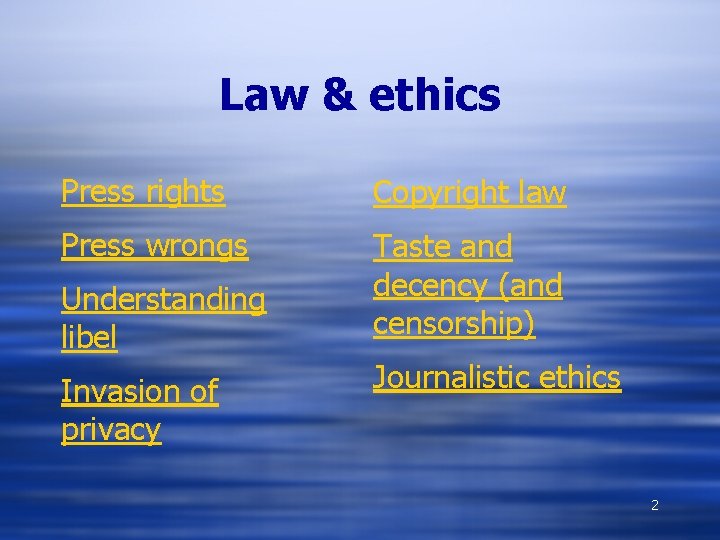
Law & ethics Press rights Copyright law Press wrongs Taste and decency (and censorship) Understanding libel Invasion of privacy Journalistic ethics 2
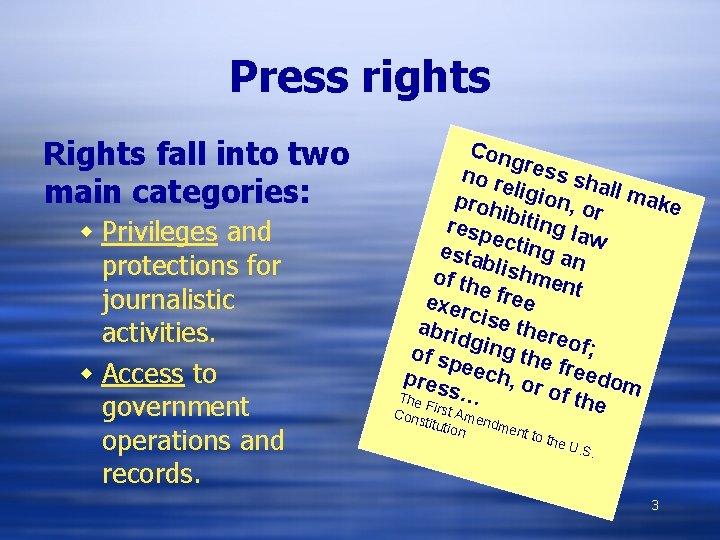
Press rights Rights fall into two main categories: w Privileges and protections for journalistic activities. w Access to government operations and records. Con gres s no r eligi shall m on, o ake proh r i resp biting la e w esta cting an b of th lishmen e fre t exer e c abri ise ther d e of sp ging the of; pres eech, or freedom s… of th The First e Con stitu Amendm tion ent t o the U . S. 3
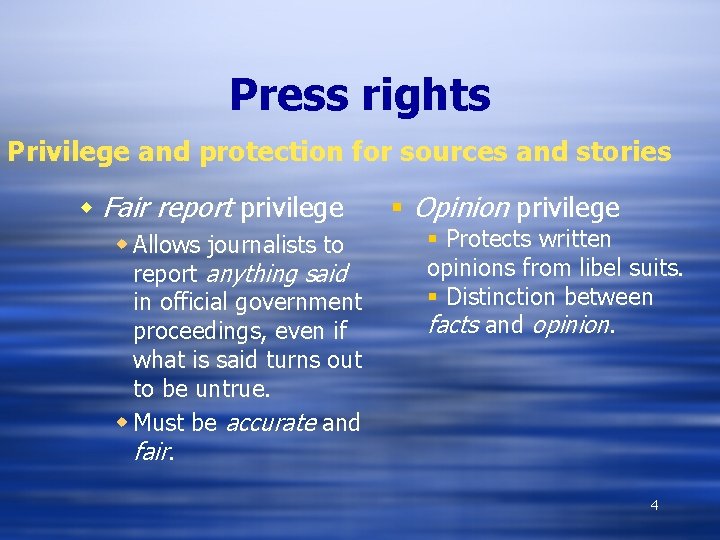
Press rights Privilege and protection for sources and stories w Fair report privilege w Allows journalists to report anything said in official government proceedings, even if what is said turns out to be untrue. w Must be accurate and fair. § Opinion privilege § Protects written opinions from libel suits. § Distinction between facts and opinion. 4
Press rights Fair comment and criticism § Allows journalists to criticize performers, politicians and other matters of public interest. § Freedom from newsroom searches § Shield laws 5
This just in. . . On April 28 th, Washington Governor Chris Gregoire signed a media shield bill into law, making Washington the 32 nd state with a statutory protection for journalists’ confidential sources and the 13 th state in which a journalist cannot be forced to reveal his confidential source’s identity under any circumstances. In addition, the Washington law protects journalists from having to reveal any information obtained during newsgathering activities.
Press rights A final question to consider: w Should bloggers be entitled to the same rights and protections as mainstream media reporters? 7
Press rights Journalistic access w Open courtrooms The issues w Does media coverage harm trial defendants? w Do cameras turn courtrooms into circuses? w Should press be banned from some trials? The law § U. S. Supreme Court ruled that criminal trials must remain open to the media except for “overriding interest. ” 8
Press rights Journalistic access w Open records The issues w Should all government records be accessible to the public? w Who decides what is off-limits? The law • 1966 Freedom of Information Act requires federal agencies to make most of their records available. • Every state has own version of FOIA. 9
Press wrongs Reporter’s Guide to Trouble w Stories that can get you jailed w Contempt of court w Trespassing w Sedition §Stories that can get you sued • Libel • Invasion of privacy • Breach of contract 10
Press wrongs Reporter’s Guide to Trouble w Stories that can get you fired w Plagiarism w Fabrication w Lapses in ethics § Stories that can get you angry phone calls • Bias • Bad taste • Blunders & bloopers 11
Understanding libel Beginning reporter’s guide to libel w Who can sue for libel? w Living people. w Small groups. w Who is it that gets sued? w Usually, the publication. What is libel? • False statements and • Defamatory and • Published and • Identifiable plaintiffs and • Defendant must be at fault through negligence or malice. 12
Understanding libel Beginning reporter’s guide to libel w How do I defend myself? w Truth w Privilege w Fair Comment and Criticism §How can I avoid libel? • Verify material. • Allow people to defend themselves. • Remember, public officials often make “unofficial” claims. • If you make mistake, correct it. 13
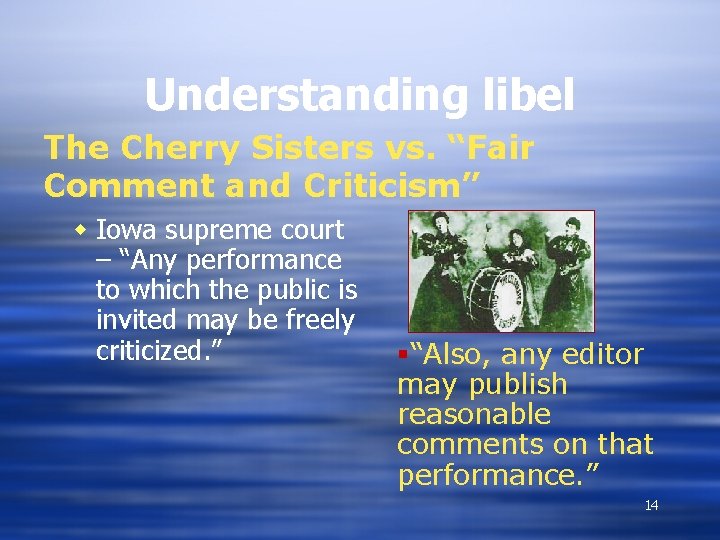
Understanding libel The Cherry Sisters vs. “Fair Comment and Criticism” w Iowa supreme court – “Any performance to which the public is invited may be freely criticized. ” §“Also, any editor may publish reasonable comments on that performance. ” 14
Understanding libel Terms to know w Actual malice – knowing you are lying or disregarding the truth • Public official – w Opinion – ideas that someone who exercises power or influence in governmental affairs w Slander – defamation • Public figure – don’t claim to be factual that is spoken person who has acquired fame or notoriety 15
Invasion of privacy 4 Most common ways to invade someone’s privacy w Intrusion w Trespass w Secret surveillance w Misrepresentation § Public disclosure of private facts § Private § Intimate § Offensive 16
Invasion of privacy 4 Most common ways to invade someone’s privacy w False light w Anything that portrays someone in an inaccurate way § Appropriation • Unauthorized use of someone’s name, photo or words to endorse or sell a product or service. 17
Copyright law A journalist’s guide to copyright w What is copyright? w What happens if I plagiarize? w Can I use excerpts from copyrighted material? §What about using copyrighted photos and illustrations? §I write for a small paper. Do big corporations really care if I use their material? 18
Taste and decency and censorship 5 Reasons your story might get spiked w Vulgar language w Offensive topics w Conflict of interest § Legal/ethical issues § Reporting flaws 19
Taste and decency and censorship Student press law: How much can a school administrator censor? w Public colleges w Student editors are entitled to control the content. § Public high schools • Some guidelines, but lots of gray area. 20
Taste and decency and censorship Student press law: How much can a school administrator censor? § Private colleges and high schools • Administrator can act like any other publisher in controlling what’s printed. 21
Terms to know w Censorship Removing a newspaper after it has been printed. w Prior Restraint Keeping a story from being published 22
The seven deadly sins Ethical pitfalls §Deception • Lying or misrepresenting yourself to obtain information. §Conflict of interest • Accepting gifts or favors from sources or promoting social and political causes. 23
The seven deadly sins Ethical pitfalls §Bias • Slanting a story by manipulating facts to sway opinions. §Fabrication • Manufacturing quotes or imaginary sources or writing anything you know to be untrue. 24
The seven deadly sins Ethical pitfalls §Theft • Obtaining information unlawfully or without a source’s permission. §Burning a source • Deceiving or betraying the confidence of a source. §Plagiarism • Passing off someone else’s words or ideas as your own. 25
Journalistic ethics Reporters, editors maintain high standard of professional behavior w When you face an ethical dilemma: w What purpose does it serve to print this? w Who gains? w Who loses? w Is it worth it? w What best serves the readers? 26
Journalistic ethics Code of ethics Do we love the press? • 62% of Americans say w Seek truth and they don’t trust the report it. press. • 59% think w Minimize harm. newspapers care more w Act independently. about profits than public interests. w Be accountable. • 58% don’t think reporters care about inaccuracies. 27