
LCLS Startup Commissioning and Future Scenarios Requirements Schedule
- Slides: 40
LCLS Startup, Commissioning and Future Scenarios Requirements Schedule Effort Budget Future 11 August 2004 LCLS Startup, Commissioning and Future Scenarios John N. Galayda galayda@slac. stanford. edu
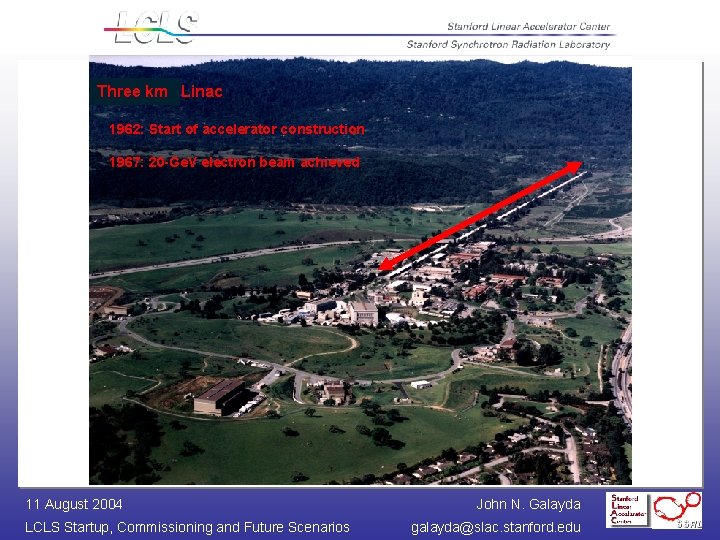
Three Two km Mile Linac 1962: Start of accelerator construction 1967: 20 -Ge. V electron beam achieved 11 August 2004 LCLS Startup, Commissioning and Future Scenarios John N. Galayda galayda@slac. stanford. edu
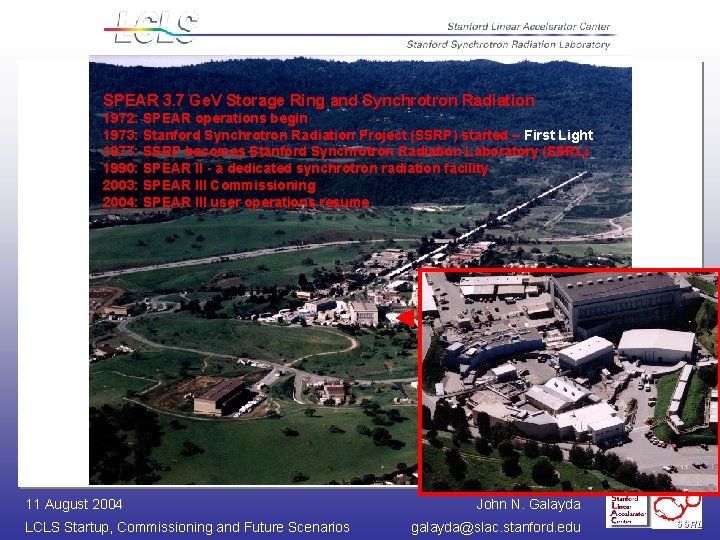
SPEAR 3. 7 Ge. V Storage Ring and Synchrotron Radiation 1972: SPEAR operations begin 1973: Stanford Synchrotron Radiation Project (SSRP) started – First Light 1977: SSRP becomes Stanford Synchrotron Radiation Laboratory (SSRL) 1990: SPEAR II - a dedicated synchrotron radiation facility 2003: SPEAR III Commissioning 2004: SPEAR III user operations resume 11 August 2004 LCLS Startup, Commissioning and Future Scenarios John N. Galayda galayda@slac. stanford. edu
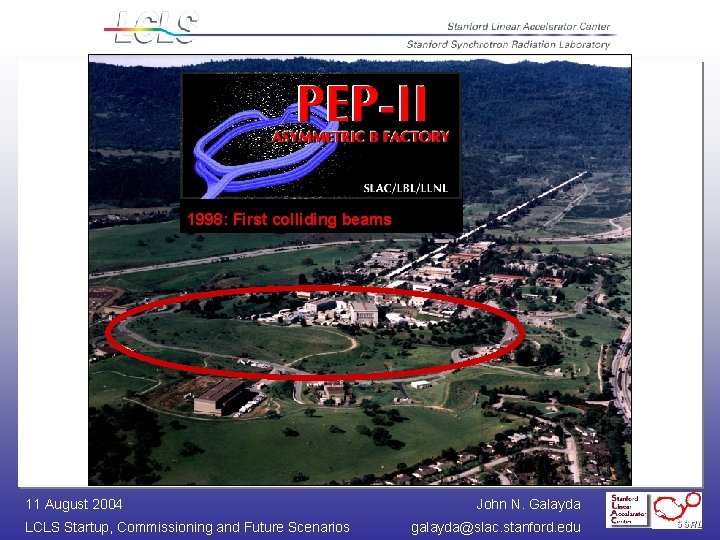
PEP Colliding Beam Facility A collaborative project: SLAC and LBNL 1980: PEP operations begin 1987 PEP tested as a synchrotron source Brighter thancolliding APS, SPring-8 design goals 1998: First beams 11 August 2004 LCLS Startup, Commissioning and Future Scenarios John N. Galayda galayda@slac. stanford. edu
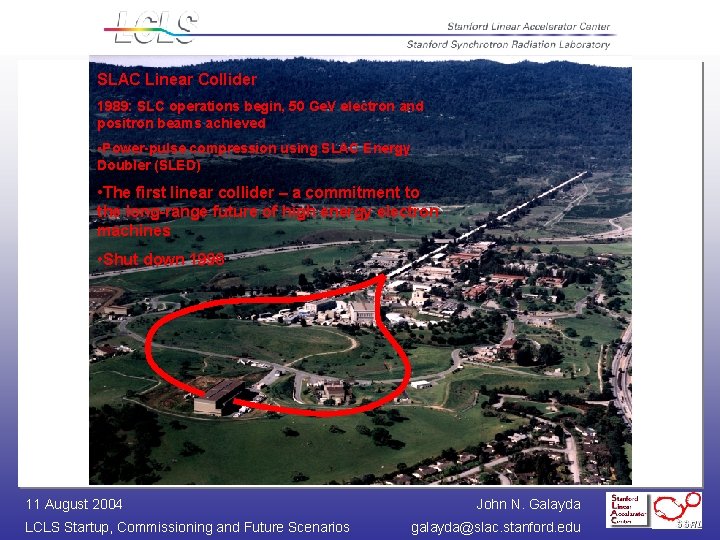
SLAC Linear Collider 1989: SLC operations begin, 50 Ge. V electron and positron beams achieved • Power-pulse compression using SLAC Energy Doubler (SLED) • The first linear collider – a commitment to the long-range future of high energy electron machines • Shut down 1998 11 August 2004 LCLS Startup, Commissioning and Future Scenarios John N. Galayda galayda@slac. stanford. edu
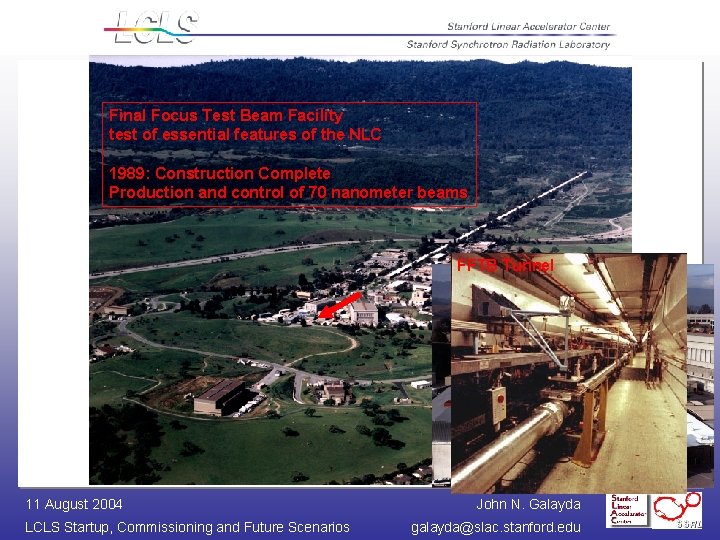
Final Focus Test Beam Facility test of essential features of the NLC 1989: Construction Complete Production and control of 70 nanometer beams FFTB Tunnel 11 August 2004 LCLS Startup, Commissioning and Future Scenarios John N. Galayda galayda@slac. stanford. edu
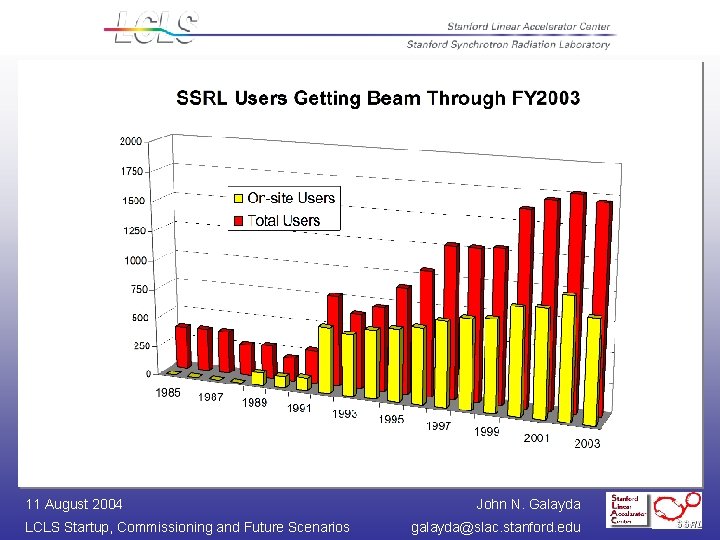
11 August 2004 LCLS Startup, Commissioning and Future Scenarios John N. Galayda galayda@slac. stanford. edu
LCLS Project Mission Definition • General Requirements Document –CD-4 Goals & Requirements • Subsystem Commissioning Goals –CD-0 Goals • Accelerator Readiness 11 August 2004 LCLS Startup, Commissioning and Future Scenarios John N. Galayda galayda@slac. stanford. edu
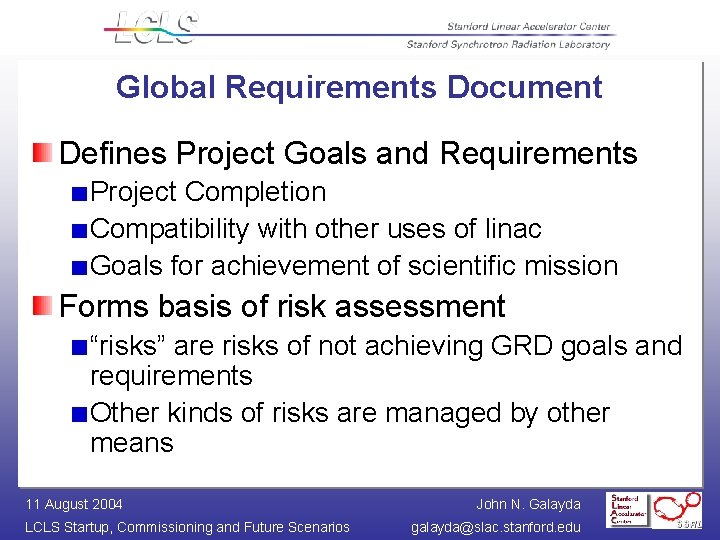
Global Requirements Document Defines Project Goals and Requirements Project Completion Compatibility with other uses of linac Goals for achievement of scientific mission Forms basis of risk assessment “risks” are risks of not achieving GRD goals and requirements Other kinds of risks are managed by other means 11 August 2004 LCLS Startup, Commissioning and Future Scenarios John N. Galayda galayda@slac. stanford. edu
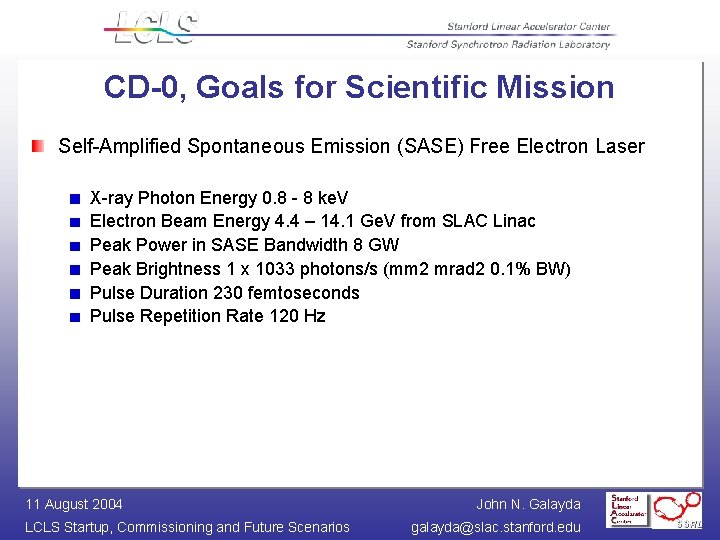
CD-0, Goals for Scientific Mission Self-Amplified Spontaneous Emission (SASE) Free Electron Laser X-ray Photon Energy 0. 8 - 8 ke. V Electron Beam Energy 4. 4 – 14. 1 Ge. V from SLAC Linac Peak Power in SASE Bandwidth 8 GW Peak Brightness 1 x 1033 photons/s (mm 2 mrad 2 0. 1% BW) Pulse Duration 230 femtoseconds Pulse Repetition Rate 120 Hz 11 August 2004 LCLS Startup, Commissioning and Future Scenarios John N. Galayda galayda@slac. stanford. edu
Office of Basic Energy Sciences Office of Science, U. S. Department of Energy LCLS Update Eric A. Rohlfing BESAC Meeting August 2, 2001 Basic Energy Sciences Atomic, Molecular & Optical Sciences Fundamental Interactions Team Chemical Sciences, Geosciences, and Biosciences Division
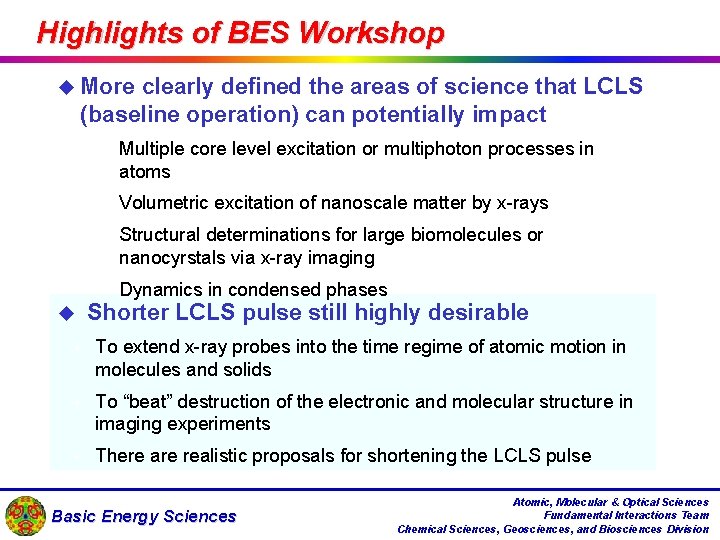
Highlights of BES Workshop u u More clearly defined the areas of science that LCLS (baseline operation) can potentially impact • Multiple core level excitation or multiphoton processes in atoms • Volumetric excitation of nanoscale matter by x-rays • Structural determinations for large biomolecules or nanocyrstals via x-ray imaging • Dynamics in condensed phases Shorter LCLS pulse still highly desirable • To extend x-ray probes into the time regime of atomic motion in molecules and solids • To “beat” destruction of the electronic and molecular structure in imaging experiments • There are realistic proposals for shortening the LCLS pulse Basic Energy Sciences Atomic, Molecular & Optical Sciences Fundamental Interactions Team Chemical Sciences, Geosciences, and Biosciences Division
CD-4 Approval Verifies that construction is done and systems are operational In this sense, it is an important schedule constraint on construction Achievement of peak brightness as advertised in CD-0 may take longer Difficulty of CD-0 goals depends on wavelength 11 August 2004 LCLS Startup, Commissioning and Future Scenarios John N. Galayda galayda@slac. stanford. edu
CD-4 Approval of Start of Operations PR 1‐ 1 The Project Execution Plan states the summary requirement for achievement of Critical Decision 4, Start of Operations. “The top‐level commissioning goal is to generate x‐rays in the LCLS undulator and detect them in the Far Hall. ” The Far Hall is one of two locations where x‐ray experiments may be carried out with the LCLS beam. This milestone is to be achieved by 30 September 2008. The Project construction schedule is constrained by this requirement. Achievement of CD‐ 4 entails; achievement of commissioning goals for the injector achievement of commissioning goals for the linac achievement of commissioning goals for the undulator systems beneficial occupancy of the Near Experiment Hall beneficial occupancy of the Far Experiment Hall completion of beam path from the undulator to the Near Experiment Hall completion of the beam path from the Near Experiment Hall to the Far Experiment Hall operational personnel protection systems for all electron beam enclosures operational personnel protection systems for the hutches in the Near Experiment Hall operational personnel protection system for the center hutch in the Far Experiment Hall a functional x‐ray detector in the center hutch of the Far Experiment Hall achievement of commissioning goals and requirements for all level 2 WBS elements successful transport of an x‐ray beam from the undulator hall to the Far Experiment Hall detection of x‐ray photons in the Far Experiment Hall 11 August 2004 LCLS Startup, Commissioning and Future Scenarios John N. Galayda galayda@slac. stanford. edu
Commissioning Goals to support CD-4 A 1‐ 1 (Injector Commissioning Goals) Repetition rate 10 Hz or greater Nominal Charge/pulse 0. 5 n. C or greater Nominal pulse length 3‐ 10 ps Projected emittance 2. 0 mm‐mrad or less A 1‐ 2 (Linac Commissioning Goals) Repetition rate 10 Hz or greater Nominal Charge/pulse 0. 5 n. C or greater Nominal pulse length 3‐ 10 ps Projected emittance 2. 0 mm‐mrad or less A 1‐ 3 (Undulator Commissioning Goals) Transport of electrons without loss to beam dump, 4. 4‐ 14. 1 Ge. V Diagnostics and machine protection systems functional 1‐ 10 Hz A 1‐ 4 (Project Commissioning Goal for Project Completion (CD‐ 4)) Detect x‐rays in Far Hall 11 August 2004 LCLS Startup, Commissioning and Future Scenarios John N. Galayda galayda@slac. stanford. edu
Functional Requirements FR 1‐ 1 Operation of the LCLS linac for the x‐ray experiment program and LCLS-related FEL and electron beam physics studies will be scheduled for at least 75% of the scheduled operating time of the Two‐Mile Linac as a whole. Maintenance to the LCLS linac requiring entry to the linac enclosure may only be carried out when the entire linac is shut down for access. FR 1‐ 2 Operation of the LCLS will be completely compatible with simultaneous operation of the linac in support of the PEP‐II program. FR 1‐ 3 It will be possible to switch from LCLS operation to acceleration of beam from the damping rings (e. g. to End Station A) without the need to enter the linac tunnel. Acceleration of beam from the CID guns may require removal of the xband accelerating structure in sector 21 of the LCLS Linac. It will be possible to remove this accelerating structure and make the linac ready for beams from CID in 24 hours or less. FR 1‐ 4 Operations control of the LCLS linac and the electron beam will be carried out from the SLAC Main Control Center. Necessary data for monitoring and control of the LCLS will be available to the SLC controls system. 11 August 2004 LCLS Startup, Commissioning and Future Scenarios John N. Galayda galayda@slac. stanford. edu
Functional Goals FG 1‐ 1 The LCLS linac and undulator systems should be designed to operate with bunch charges in the range 0. 2 – 1. 0 nanocoulombs. FG 1‐ 2 Operational availability should be greater than 90%. The linac is typically operated about 6600 hours per year for all purposes (PEP, FFTB, End Station A, tune‐up/training/studies) FG 1‐ 3 The traditional tolerance for transverse beam stability in a synchrotron source is 10% of beam size. This will be a challenging goal due to the small emittance of the LCLS beam. FG 1‐ 4 EPICS controls should be implemented where practical; it is expected that the injector, undulator systems, x‐ray transport/optics/diagnostics and end station systems will implement EPICS for device control. FG 1‐ 5 Achievement of the CD‐ 0 performance goals PG 1‐ 1, PG 1‐ 3, PG 1‐ 4, and PG 1‐ 5 will be verified using devices that are part of WBS 1. 4, X‐ray Transport, Optics and Diagnostics. The brightness measurement requires that an upper limit be determined for the x‐ray pulse duration, and that the total energy of the photon pulse be measured. The measurement will depend on calibration of the x‐ray attenuators, which must reduce the xray intensity by a factor of 10, 000. Nonlinearity in the attenuator will itself be the subject of early atomic physics experiments at LCLS. For this reason, it is to be expected that the uncertainty in peak power output of the LCLS will be approximately a factor of 10, through the first year of operation ofthe facility. 11 August 2004 LCLS Startup, Commissioning and Future Scenarios John N. Galayda galayda@slac. stanford. edu
LCLS Startup and Commissioning • Startup/Commissioning in Modules –Laser “commissioning” • Not capable of creating a radiological area –Gun/Injector Commissioning –Linac Commissioning –Undulator/FEE –Near Hall Experiment Hutches –X-ray transport, Far Hall Hutches • Permission to Operate at CD-4 11 August 2004 LCLS Startup, Commissioning and Future Scenarios John N. Galayda galayda@slac. stanford. edu
DOE O 420. 2 X Requirements 1 -Accelerator Safety Envelope – Basis for Safety Assessment 2 -Safety Assessment Document Hazards Mitigations 3 -Unreviewed Safety Issue Operations halted Restart requires DOE approval 11 August 2004 LCLS Startup, Commissioning and Future Scenarios John N. Galayda galayda@slac. stanford. edu
Preliminary Safety Assessment Document http: //www-ssrl. slac. stanford. edu/lcls/eir/documents/hazards_analysis/PSAD. pdf 5 k. W beam power 15 Ge. V, 333 n. A 28 Ge. V, 178 n. A 150 k. W Maximum Credible Incident Operations beam power 1. 7 k. W 11 August 2004 LCLS Startup, Commissioning and Future Scenarios John N. Galayda galayda@slac. stanford. edu
DOE O 420. 2 X Requirements 4 -Accelerator Readiness Reviews 5 -Training and Qualification 6 -Written Procedures 7 -Internal Safety Review System SLAC Operations in place and mature 11 August 2004 LCLS Startup, Commissioning and Future Scenarios John N. Galayda galayda@slac. stanford. edu
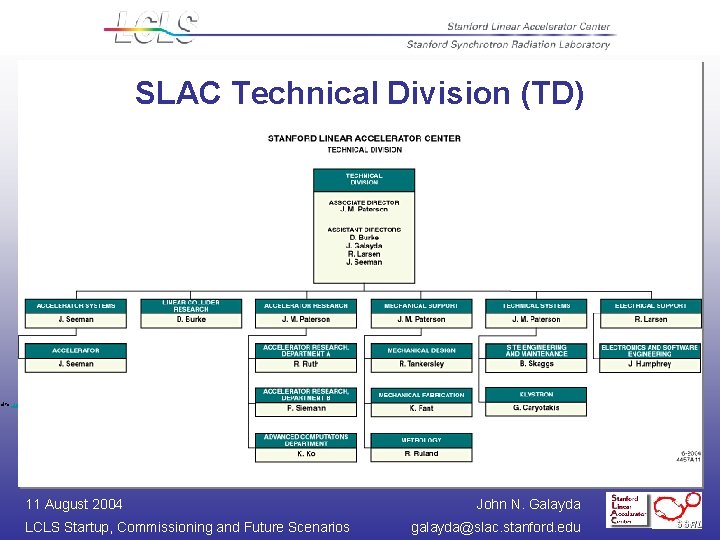
SLAC Technical Division (TD) ed to Linda Ahlf (x 2354). 11 August 2004 LCLS Startup, Commissioning and Future Scenarios John N. Galayda galayda@slac. stanford. edu
Accelerator/Light Source Operations SLAC Accelerator Department Home Page https: //www-internal. slac. stanford. edu/ad/ad. html SLAC Accelerator Operations Group Home Page http: //www. slac. stanford. edu/grp/ad/op/ SLAC Accelerator Department Maintenance Office Home Page https: //www-internal. slac. stanford. edu/ad/admo/ADMO_HP. htm SSRL Home Page http: //www-ssrl. slac. stanford. edu/welcome. html SSRL User Program http: //www-ssrl. slac. stanford. edu/user_administration. html 11 August 2004 LCLS Startup, Commissioning and Future Scenarios John N. Galayda galayda@slac. stanford. edu
SSRL User Program SSRL Home Page http: //www-ssrl. slac. stanford. edu/welcome. html SSRL User Program http: //www-ssrl. slac. stanford. edu/user_administration. html 11 August 2004 LCLS Startup, Commissioning and Future Scenarios John N. Galayda galayda@slac. stanford. edu
Startup/Commissioning Milestones Start Injector Commissioning – 5/06 First Beam on linac axis - 6/07 Start of Undulator Commiss - 5/08 Staff will work to achieve an earlier start LCLS PRD-1. 1 -2, FEL Commissioning Plan Undulator protection Beam-based alignment Measurement of basic performance parameters 11 August 2004 LCLS Startup, Commissioning and Future Scenarios John N. Galayda galayda@slac. stanford. edu
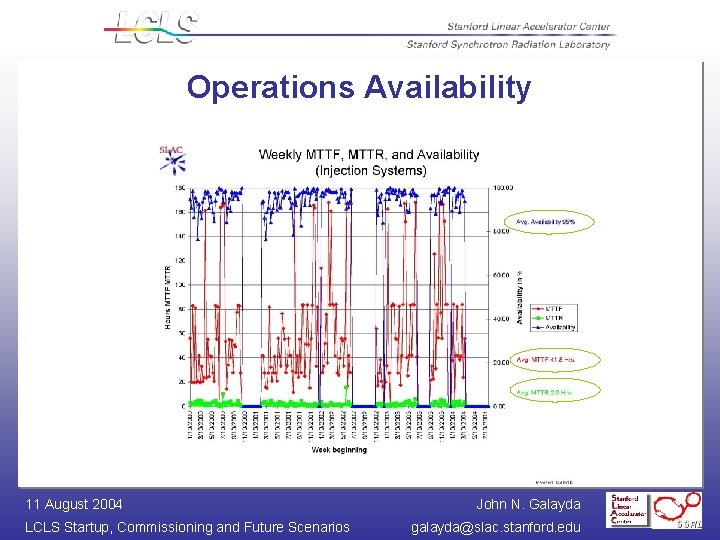
Operations Availability 11 August 2004 LCLS Startup, Commissioning and Future Scenarios John N. Galayda galayda@slac. stanford. edu
FEL Startup Test Plan 11 August 2004 LCLS Startup, Commissioning and Future Scenarios John N. Galayda galayda@slac. stanford. edu
11 August 2004 LCLS Startup, Commissioning and Future Scenarios John N. Galayda galayda@slac. stanford. edu
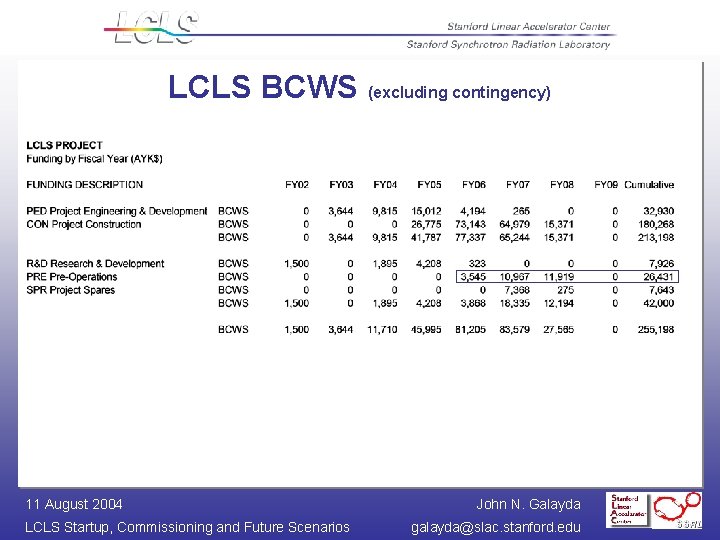
LCLS BCWS (excluding contingency) 11 August 2004 LCLS Startup, Commissioning and Future Scenarios John N. Galayda galayda@slac. stanford. edu
LCLS Startup 11 August 2004 LCLS Startup, Commissioning and Future Scenarios John N. Galayda galayda@slac. stanford. edu
Startup Effort (FTE) 11 August 2004 LCLS Startup, Commissioning and Future Scenarios John N. Galayda galayda@slac. stanford. edu
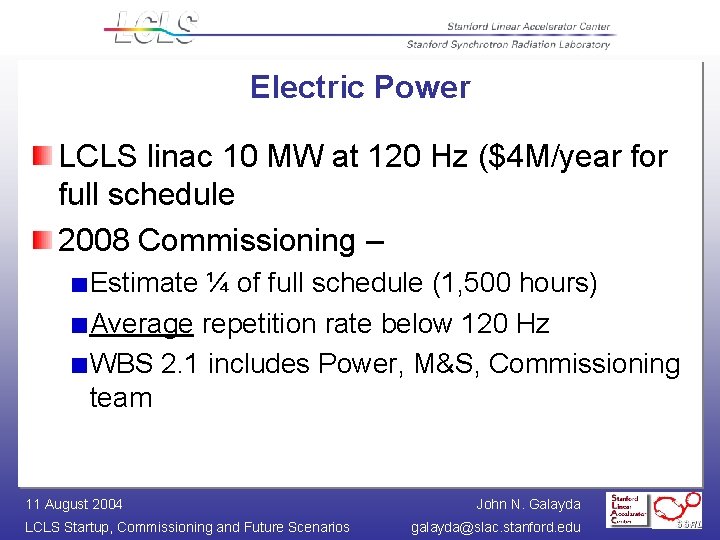
Electric Power LCLS linac 10 MW at 120 Hz ($4 M/year for full schedule 2008 Commissioning – Estimate ¼ of full schedule (1, 500 hours) Average repetition rate below 120 Hz WBS 2. 1 includes Power, M&S, Commissioning team 11 August 2004 LCLS Startup, Commissioning and Future Scenarios John N. Galayda galayda@slac. stanford. edu
Conclusions - Startup SLAC, SSRL organization prepared to support high-quality LCLS operations Commissioning planning well underway Injector commissioning 2006 -2007 Linac commissioning 2007 -2008 FEL commissioning before 7/2008 Can be accelerated with some schedule adjustment 11 August 2004 LCLS Startup, Commissioning and Future Scenarios John N. Galayda galayda@slac. stanford. edu
Post-Project Directions Harmonic or circular polarized afterburners? space available downstream of existng undulator Self-seeding requires relocation of undulator modules As science program allows/dictates 11 August 2004 LCLS Startup, Commissioning and Future Scenarios John N. Galayda galayda@slac. stanford. edu
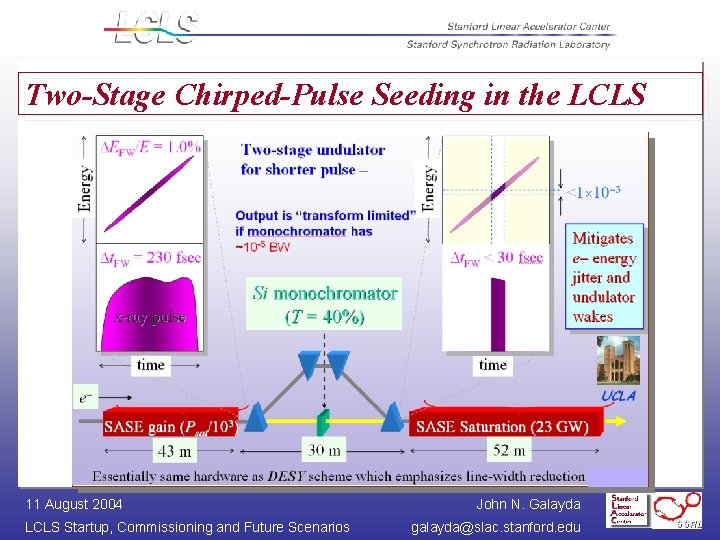
Two-Stage Chirped-Pulse Seeding in the LCLS z 11 August 2004 LCLS Startup, Commissioning and Future Scenarios John N. Galayda galayda@slac. stanford. edu
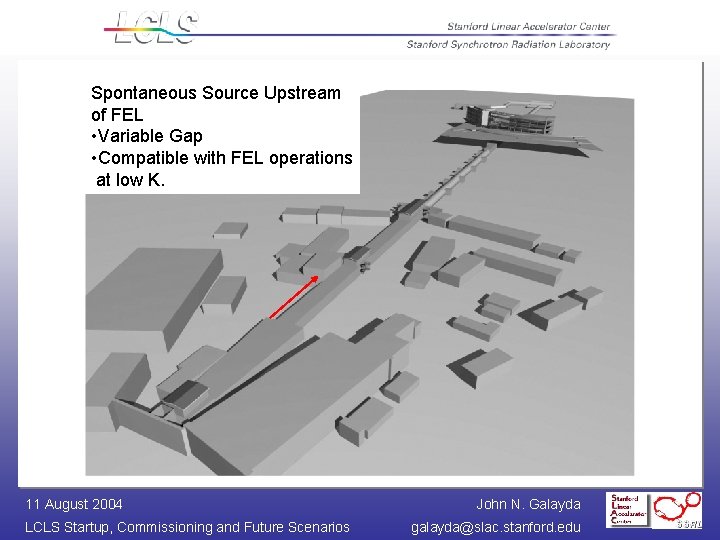
Spontaneous Source Upstream of FEL • Variable Gap • Compatible with FEL operations at low K. 11 August 2004 LCLS Startup, Commissioning and Future Scenarios John N. Galayda galayda@slac. stanford. edu
• Expandable to at least six “hard x-ray” FEL undulators 11 August 2004 LCLS Startup, Commissioning and Future Scenarios John N. Galayda galayda@slac. stanford. edu
More Undulators? Second 0 -degree device could support selfseeding – online in 2013? More undulators and support facilities – online 2015 -2018? Best to do conventional construction for additional undulators in one pass 11 August 2004 LCLS Startup, Commissioning and Future Scenarios John N. Galayda galayda@slac. stanford. edu
Let’s Not Get Ahead of Ourselves We will learn a lot from building the LCLS We will learn a lot from first operation of LCLS Expansion based on lessons learned, scientific opportunity 11 August 2004 LCLS Startup, Commissioning and Future Scenarios John N. Galayda galayda@slac. stanford. edu
End of Presentation 11 August 2004 LCLS Startup, Commissioning and Future Scenarios John N. Galayda galayda@slac. stanford. edu