
LCD 720 012809 Introduction History of pronunciation teaching





- Slides: 33
LCD 720 – 01/28/09 Introduction History of pronunciation teaching
Announcements • Syllabus – Goals – Schedule – Grading & attendance – Textbook • Homework due dates: – March 3, May 5 (= day BEFORE class; you’ll get it back in class)
Announcements • Blackboard – Announcements – Syllabus and assignments – Grades for homework, etc. – Powerpoint slides, day before class • 10 -minute break or stop early?
Why teach pronunciation? • Is it important? • Is it possible? • Is it fun?
Your experience • When you learned a second/foreign language: – Did your teacher teach pronunciation? If so, how? – Do you think this was successful? – What would you have done differently?
ESL speakers • Examples of ESL speakers – What do you think is their first language? – What do you notice about their pronunciation? – What would you do to help these students improve their pronunciation? the topic is shopping for food in your &coun my country the same as in USA my country food usually spicy food but USA food is usually swee(t) is sweet usually sweet and … also USA an(d) my country's food are usually eat [= eaten] vegetable I think vegetable is same thing my my country's food is rice some side dishes but USA food is usually vegetable an(d) spaghetti our best food ah I think so I I like USA's USA US food but US ah food is ah unhealthy I think ah but so healthy &m my country's food an(d)
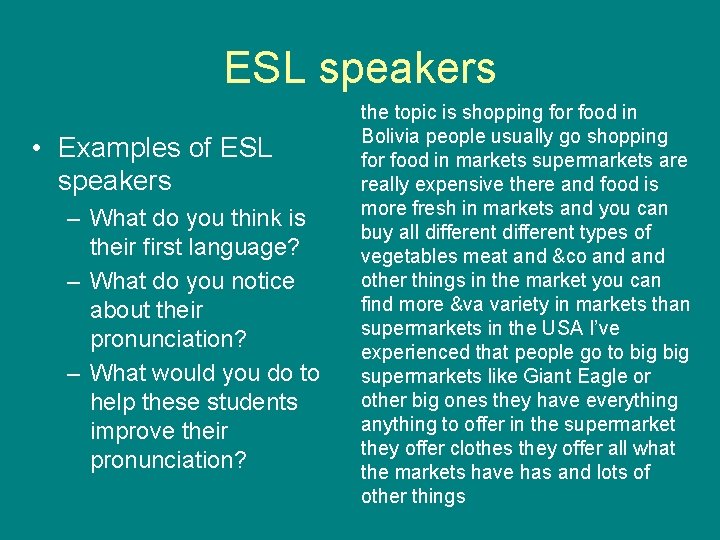
ESL speakers • Examples of ESL speakers – What do you think is their first language? – What do you notice about their pronunciation? – What would you do to help these students improve their pronunciation? the topic is shopping for food in Bolivia people usually go shopping for food in markets supermarkets are really expensive there and food is more fresh in markets and you can buy all different types of vegetables meat and &co and other things in the market you can find more &va variety in markets than supermarkets in the USA I’ve experienced that people go to big supermarkets like Giant Eagle or other big ones they have everything anything to offer in the supermarket they offer clothes they offer all what the markets have has and lots of other things
ESL speakers • Examples of ESL speakers – What do you think is their first language? – What do you notice about their pronunciation? – What would you do to help these students improve their pronunciation? Our budget problem is not because California’s economy is in trouble. In spite of weakness in housing, other areas of our economy continue to thrive. We remain a powerhouse of technology, of agriculture, advanced research, venture capital, international trade, and innovation. And we continue to have job growth, so our revenues this coming year are not going to be lower than last year, they’re not going down. No, the situation is that we’re simply going to hold steady with our revenues. …
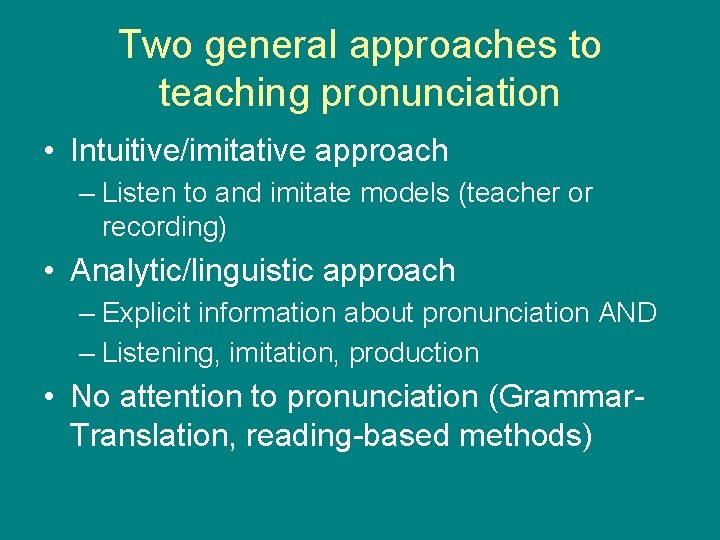
Two general approaches to teaching pronunciation • Intuitive/imitative approach – Listen to and imitate models (teacher or recording) • Analytic/linguistic approach – Explicit information about pronunciation AND – Listening, imitation, production • No attention to pronunciation (Grammar. Translation, reading-based methods)
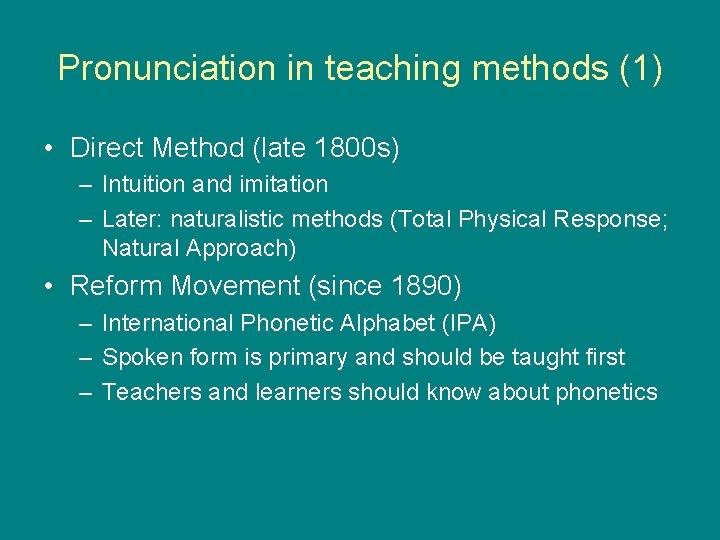
Pronunciation in teaching methods (1) • Direct Method (late 1800 s) – Intuition and imitation – Later: naturalistic methods (Total Physical Response; Natural Approach) • Reform Movement (since 1890) – International Phonetic Alphabet (IPA) – Spoken form is primary and should be taught first – Teachers and learners should know about phonetics
Pronunciation in teaching methods (2) • Audiolingualism (1940 s, 1950 s) – Pronunciation very important, taught explicitly from the start – Minimal pair drills • (Remember minimal pairs? )
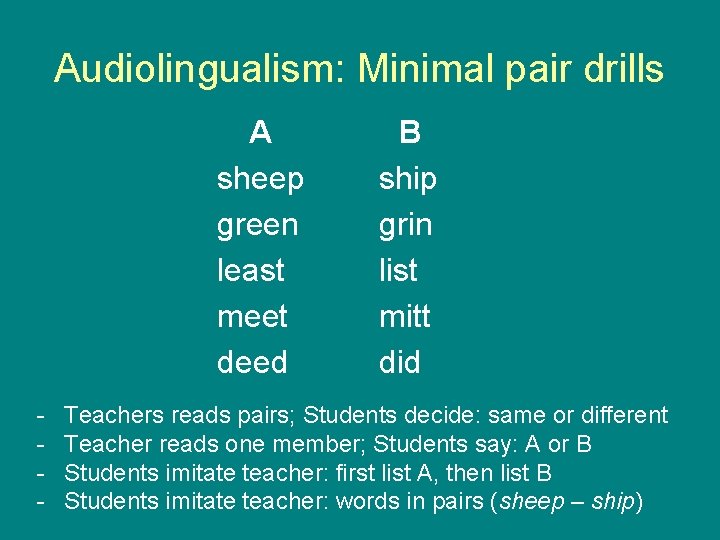
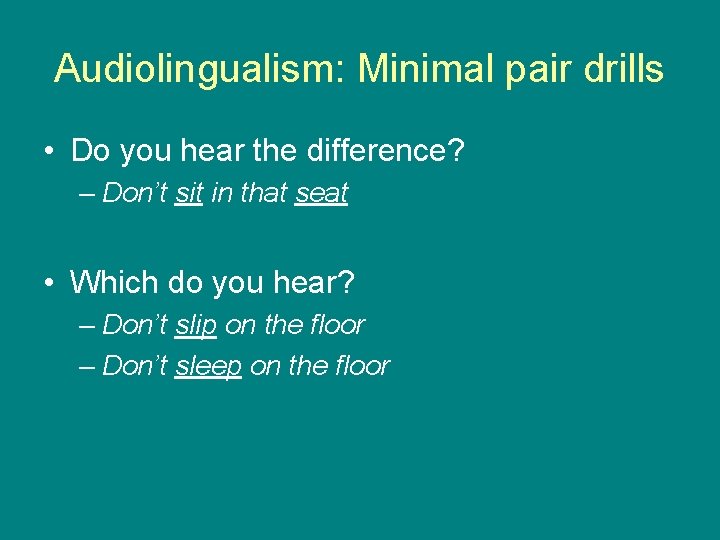
Audiolingualism: Minimal pair drills A sheep green least meet deed - B ship grin list mitt did Teachers reads pairs; Students decide: same or different Teacher reads one member; Students say: A or B Students imitate teacher: first list A, then list B Students imitate teacher: words in pairs (sheep – ship)
Audiolingualism: Minimal pair drills • Do you hear the difference? – Don’t sit in that seat • Which do you hear? – Don’t slip on the floor – Don’t sleep on the floor
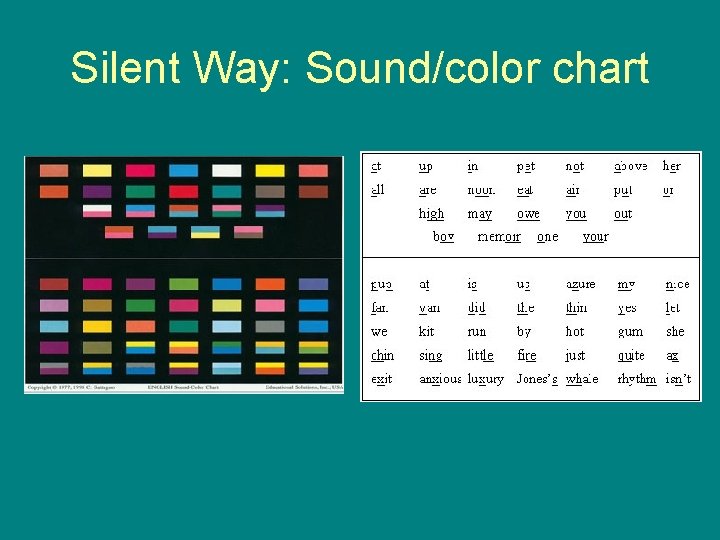
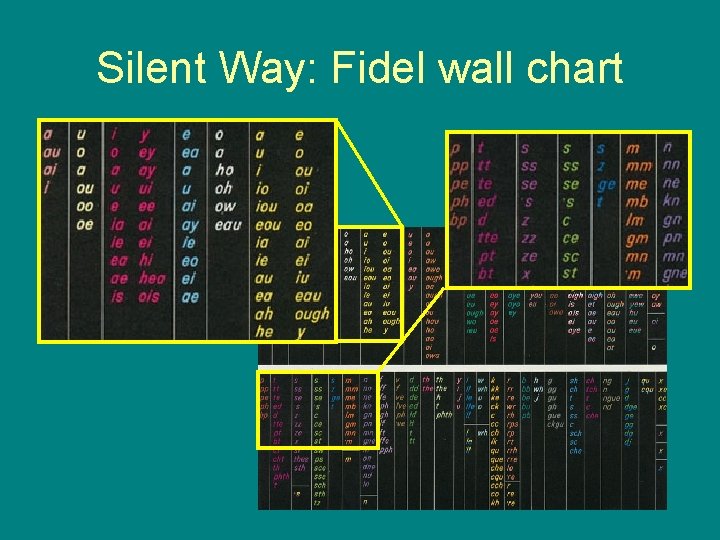
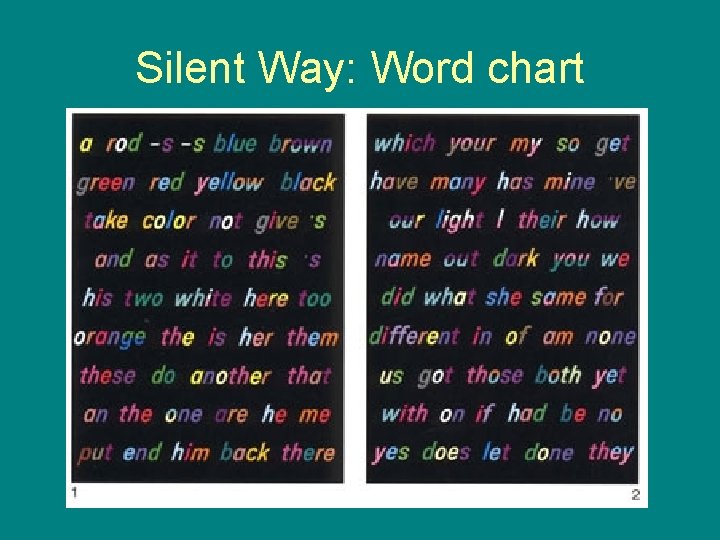
Pronunciation in teaching methods (3) • Cognitive Approach (1960 s) – Native-like pronunciation is unrealistic objective – Preference for grammar and words (more learnable) • Silent Way (1970 s) – Teacher is mostly silent – Use of colors, charts, rods, etc. to ‘bypass the ear’ – Sound-color charts; Fidel wall charts
Silent Way: Sound/color chart
Silent Way: Fidel wall chart
Silent Way: Word chart
Current approaches • Communicative Approach – Goal is effective communication • Intelligible pronunciation, not native-like pronunciation • Threshold level for intelligibility • Pronunciation should not detract for the ability to communicate • No agreed-upon strategies for teaching pronunciation communicatively
Current approaches • A wide range of techniques, including – Listen and imitate (cf. Direct Method) – Phonetic training (cf. Reform Movement) – Minimal pair drills (cf. Audiolingualism) • Also contextualized minimal pairs – Add context and meaning – The blacksmith hits/heats the horseshoe – … with the hammer / in the fire – Visual aids (Silent Way)
Current approaches • Techniques – Practice of vowel shifts and stress shifts • mime vs. mimic • I can tell from these PHOtographs that you are very good at pho. TOGraphy – Reading aloud/recitation • Genres that are meant to be spoken (poems, plays, speeches) – Recordings of learner’s production
Current approaches • Problem: Emphasis is often on the word level and controlled sentence level – Spontaneous production is often not addressed • Segmentals and suprasegmentals – Segmentals: Individual sounds – Suprasegmentals: Rhythm, stress, intonation – Both can have a negative impact on comprehensibility – Should find balance; what is most important – Meet the needs of learners
Focus • Focus on North American English (NAE) – Much variability among NAE speakers • Not only pronunciation, but also speech recognition (listening comprehension)
Your opinion • What should an ESL teacher know about NAE pronunciation? Why? • For example: – Teaching techniques – NAE phonology, including International Phonetic Alphabet (IPA) – Phonology of students’ L 1 s
What ESL teachers need to know about pronunciation • The English sound system • How to select pedagogical techniques (preferably communicatively oriented) • How to assess students’ pronunciation needs • How to set realistic goals • How to use reference materials
The learner • Learner-based variables – Age – Exposure to the target language – Aptitude – Sociocultural and affective variables
Age • Critical/sensitive period – Different for phonology (vs. morphology, syntax) – Possibly related to brain plasticity, neuromuscular control – Might be explained by other factors, such as • L 1 transfer: Adult L 2 learners have competing phonological knowledge from L 1 • Amount of exposure: Child learners generally have more exposure than adult learners • Motivation: Does not play a role in young children
Amount of exposure • Language is acquired primarily from (comprehensible) input. – Generally: more input is better • Foreign language settings: – Less input; mostly from teacher (and TV, radio) • ESL settings: – Some learners live in L 1 surroundings • Pronunciation instruction: – Often repetition drills, and – little or no explicit attention to pronunciation
Aptitude • Language aptitude (Carroll, 1965, 1981) – Hearing and recalling sounds (phonemic coding ability) – Figuring out rules – Learning through exposure – Amount of rote learning needed for learning • Phonemic coding ability is not (strongly) related to intelligence • Different learners have different aptitudes, so rate of learning may vary
Sociocultural and affective variables • Acculturation model (Schumann, 1986) – Sociocultural variables: Social dominance, size of L 1 population, congruence of cultures – Affective variables: Ego permeability, personality, type of motivation – Sociocultural and affective variables interact • Affective variables are stronger than sociocultural variables
Types of motivation • Integrative motivation – Desire to be socially integrated • Instrumental motivation – Learn L 2 to achieve a goal (education, job) • Integratively motivated learners usually achieve higher levels of proficiency • Also: Intensity of motivation
What can we do? • What can we do about …? – – – Age Exposure Aptitude Sociocultural variables Affective variables, incl. motivation • We can … – Work on those factors that can be changed (exposure, some affective variables) – Set appropriate goals for pronunciation practice, e. g. , near-nativeness or intelligibility
Some terminology relevant to Derwing & Munro (2005) • Lingua franca: a common language used by speakers of different languages • Intelligibility, comprehensibility, and accentedness • Segmental and suprasegmental phonology
Next week • Read Chapters 1 and 2 – Skim pp. 1 -19 – Focus on pp. 19 -29 • Read Derwing & Munro (2005) – Find two issues in research on pronunciation teaching that interest you • Get access to Blackboard