
Layout and optimization of the linac rf system
![SINGLE CELL PARAMETRIZATION a [mm] 2÷ 5 b [mm] 10. 155 ÷ 11. 215](https://slidetodoc.com/presentation_image_h2/dc56b17e991d276dacd284d2029896c8/image-6.jpg "SINGLE CELL PARAMETRIZATION a [mm] 2÷ 5 b [mm] 10. 155 ÷ 11. 215")
![LINAC OPTIMIZATION X-band linac main parameters Freq. [GHz] 11. 9942 RF pulse [µs] 1.](https://slidetodoc.com/presentation_image_h2/dc56b17e991d276dacd284d2029896c8/image-12.jpg "LINAC OPTIMIZATION X-band linac main parameters Freq. [GHz] 11. 9942 RF pulse [µs] 1.")
- Slides: 16
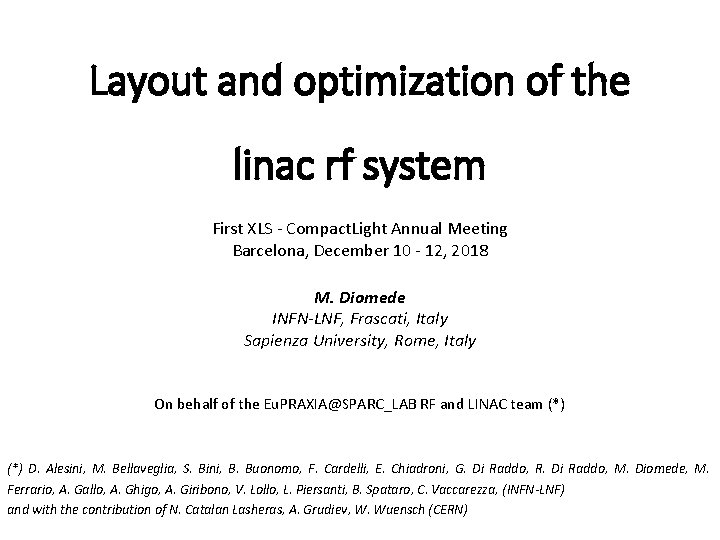
Layout and optimization of the linac rf system First XLS - Compact. Light Annual Meeting Barcelona, December 10 - 12, 2018 M. Diomede INFN-LNF, Frascati, Italy Sapienza University, Rome, Italy On behalf of the Eu. PRAXIA@SPARC_LAB RF and LINAC team (*) D. Alesini, M. Bellaveglia, S. Bini, B. Buonomo, F. Cardelli, E. Chiadroni, G. Di Raddo, R. Di Raddo, M. Diomede, M. Ferrario, A. Gallo, A. Ghigo, A. Giribono, V. Lollo, L. Piersanti, B. Spataro, C. Vaccarezza, (INFN-LNF) and with the contribution of N. Catalan Lasheras, A. Grudiev, W. Wuensch (CERN)
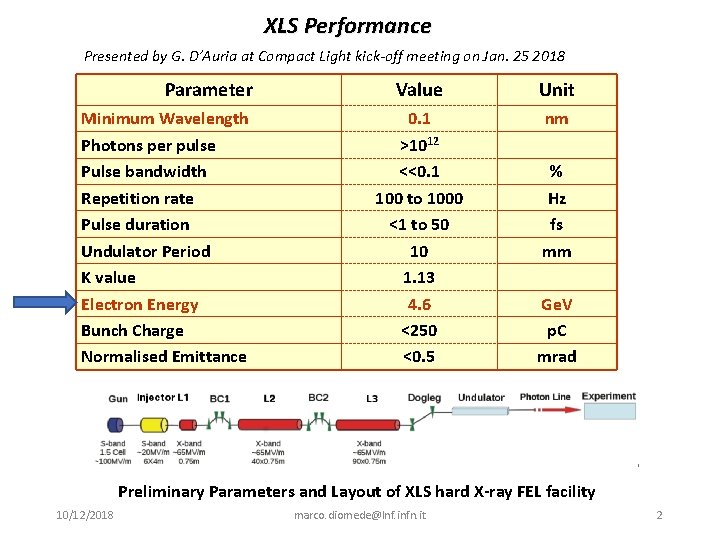
XLS Performance Presented by G. D’Auria at Compact Light kick-off meeting on Jan. 25 2018 Parameter Minimum Wavelength Photons per pulse Pulse bandwidth Repetition rate Pulse duration Undulator Period K value Electron Energy Bunch Charge Normalised Emittance Value Unit 0. 1 >1012 <<0. 1 100 to 1000 <1 to 50 10 1. 13 4. 6 <250 <0. 5 nm % Hz fs mm Ge. V p. C mrad Preliminary Parameters and Layout of XLS hard X-ray FEL facility 10/12/2018 marco. diomede@lnf. infn. it 2
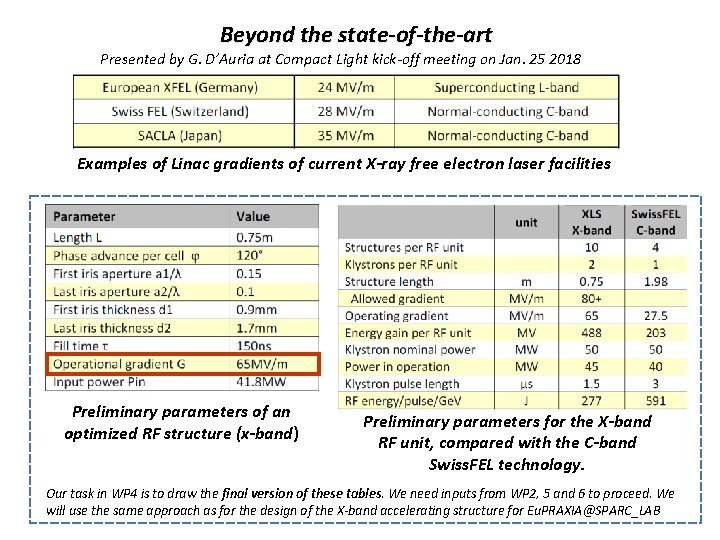
Beyond the state-of-the-art Presented by G. D’Auria at Compact Light kick-off meeting on Jan. 25 2018 Examples of Linac gradients of current X-ray free electron laser facilities Preliminary parameters of an optimized RF structure (x-band) Preliminary parameters for the X-band RF unit, compared with the C-band Swiss. FEL technology. Our task in WP 4 is to draw the final version of these tables. We need inputs from WP 2, 5 and 6 to proceed. We will use the same approach as for the design of the X-band accelerating structure for Eu. PRAXIA@SPARC_LAB
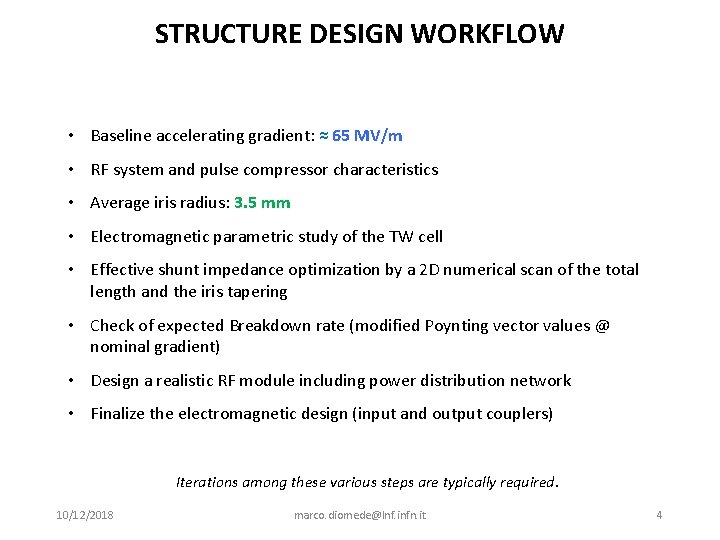
STRUCTURE DESIGN WORKFLOW • Baseline accelerating gradient: ≈ 65 MV/m • RF system and pulse compressor characteristics • Average iris radius: 3. 5 mm • Electromagnetic parametric study of the TW cell • Effective shunt impedance optimization by a 2 D numerical scan of the total length and the iris tapering • Check of expected Breakdown rate (modified Poynting vector values @ nominal gradient) • Design a realistic RF module including power distribution network • Finalize the electromagnetic design (input and output couplers) Iterations among these various steps are typically required. 10/12/2018 marco. diomede@lnf. infn. it 4
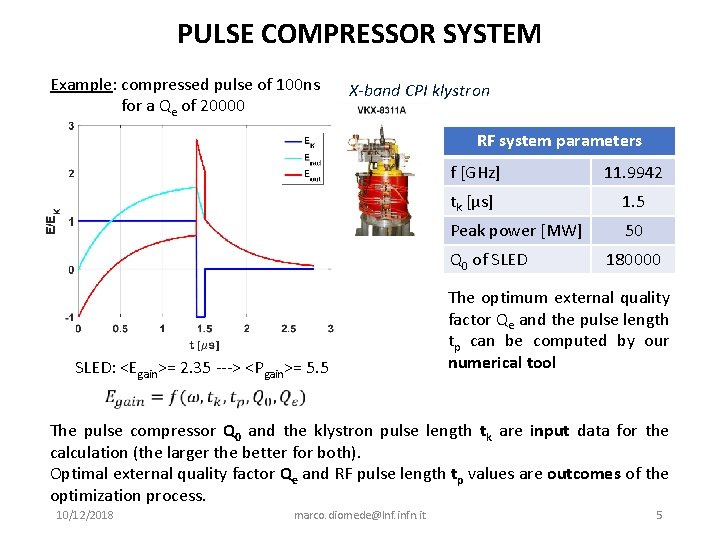
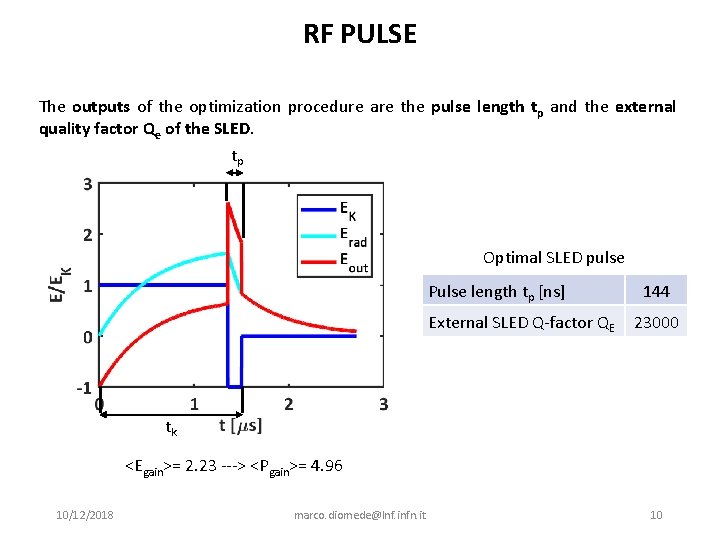
PULSE COMPRESSOR SYSTEM Example: compressed pulse of 100 ns for a Qe of 20000 X-band CPI klystron RF system parameters f [GHz] 11. 9942 tk [μs] 1. 5 Peak power [MW] 50 Q 0 of SLED: <Egain>= 2. 35 ---> <Pgain>= 5. 5 180000 The optimum external quality factor Qe and the pulse length tp can be computed by our numerical tool The pulse compressor Q 0 and the klystron pulse length tk are input data for the calculation (the larger the better for both). Optimal external quality factor Qe and RF pulse length tp values are outcomes of the optimization process. 10/12/2018 marco. diomede@lnf. infn. it 5
SINGLE CELL PARAMETRIZATION a [mm] 2÷ 5 b [mm] 10. 155 ÷ 11. 215 d [mm] 8. 332 (2π/3 mode) r 0 [mm] 2. 5 t [mm] 2 r 1/r 2 10/12/2018 1. 3 (Min Sc max for a=3. 2 mm) A scan of the iris radius a from 2 mm to 5 mm has been performed with HFSS in order to obtain the single cell parameters (R, vg/c, Q, Scmax/E 2 acc) as a function of the iris radius. Moreover, the iris has been shaped (tapered) with an elliptical shape to minimize Scmax/E 2 acc. marco. diomede@lnf. infn. it 6
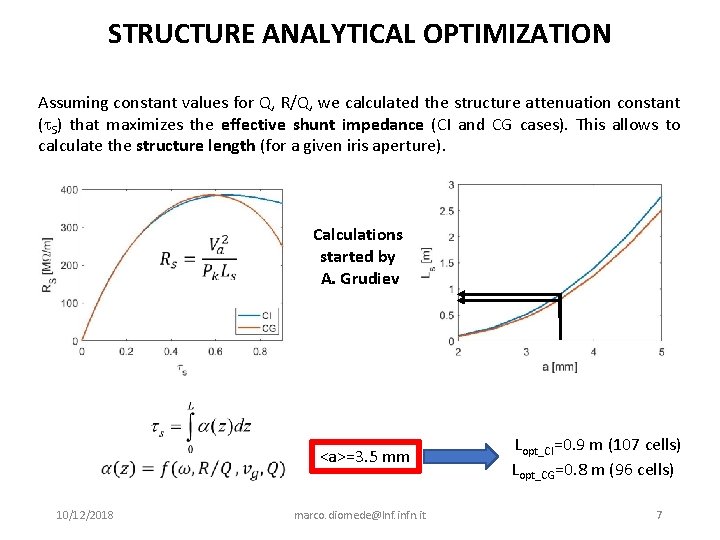
STRUCTURE ANALYTICAL OPTIMIZATION Assuming constant values for Q, R/Q, we calculated the structure attenuation constant ( S) that maximizes the effective shunt impedance (CI and CG cases). This allows to calculate the structure length (for a given iris aperture). Calculations started by A. Grudiev <a>=3. 5 mm 10/12/2018 marco. diomede@lnf. infn. it Lopt_CI=0. 9 m (107 cells) Lopt_CG=0. 8 m (96 cells) 7
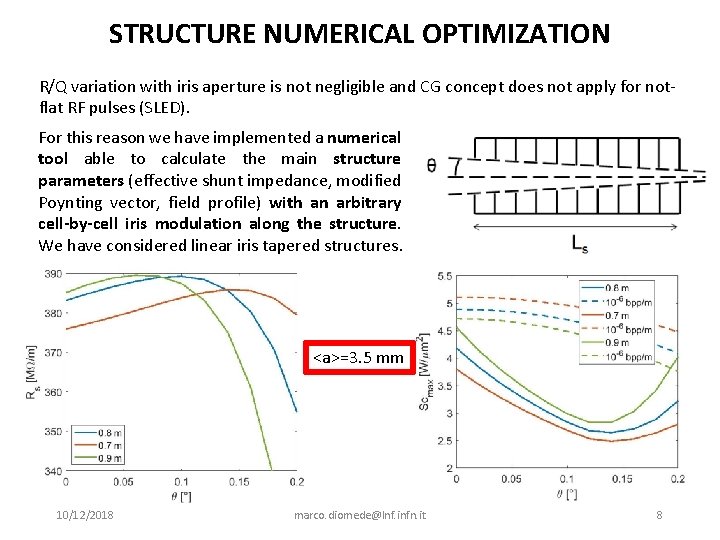
STRUCTURE NUMERICAL OPTIMIZATION R/Q variation with iris aperture is not negligible and CG concept does not apply for notflat RF pulses (SLED). For this reason we have implemented a numerical tool able to calculate the main structure parameters (effective shunt impedance, modified Poynting vector, field profile) with an arbitrary cell-by-cell iris modulation along the structure. We have considered linear iris tapered structures. <a>=3. 5 mm 10/12/2018 marco. diomede@lnf. infn. it 8
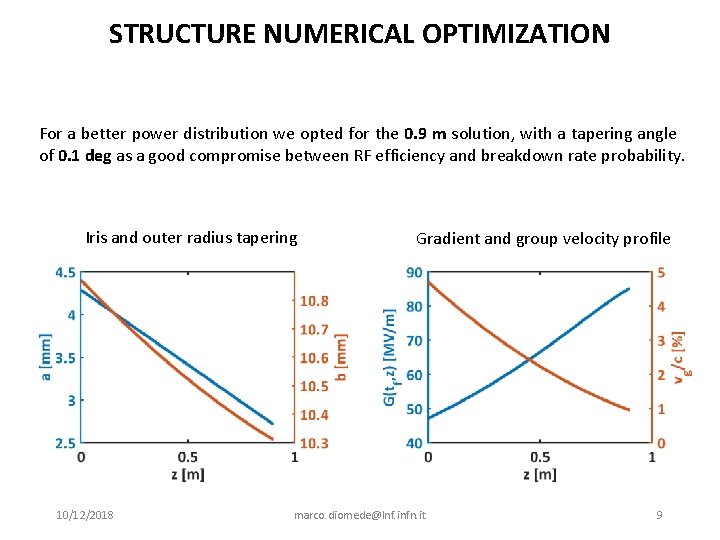
STRUCTURE NUMERICAL OPTIMIZATION For a better power distribution we opted for the 0. 9 m solution, with a tapering angle of 0. 1 deg as a good compromise between RF efficiency and breakdown rate probability. Iris and outer radius tapering 10/12/2018 Gradient and group velocity profile marco. diomede@lnf. infn. it 9
RF PULSE The outputs of the optimization procedure are the pulse length tp and the external quality factor Qe of the SLED. tp Optimal SLED pulse Pulse length tp [ns] External SLED Q-factor QE 144 23000 tk <Egain>= 2. 23 ---> <Pgain>= 4. 96 10/12/2018 marco. diomede@lnf. infn. it 10
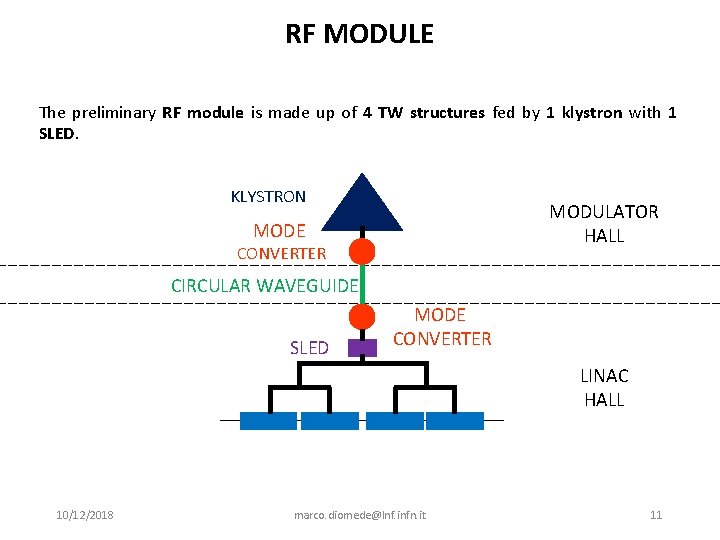
RF MODULE The preliminary RF module is made up of 4 TW structures fed by 1 klystron with 1 SLED. KLYSTRON MODULATOR HALL MODE CONVERTER CIRCULAR WAVEGUIDE SLED MODE CONVERTER LINAC HALL 10/12/2018 marco. diomede@lnf. infn. it 11
LINAC OPTIMIZATION X-band linac main parameters Freq. [GHz] 11. 9942 RF pulse [µs] 1. 5 Average gradient <G> [MV/m] 65 MV/m Linac Energy gain Egain [Ge. V] 4. 5 Linac active length Lact [m] 70 Unloaded SLED Q-factor Q 0 180000 External SLED Q-factor QE 23000 No. of cells 107 Structure length Ls [m] 0. 9 Iris radius a [mm] 4. 3 -2. 7 Group velocity vg [%] 4. 7 -1 Effective shunt Imp. Rs [M /m] 387 Filling time tf [ns] 144 Klystron power per structure Pk_s [MW] (w/o attenuation) 10 Structures per module Nm (kly. power per module Pk_m [MW]) 10/12/2018 4 (40) Total number of structures Ntot ≈80 Total number of klystrons Nk ≈20 marco. diomede@lnf. infn. it 12
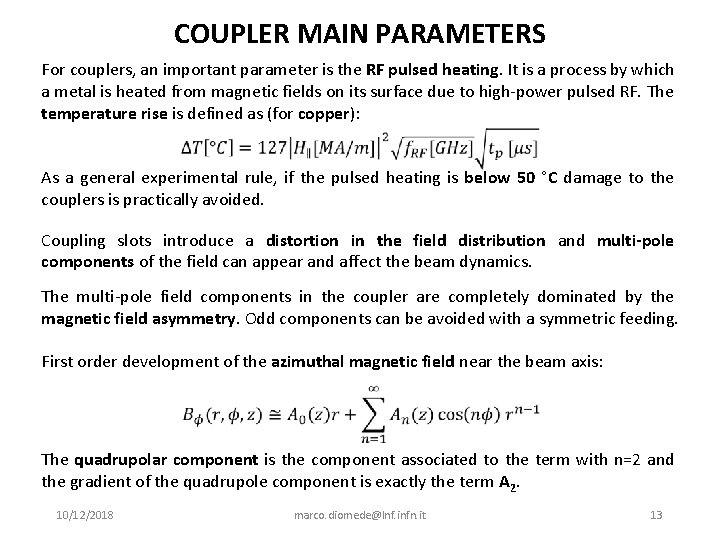
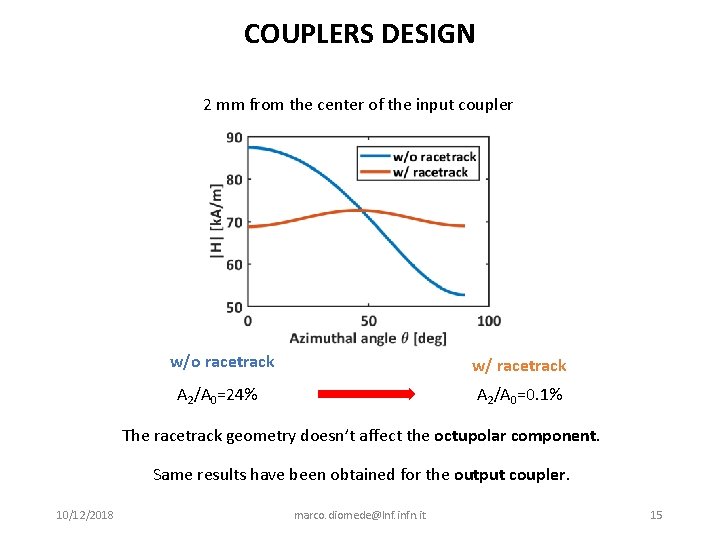
COUPLER MAIN PARAMETERS For couplers, an important parameter is the RF pulsed heating. It is a process by which a metal is heated from magnetic fields on its surface due to high-power pulsed RF. The temperature rise is defined as (for copper): As a general experimental rule, if the pulsed heating is below 50 °C damage to the couplers is practically avoided. Coupling slots introduce a distortion in the field distribution and multi-pole components of the field can appear and affect the beam dynamics. The multi-pole field components in the coupler are completely dominated by the magnetic field asymmetry. Odd components can be avoided with a symmetric feeding. First order development of the azimuthal magnetic field near the beam axis: The quadrupolar component is the component associated to the term with n=2 and the gradient of the quadrupole component is exactly the term A 2. 10/12/2018 marco. diomede@lnf. infn. it 13
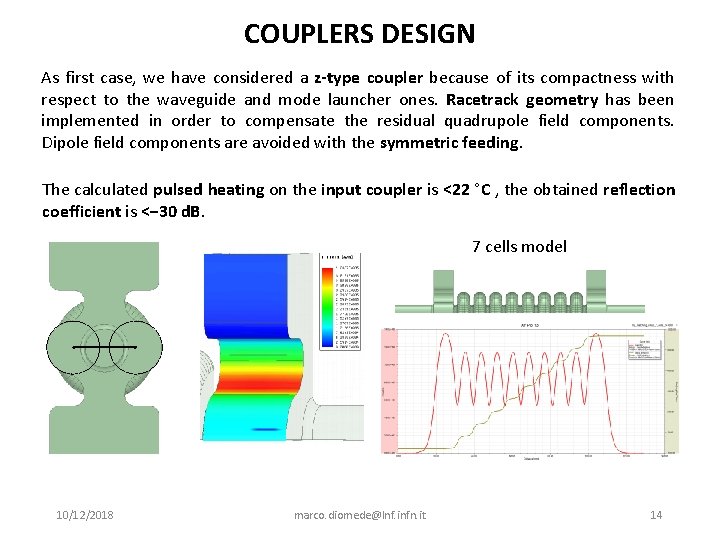
COUPLERS DESIGN As first case, we have considered a z-type coupler because of its compactness with respect to the waveguide and mode launcher ones. Racetrack geometry has been implemented in order to compensate the residual quadrupole field components. Dipole field components are avoided with the symmetric feeding. The calculated pulsed heating on the input coupler is <22 °C , the obtained reflection coefficient is <− 30 d. B. 7 cells model 10/12/2018 marco. diomede@lnf. infn. it 14
COUPLERS DESIGN 2 mm from the center of the input coupler w/o racetrack w/ racetrack A 2/A 0=24% A 2/A 0=0. 1% The racetrack geometry doesn’t affect the octupolar component. Same results have been obtained for the output coupler. 10/12/2018 marco. diomede@lnf. infn. it 15
NEXT STEPS Go through the iteration process with different or updated starting conditions Finalize the electromagnetic design (input and output waveguide couplers) Design the RF module: waveguide network, converters, RF windows… (input for Task 5: Integration) Simulate the entire structure (feasibility to be checked) … 10/12/2018 marco. diomede@lnf. infn. it 16