
LayOn Gable Frame Connection Overview Revised 3222017 SBCA

Lay-On Gable Frame Connection Overview Revised 3/22/2017

SBCA has been the voice of the structural building components industry since 1983, providing educational programs and technical information, disseminating industry news, and facilitating networking opportunities for manufacturers of roof trusses, wall panels and floor trusses. SBCA endeavors to expand component manufacturers’ market share and enhance the professionalism of the component manufacturing industry. Copyright © 2017 Structural Building Components Association.
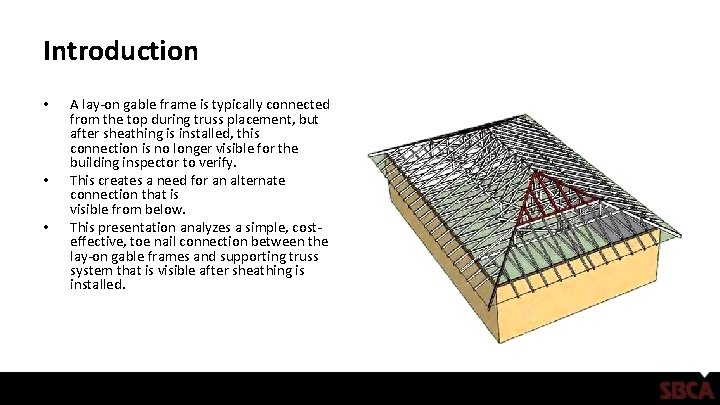
Introduction • • • A lay-on gable frame is typically connected from the top during truss placement, but after sheathing is installed, this connection is no longer visible for the building inspector to verify. This creates a need for an alternate connection that is visible from below. This presentation analyzes a simple, costeffective, toe nail connection between the lay-on gable frames and supporting truss system that is visible after sheathing is installed.
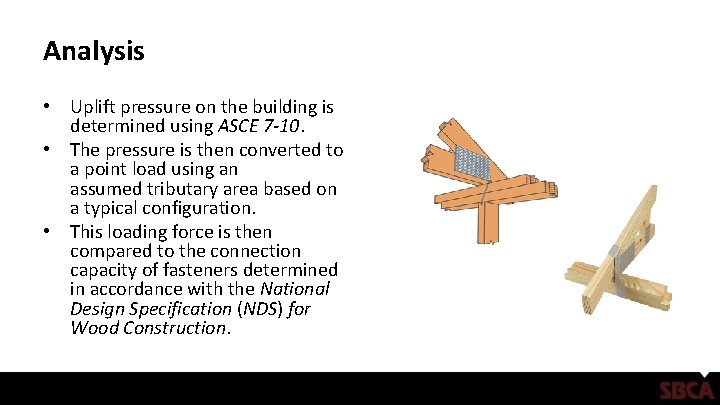
Analysis • Uplift pressure on the building is determined using ASCE 7 -10. • The pressure is then converted to a point load using an assumed tributary area based on a typical configuration. • This loading force is then compared to the connection capacity of fasteners determined in accordance with the National Design Specification (NDS) for Wood Construction.
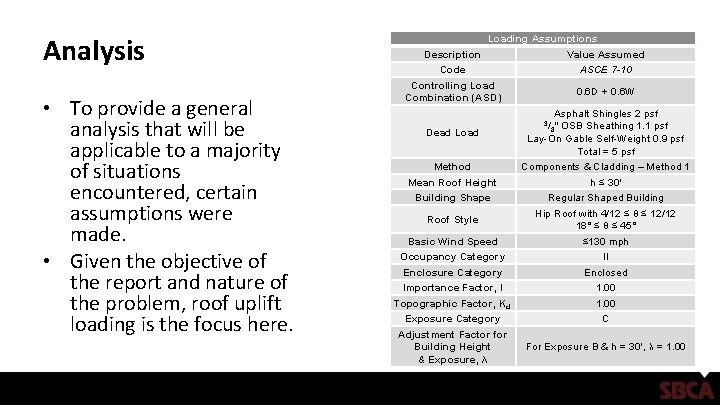
Analysis • To provide a general analysis that will be applicable to a majority of situations encountered, certain assumptions were made. • Given the objective of the report and nature of the problem, roof uplift loading is the focus here. Loading Assumptions Description Value Assumed Code ASCE 7 -10 Controlling Load 0. 6 D + 0. 6 W Combination (ASD) Asphalt Shingles 2 psf 3/ " OSB Sheathing 1. 1 psf 8 Dead Load Lay-On Gable Self-Weight 0. 9 psf Total = 5 psf Method Components & Cladding – Method 1 Mean Roof Height h ≤ 30' Building Shape Regular Shaped Building Hip Roof with 4/12 ≤ θ ≤ 12/12 Roof Style 18° ≤ θ ≤ 45° Basic Wind Speed ≤ 130 mph Occupancy Category II Enclosure Category Enclosed Importance Factor, I 1. 00 Topographic Factor, Kzt 1. 00 Exposure Category C Adjustment Factor for For Exposure B & h = 30', λ = 1. 00 Building Height & Exposure, λ
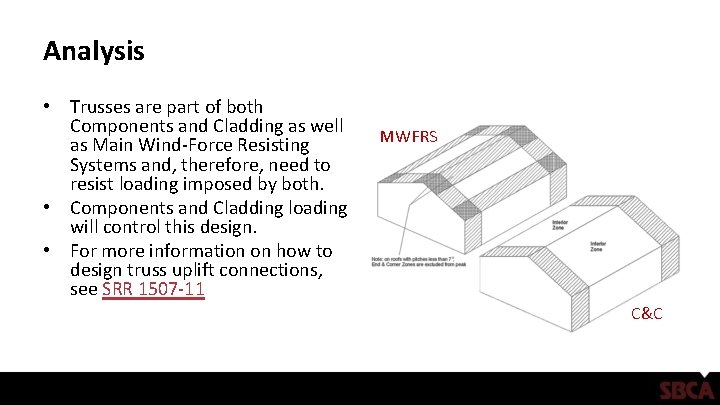
Analysis • Trusses are part of both Components and Cladding as well as Main Wind-Force Resisting Systems and, therefore, need to resist loading imposed by both. • Components and Cladding loading will control this design. • For more information on how to design truss uplift connections, see SRR 1507 -11 MWFRS C&C
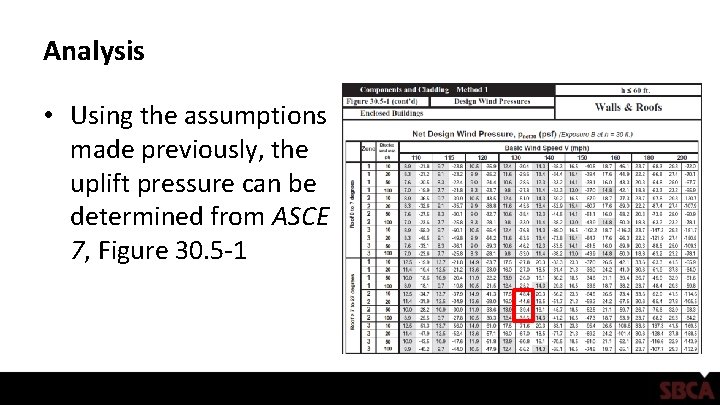
Analysis • Using the assumptions made previously, the uplift pressure can be determined from ASCE 7, Figure 30. 5 -1
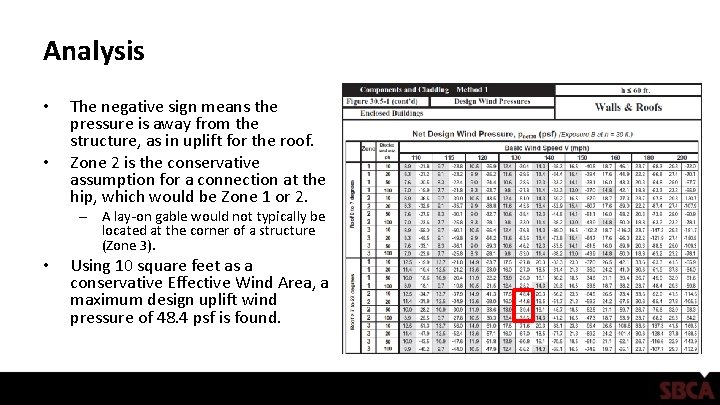
Analysis • • The negative sign means the pressure is away from the structure, as in uplift for the roof. Zone 2 is the conservative assumption for a connection at the hip, which would be Zone 1 or 2. – A lay-on gable would not typically be located at the corner of a structure (Zone 3). • Using 10 square feet as a conservative Effective Wind Area, a maximum design uplift wind pressure of 48. 4 psf is found.
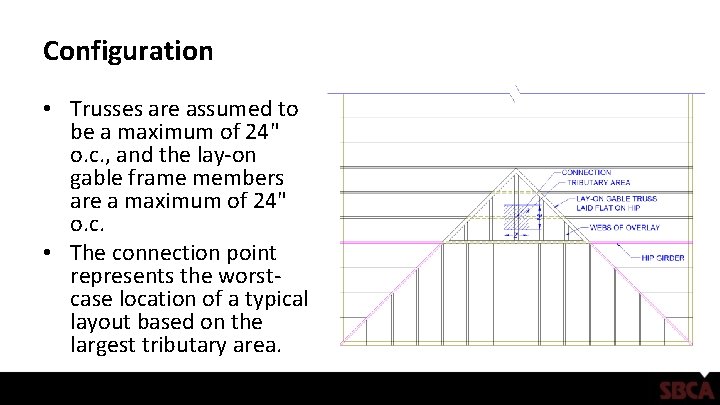
Configuration • Trusses are assumed to be a maximum of 24" o. c. , and the lay-on gable frame members are a maximum of 24" o. c. • The connection point represents the worstcase location of a typical layout based on the largest tributary area.

Configuration
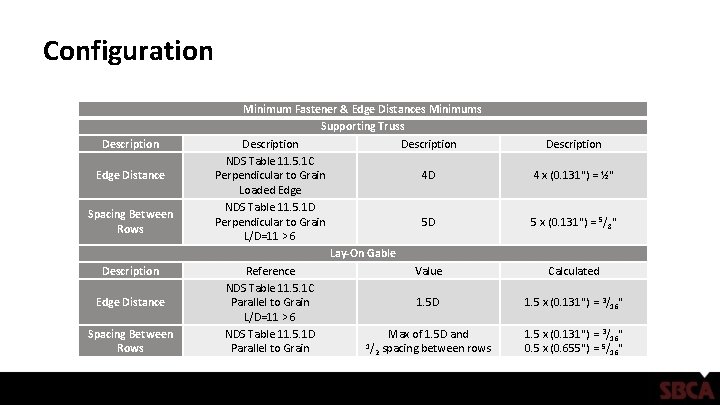
Configuration Description Edge Distance Spacing Between Rows Minimum Fastener & Edge Distances Minimums Supporting Truss Description NDS Table 11. 5. 1 C 4 D Perpendicular to Grain Loaded Edge NDS Table 11. 5. 1 D 5 D Perpendicular to Grain L/D=11 > 6 Lay-On Gable Reference Value NDS Table 11. 5. 1 C 1. 5 D Parallel to Grain L/D=11 > 6 NDS Table 11. 5. 1 D Max of 1. 5 D and 1 Parallel to Grain /2 spacing between rows Description 4 x (0. 131") = ½" 5 x (0. 131") = 5/8" Calculated 1. 5 x (0. 131") = 3/16" 0. 5 x (0. 655") = 5/16"
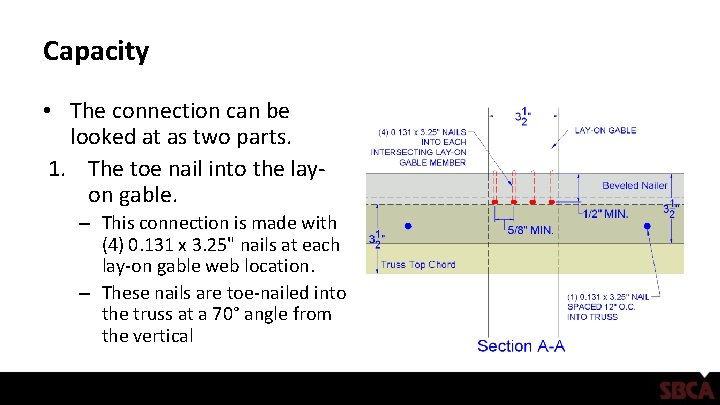
Capacity • The connection can be looked at as two parts. 1. The toe nail into the layon gable. – This connection is made with (4) 0. 131 x 3. 25" nails at each lay-on gable web location. – These nails are toe-nailed into the truss at a 70° angle from the vertical
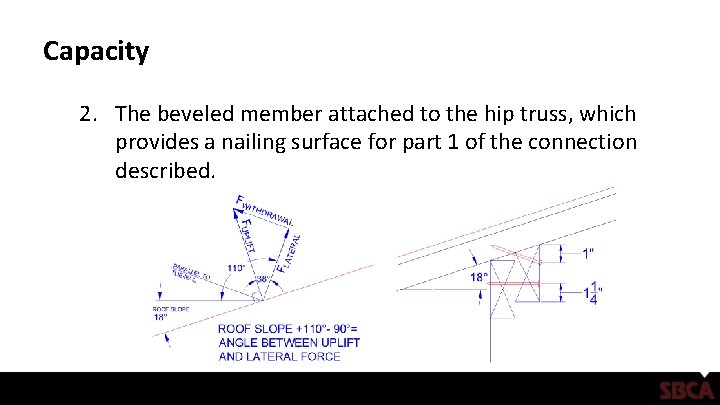
Capacity 2. The beveled member attached to the hip truss, which provides a nailing surface for part 1 of the connection described.
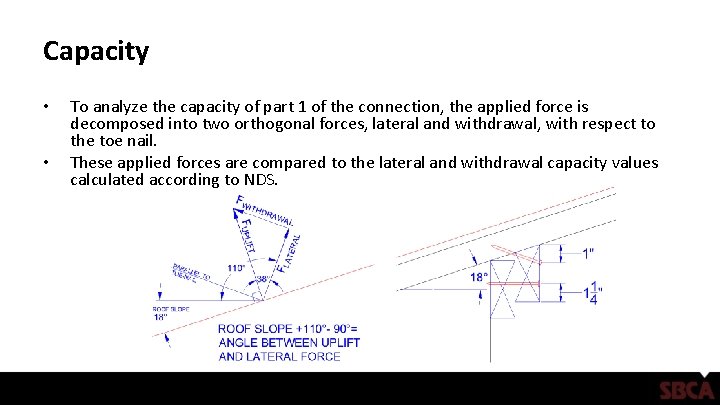
Capacity • • To analyze the capacity of part 1 of the connection, the applied force is decomposed into two orthogonal forces, lateral and withdrawal, with respect to the toe nail. These applied forces are compared to the lateral and withdrawal capacity values calculated according to NDS.
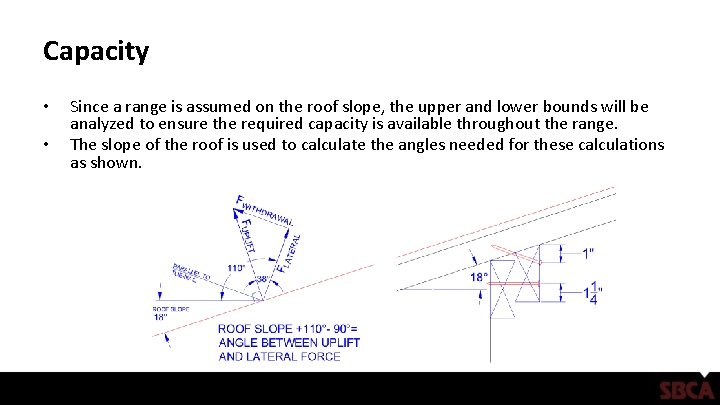
Capacity • • Since a range is assumed on the roof slope, the upper and lower bounds will be analyzed to ensure the required capacity is available throughout the range. The slope of the roof is used to calculate the angles needed for these calculations as shown.
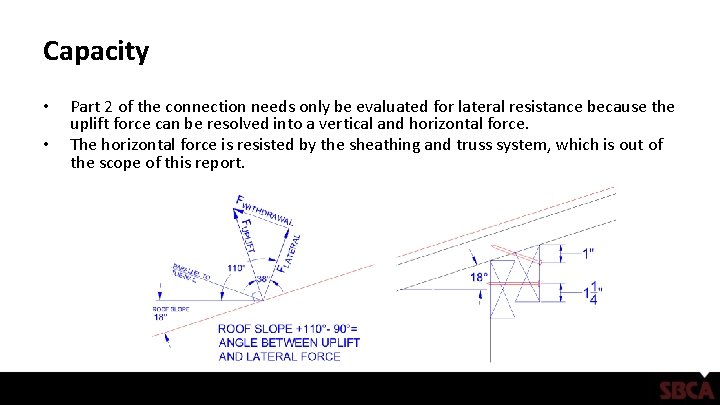
Capacity • • Part 2 of the connection needs only be evaluated for lateral resistance because the uplift force can be resolved into a vertical and horizontal force. The horizontal force is resisted by the sheathing and truss system, which is out of the scope of this report.
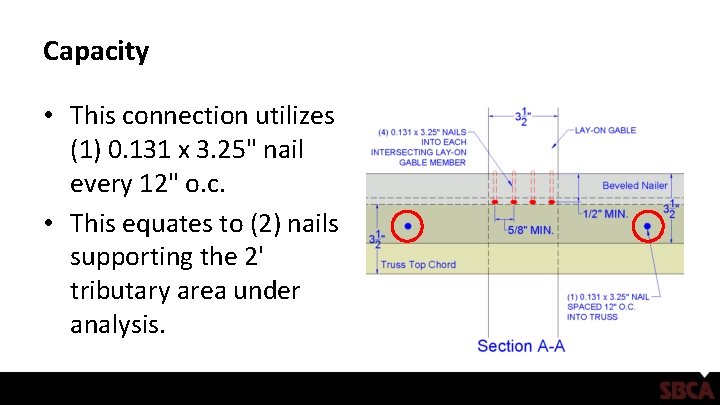
Capacity • This connection utilizes (1) 0. 131 x 3. 25" nail every 12" o. c. • This equates to (2) nails supporting the 2' tributary area under analysis.
Capacity • Full calculations can be found in SRR 1505 -02: – – – Design Load Calculations – Figure 6 Capacity Calculations for Roof Slope = 18° (Lower Bound) – Figure 7 Capacity Calculations for Roof Slope = 45° (Upper Bound) – Figure 8 Bevel Member Capacity Calculations for Roof Slope = 18° – Figure 9 Bevel Member Capacity Calculations for Roof Slope = 45° – Figure 10
Conclusion • Part 1 and Part 2 of the connection are determined to be adequate by the above calculations. • Therefore, the load path of this connection is verified as being adequate for the design loading using the discussed assumptions. • The connection with the largest tributary area was analyzed to show that the connections adjacent, with smaller tributary area, therefore smaller loadings, will also be adequate. • Any project specific variables that reduce the loading, as well as better materials and fasteners, will make the connection more conservative. • The connection described in this presentation is determined to have adequate capacity to resist the applied uplift loads.
References • American Society of Civil Engineers, Minimum Design Loads for Buildings and Other Structures (ASCE/SEI 7 -10). • American Wood Council, National Design Specification® for Wood Construction (AWC/NDS), 2015.
- Slides: 20