
Laying the Foundation for Communication Exchange Practical Strategies
- Slides: 55
Laying the Foundation for Communication Exchange: Practical Strategies Presented for the National Center on Deaf. Blindness March 21, 2018 Presented by: Susan M. Bashinski Missouri Western State University
OBJECTIVES Following this webinar, participants will be able to: 1. Generate at least one example, regarding a familiar learner, of how development of different communication modes for receptive communication and expressive communication might be very helpful. 2. Develop a pair of receptive and expressive nonsymbolic communication dictionaries for a particular learner. 3. Describe the aspects of a routine, which can make a critical contribution to a learner’s feeling sufficiently safe and secure to reach
ASSUMPTIONS There is absolutely NO learner who does not communicate. Learners who are NONsymbolic communicators DO primarily communicate using idiosyncratic, nonconventional forms.
COMMUNICATION REMINDERS (1 of 2) Early expression of “memories” will likely incorporate the movement and tactile aspects of the experience the learner is recalling.
COMMUNICATION REMINDERS (2 of 2) For a learner who experiences deaf -blindness, the way in which she receives info. might be different from the way she expresses information
LEARNER NEEDS Deaf-blindness requires a learner’s partners to take time to… �plan how a learner will RECEIVE information in every activity �plan what a learner will DO in every activity �consider the IMMEDIATE physical, visual, and auditory
PARTNER’S ROLE / REPERTOIRE TA needs to provide potential communication partners with: �specific strategies they might implement, to facilitate a learner’s growth, �in the direction of conventional, intentional communication. Partners’ repeated interpretations of a learner’s behaviors, over time, will shape intentionality & conventionality.
STRATEGIES FOR FACILITATING NONSYMBOLIC / CONCRETE SYMBOLIC COMMUNICATION DEVELOPMENT
COMMUNICATION BEGINS WITH NONSYMBOLIC BEHAVIOR �Observe �Follow a learner during unstructured time the learner’s lead �Embellish potential communicative signals OFTEN…. . Nonsymbolic skills must be directly taught
COMMUNICATIVE INTERVENTION: FACILITATION OF SYMBOLIZATION ABILITY �Experiences that involve movement and action �Multi-sensory exploration, including touch �Interaction with objects / activities that are highly preferred by the learner �Interactions that occur during play �Implementation �Highly of regular routines responsive adults!!!
Primary Goal: ACHIEVING EQUAL COMMUNICATION PARTNERSHIP
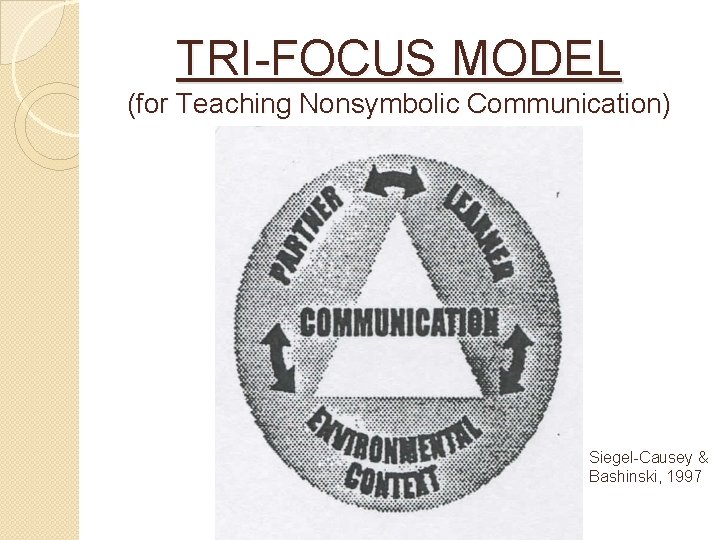
TRI-FOCUS MODEL (for Teaching Nonsymbolic Communication) Siegel-Causey & Bashinski, 1997
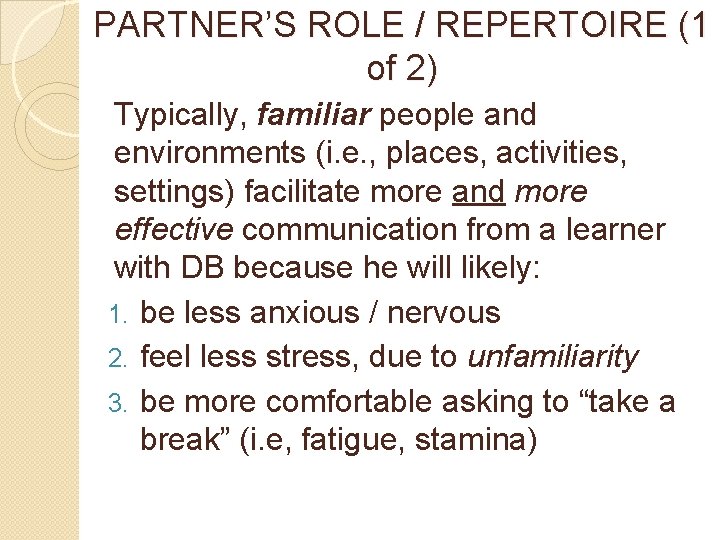
PARTNER’S ROLE / REPERTOIRE (1 of 2) Typically, familiar people and environments (i. e. , places, activities, settings) facilitate more and more effective communication from a learner with DB because he will likely: 1. be less anxious / nervous 2. feel less stress, due to unfamiliarity 3. be more comfortable asking to “take a break” (i. e, fatigue, stamina)
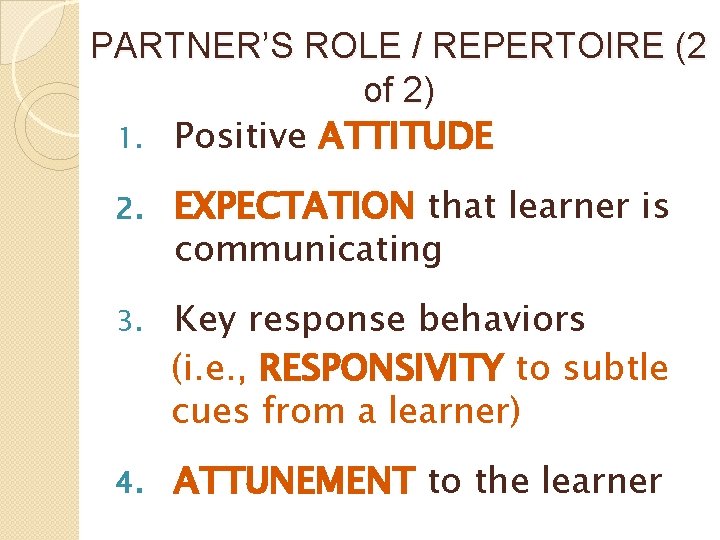
PARTNER’S ROLE / REPERTOIRE (2 of 2) 1. Positive ATTITUDE 2. EXPECTATION that learner is communicating 3. Key response behaviors (i. e. , RESPONSIVITY to subtle cues from a learner) 4. ATTUNEMENT to the learner
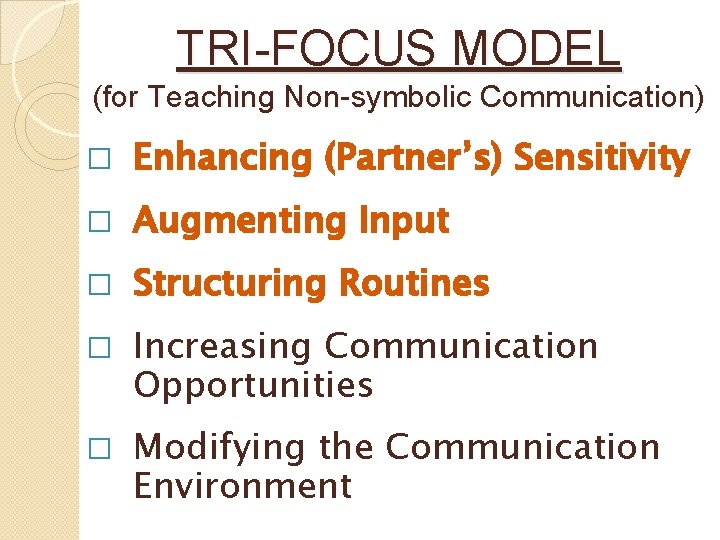
TRI-FOCUS MODEL (for Teaching Non-symbolic Communication) � Enhancing (Partner’s) Sensitivity � Augmenting Input � Structuring Routines � Increasing Communication Opportunities � Modifying the Communication Environment
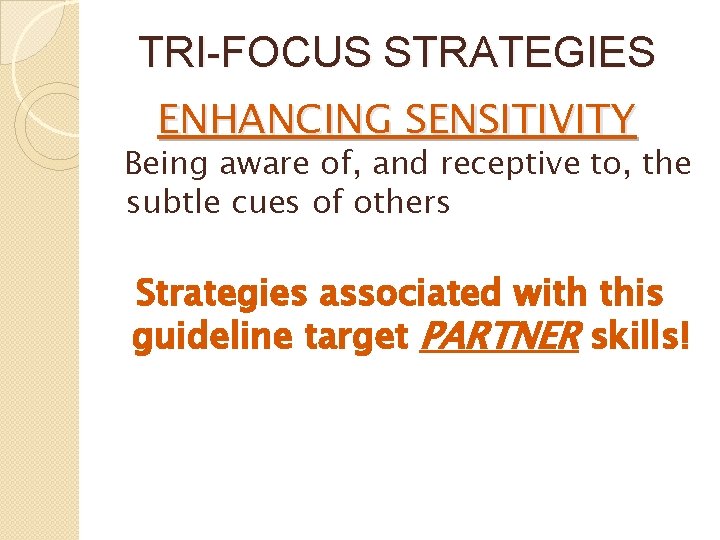
TRI-FOCUS STRATEGIES ENHANCING SENSITIVITY Being aware of, and receptive to, the subtle cues of others Strategies associated with this guideline target PARTNER skills!
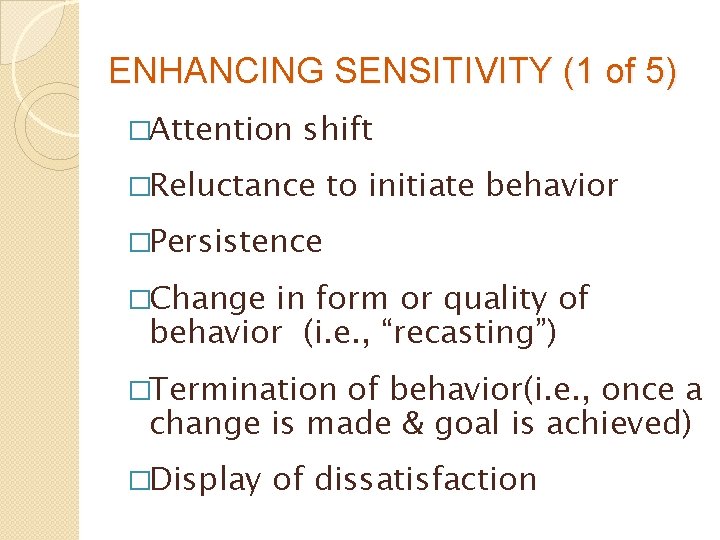
ENHANCING SENSITIVITY (1 of 5) �Attention shift �Reluctance to initiate behavior �Persistence �Change in form or quality of behavior (i. e. , “recasting”) �Termination of behavior(i. e. , once a change is made & goal is achieved) �Display of dissatisfaction
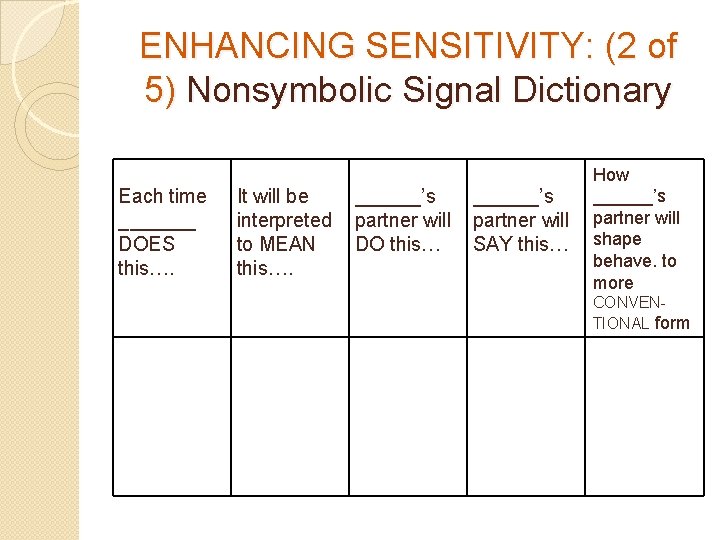
ENHANCING SENSITIVITY: (2 of 5) Nonsymbolic Signal Dictionary Each time _______ DOES this…. It will be interpreted to MEAN this…. ______’s partner will DO this… ______’s partner will SAY this… How ______’s partner will shape behave. to more CONVENTIONAL form
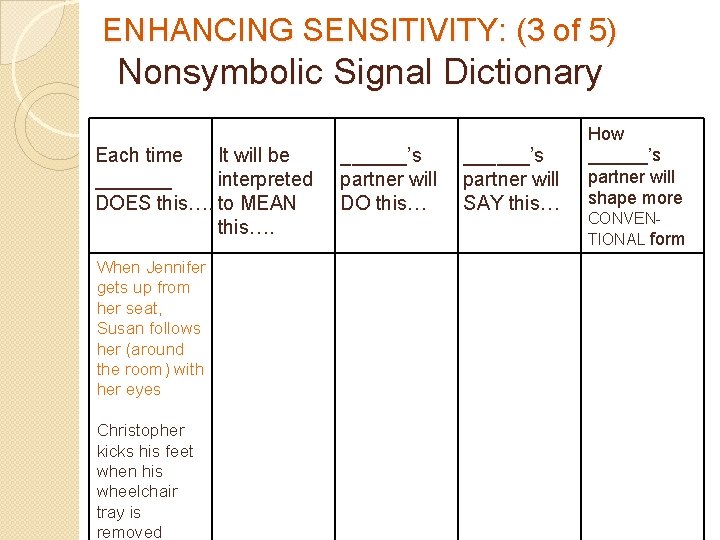
ENHANCING SENSITIVITY: (3 of 5) Nonsymbolic Signal Dictionary Each time It will be _______ interpreted DOES this…. to MEAN this…. When Jennifer gets up from her seat, Susan follows her (around the room) with her eyes Christopher kicks his feet when his wheelchair tray is removed ______’s partner will DO this… ______’s partner will SAY this… How ______’s partner will shape more CONVENTIONAL form
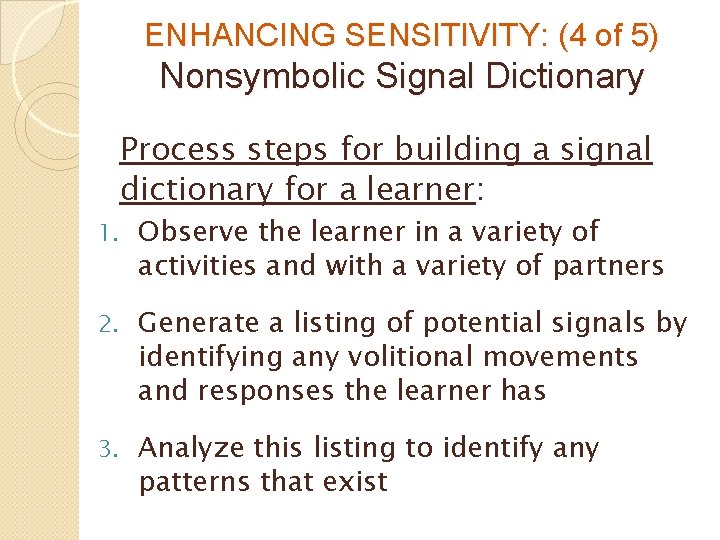
ENHANCING SENSITIVITY: (4 of 5) Nonsymbolic Signal Dictionary Process steps for building a signal dictionary for a learner: 1. Observe the learner in a variety of activities and with a variety of partners 2. Generate a listing of potential signals by identifying any volitional movements and responses the learner has 3. Analyze this listing to identify any patterns that exist
ENHANCING SENSITIVITY: (5 of 5) Nonsymbolic Signal Dictionary Process steps for building a signal dictionary for a learner (CON’T. ): 4. Select a few of these as core signals 5. Assign meaning to each of these 6. Determine corresponding partner behavior (DO, SAY, & SCAFFOLD) 7. Stress to all partners the importance of consistent, immediate responding
TRI-FOCUS STRATEGIES (1 of 2) ENHANCING SENSITIVITY KEY: Accept the learner’s message! Listen with your eyes, and hands, and heart….
TRI-FOCUS STRATEGIES (2 of 2) AUGMENTING INPUT: Enhancing meaning and facilitating retention by pairing verbal input and alternative modes (forms) ALL COMMUNICATION SHOULD BE MULTI-MODAL!
TOUCH CUES
WHAT IS A TOUCH CUE? A TOUCH CUE consists of tactile contact, made in a consistent manner, directly on the learner’s body, to communicate with him.
WHY USE TOUCH CUES? The PURPOSE of a touch cue is to communicate a variety of a partner’s intents. The use of touch cues may reduce a learner’s startle, or challenging behaviors, by helping him anticipate what is going to occur. Touch cues are intended to support comprehension.
GUIDELINES FOR USING TOUCH CUES (1 of 2) � Does the learner have any severe neurological disability? (This might affect his ability to perceive the touch cue OR he might have significant tactile defensiveness. ) � Solicit input from the learner’s family � Collaborate with all professionals on the learner’s team � Talk with the learner’s physical therapist and / or occupational therapist!
GUIDELINES FOR USING TOUCH CUES (2 of 2) �Consider the learner’s preferences when selecting both the type of, and placement for, a touch cue. �NEVER force a learner to accept a touch cue, or to engage in mutual touch “conversations. ” �Touch cues should be easy for the learner to differentiate from routine physical contact
EXAMPLES OF TOUCH CUES �Tapping the child’s bottom (in supine)“I’m going to lift your hips (for diaper) �Gently pulling up on the child’s upper arms - “Get ready to stand up. ” �Touching the preschooler’s left elbow “This is the way I say ‘HI, ’ so you know who I am. ” �Rubbing the middle of the toddler’s back “I like that. ”
TOUCH CUES See Project SALUTE: Successful Adaptations for Learning to Use Touch Effectively http: //www. projectsalute. net/Learned/ Learnedhtml/Touch. Cue. html “What We’ve Learned-Information Sheets”
OBJECT CUES
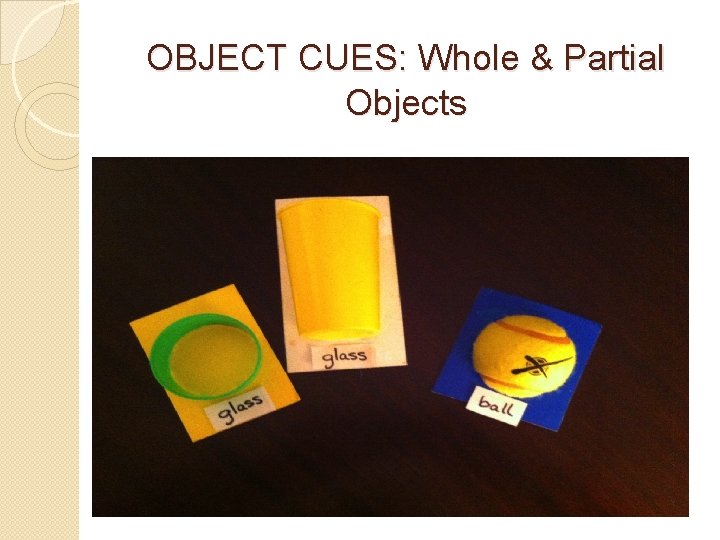
WHAT IS AN OBJECT CUE? An OBJECT CUE is an object, or a part of an object, that is used to REFER to a person, place, thing, or activity.
WHY USE OBJECT CUES? The PURPOSE of an object cue is to provide a concrete means of supporting conversational interactions AND facilitating communication development.
GUIDELINES FOR USING OBJECT CUES (1 of 2) �Does the learner have sufficient motor ability to actively explore / manipulate the object? �Does the learner have sufficient sensory ability to process the object’s features? AVOID the use of miniatures with a learner who has a significant vision loss!
GUIDELINES FOR USING OBJECT CUES (2 of 2) �NEVER force the learner to accept an object cue, or to engage in exploring one! �Demonstrate how to explore the object cue’s surface, guiding the learner to do the same (i. e. , use “tactile modeling”) �Offer object cues to the learner, gently-especially initially
EXAMPLES OF OBJECT CUES WHOLE objects �bag - to mean, “Get your things to go home. ” �bubble wrapping - to mean, “Take a break. ” PARTS of objects �top of plastic bottle – to mean, “Lunch! Go to the table. ” �partial zipper – to mean, “Time to get dressed. ”
OBJECT CUES: Whole & Partial Objects
PREPARATION OF OBJECT CUES Mount the objects used in these supports for the development of symbolization to help the learner distinguish: � when the object is an object and �when it is a representation (of the object)
OBJECT CUES See Project SALUTE: Successful Adaptations for Learning to Use Touch Effectively http: //www. projectsalute. net/Learnedhtml/Object. Cue. html “What We’ve Learned-Information Sheets”
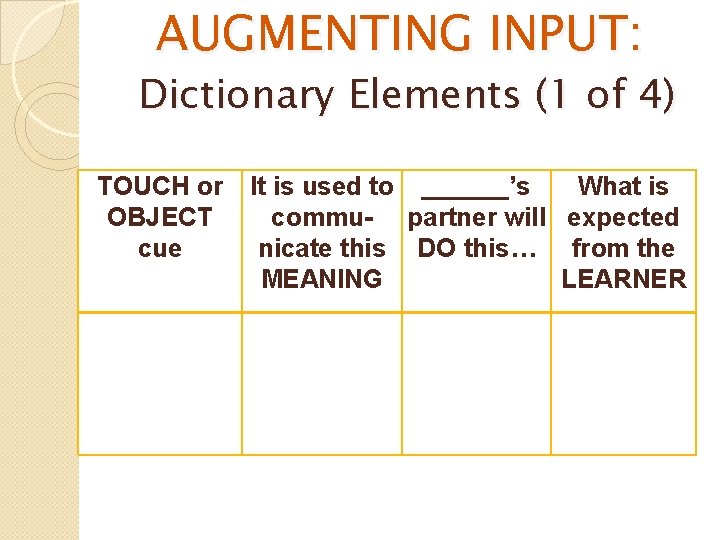
AUGMENTING INPUT: Dictionary Elements (1 of 4) TOUCH or OBJECT cue It is used to ______’s What is commu- partner will expected nicate this DO this… from the MEANING LEARNER
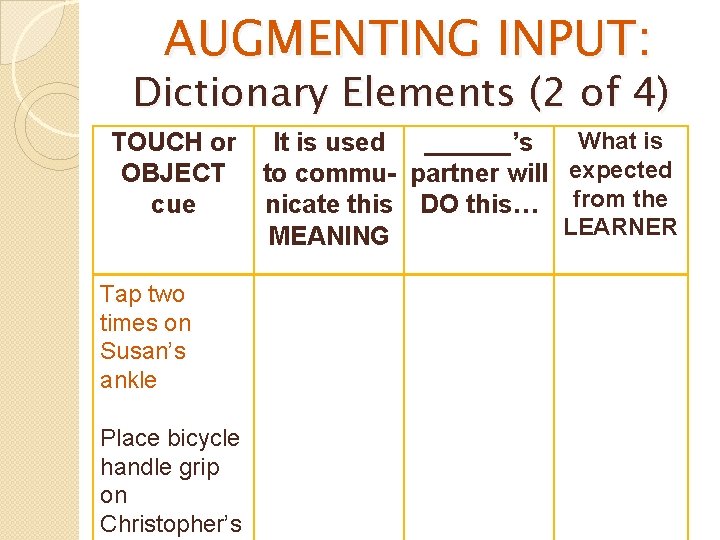
AUGMENTING INPUT: Dictionary Elements (2 of 4) TOUCH or OBJECT cue Tap two times on Susan’s ankle Place bicycle handle grip on Christopher’s What is It is used ______’s to commu- partner will expected nicate this DO this… from the LEARNER MEANING
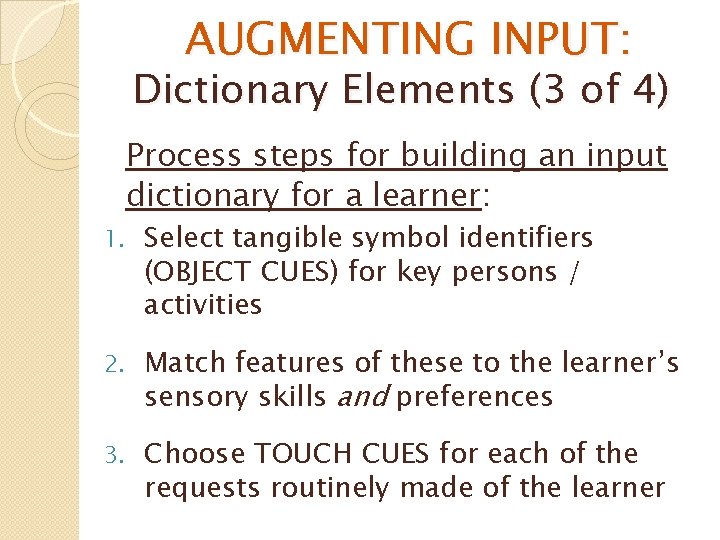
AUGMENTING INPUT: Dictionary Elements (3 of 4) Process steps for building an input dictionary for a learner: 1. Select tangible symbol identifiers (OBJECT CUES) for key persons / activities 2. Match features of these to the learner’s sensory skills and preferences 3. Choose TOUCH CUES for each of the requests routinely made of the learner
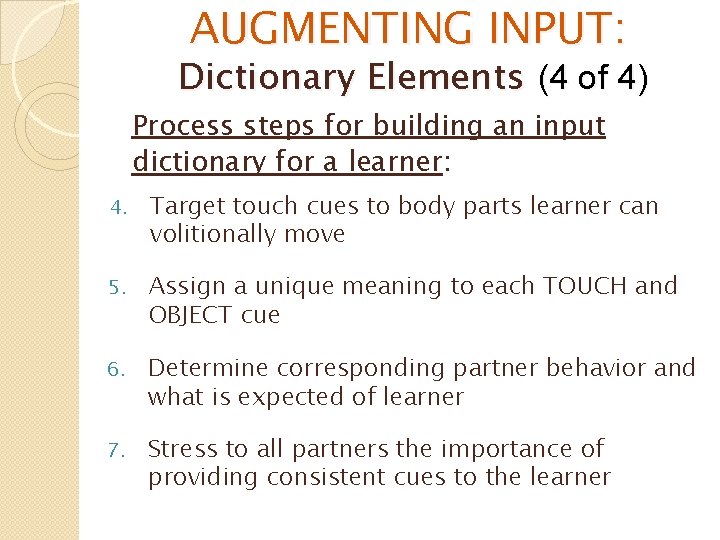
AUGMENTING INPUT: Dictionary Elements (4 of 4) Process steps for building an input dictionary for a learner: 4. Target touch cues to body parts learner can volitionally move 5. Assign a unique meaning to each TOUCH and OBJECT cue 6. Determine corresponding partner behavior and what is expected of learner 7. Stress to all partners the importance of providing consistent cues to the learner
TRI-FOCUS STRATEGIES AUGMENTING INPUT KEY: Support the learner’s comprehension! Talk with more than your mouth….
STRUCTURING ROUTINES 45
INTRODUCTION Partnering with a learner with deafblindness involves… INVITING THE CHILD“OUT (of her body)…” to join you in the world, and to build levels of connections with her
STRUCTURING ROUTINES (1 of 3) Definition of “routine”: A related series of activities, organized into a predictable format Consistent implementation of routines serve to organize a learner’s activities —and world! A LEARNER NEEDS TO LEARN TO ANTICIPATE
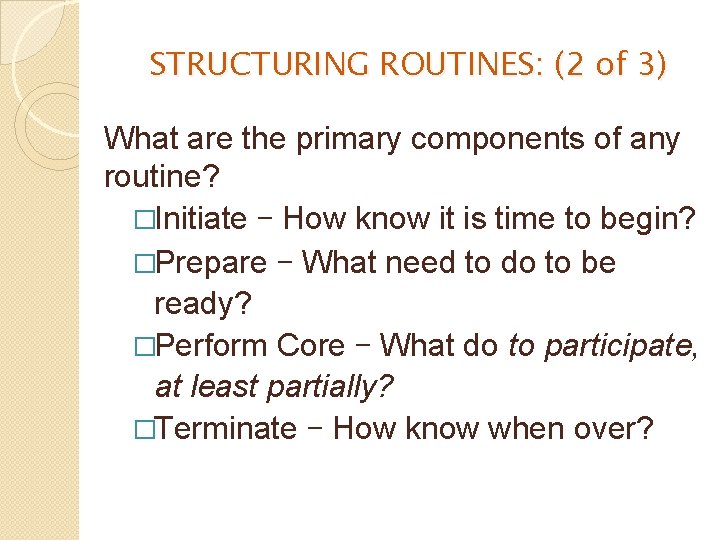
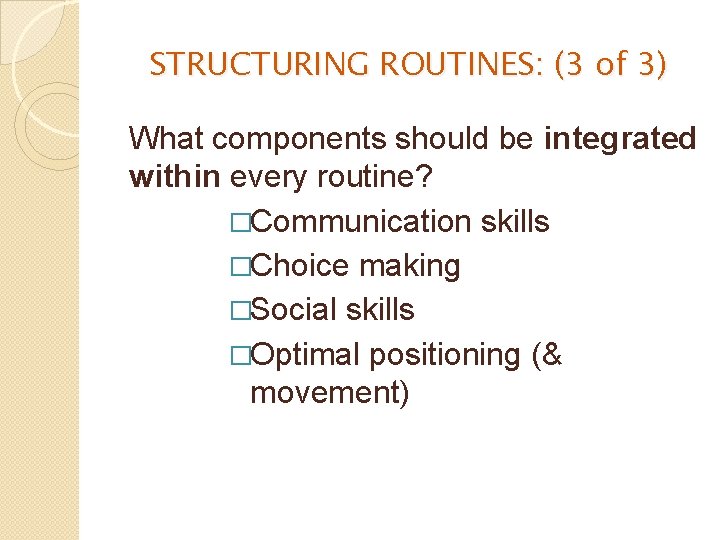
STRUCTURING ROUTINES: (2 of 3) What are the primary components of any routine? �Initiate – How know it is time to begin? �Prepare – What need to do to be ready? �Perform Core – What do to participate, at least partially? �Terminate – How know when over?
STRUCTURING ROUTINES: (3 of 3) What components should be integrated within every routine? �Communication skills �Choice making �Social skills �Optimal positioning (& movement)
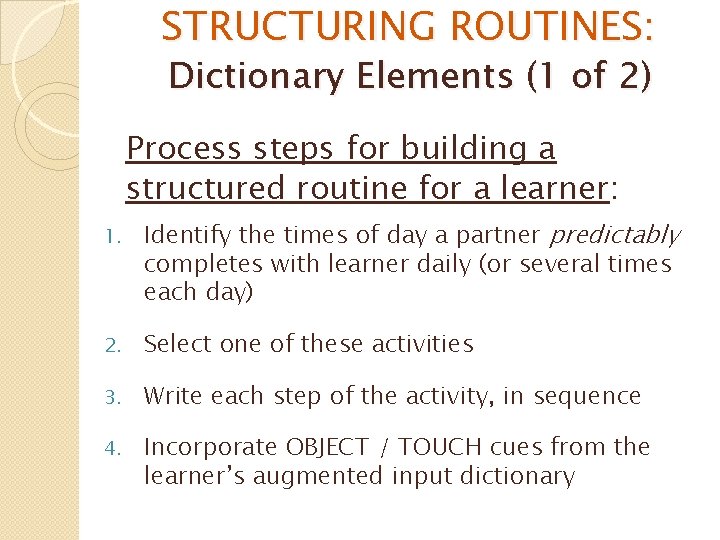
STRUCTURING ROUTINES: Dictionary Elements (1 of 2) Process steps for building a structured routine for a learner: 1. Identify the times of day a partner predictably completes with learner daily (or several times each day) 2. Select one of these activities 3. Write each step of the activity, in sequence 4. Incorporate OBJECT / TOUCH cues from the learner’s augmented input dictionary
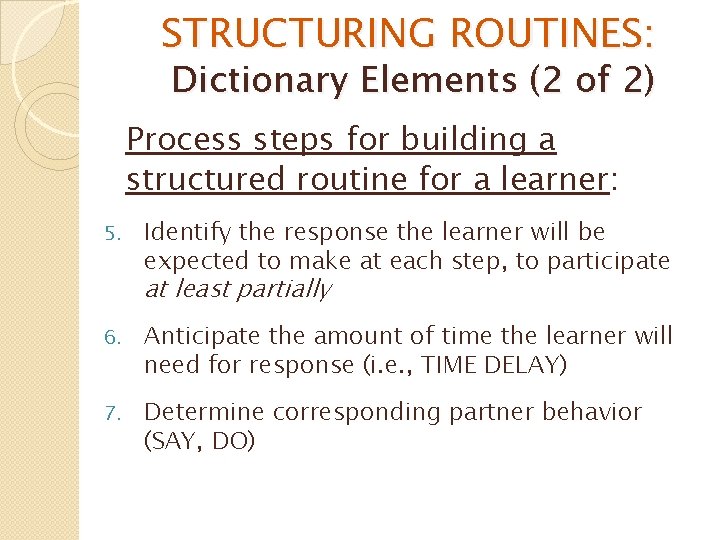
STRUCTURING ROUTINES: Dictionary Elements (2 of 2) Process steps for building a structured routine for a learner: 5. Identify the response the learner will be expected to make at each step, to participate at least partially 6. Anticipate the amount of time the learner will need for response (i. e. , TIME DELAY) 7. Determine corresponding partner behavior (SAY, DO)
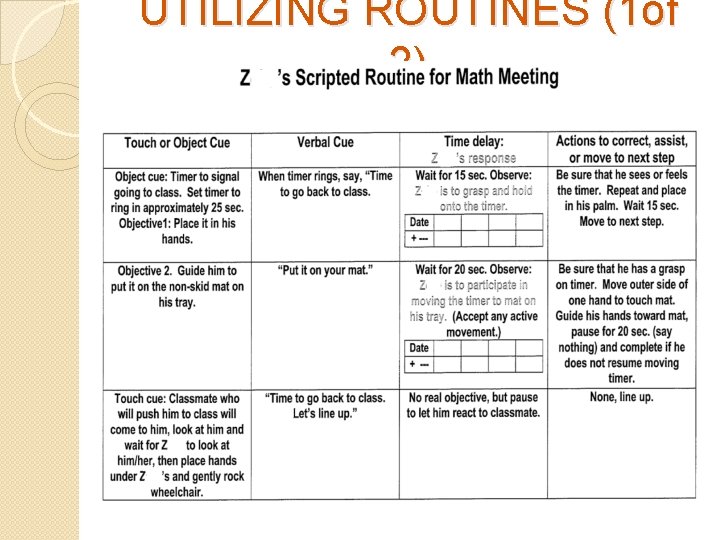
UTILIZING ROUTINES (1 of 2)
UTILIZING ROUTINES (2 of 2) KEY: Create predictability for the learner! MUST have a clear: beginning, middle, & end!
ESSENTIAL TAKE-AWAYS: COMMUNICATIVE INTERVENTION (with learners who are NON-symbolic or use CONCRETE representations) Listen with your eyes, and hands, and heart…. (to develop learner’s expressive skills) & Talk with more than your mouth…. (to develop learner’s receptive skills)
THANK YOU! Susan M. Bashinski 816. 271. 5629 sbashinski@missouriwestern. e du