
Layers of the Cyberstack Lessons for Cybersecurity Peter
“Layers of the Cyberstack: Lessons for Cybersecurity” Peter Swire Huang Professor of Law & Ethics Panel on “Cyber Threats to Business” Academy of Legal Studies of Business August 10, 2017
The Challenge § I have taught law and policy of cybersecurity for 15 years § A challenge for law, policy, and business classes about cybersecurity: § “Real” cybersecurity is about writing code and doing technical work § The “soft” issues are seen as not central to the task of cybersecurity § Vague approval of “inter-disciplinary” studies for cybersecurity § But, with a lower priority than “real” cybersecurity § My remarks today: § A new conceptual framework § Organizes numerous, important, & non-technical cyber-issues § Presents the curriculum and issues in ways that make sense to both technical and non-technical audiences in cybersecurity
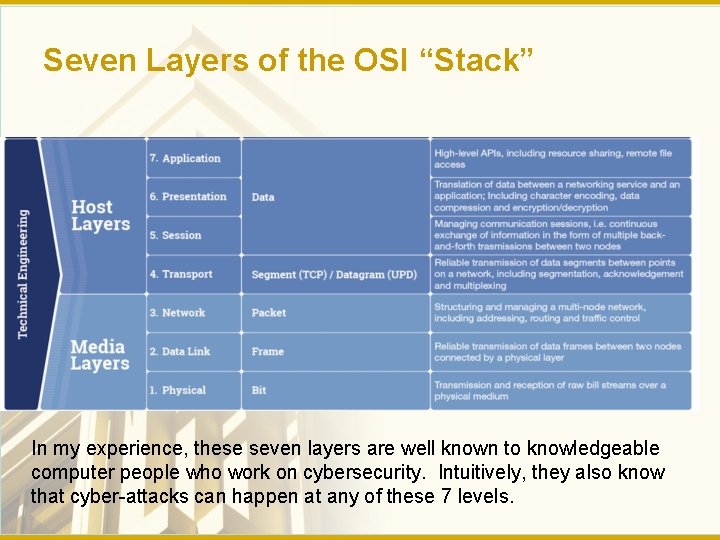
Seven Layers of the OSI “Stack” In my experience, these seven layers are well known to knowledgeable computer people who work on cybersecurity. Intuitively, they also know that cyber-attacks can happen at any of these 7 levels.
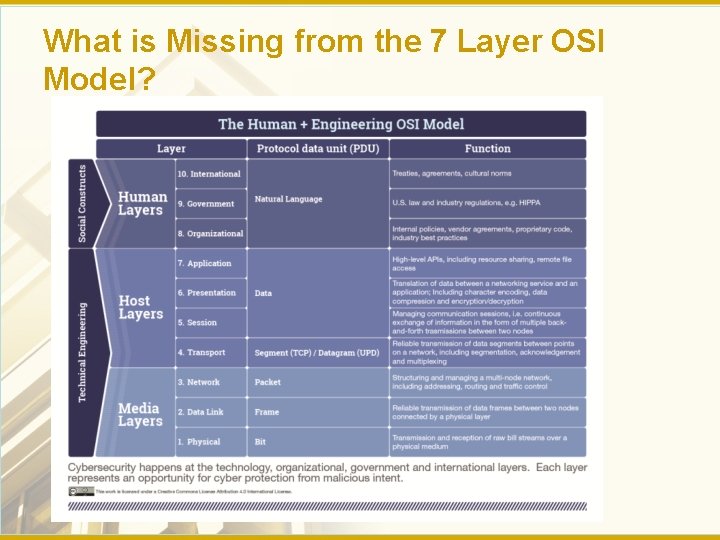
What is Missing from the 7 Layer OSI Model?
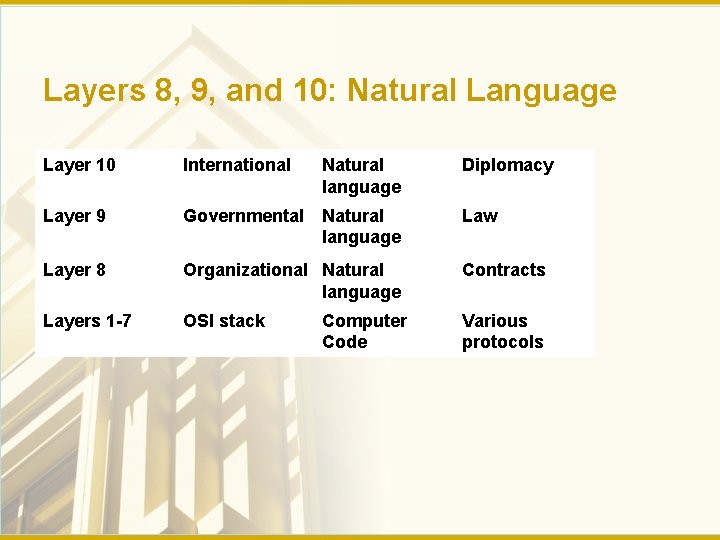
Layers 8, 9, and 10: Natural Language Layer 10 International Natural language Diplomacy Layer 9 Governmental Natural language Law Layer 8 Organizational Natural language Contracts Layers 1 -7 OSI stack Various protocols Computer Code
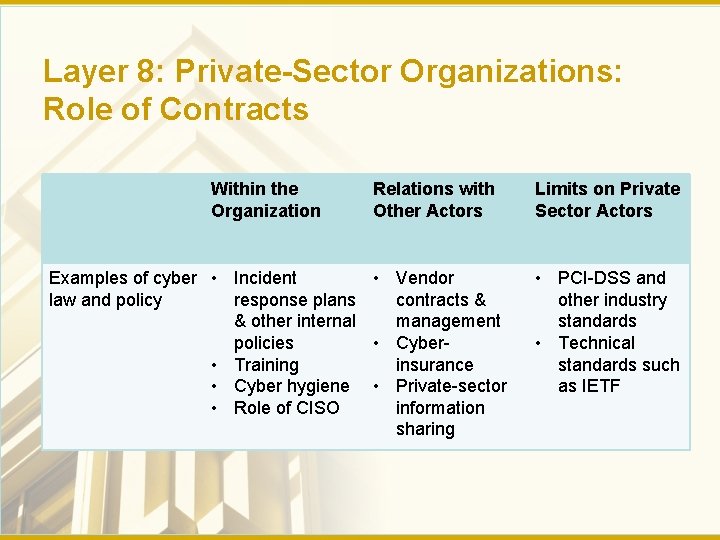
Layer 8: Private-Sector Organizations: Role of Contracts Within the Organization Relations with Other Actors Examples of cyber • Incident • Vendor law and policy response plans contracts & & other internal management policies • Cyber • Training insurance • Cyber hygiene • Private-sector • Role of CISO information sharing Limits on Private Sector Actors • PCI-DSS and other industry standards • Technical standards such as IETF
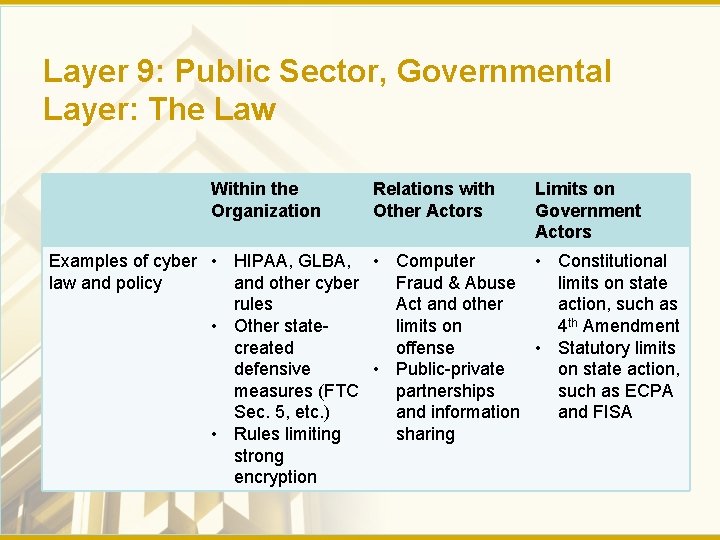
Layer 9: Public Sector, Governmental Layer: The Law Within the Organization Relations with Other Actors Limits on Government Actors Examples of cyber • HIPAA, GLBA, • Computer • Constitutional law and policy and other cyber Fraud & Abuse limits on state rules Act and other action, such as • Other statelimits on 4 th Amendment created offense • Statutory limits defensive • Public-private on state action, measures (FTC partnerships such as ECPA Sec. 5, etc. ) and information and FISA • Rules limiting sharing strong encryption
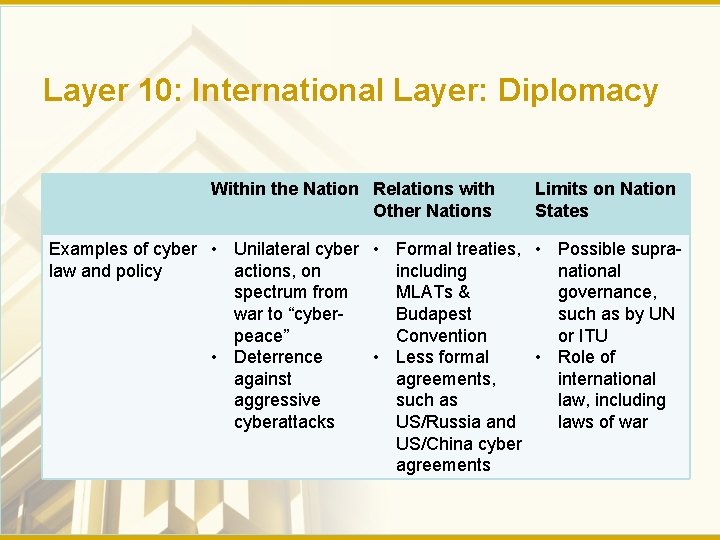
Layer 10: International Layer: Diplomacy Within the Nation Relations with Other Nations Limits on Nation States Examples of cyber • Unilateral cyber • Formal treaties, • Possible supralaw and policy actions, on including national spectrum from MLATs & governance, war to “cyber. Budapest such as by UN peace” Convention or ITU • Deterrence • Less formal • Role of against agreements, international aggressive such as law, including cyberattacks US/Russia and laws of war US/China cyber agreements
Contributions of the 10 -layer stack § Parsimonious structure to organize the numerous issues now crowding into cyber law, policy, and business courses § I have covered every issue in 3 charts in my cyber course § For students and teachers, a way to keep the many issues straight § Attacks can happen at layers 8, 9, and 10, if the company has bad policies, the nation has bad laws, or the international community does not prevent attacks § Vulnerabilities at layers 8, 9, and 10 thus fundamentally similar to vulnerabilities at layers 1 to 7 § Next steps: § Complete the text and diagrams for the 10 layers of the cyberstack – I welcome your comments and suggestions § Apply the 10 layers to privacy and other cyber-issues
- Slides: 9