
Layers of the Atmosphere In our atmosphere temperature
![Works Cited Discovery Education. (2003). Clouds, storm [Image]. Available from http: //www. discoveryeducation. com/](https://slidetodoc.com/presentation_image/1c34b39ac095d1fb602c579c120a4590/image-19.jpg "Works Cited Discovery Education. (2003). Clouds, storm [Image]. Available from http: //www. discoveryeducation. com/")
- Slides: 19
Layers of the Atmosphere In our atmosphere temperature and pressure change with increasing height.
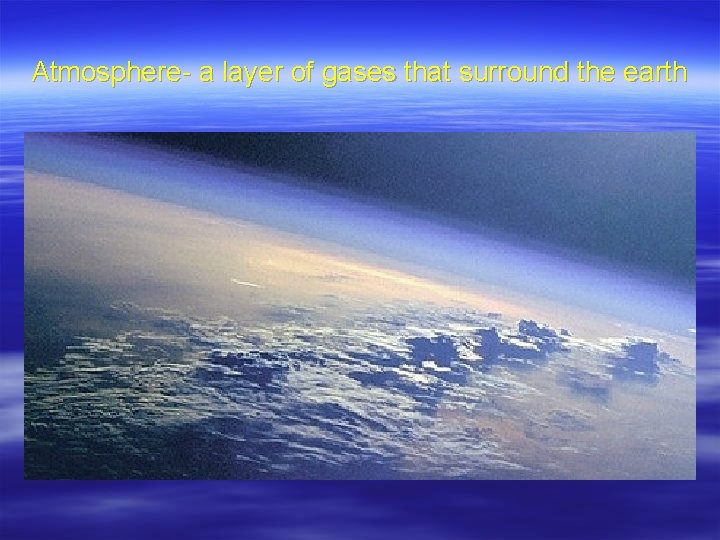
Atmosphere- a layer of gases that surround the earth
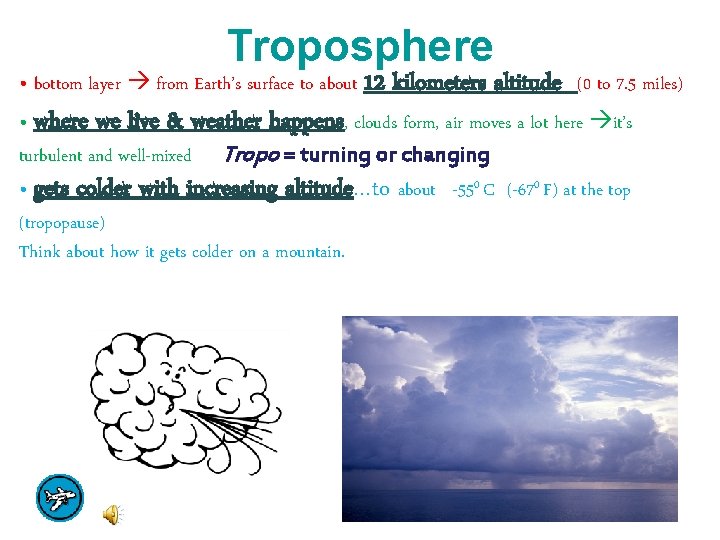
Troposphere • bottom layer from Earth’s surface to about 12 kilometers altitude (0 to 7. 5 miles) • where we live & weather happens, clouds form, air moves a lot here it’s turbulent and well-mixed Tropo = turning or changing • gets colder with increasing altitude…to about -550 C (-670 F) at the top (tropopause) Think about how it gets colder on a mountain.
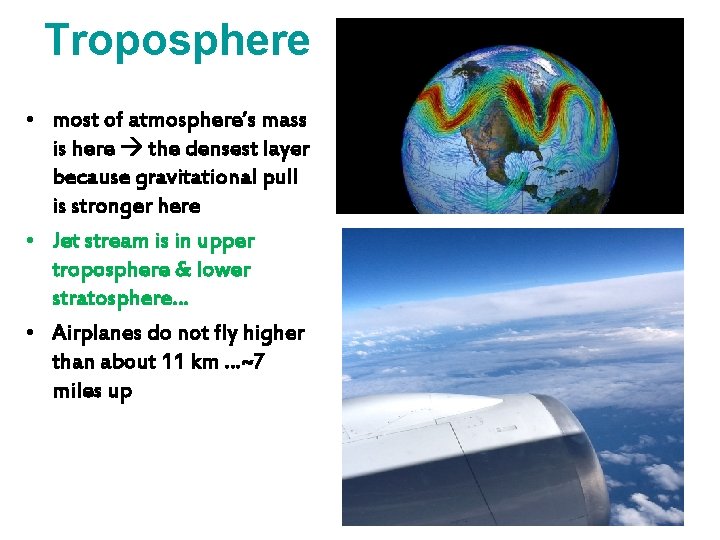
Troposphere • most of atmosphere’s mass is here the densest layer because gravitational pull is stronger here • Jet stream is in upper troposphere & lower stratosphere… • Airplanes do not fly higher than about 11 km …~7 miles up
Video clip about flying in the stratosphere Use my username: kendrewi and password: science to access United Streaming. http: //player. discoveryeducation. com/index. cfm? guid. Asset. Id=D 23 E 822 Hyperlink
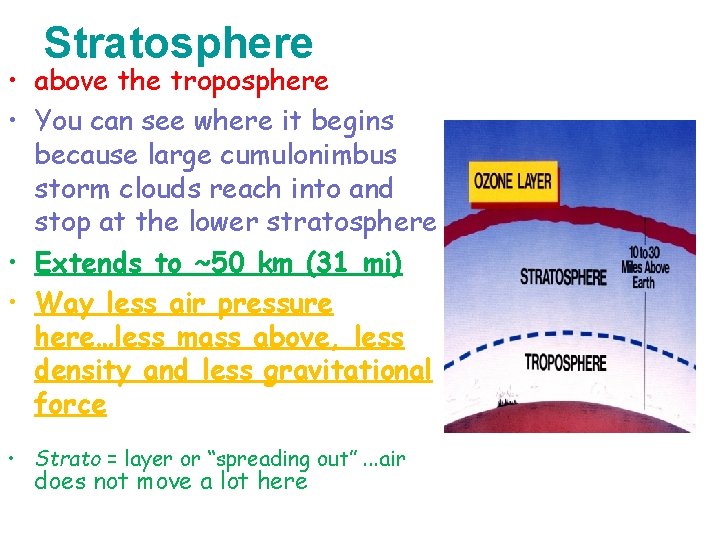
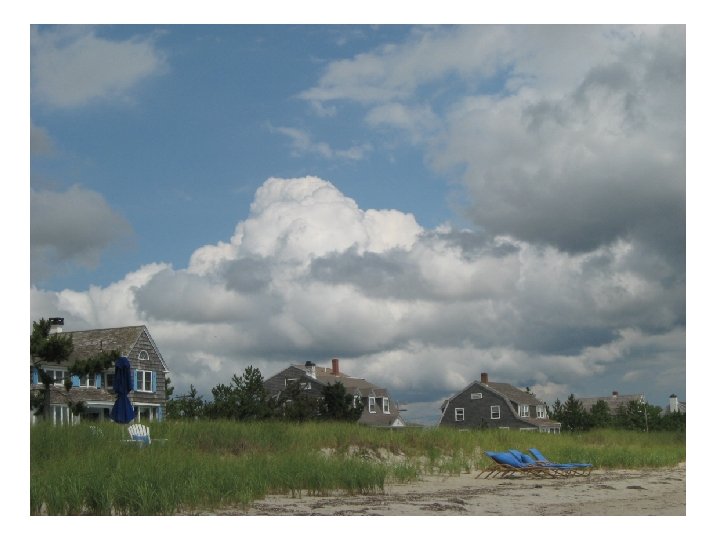
Stratosphere • above the troposphere • You can see where it begins because large cumulonimbus storm clouds reach into and stop at the lower stratosphere • Extends to ~50 km (31 mi) • Way less air pressure here…less mass above, less density and less gravitational force • Strato = layer or “spreading out”. . . air does not move a lot here
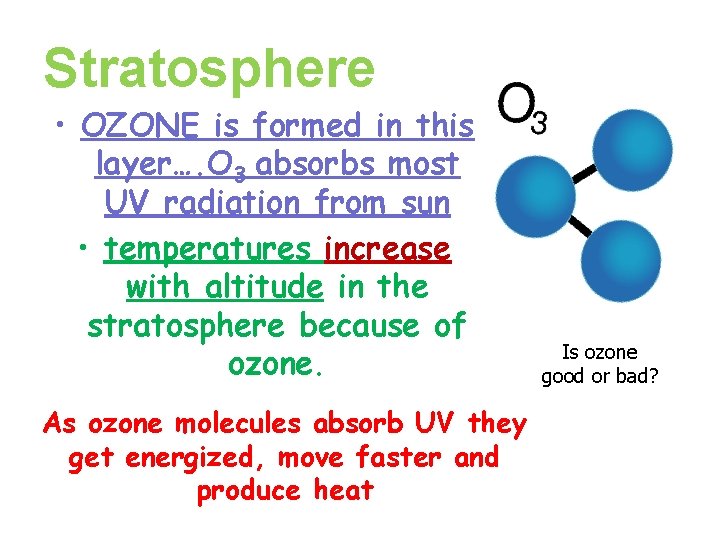
Stratosphere • OZONE is formed in this layer…. O 3 absorbs most UV radiation from sun • temperatures increase with altitude in the stratosphere because of ozone. As ozone molecules absorb UV they get energized, move faster and produce heat Is ozone good or bad?
Video clip about ozone! http: //player. discoveryeducation. com/index. cfm? guid. Asset. Id=E 320368 D-9247 -4 FDC-9949 -3 B 7 E 8983 E 67 E&bln. From. Search=1&productcode=DSC
Mesosphere • ~50 -90 km (31 – 50 mi) • meso = middle • 99. 9% of mass lies below the mesosphere • Not enough oxygen to breathe but % is still the same (What % is that? ) • Most meteoroids burn up here…. the air is very thin, but still dense enough to slow down meteoroids due because of friction
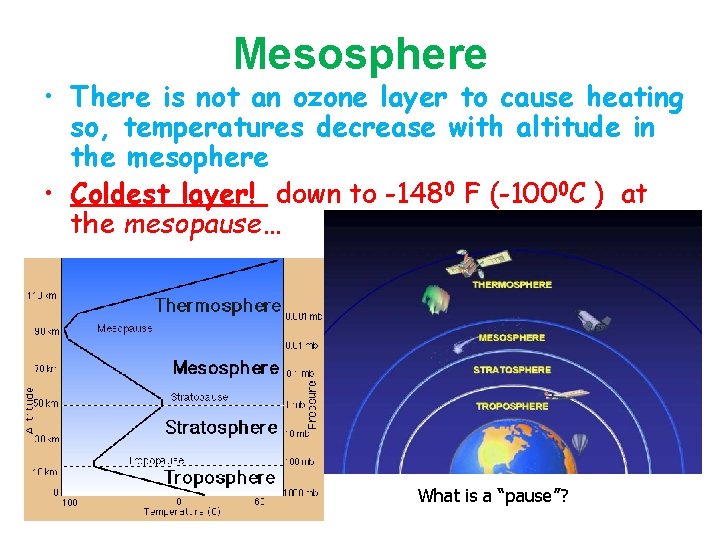
Mesosphere • There is not an ozone layer to cause heating so, temperatures decrease with altitude in the mesophere • Coldest layer! down to -1480 F (-1000 C ) at the mesopause… What is a “pause”?
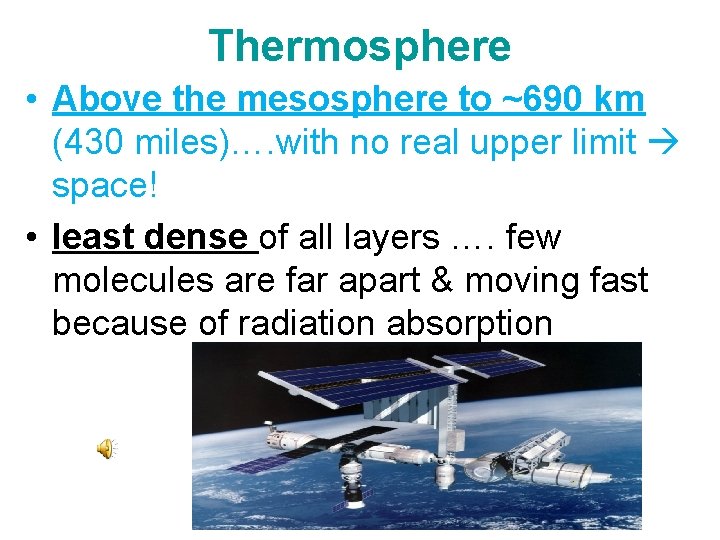
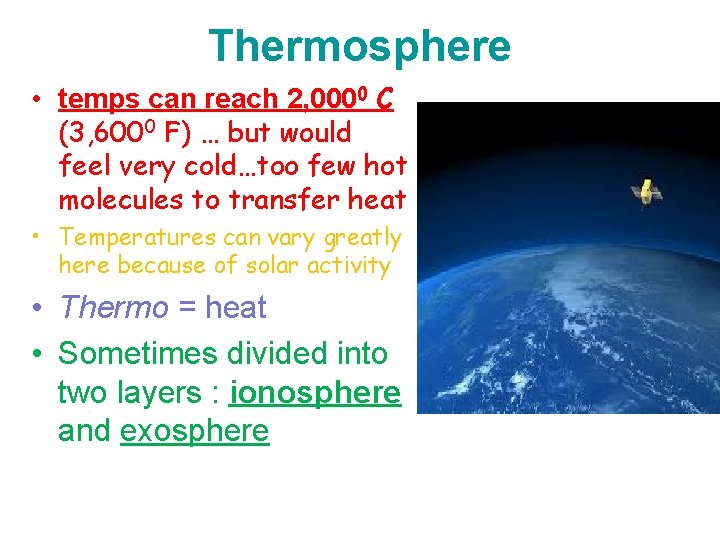
Thermosphere • Above the mesosphere to ~690 km (430 miles)…. with no real upper limit space! • least dense of all layers …. few molecules are far apart & moving fast because of radiation absorption
Thermosphere • temps can reach 2, 0000 C (3, 6000 F) … but would feel very cold…too few hot molecules to transfer heat • Temperatures can vary greatly here because of solar activity • Thermo = heat • Sometimes divided into two layers : ionosphere and exosphere
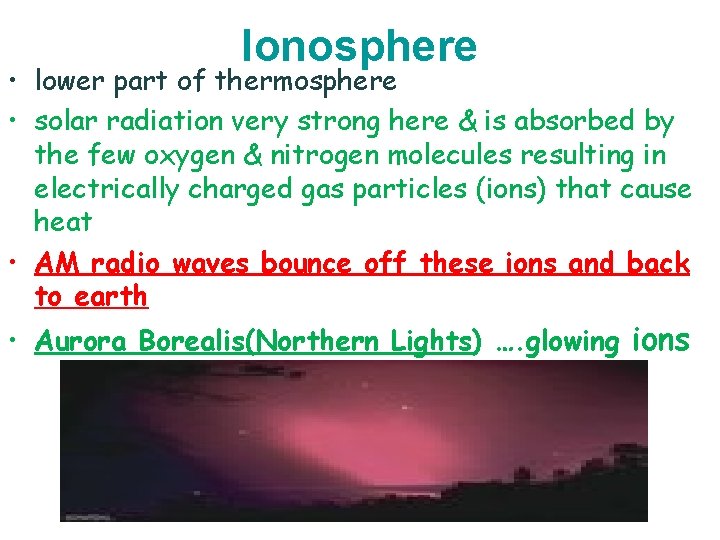
Ionosphere • lower part of thermosphere • solar radiation very strong here & is absorbed by the few oxygen & nitrogen molecules resulting in electrically charged gas particles (ions) that cause heat • AM radio waves bounce off these ions and back to earth • Aurora Borealis(Northern Lights) …. glowing ions
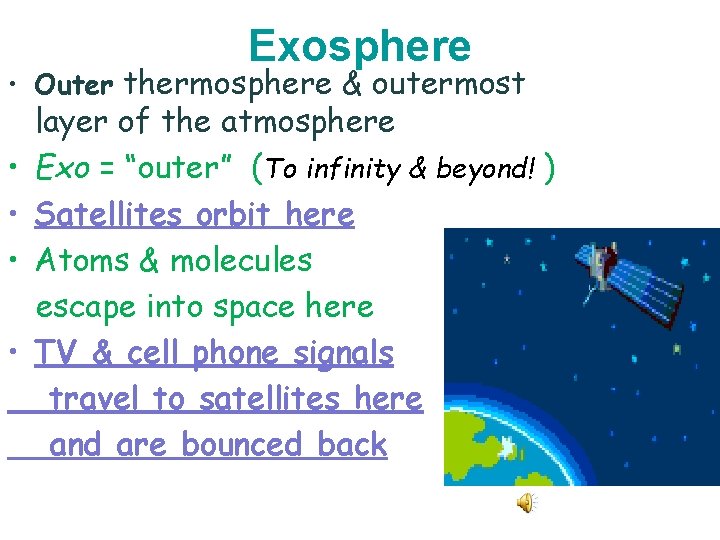
Exosphere • Outer thermosphere & outermost • • layer of the atmosphere Exo = “outer” (To infinity & beyond! ) Satellites orbit here Atoms & molecules escape into space here TV & cell phone signals travel to satellites here and are bounced back
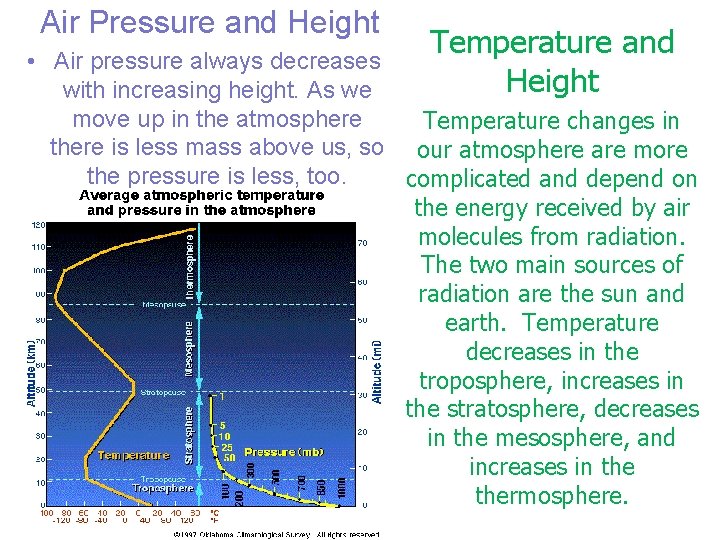
Air Pressure and Height Temperature and Height • Air pressure always decreases with increasing height. As we move up in the atmosphere Temperature changes in there is less mass above us, so our atmosphere are more the pressure is less, too. complicated and depend on the energy received by air molecules from radiation. The two main sources of radiation are the sun and earth. Temperature decreases in the troposphere, increases in the stratosphere, decreases in the mesosphere, and increases in thermosphere.
Click Links below: • National Geographic Northern Lights • Mr. Parr - Atmosphere Song
Layers of the Atmosphere http: //player. discoveryeducation. com/index. cfm? guid. Asset. Id=BDC 06 C 08 -C 65 C-4253 -8449 -54 B 948 C 963 DA
Works Cited Discovery Education. (2003). Clouds, storm [Image]. Available from http: //www. discoveryeducation. com/ Discovery Education. (2010). Illustration of U. S. Space Station in orbit [Image]. Available from http: //www. discoveryeducation. com/ York Films. (2003). All About Auroras: Natures Light Show [Video Segment]. Available from http: //www. discoveryeducation. com/ Discovery Education. (2010). Aurora borealis [Image]. Available from http: //www. discoveryeducation. com/ Discovery Education. (2004). Flying in Earth's Stratosphere [Video Segment]. Available from http: //www. discoveryeducation. com/ Discovery Education. (2004). Ozone layer, location in atmosphere of [Image]. Available from http: //www. discoveryeducation. com/ Paul Fuqua. (1993). Ozone: Harmful and Helpful [Video Segment]. Available from http: //www. discoveryeducation. com/ Discovery Education. (2005). Elements of Earth Science: Earth's Atmosphere, Weather, and Climate [Full Video]. Available from http: //www. discoveryeducation. com/