
Layers of Product Concept 8 1 The Core
- Slides: 51
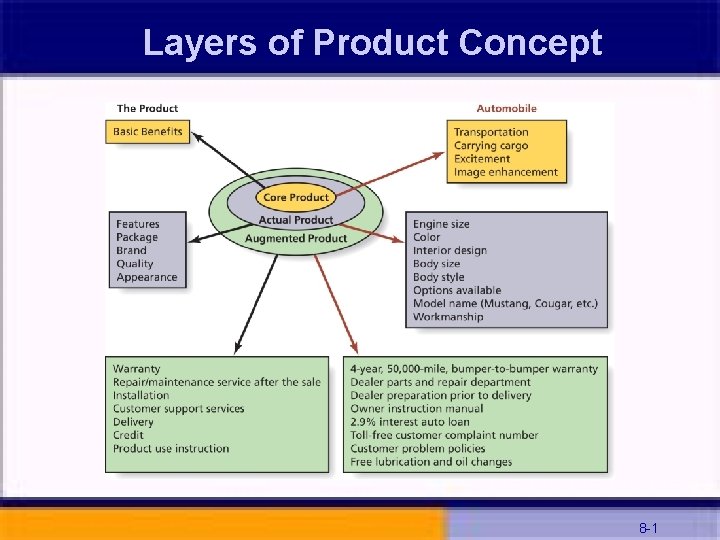
Layers of Product Concept 8 -1
The Core Product • Consists of all the benefits the product will provide for consumers or business customers • A customer purchases a 1/2” drill bit. What does s/he want? – A 1/2” hole! • Marketing is about supplying benefits, not products. 8 -2
The Actual Product • Consists of the physical good or delivered service that supplies the desired benefit • Example: – A washing machine’s core product is the ability to get clothes clean, but the actual product is a large, square, metal apparatus • Actual product also includes appearance, styling, packaging, and the brand 8 -3
The Augmented Product • Consists of the actual product plus other supporting features such as warranty, credit, delivery, installation, and repair service after the sale 8 -4
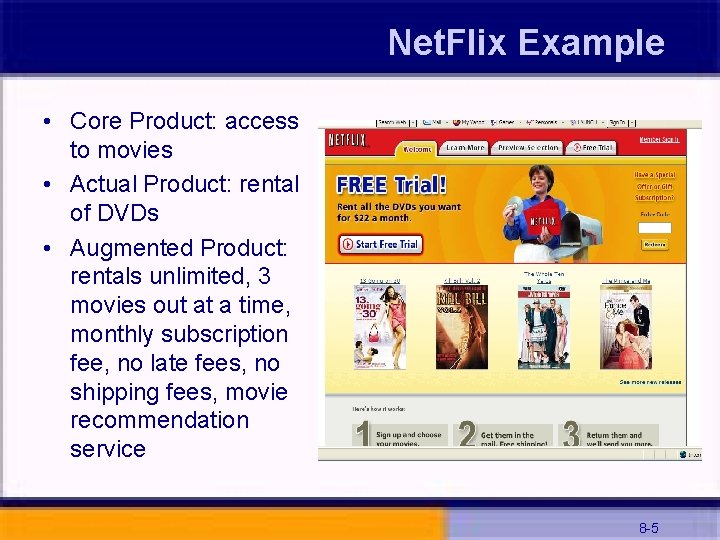
Net. Flix Example • Core Product: access to movies • Actual Product: rental of DVDs • Augmented Product: rentals unlimited, 3 movies out at a time, monthly subscription fee, no late fees, no shipping fees, movie recommendation service 8 -5
Classifying Consumer Products • By how long they last – Durable – Nondurable • By how consumers buy them – Convenience – Shopping – Specialty – Unsought 8 -6
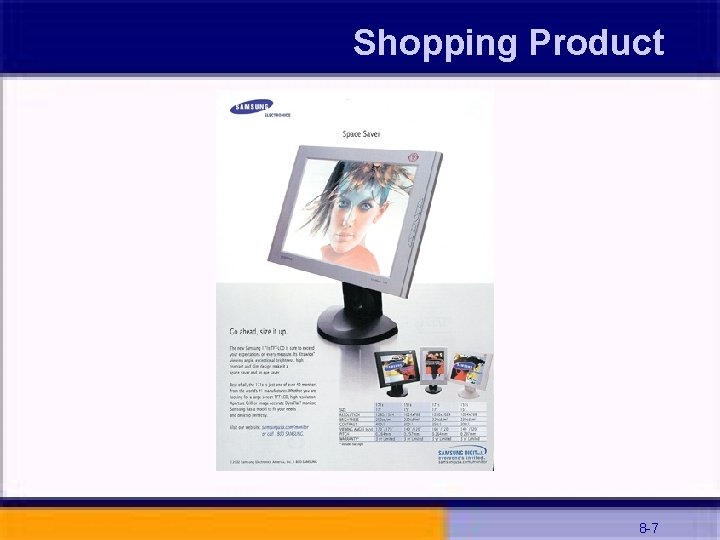
Shopping Product 8 -7
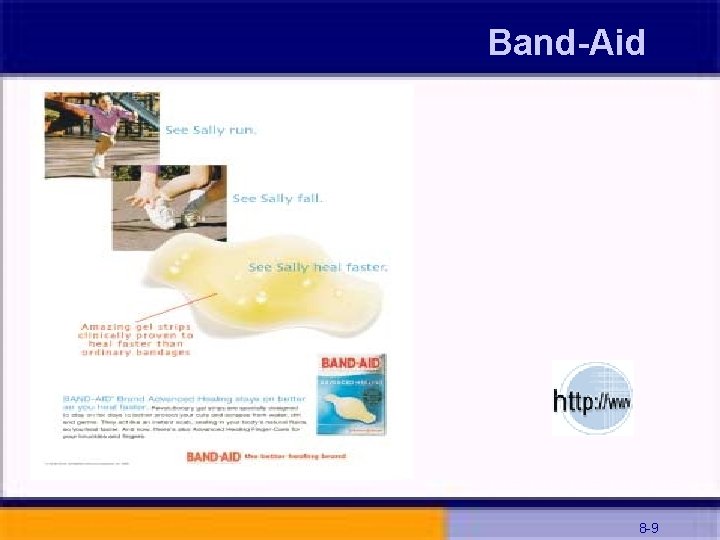
Convenience Products • Good or service that consumers purchase frequently with a minimum of comparison and effort • Types of convenience products – staples – impulse products – emergency products 8 -8
Band-Aid 8 -9
Shopping Products • Good or service for which consumers will spend time and effort gathering information on price, product attributes, and product quality • Consumers will tend to compare alternatives before making a purchase • Types of shopping products – attribute-based shopping products – price-based shopping products 8 -10
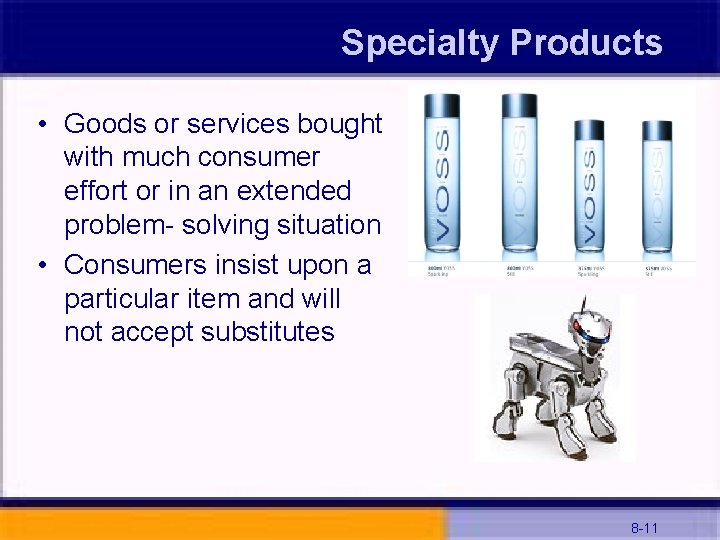
Specialty Products • Goods or services bought with much consumer effort or in an extended problem- solving situation • Consumers insist upon a particular item and will not accept substitutes 8 -11
Unsought Products • Goods or services for which a consumer has little awareness or interest until a need arises • Require a good deal of advertising or personal selling to interest people 8 -12
It’s New and Improved • What is a new product? – According to the FTC, a new product is one that is entirely new or changed significantly and that product may be called new for only six months – From a marketing perspective, new is anything a customer perceives as new and different 8 -13
Life-Changing Innovations • • CD Photocopier Fax Cell phone Post-it Notes Air conditioner Microwave What is your favorite life-changing innovation? 8 -14
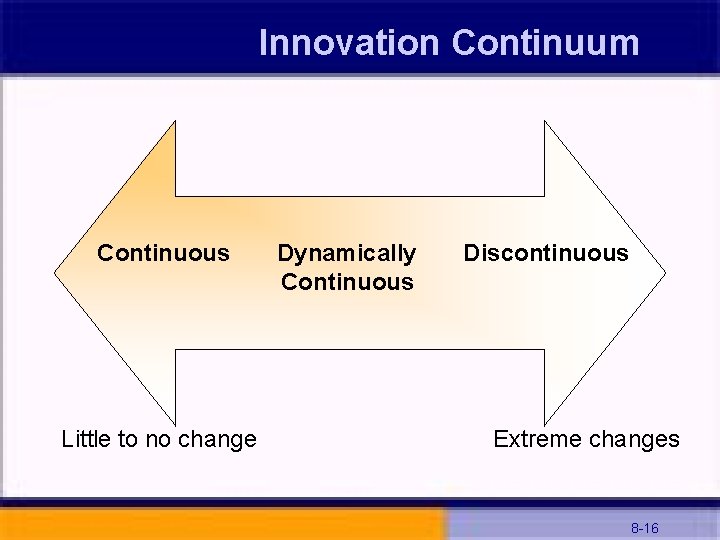
Types of Innovations • Innovations differ in their degree of newness and this helps to determine how quickly products will be adopted by a target market • The more novel the innovation, the slower the diffusion process • Innovation continuum is based on the amount of disruption or change 8 -15
Innovation Continuum Continuous Little to no change Dynamically Continuous Discontinuous Extreme changes 8 -16
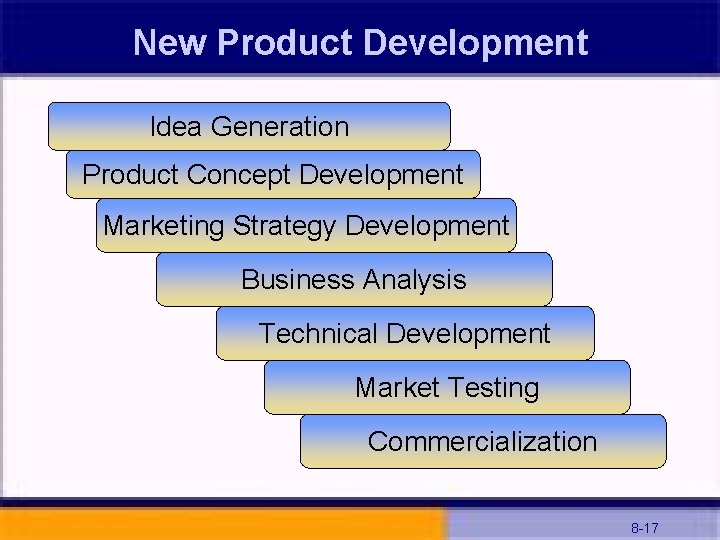
New Product Development Idea Generation Product Concept Development Marketing Strategy Development Business Analysis Technical Development Market Testing Commercialization 8 -17
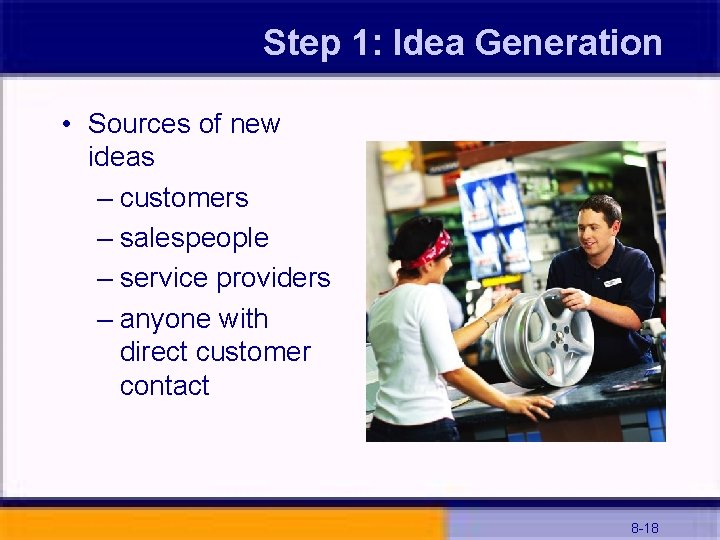
Step 1: Idea Generation • Sources of new ideas – customers – salespeople – service providers – anyone with direct customer contact 8 -18
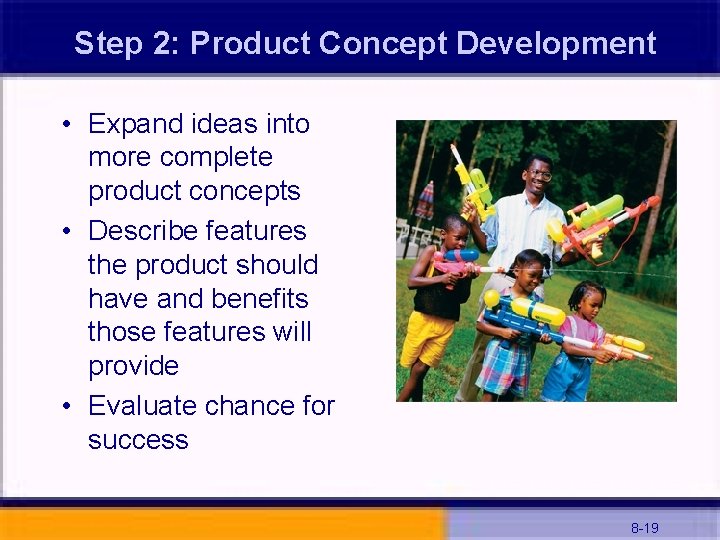
Step 2: Product Concept Development • Expand ideas into more complete product concepts • Describe features the product should have and benefits those features will provide • Evaluate chance for success 8 -19
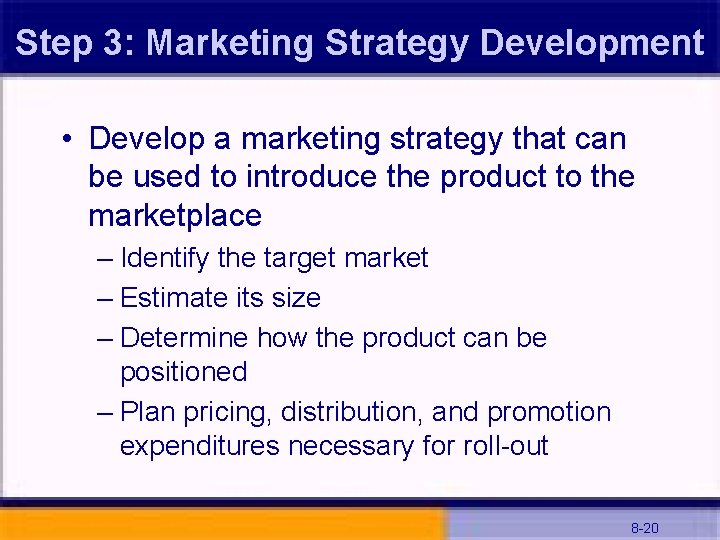
Step 3: Marketing Strategy Development • Develop a marketing strategy that can be used to introduce the product to the marketplace – Identify the target market – Estimate its size – Determine how the product can be positioned – Plan pricing, distribution, and promotion expenditures necessary for roll-out 8 -20
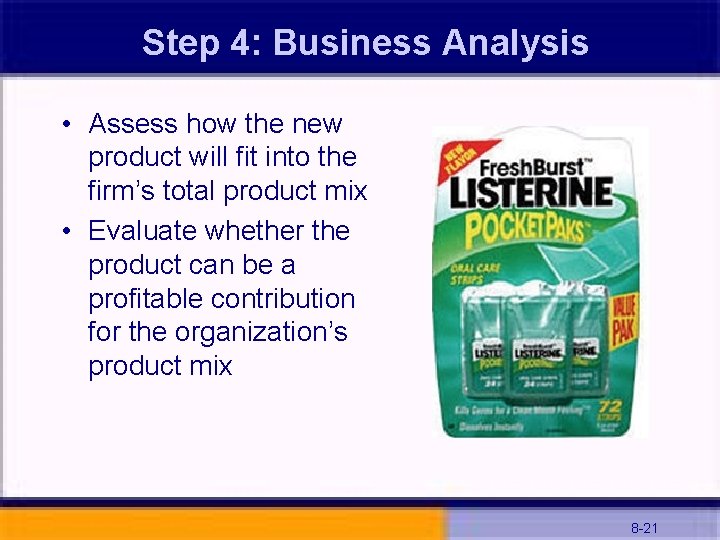
Step 4: Business Analysis • Assess how the new product will fit into the firm’s total product mix • Evaluate whether the product can be a profitable contribution for the organization’s product mix 8 -21
Step 5: Technical Development • Work with engineers to refine the design and production process • Develop one or more prototypes • Evaluate prototypes with prospective customers • If applicable, apply for a patent 8 -22
Market Testing • Try out the complete marketing plan (product, price, place, and promotion) in a small geographic area that is similar to larger target market – Traditional test marketing is expensive and gives competition a chance to evaluate the new product – Simulated test markets eliminate competitive viewing and cost less 8 -23
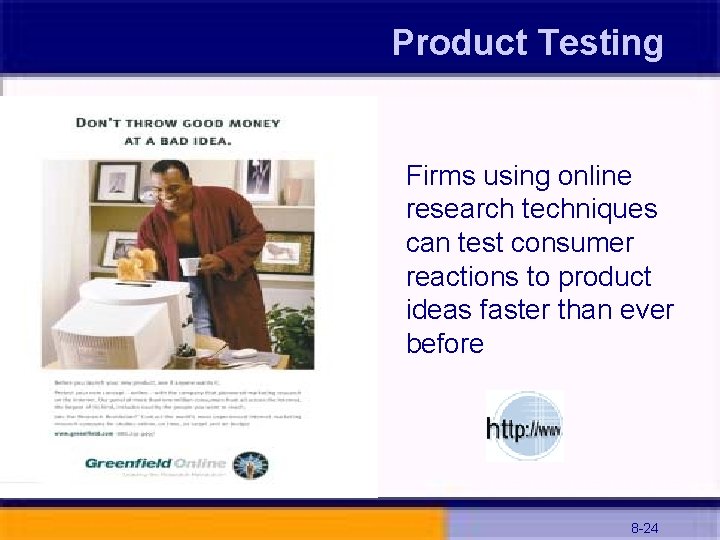
Product Testing Firms using online research techniques can test consumer reactions to product ideas faster than ever before 8 -24
Commercialization • Launch the product! – Full-scale production – Distribution – Advertising – Sales promotion – and more 8 -25
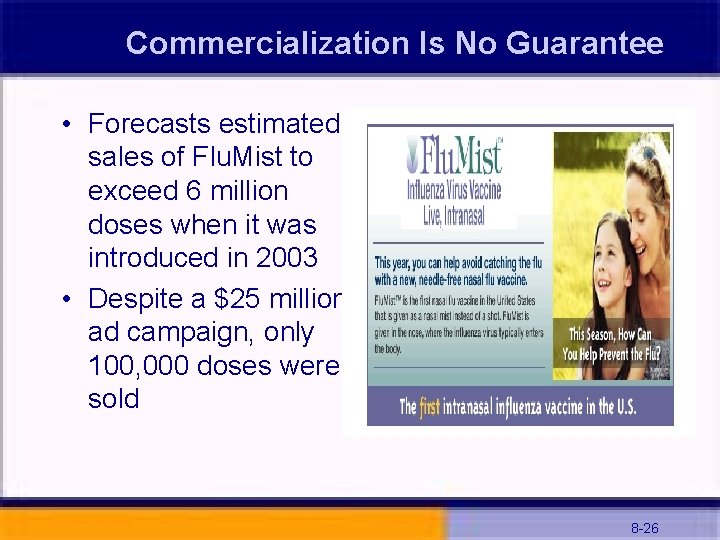
Commercialization Is No Guarantee • Forecasts estimated sales of Flu. Mist to exceed 6 million doses when it was introduced in 2003 • Despite a $25 million ad campaign, only 100, 000 doses were sold 8 -26
Adoption and Diffusion Processes • Adoption is the process by which a consumer or business customer begins to buy and use a new good, service, or idea • Diffusion describes how the use of a product spreads throughout a population 8 -27
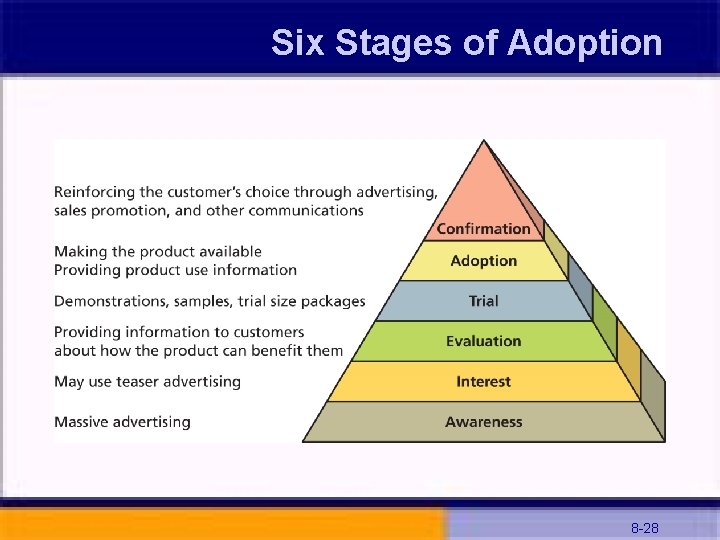
Six Stages of Adoption 8 -28
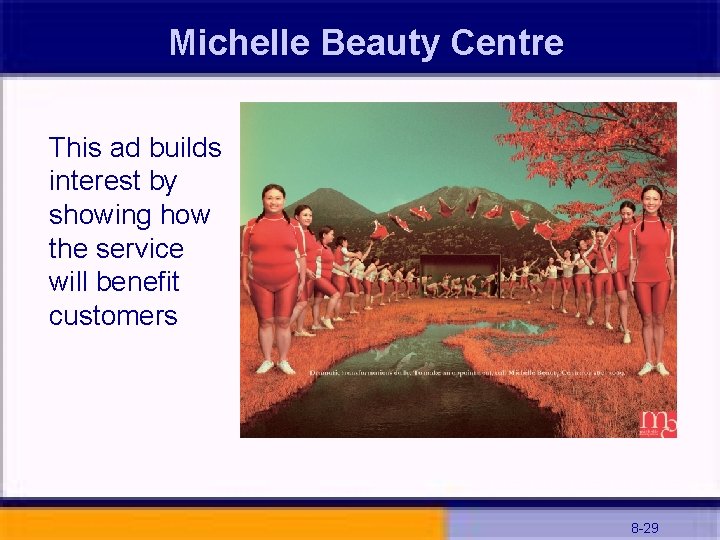
Michelle Beauty Centre This ad builds interest by showing how the service will benefit customers 8 -29
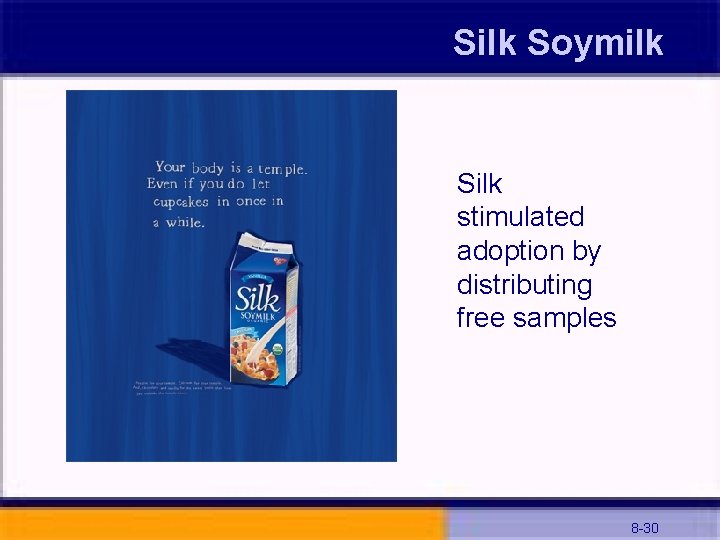
Silk Soymilk Silk stimulated adoption by distributing free samples 8 -30
Diffusion Process • Concerned with the broader issue of how an innovation is communicated and adopted throughout the marketplace • The process of spreading out 8 -31
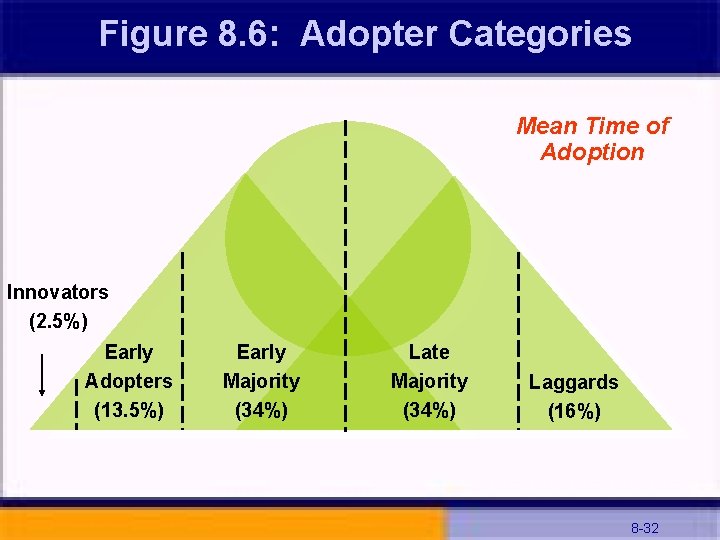
Figure 8. 6: Adopter Categories Mean Time of Adoption Innovators (2. 5%) Early Adopters (13. 5%) Early Majority (34%) Late Majority (34%) Laggards (16%) 8 -32
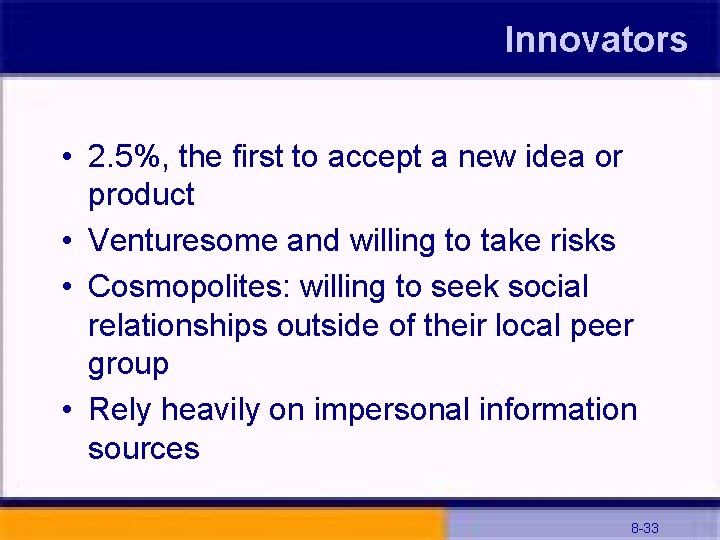
Innovators • 2. 5%, the first to accept a new idea or product • Venturesome and willing to take risks • Cosmopolites: willing to seek social relationships outside of their local peer group • Rely heavily on impersonal information sources 8 -33
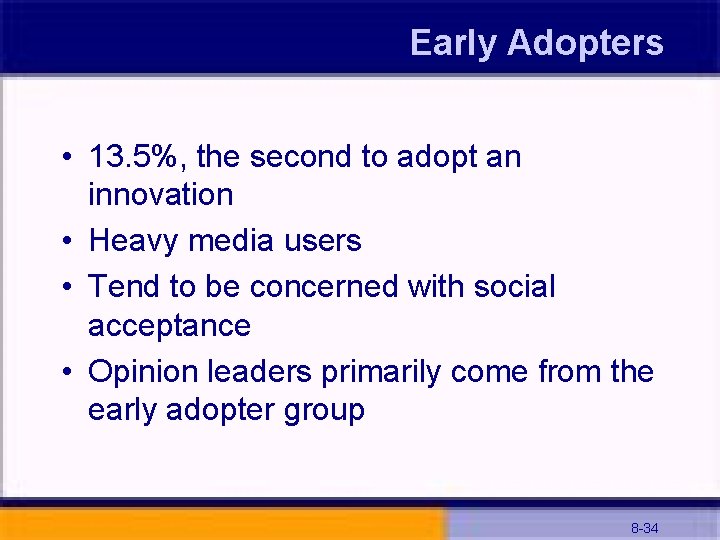
Early Adopters • 13. 5%, the second to adopt an innovation • Heavy media users • Tend to be concerned with social acceptance • Opinion leaders primarily come from the early adopter group 8 -34
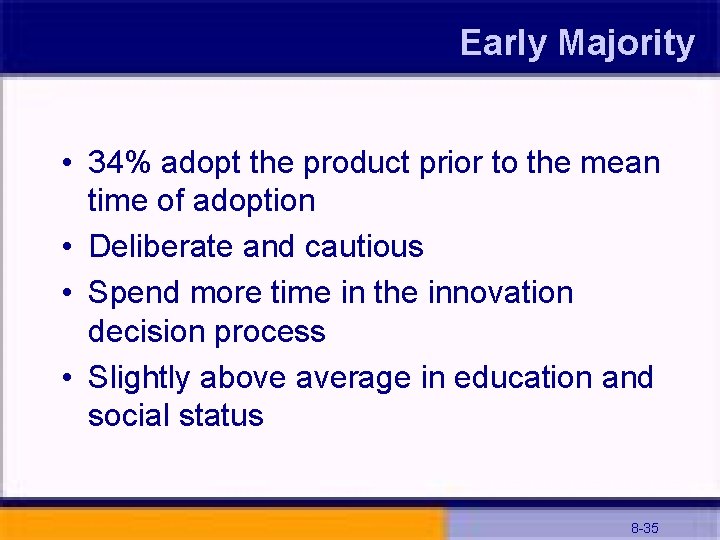
Early Majority • 34% adopt the product prior to the mean time of adoption • Deliberate and cautious • Spend more time in the innovation decision process • Slightly above average in education and social status 8 -35
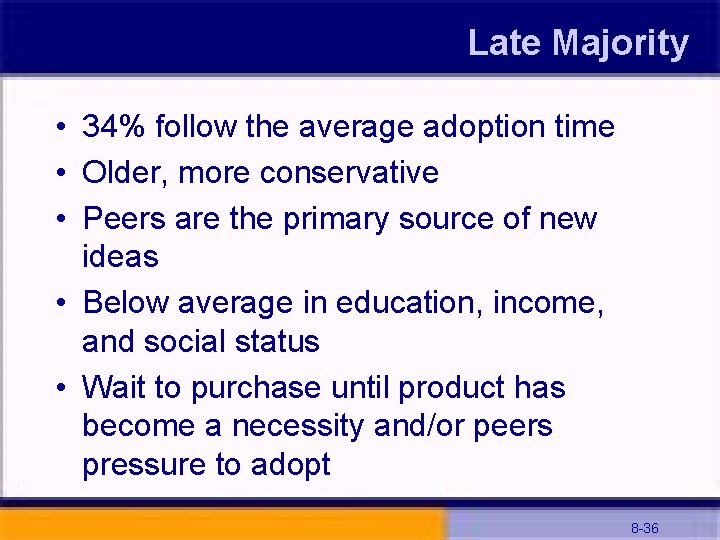
Late Majority • 34% follow the average adoption time • Older, more conservative • Peers are the primary source of new ideas • Below average in education, income, and social status • Wait to purchase until product has become a necessity and/or peers pressure to adopt 8 -36
Laggards • 16% - last to adopt an innovation • Lower in social class than other categories • Bound by tradition • Product may have already been replaced by another innovation 8 -37
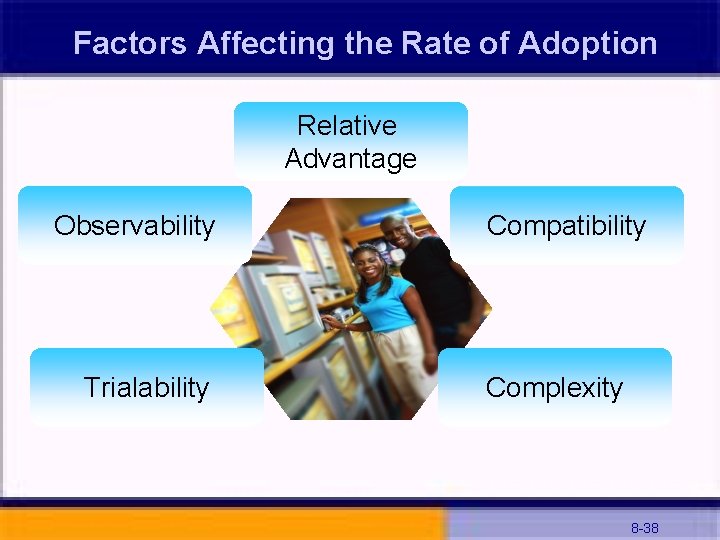
Factors Affecting the Rate of Adoption Relative Advantage Observability Trialability Compatibility Complexity 8 -38
Relative Advantage • A product innovation is perceived as better than existing alternatives • Positively correlated with an innovation’s adoption rate • Exist when a new product offers: – Better performance, increased comfort, saving in time and effort, or immediacy of reward 8 -39
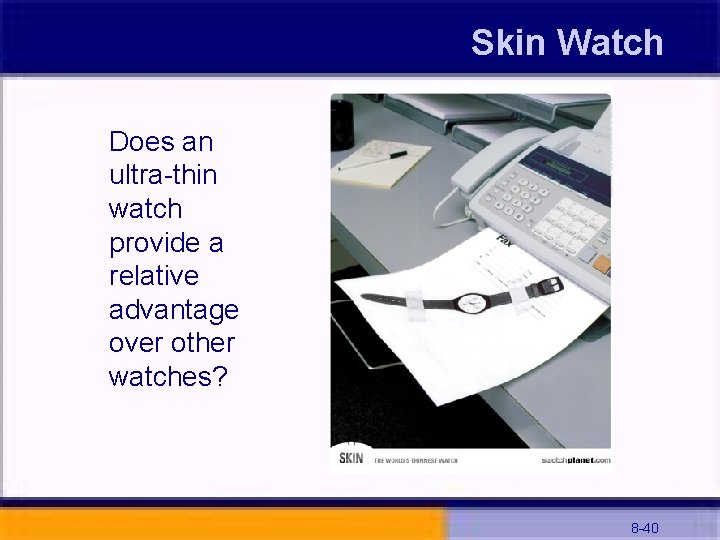
Skin Watch Does an ultra-thin watch provide a relative advantage over other watches? 8 -40
Compatibility • An innovation is perceived to fit into a person’s way of doing things • The greater compatibility, the more rapid a product’s rate of adoption • Overcome perception of incompatibility through heavy advertising to persuade consumers 8 -41
Complexity • The more complex the product, the more slowly a product’s rate of adoption • Overcome perception of complexity with demonstrations, personal selling, and emphasis on ease of use 8 -42
Trialability • An innovation can be used on a limited basis prior to making a full-blown commitment • The trial experience serves to reduce the risk of a consumer’s being dissatisfied with a product after having permanently committed to it through outright purchase 8 -43
Observability • The product user or other people can observe the positive effects of new product usage • The higher the visibility, the more rapid the adoption rate 8 -44
B 2 B Adoption Factors • Increase in gross margin and profits • Consistency with firm’s way of doing business • Benefit relative to required investment 8 -45
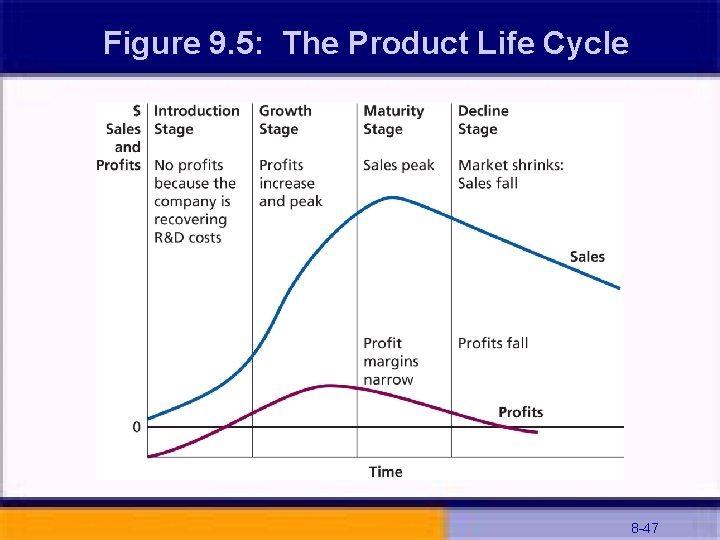
Marketing Throughout the PLC • The Product Life Cycle (PLC) explains how features change over the life of a product • Marketing strategies must change and evolve as a product moves through the PLC • The PLC relates to a product category 8 -46
Figure 9. 5: The Product Life Cycle 8 -47
Introduction • Full-scale launch of new product into marketplace • Sales are low, high failure rate • Little competition • Frequent product modification • Limited distribution • High marketing and product costs • Promotion focused on product awareness and to stimulate primary demand • Intensive personal selling to retailers and wholesalers 8 -48
Growth • Sales grow at an increasing rate • Many competitors enter market • Large companies may acquire small pioneering firms • Profits are healthy • Promotion emphasizes brand advertising and comparative ads • Wider distribution • Toward end of growth stage, prices fall • Sales volume creates economies of scale 8 -49
Maturity • Sales continue to increase but at a decreasing rate • Marketplace is approaching saturation • Typified by annual models of products with an emphasis on style rather than function • Product lines are widened or extended • Marginal competitors drop out • Heavy promotions - sales promotions • Prices and profits fall 8 -50
Decline • Signaled by a long-run drop in sales • Rate of decline is governed by how rapidly consumer tastes change or how rapidly substitute products are adopted • Falling demand forces many out of market • Few specialty firms left 8 -51