
LayerbyLayer Electrostatic Self Assembly at the Industrial Scale
Layer-by-Layer Electrostatic Self. Assembly at the Industrial Scale Lee Boman, Chris Stoessel, Kevin Krogman, Tara Cary Eastman Chemical Company AIMCAL R 2 R Conference
Agenda § Layer-by-Layer (Lb. L) - What is it and how it works § Lb. L - Applications § Lb. L - Scale-up § Questions
Layer by Layer What is it and How Does it Work
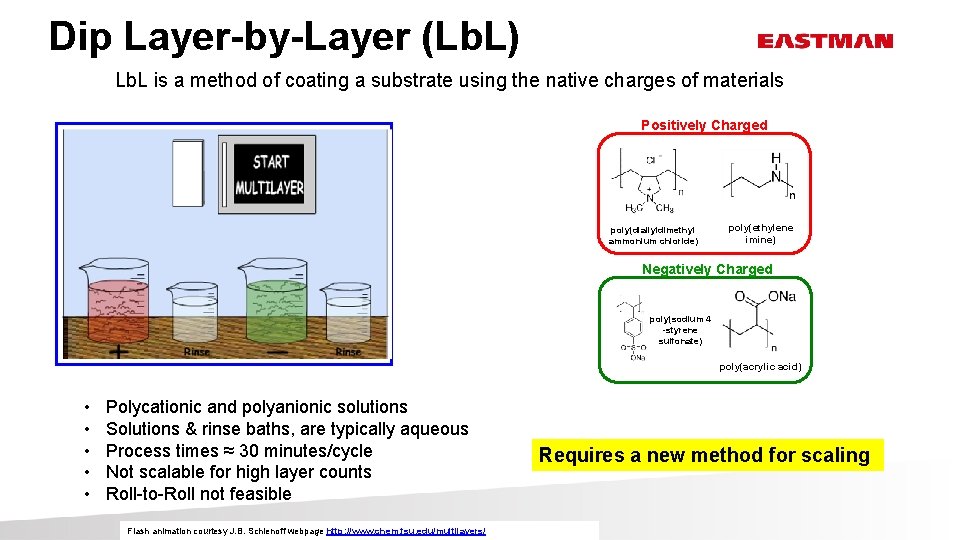
Dip Layer-by-Layer (Lb. L) Lb. L is a method of coating a substrate using the native charges of materials Positively Charged poly(diallyldimethyl ammonium chloride) poly(ethylene imine) Negatively Charged poly(sodium 4 -styrene sulfonate) poly(acrylic acid) • • • Polycationic and polyanionic solutions Solutions & rinse baths, are typically aqueous Process times ≈ 30 minutes/cycle Not scalable for high layer counts Roll-to-Roll not feasible Flash animation courtesy J. B. Schlenoff webpage http: //www. chem. fsu. edu/multilayers/ Requires a new method for scaling
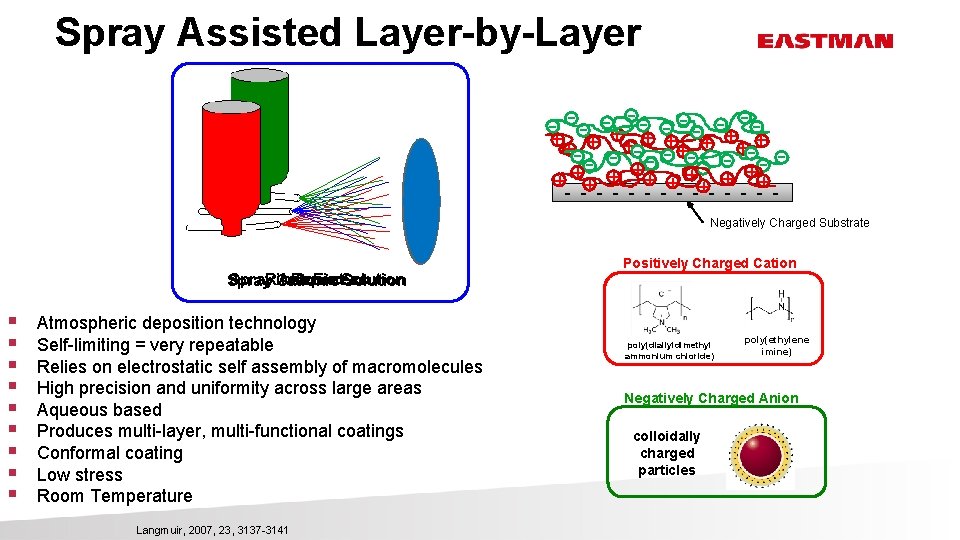
Spray Assisted Layer-by-Layer + + ++ + ++ - - - - Negatively Charged Substrate Spray Anionic Solution Rinse Excess Repeat Spray Cationic Solution § § § § § Atmospheric deposition technology Self-limiting = very repeatable Relies on electrostatic self assembly of macromolecules High precision and uniformity across large areas Aqueous based Produces multi-layer, multi-functional coatings Conformal coating Low stress Room Temperature Langmuir, 2007, 23, 3137 -3141 Positively Charged Cation poly(diallyldimethyl ammonium chloride) poly(ethylene imine) Negatively Charged Anion colloidally charged particles
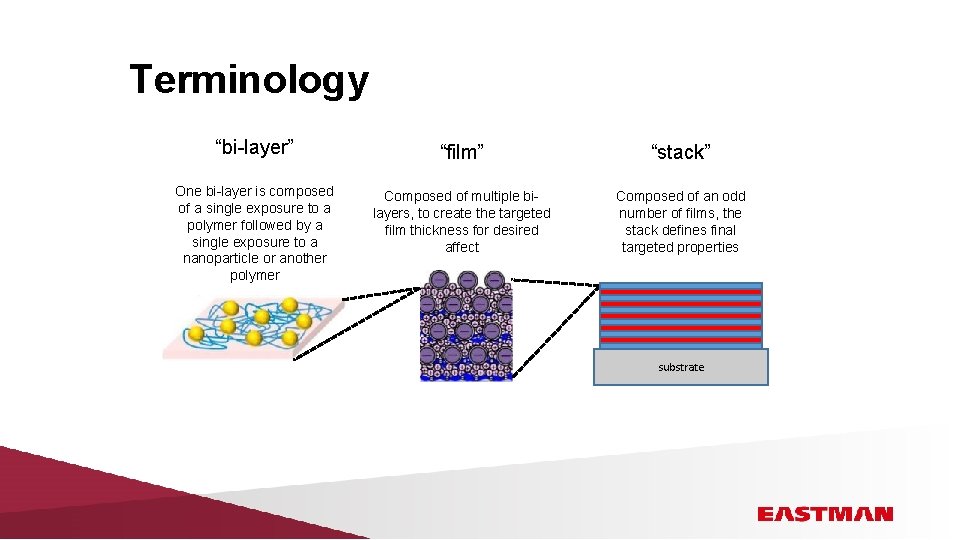
Terminology “bi-layer” “film” “stack” One bi-layer is composed of a single exposure to a polymer followed by a single exposure to a nanoparticle or another polymer Composed of multiple bilayers, to create the targeted film thickness for desired affect Composed of an odd number of films, the stack defines final targeted properties substrate
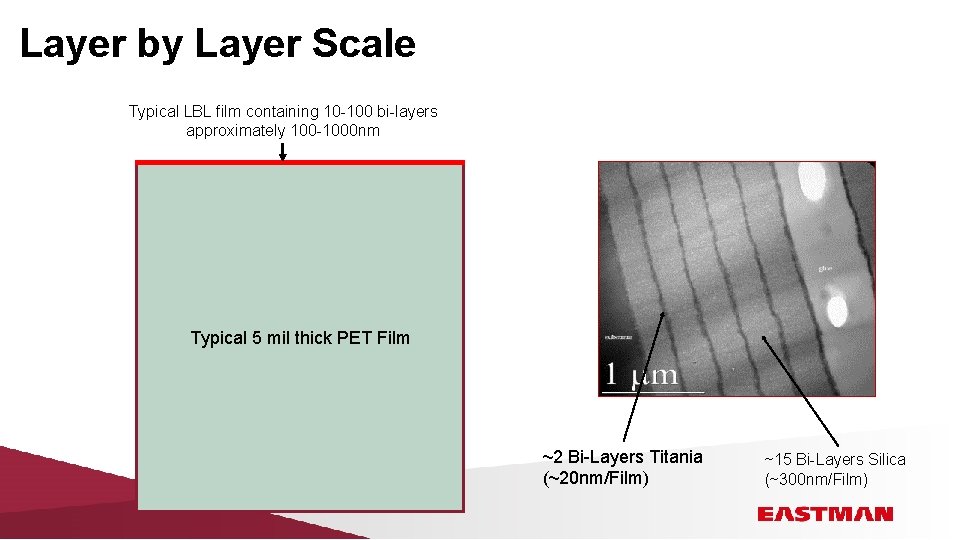
Layer by Layer Scale Typical LBL film containing 10 -100 bi-layers approximately 100 -1000 nm Typical 5 mil thick PET Film ~2 Bi-Layers Titania (~20 nm/Film) ~15 Bi-Layers Silica (~300 nm/Film)
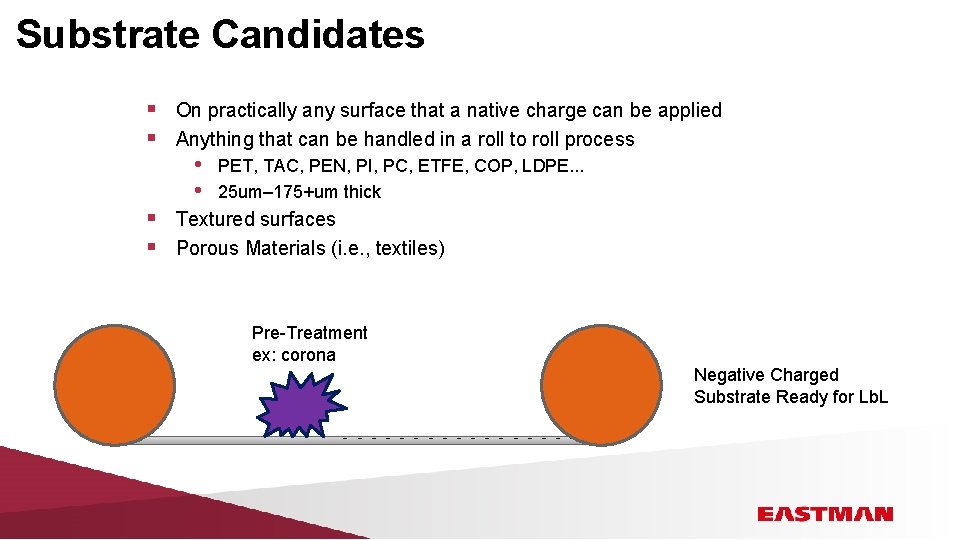
Substrate Candidates On practically any surface that a native charge can be applied Anything that can be handled in a roll to roll process • • § § PET, TAC, PEN, PI, PC, ETFE, COP, LDPE. . . 25 um– 175+um thick Textured surfaces Porous Materials (i. e. , textiles) Pre-Treatment ex: corona Negative Charged Substrate Ready for Lb. L - - - - - § §
Layer by Layer Applications
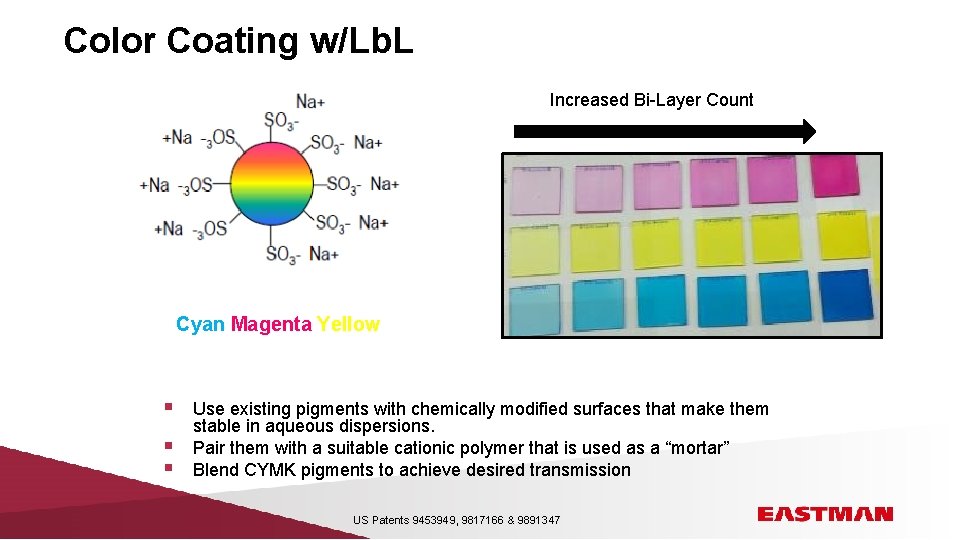
Color Coating w/Lb. L Increased Bi-Layer Count Cyan Magenta Yellow § § § Use existing pigments with chemically modified surfaces that make them stable in aqueous dispersions. Pair them with a suitable cationic polymer that is used as a “mortar” Blend CYMK pigments to achieve desired transmission US Patents 9453949, 9817166 & 9891347
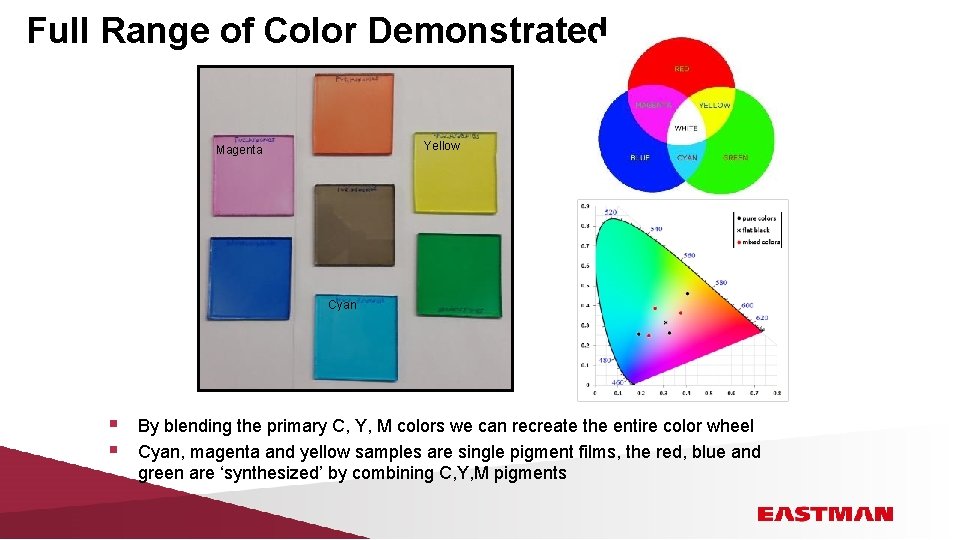
Full Range of Color Demonstrated Yellow Magenta Cyan § § By blending the primary C, Y, M colors we can recreate the entire color wheel Cyan, magenta and yellow samples are single pigment films, the red, blue and green are ‘synthesized’ by combining C, Y, M pigments
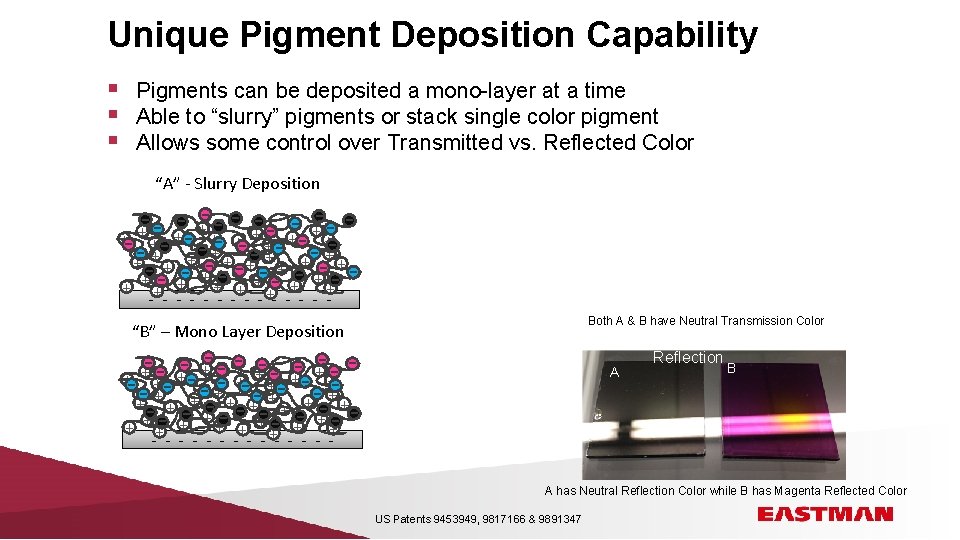
Unique Pigment Deposition Capability § § § Pigments can be deposited a mono-layer at a time Able to “slurry” pigments or stack single color pigment Allows some control over Transmitted vs. Reflected Color “A” - Slurry Deposition A + + + ++ + ++ + ++ + - - - - Transmission B 12 Both A & B have Neutral Transmission Color “B” – Mono Layer Deposition + + + ++ + ++ + ++ + - - - - A Reflection B A has Neutral Reflection Color while B has Magenta Reflected Color US Patents 9453949, 9817166 & 9891347
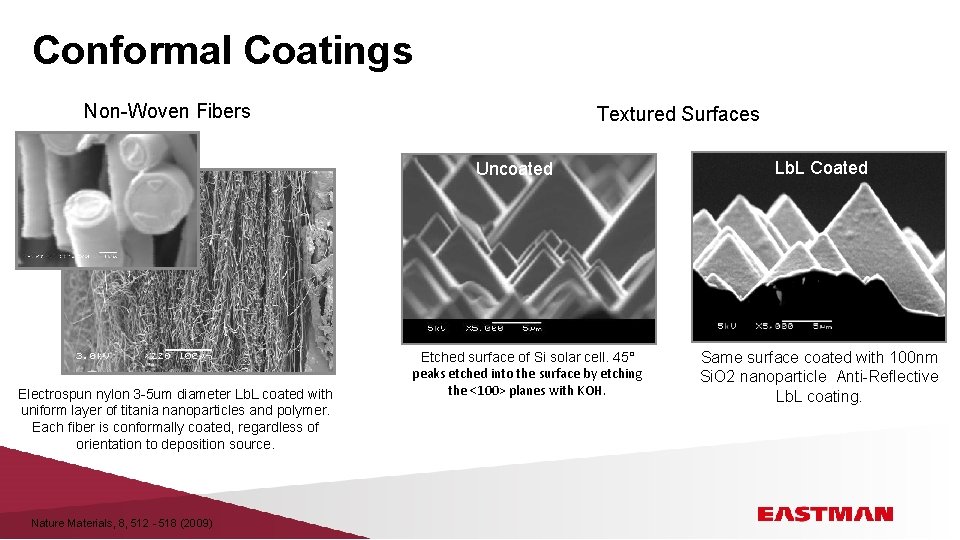
Conformal Coatings Non-Woven Fibers Textured Surfaces Uncoated Electrospun nylon 3 -5 um diameter Lb. L coated with uniform layer of titania nanoparticles and polymer. Each fiber is conformally coated, regardless of orientation to deposition source. Nature Materials, 8, 512 - 518 (2009) Etched surface of Si solar cell. 45° peaks etched into the surface by etching the <100> planes with KOH. Lb. L Coated Same surface coated with 100 nm Si. O 2 nanoparticle Anti-Reflective Lb. L coating.
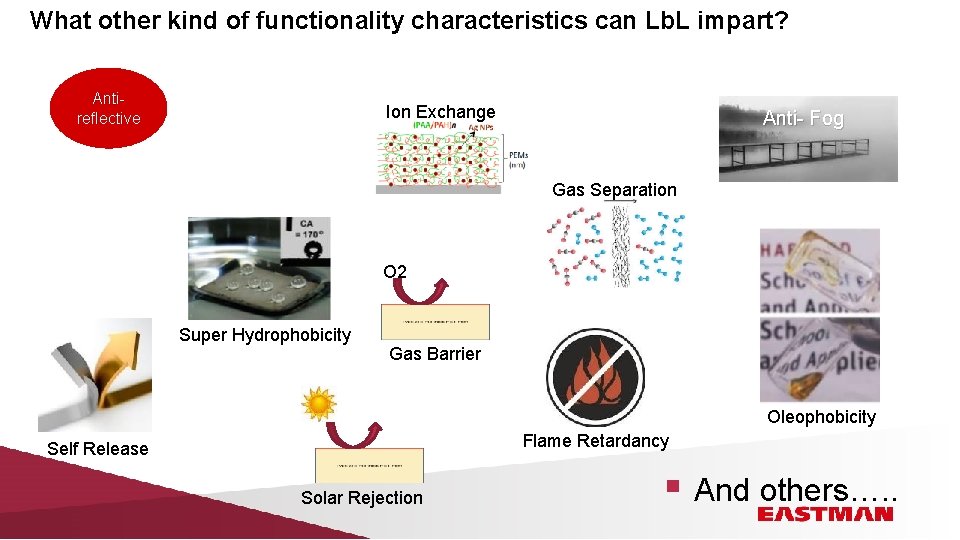
What other kind of functionality characteristics can Lb. L impart? Antireflective Ion Exchange Anti- Fog Gas Separation O 2 Super Hydrophobicity Gas Barrier Oleophobicity Flame Retardancy Self Release Solar Rejection § And others…. .
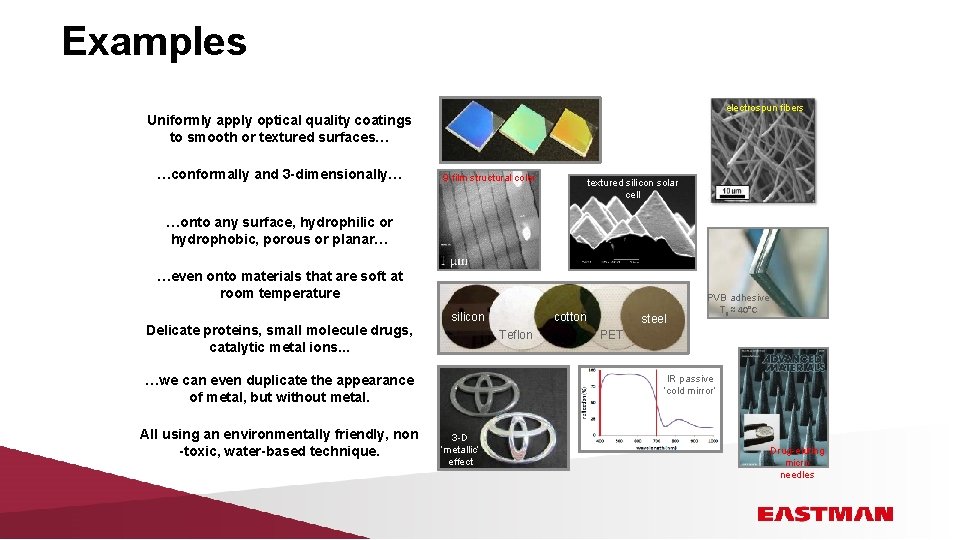
Examples electrospun fibers Uniformly apply optical quality coatings to smooth or textured surfaces… …conformally and 3 -dimensionally… 9 -film structural color textured silicon solar cell …onto any surface, hydrophilic or hydrophobic, porous or planar… …even onto materials that are soft at room temperature Delicate proteins, small molecule drugs, catalytic metal ions. . . silicon Teflon …we can even duplicate the appearance of metal, but without metal. All using an environmentally friendly, non -toxic, water-based technique. cotton steel PVB adhesive Tg ≈ 40°C PET IR passive ‘cold mirror’ 3 -D ‘metallic’ effect Drug-eluting micro needles
Layer by Layer Scale-up
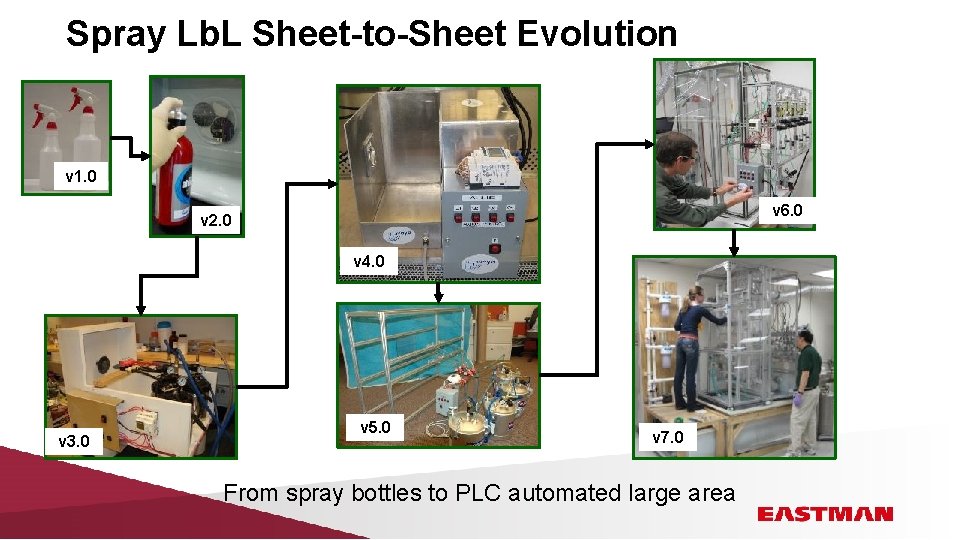
Spray Lb. L Sheet-to-Sheet Evolution v 1. 0 v 6. 0 v 2. 0 v 4. 0 v 3. 0 v 5. 0 v 7. 0 From spray bottles to PLC automated large area
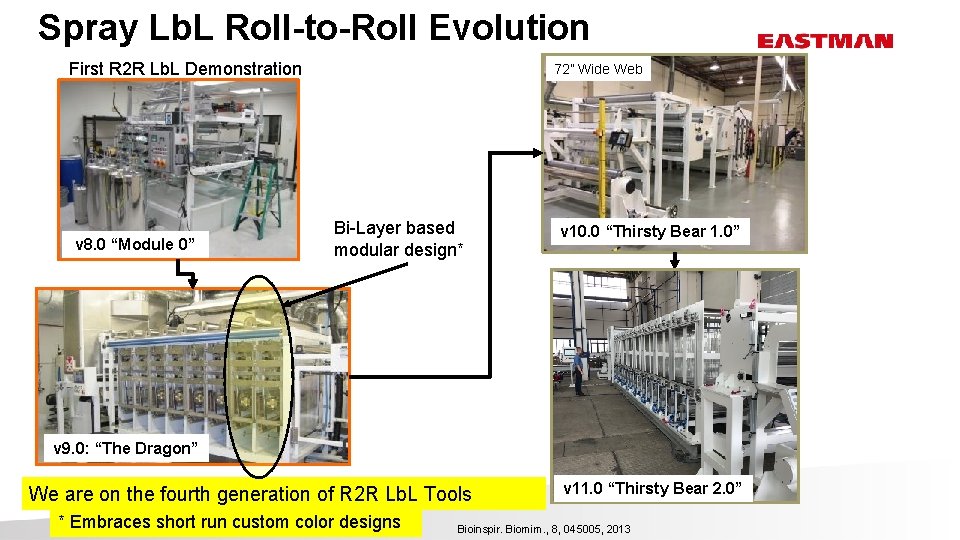
Spray Lb. L Roll-to-Roll Evolution First R 2 R Lb. L Demonstration v 8. 0 “Module 0” 72” Wide Web Bi-Layer based modular design* v 10. 0 “Thirsty Bear 1. 0” v 9. 0: “The Dragon” We are on the fourth generation of R 2 R Lb. L Tools * Embraces short run custom color designs v 11. 0 “Thirsty Bear 2. 0” Bioinspir. Biomim. , 8, 045005, 2013
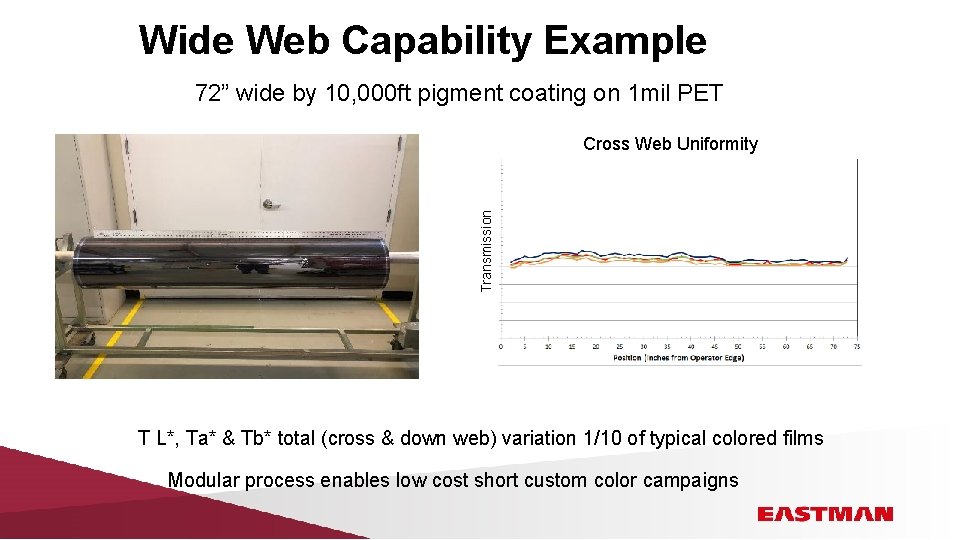
Wide Web Capability Example 72” wide by 10, 000 ft pigment coating on 1 mil PET Transmission Cross Web Uniformity T L*, Ta* & Tb* total (cross & down web) variation 1/10 of typical colored films Modular process enables low cost short custom color campaigns
Summary § § § Layer-by-Layer deposition is now scaled to full R 2 R process Key characteristics of this new coating technology are: • • Water based Self limiting Uniform Room temperature Low stress Conformal Flexible platform Large number of coating options
- Slides: 20