
Laws of Thermodynamics and Engine Technology B 3
Laws of Thermodynamics and Engine Technology B 3. 1 and B 3. 2
Laws of Thermodynamics is the study of the interrelationships between heat, work and energy. THE LAWS OF THERMODYNAMICS STATE… 1. The total energy, including heat, in a system and it’s surroundings remains constant n n n Types of systems include: open (exchange both matter and energy), closed (exchange energy ONLY) and isolated systems (exchanges neither). The total energy in a system can be increased by adding heat to a system from the surroundings or by increasing the amount of work done on a system. (Positive Work) Negative work results when the total energy in a system decreases or the amount of work done in a system decreases
Laws of Thermodynamics 2. Heat flows from warmer objects to cooler objects, resulting in some heat being converted into mechanical energy to do work n n As a result, perpetual motion or perfect machines are not possible since some input energy is ALWAYS converted to heat You can never have 100% efficiency… you can never get out of a machine as much as you put in.
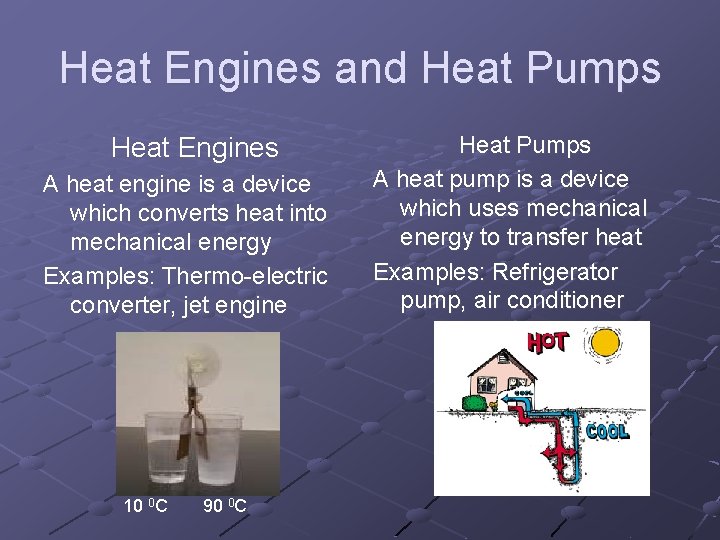
Heat Engines and Heat Pumps Heat Engines A heat engine is a device which converts heat into mechanical energy Examples: Thermo-electric converter, jet engine 10 0 C 90 0 C Heat Pumps A heat pump is a device which uses mechanical energy to transfer heat Examples: Refrigerator pump, air conditioner
Homework Read pages 198 -205 B 3. 1 Check and Reflect page 205 #’s 1 -10
3. 2 Engine Technology

Engine Timeline Developing Technology If we look at the technology we have today, we know that we take it all for granted; cars, planes, computers, ipods, cell phones etc. How long has it taken to develop the various technologies used personally, professionally or even the military?
Your Task! This section is focusing on Internal combustion engines. We are going to look at the various developments in engine technology over the years. Use your textbook to fill in the following information on the development of these engines. Remember to keep your answers summative (don’t copy directly from the text).
Read section B 3. 2 pages 206 - 214 Complete the section in your notes B 3. 2 Check and Reflect Page 214 #’s 1 -8
- Slides: 9