
Laws of Radiation Heat Transfer P M V
- Slides: 35
Laws of Radiation Heat Transfer P M V Subbarao Associate Professor Mechanical Engineering Department IIT Delhi Macro Description of highly complex Wave Phenomenon
Contrast in Radiative Mode of Heat Transfer • Any body (> absolute zero) emits radiation at various wavelengths. • Transparent bodies radiate energy in spherical space. • Non-transparent bodies radiate energy in hemi-spherical space. • The radiation energy emitted by a body is distributed in space at various wavelengths. • This complex phenomenon requires simplified laws for engineering use of radiation.
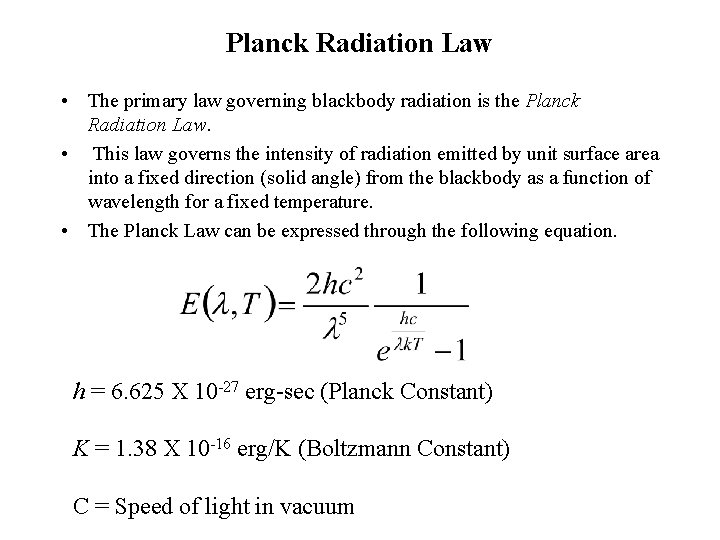
Planck Radiation Law • The primary law governing blackbody radiation is the Planck Radiation Law. • This law governs the intensity of radiation emitted by unit surface area into a fixed direction (solid angle) from the blackbody as a function of wavelength for a fixed temperature. • The Planck Law can be expressed through the following equation. h = 6. 625 X 10 -27 erg-sec (Planck Constant) K = 1. 38 X 10 -16 erg/K (Boltzmann Constant) C = Speed of light in vacuum
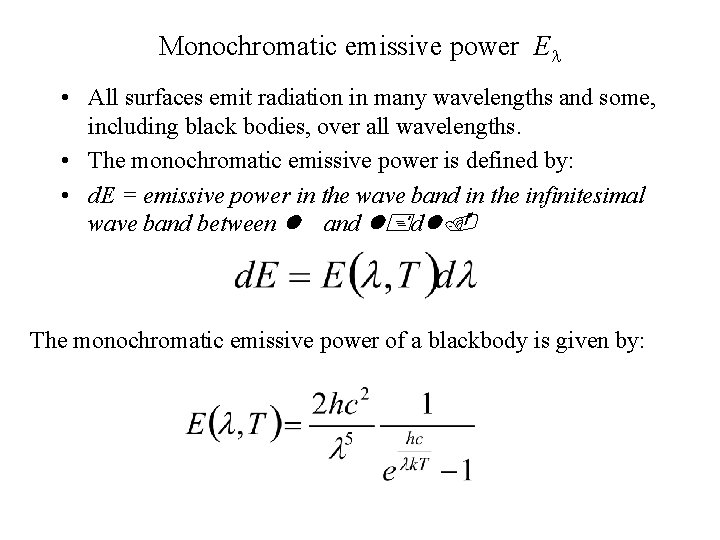
Monochromatic emissive power El • All surfaces emit radiation in many wavelengths and some, including black bodies, over all wavelengths. • The monochromatic emissive power is defined by: • d. E = emissive power in the wave band in the infinitesimal wave band between l and l+dl. The monochromatic emissive power of a blackbody is given by:
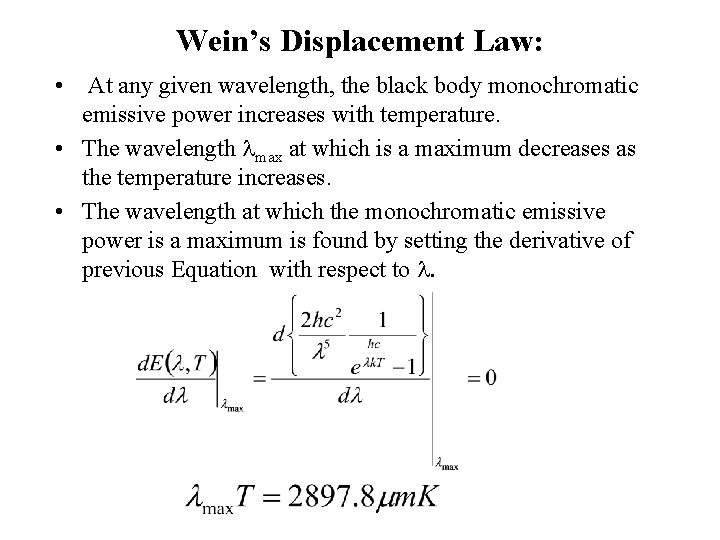
Wein’s Displacement Law: • At any given wavelength, the black body monochromatic emissive power increases with temperature. • The wavelength lmax at which is a maximum decreases as the temperature increases. • The wavelength at which the monochromatic emissive power is a maximum is found by setting the derivative of previous Equation with respect to l.
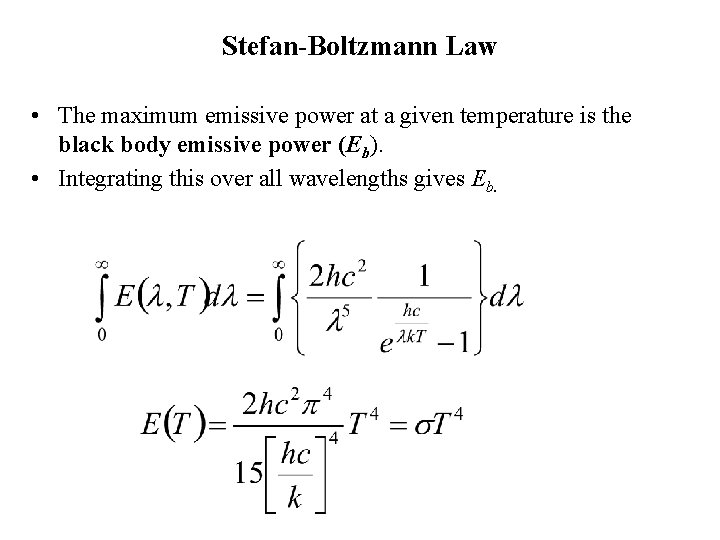
Stefan-Boltzmann Law • The maximum emissive power at a given temperature is the black body emissive power (Eb). • Integrating this over all wavelengths gives Eb.
Relevance of Eb • Driving forces: Heat transfer by radiation is driven by differences in emissive power (proportional to T 4), not just temperature differences (convection & conduction).
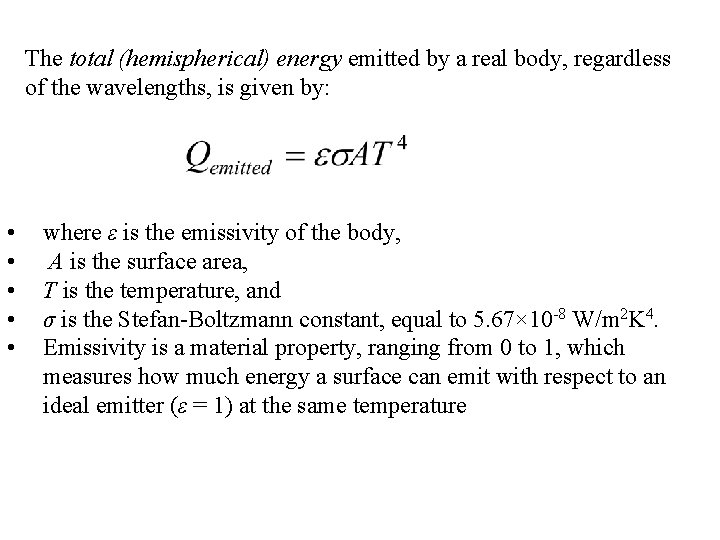
The total (hemispherical) energy emitted by a real body, regardless of the wavelengths, is given by: • • • where ε is the emissivity of the body, A is the surface area, T is the temperature, and σ is the Stefan-Boltzmann constant, equal to 5. 67× 10 -8 W/m 2 K 4. Emissivity is a material property, ranging from 0 to 1, which measures how much energy a surface can emit with respect to an ideal emitter (ε = 1) at the same temperature
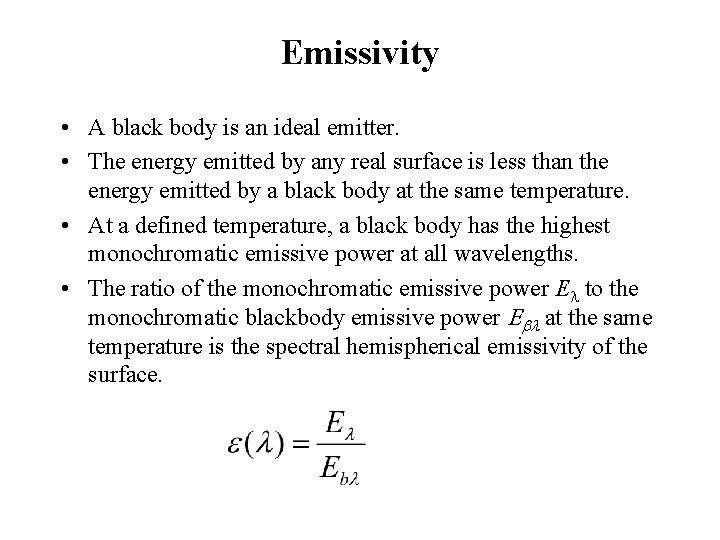
Emissivity • A black body is an ideal emitter. • The energy emitted by any real surface is less than the energy emitted by a black body at the same temperature. • At a defined temperature, a black body has the highest monochromatic emissive power at all wavelengths. • The ratio of the monochromatic emissive power El to the monochromatic blackbody emissive power Ebl at the same temperature is the spectral hemispherical emissivity of the surface.
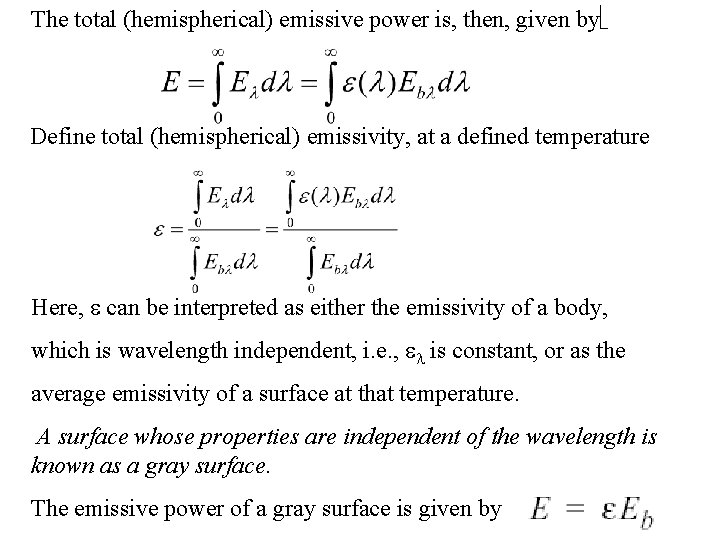
The total (hemispherical) emissive power is, then, given byë Define total (hemispherical) emissivity, at a defined temperature Here, e can be interpreted as either the emissivity of a body, which is wavelength independent, i. e. , el is constant, or as the average emissivity of a surface at that temperature. A surface whose properties are independent of the wavelength is known as a gray surface. The emissive power of a gray surface is given by
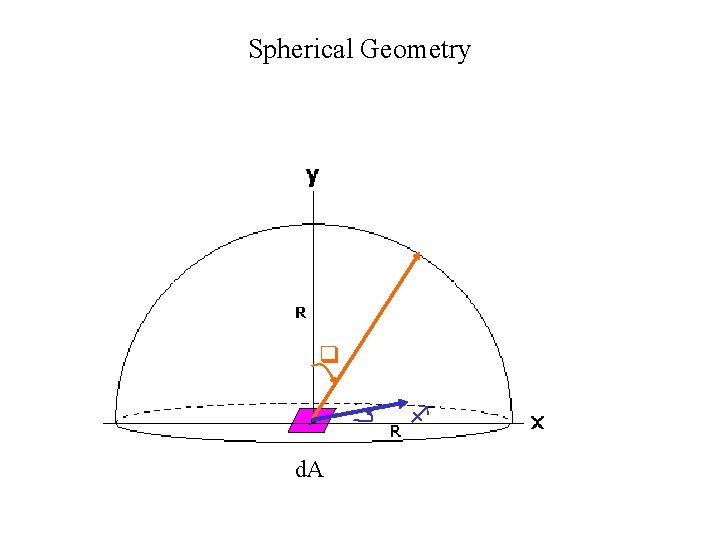
Spherical Geometry q f d. A
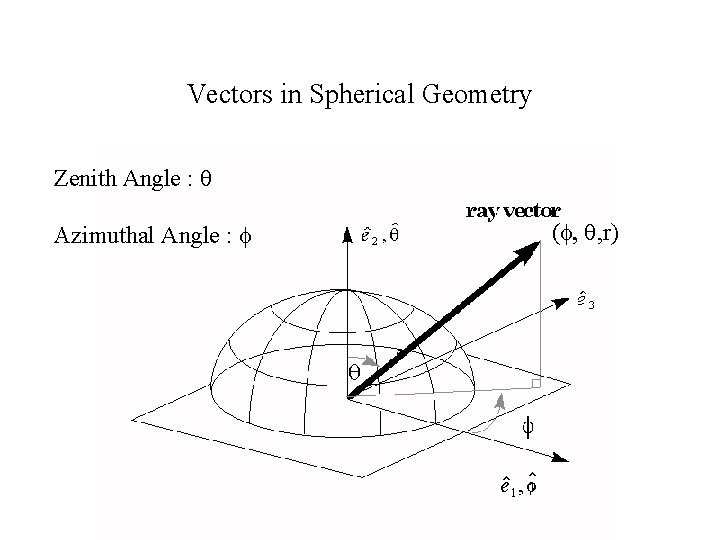
Vectors in Spherical Geometry Zenith Angle : q Azimuthal Angle : f (f, q, r)
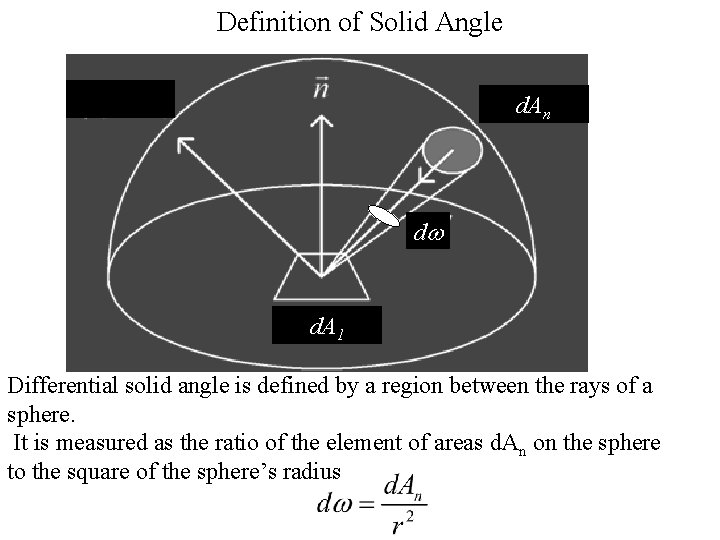
Definition of Solid Angle d. An dw d. A 1 Differential solid angle is defined by a region between the rays of a sphere. It is measured as the ratio of the element of areas d. An on the sphere to the square of the sphere’s radius
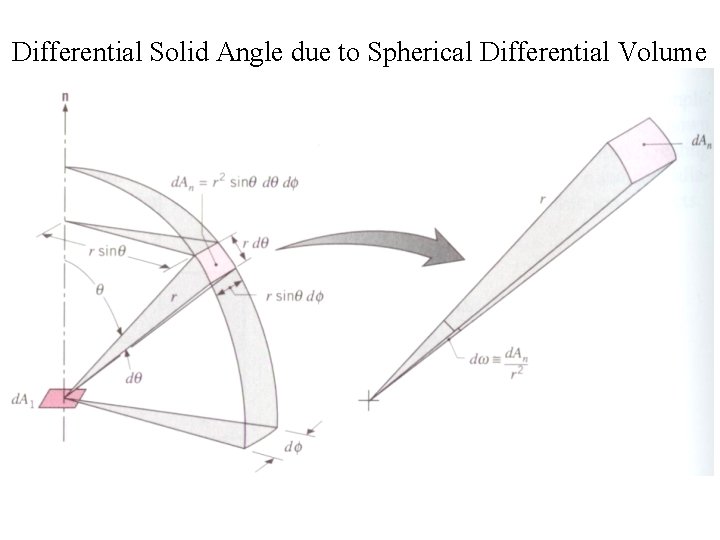
Differential Solid Angle due to Spherical Differential Volume
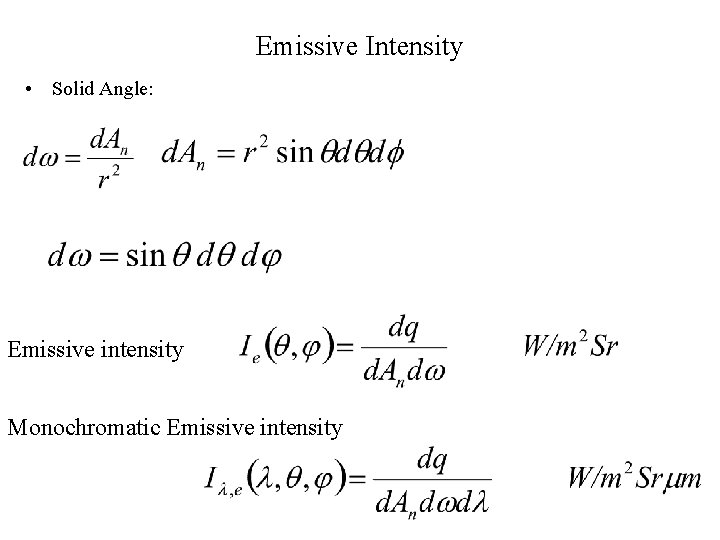
Emissive Intensity • Solid Angle: Emissive intensity Monochromatic Emissive intensity
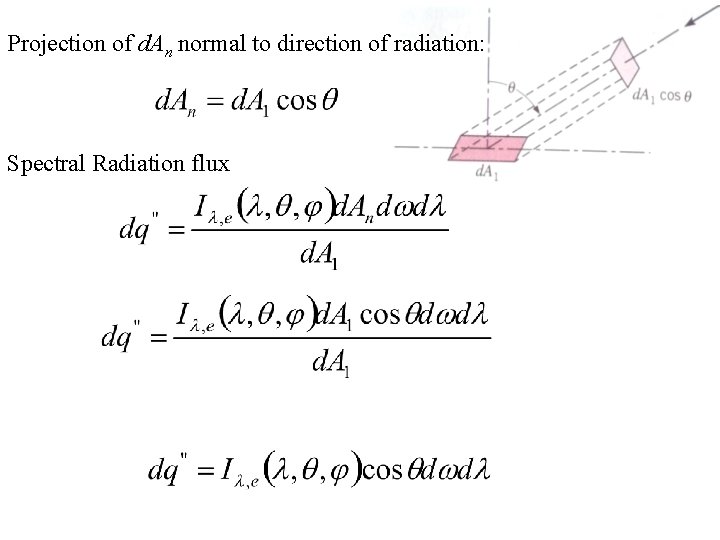
Projection of d. An normal to direction of radiation: Spectral Radiation flux
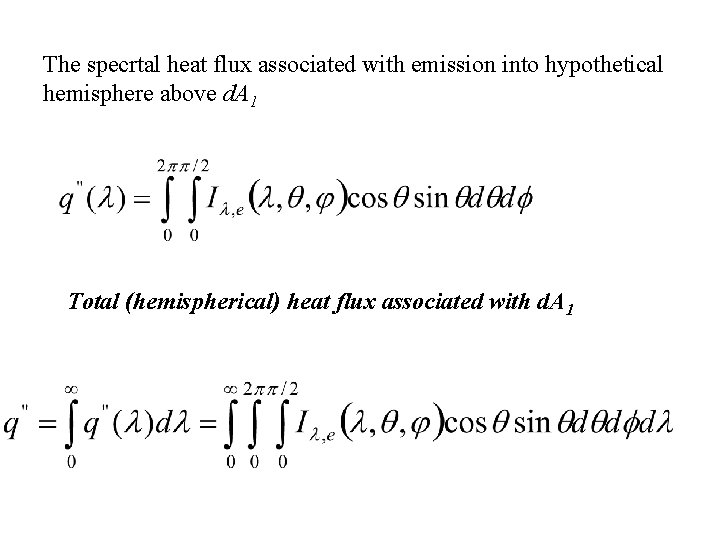
The specrtal heat flux associated with emission into hypothetical hemisphere above d. A 1 Total (hemispherical) heat flux associated with d. A 1
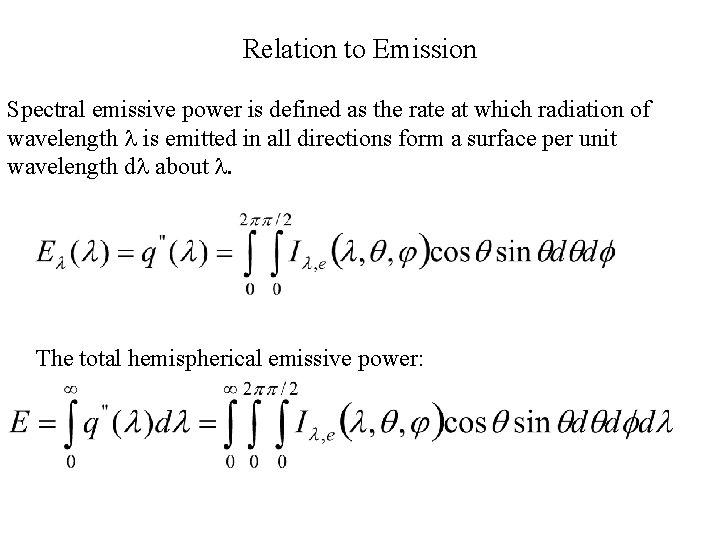
Relation to Emission Spectral emissive power is defined as the rate at which radiation of wavelength l is emitted in all directions form a surface per unit wavelength dl about l. The total hemispherical emissive power:
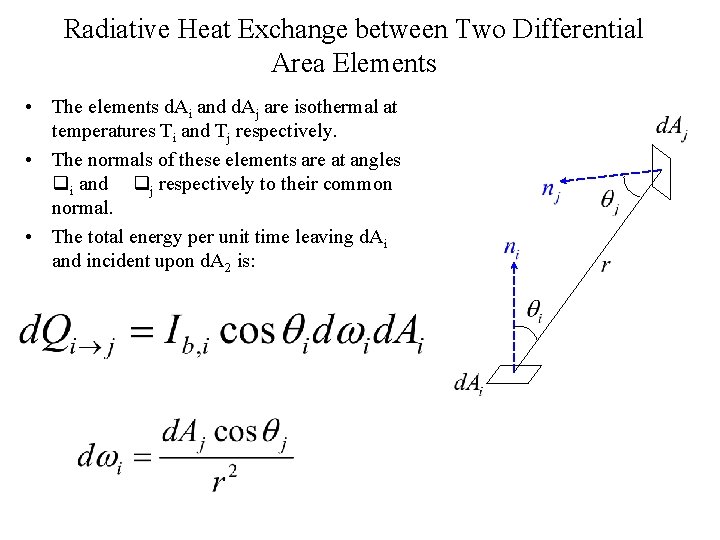
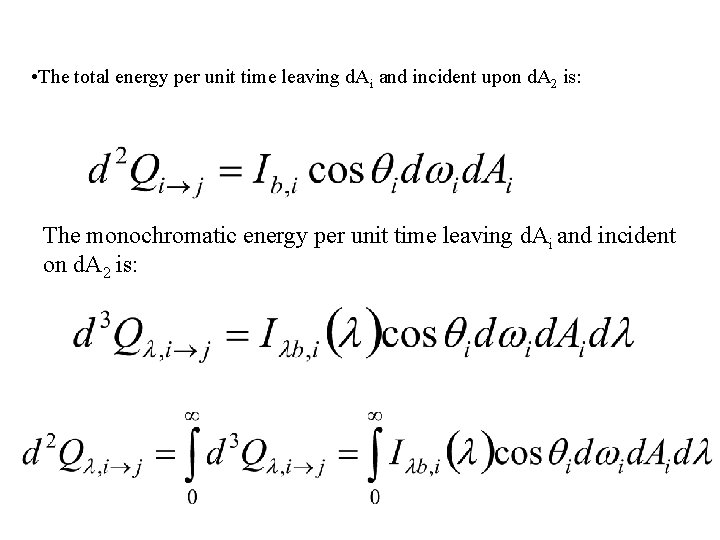
Radiative Heat Exchange between Two Differential Area Elements • The elements d. Ai and d. Aj are isothermal at temperatures Ti and Tj respectively. • The normals of these elements are at angles qi and qj respectively to their common normal. • The total energy per unit time leaving d. Ai and incident upon d. A 2 is:
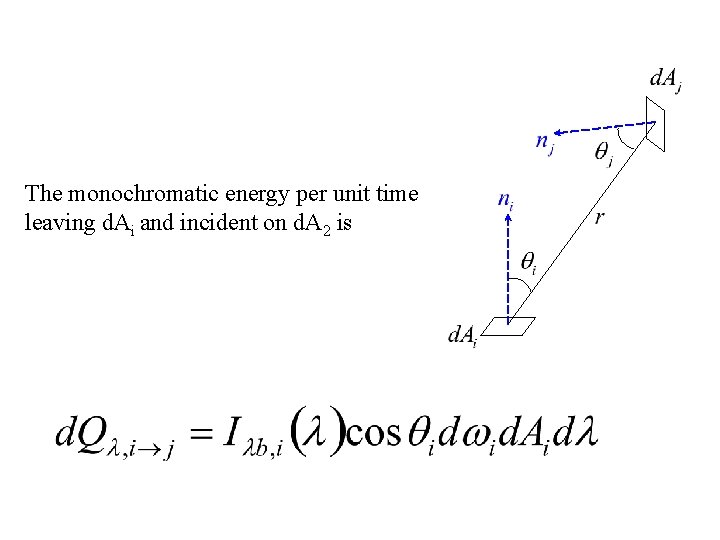
The monochromatic energy per unit time leaving d. Ai and incident on d. A 2 is
• The total energy per unit time leaving d. Ai and incident upon d. A 2 is: The monochromatic energy per unit time leaving d. Ai and incident on d. A 2 is:
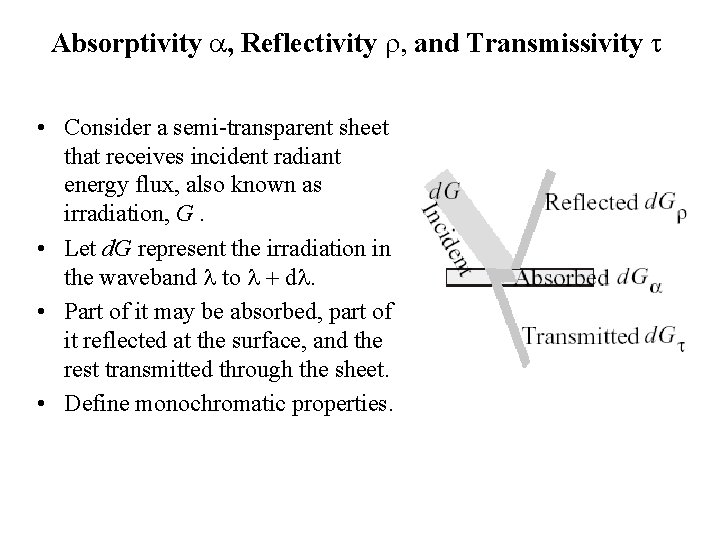
Absorptivity a, Reflectivity r, and Transmissivity t • Consider a semi-transparent sheet that receives incident radiant energy flux, also known as irradiation, G. • Let d. G represent the irradiation in the waveband l to l + dl. • Part of it may be absorbed, part of it reflected at the surface, and the rest transmitted through the sheet. • Define monochromatic properties.
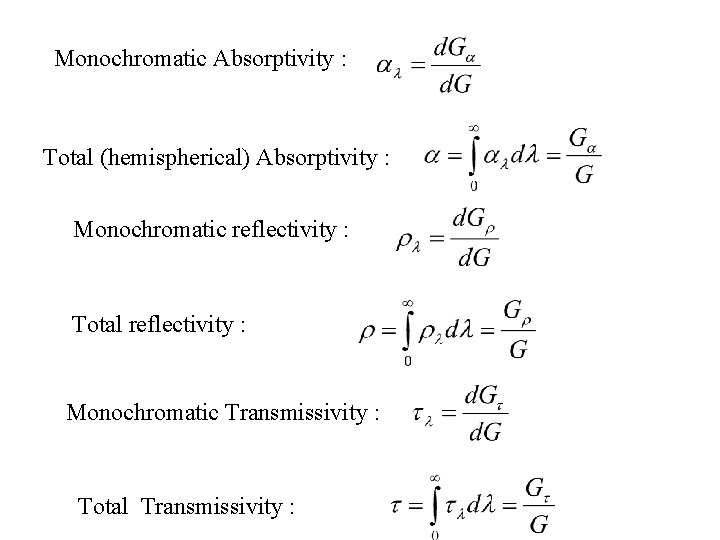
Monochromatic Absorptivity : Total (hemispherical) Absorptivity : Monochromatic reflectivity : Total reflectivity : Monochromatic Transmissivity : Total Transmissivity :
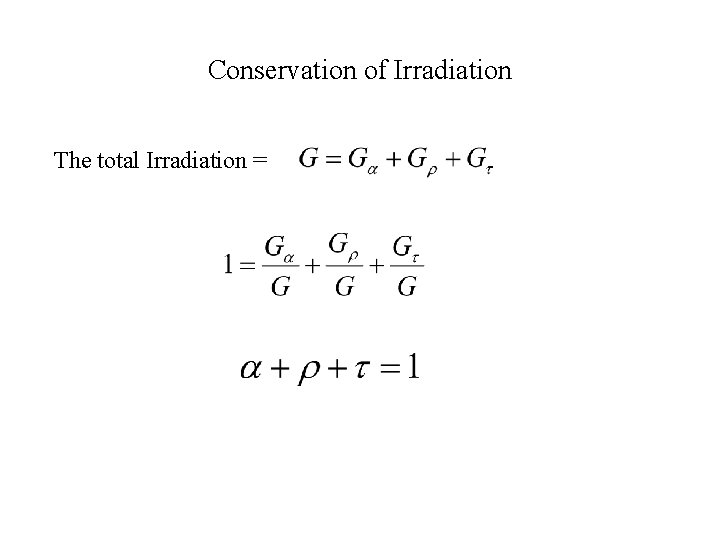
Conservation of Irradiation The total Irradiation =
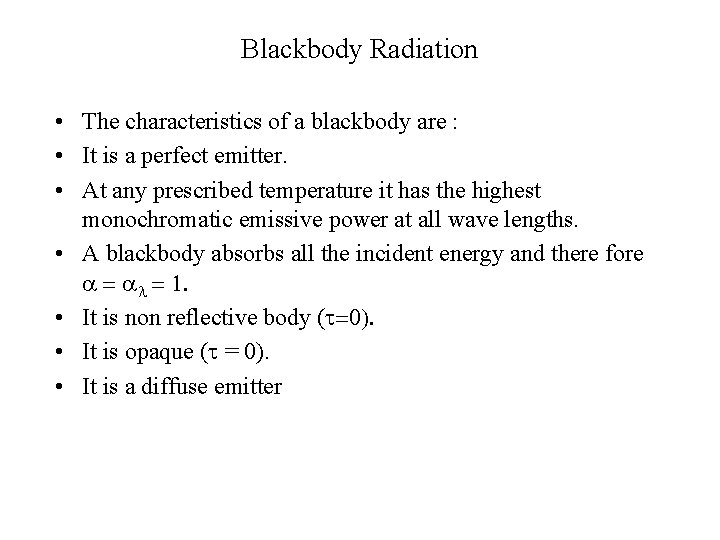
Blackbody Radiation • The characteristics of a blackbody are : • It is a perfect emitter. • At any prescribed temperature it has the highest monochromatic emissive power at all wave lengths. • A blackbody absorbs all the incident energy and there fore a = al = 1. • It is non reflective body (t=0). • It is opaque (t = 0). • It is a diffuse emitter
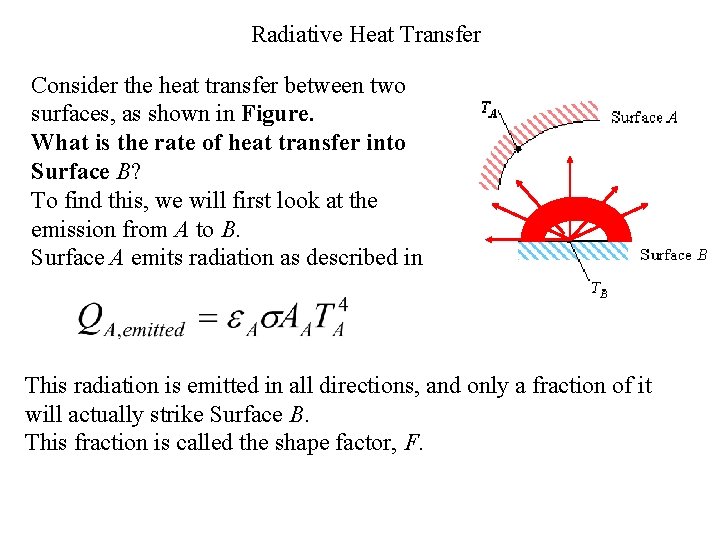
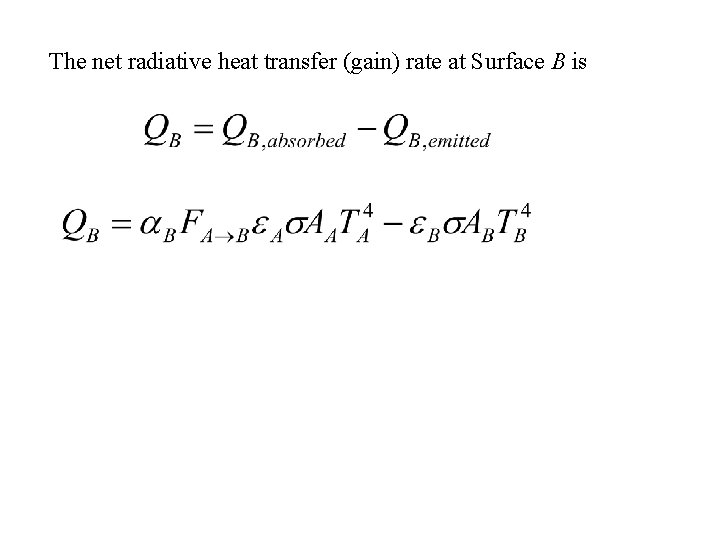
Radiative Heat Transfer Consider the heat transfer between two surfaces, as shown in Figure. What is the rate of heat transfer into Surface B? To find this, we will first look at the emission from A to B. Surface A emits radiation as described in This radiation is emitted in all directions, and only a fraction of it will actually strike Surface B. This fraction is called the shape factor, F.
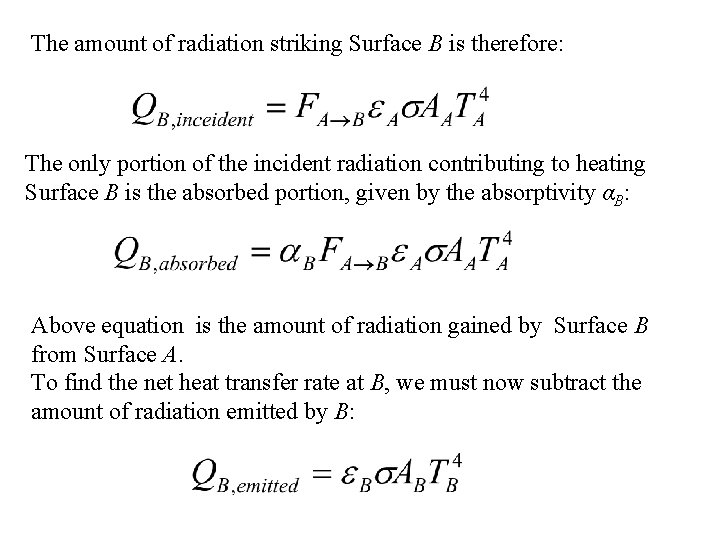
The amount of radiation striking Surface B is therefore: The only portion of the incident radiation contributing to heating Surface B is the absorbed portion, given by the absorptivity αB: Above equation is the amount of radiation gained by Surface B from Surface A. To find the net heat transfer rate at B, we must now subtract the amount of radiation emitted by B:
The net radiative heat transfer (gain) rate at Surface B is
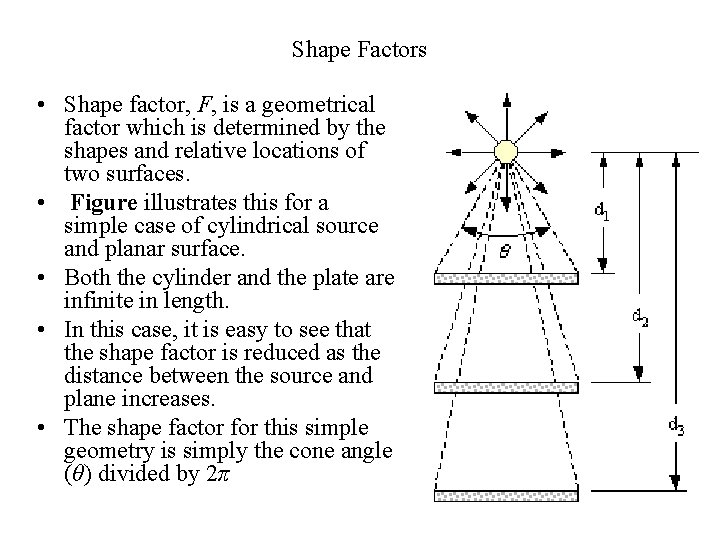
Shape Factors • Shape factor, F, is a geometrical factor which is determined by the shapes and relative locations of two surfaces. • Figure illustrates this for a simple case of cylindrical source and planar surface. • Both the cylinder and the plate are infinite in length. • In this case, it is easy to see that the shape factor is reduced as the distance between the source and plane increases. • The shape factor for this simple geometry is simply the cone angle (θ) divided by 2π
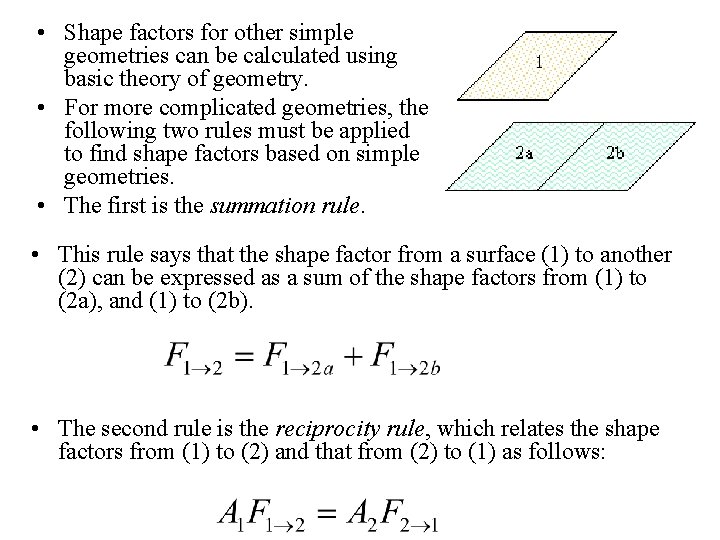
• Shape factors for other simple geometries can be calculated using basic theory of geometry. • For more complicated geometries, the following two rules must be applied to find shape factors based on simple geometries. • The first is the summation rule. • This rule says that the shape factor from a surface (1) to another (2) can be expressed as a sum of the shape factors from (1) to (2 a), and (1) to (2 b). • The second rule is the reciprocity rule, which relates the shape factors from (1) to (2) and that from (2) to (1) as follows:
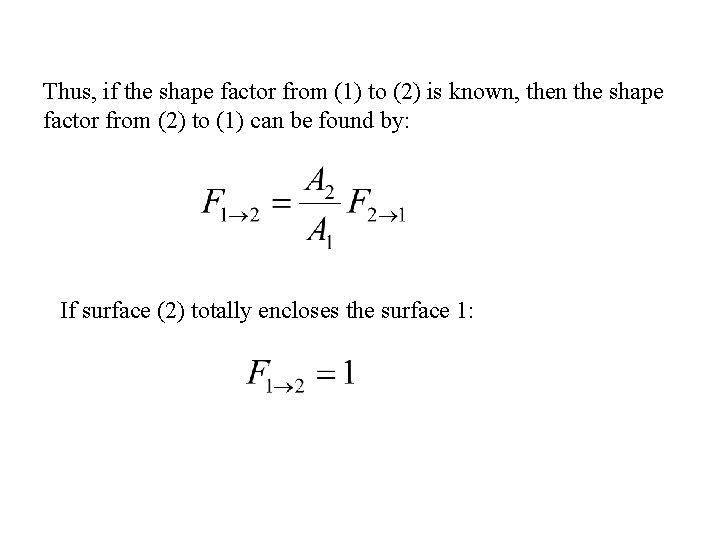
Thus, if the shape factor from (1) to (2) is known, then the shape factor from (2) to (1) can be found by: If surface (2) totally encloses the surface 1:
Geometrical Concepts in Radiation Heat Transfer
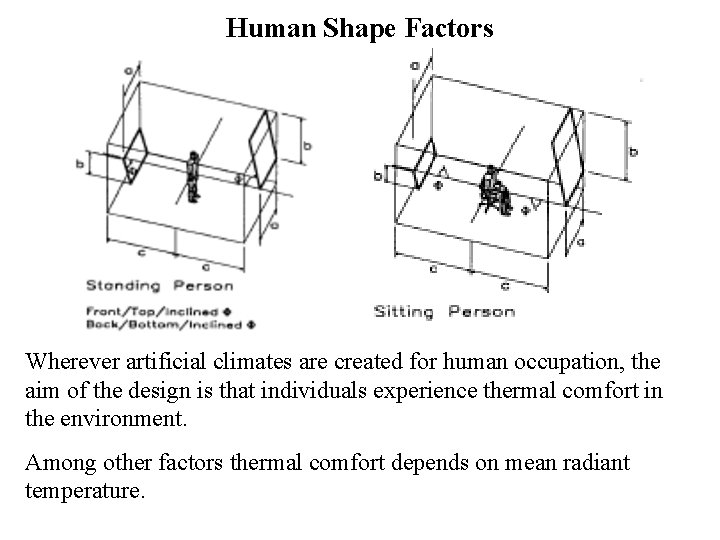
Human Shape Factors Wherever artificial climates are created for human occupation, the aim of the design is that individuals experience thermal comfort in the environment. Among other factors thermal comfort depends on mean radiant temperature.
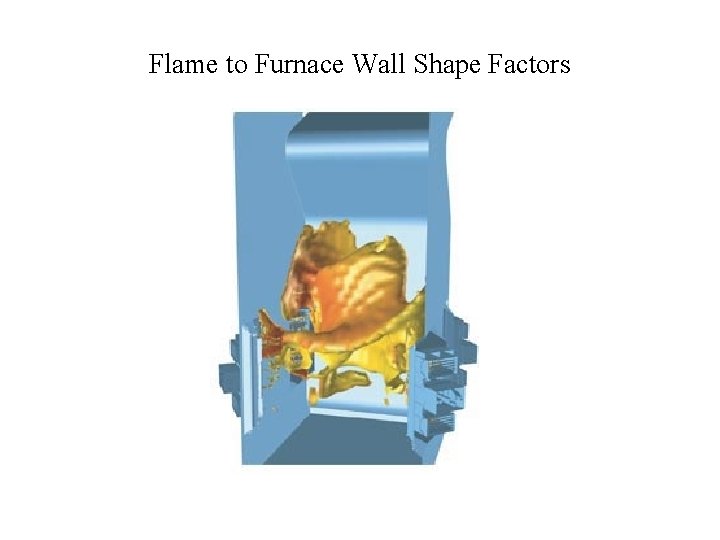
Flame to Furnace Wall Shape Factors