
Laws of Probability Help to Explain Genetic Events
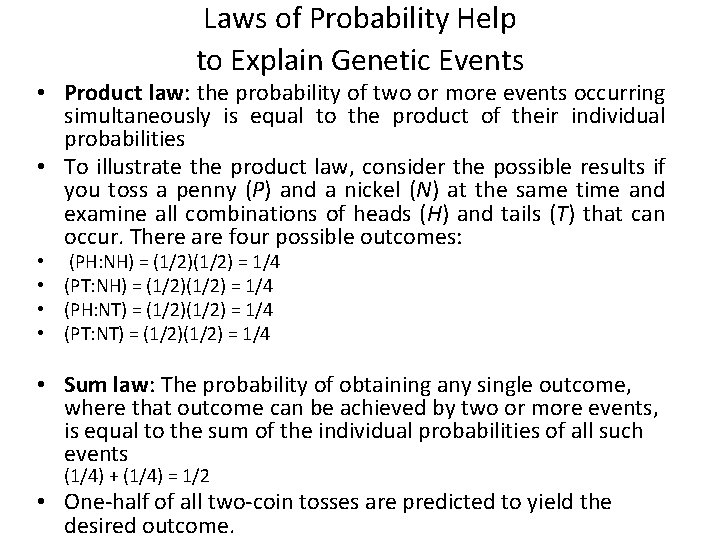
Laws of Probability Help to Explain Genetic Events • Product law: the probability of two or more events occurring simultaneously is equal to the product of their individual probabilities • To illustrate the product law, consider the possible results if you toss a penny (P) and a nickel (N) at the same time and examine all combinations of heads (H) and tails (T) that can occur. There are four possible outcomes: • (PH: NH) = (1/2) = 1/4 • (PT: NH) = (1/2) = 1/4 • (PH: NT) = (1/2) = 1/4 • (PT: NT) = (1/2) = 1/4 • Sum law: The probability of obtaining any single outcome, where that outcome can be achieved by two or more events, is equal to the sum of the individual probabilities of all such events (1/4) + (1/4) = 1/2 • One-half of all two-coin tosses are predicted to yield the desired outcome.
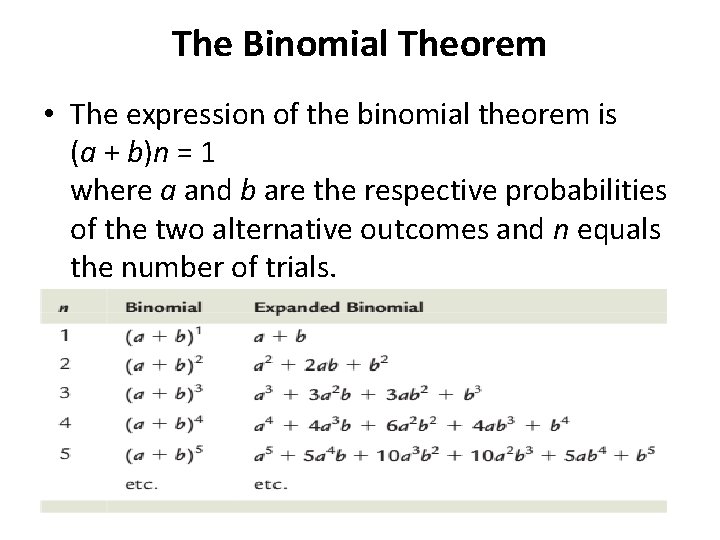
The Binomial Theorem • The expression of the binomial theorem is (a + b)n = 1 where a and b are the respective probabilities of the two alternative outcomes and n equals the number of trials.
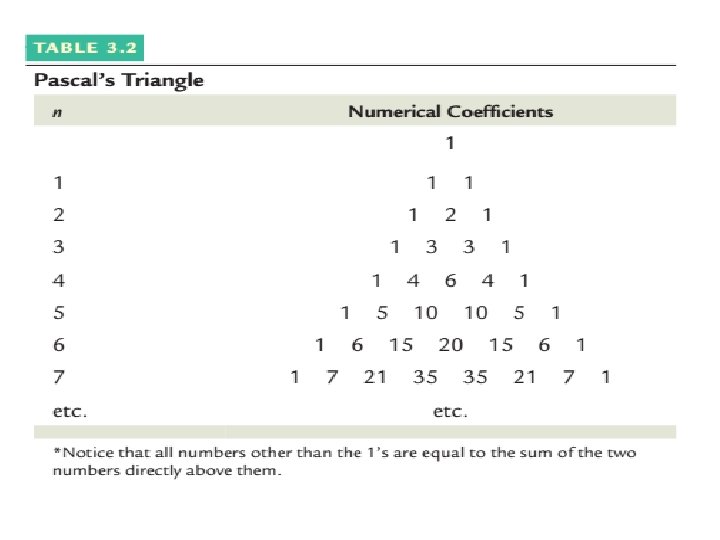
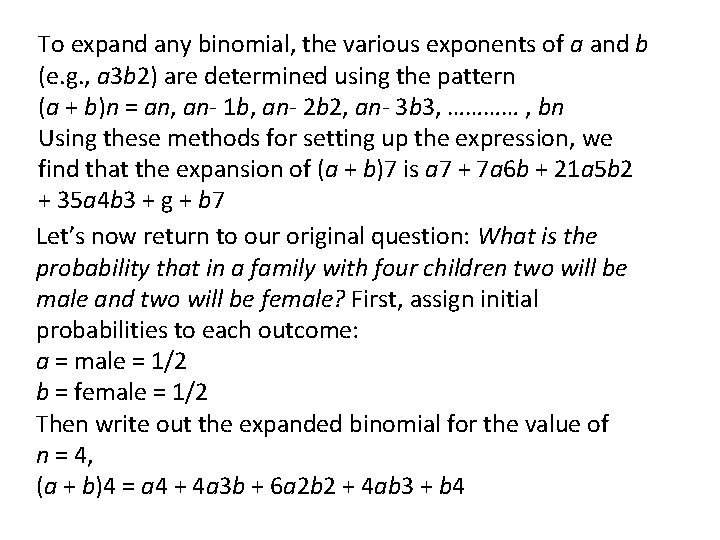
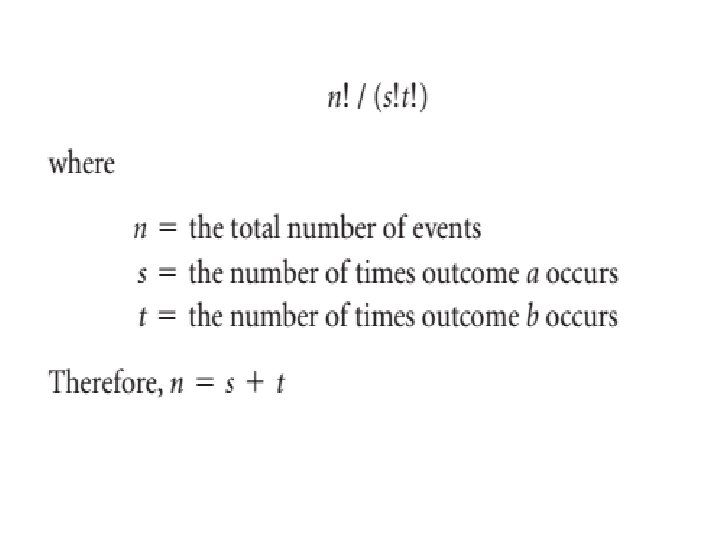
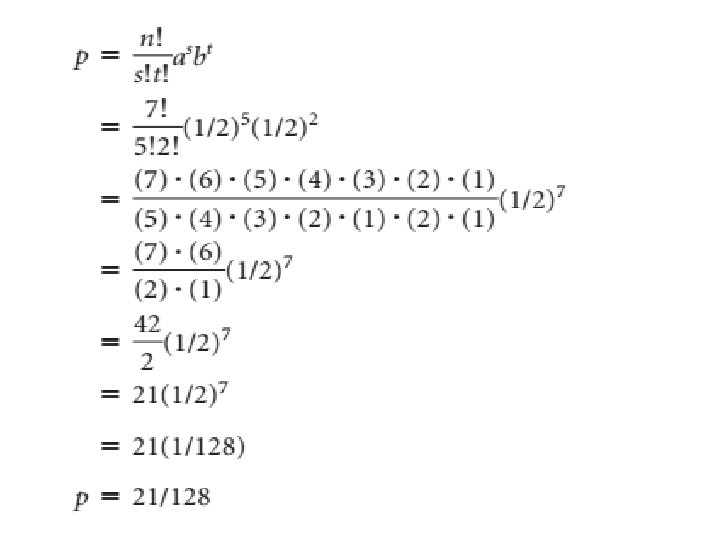
To expand any binomial, the various exponents of a and b (e. g. , a 3 b 2) are determined using the pattern (a + b)n = an, an- 1 b, an- 2 b 2, an- 3 b 3, ………… , bn Using these methods for setting up the expression, we find that the expansion of (a + b)7 is a 7 + 7 a 6 b + 21 a 5 b 2 + 35 a 4 b 3 + g + b 7 Let’s now return to our original question: What is the probability that in a family with four children two will be male and two will be female? First, assign initial probabilities to each outcome: a = male = 1/2 b = female = 1/2 Then write out the expanded binomial for the value of n = 4, (a + b)4 = a 4 + 4 a 3 b + 6 a 2 b 2 + 4 ab 3 + b 4
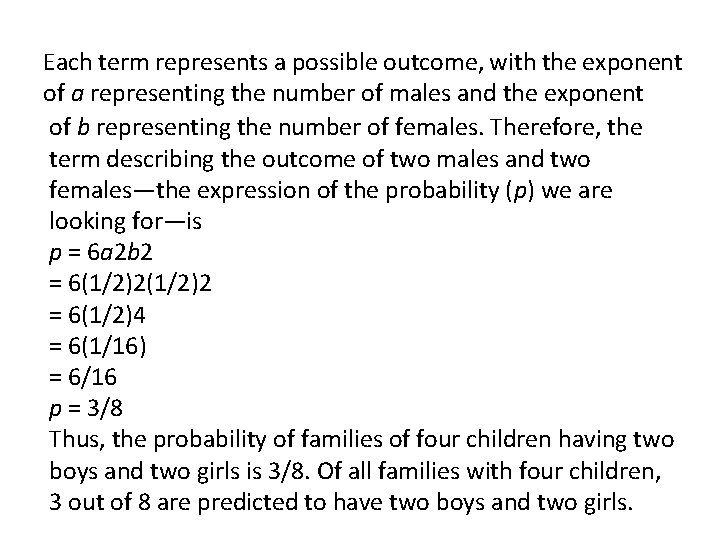
Each term represents a possible outcome, with the exponent of a representing the number of males and the exponent of b representing the number of females. Therefore, the term describing the outcome of two males and two females—the expression of the probability (p) we are looking for—is p = 6 a 2 b 2 = 6(1/2)2 = 6(1/2)4 = 6(1/16) = 6/16 p = 3/8 Thus, the probability of families of four children having two boys and two girls is 3/8. Of all families with four children, 3 out of 8 are predicted to have two boys and two girls.
Chi-Square Calculations and the Null Hypothesis • Null Hypothesis (H 0). It is so named because the hypothesis assumes that there is no real difference between the measured values (or ratio) and the predicted values (or ratio • One of the simplest statistical tests for assessing the goodness of fit of the null hypothesis is chi-square analysis. This test takes into account the observed deviation in each component of a ratio (from what was expected) as well as the sample size and reduces them to a single numerical value. The value for chi-square is then used to estimate how frequently the observed deviation can be expected to occur strictly as a result of chance
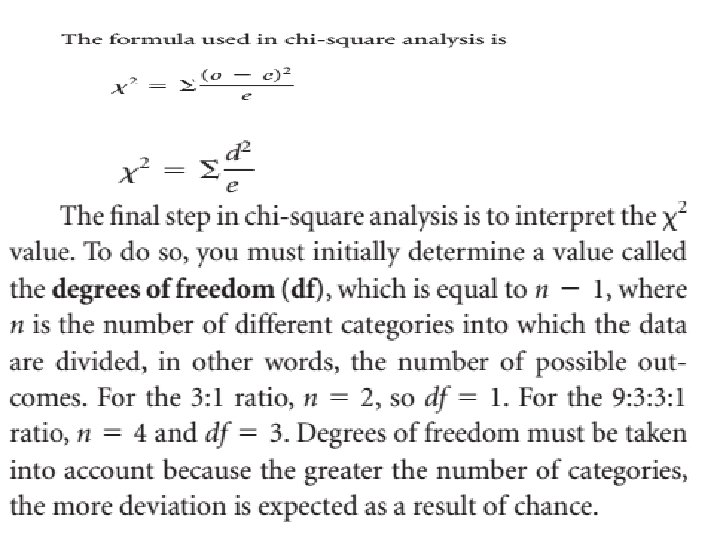
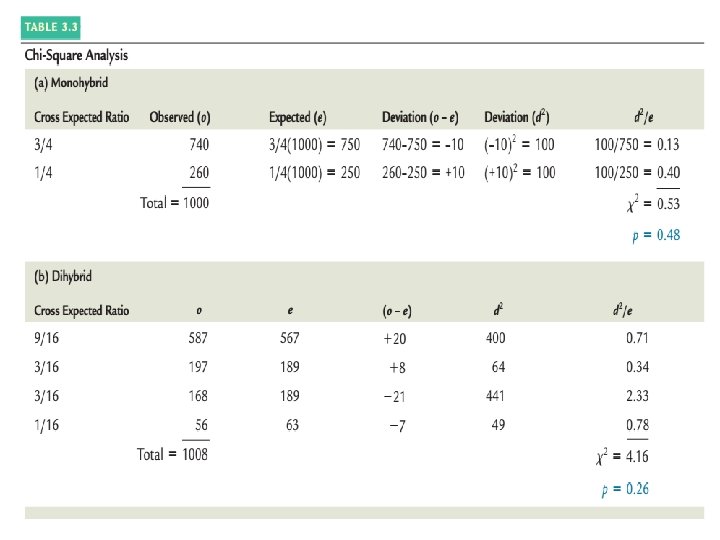
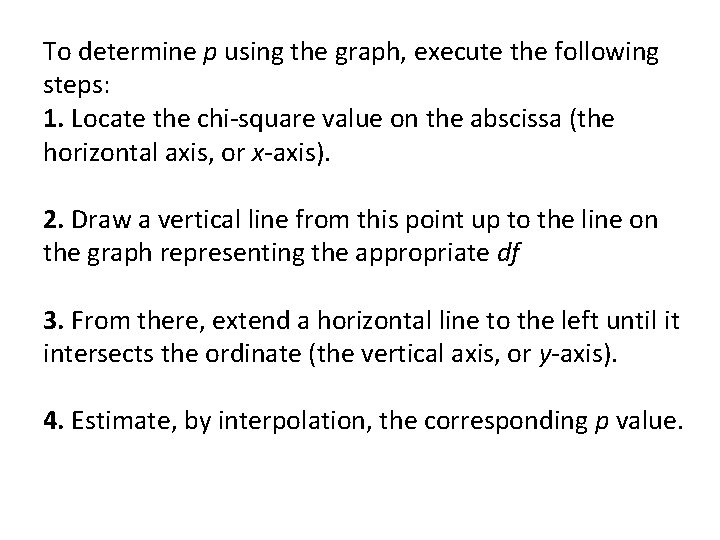
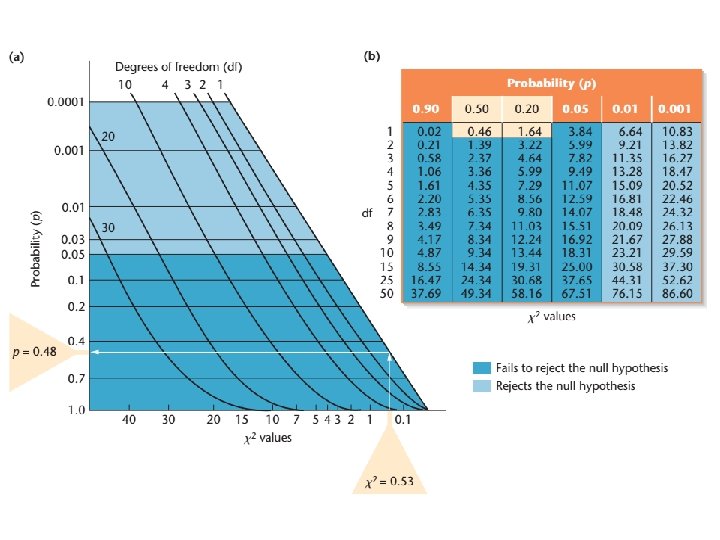
To determine p using the graph, execute the following steps: 1. Locate the chi-square value on the abscissa (the horizontal axis, or x-axis). 2. Draw a vertical line from this point up to the line on the graph representing the appropriate df 3. From there, extend a horizontal line to the left until it intersects the ordinate (the vertical axis, or y-axis). 4. Estimate, by interpolation, the corresponding p value.
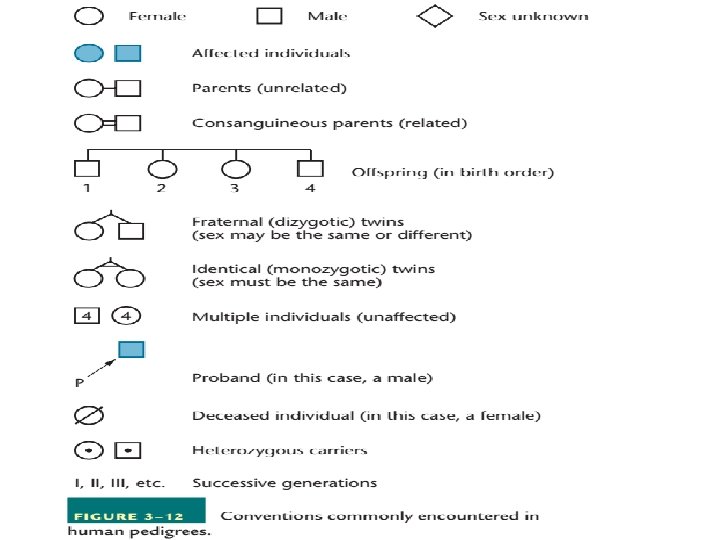
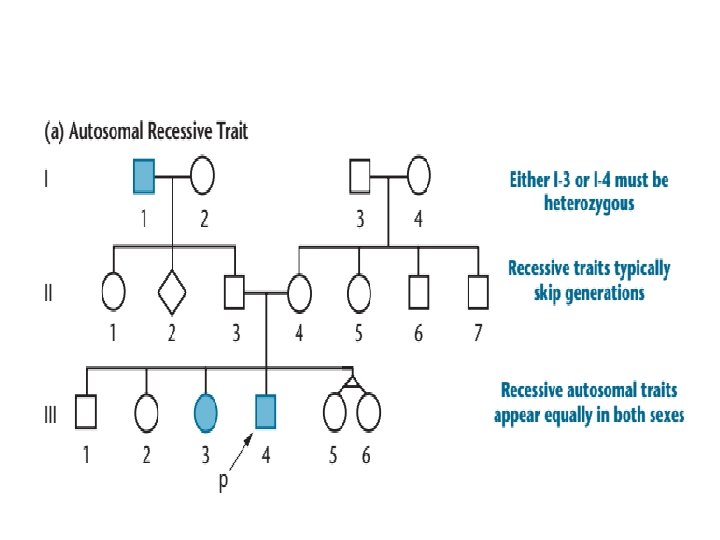
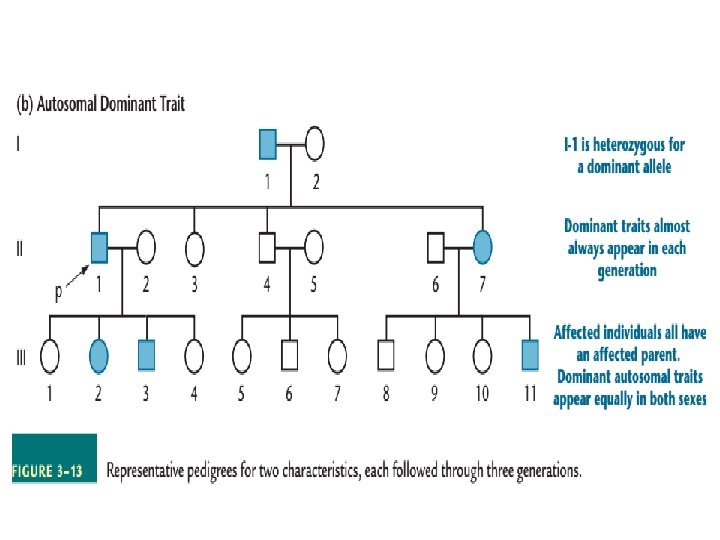
Pedigrees Reveal Patterns of Inheritance of Human Traits • The traditional way to study inheritance has been to construct a family tree, indicating the presence or absence of the trait in question for each member of each generation. Such a family tree is called a pedigree. By analyzing a pedigree, we may be able to predict how the trait under study is inherited—for example, is it due to a dominant or recessive allele? When many pedigrees for the same trait are studied, we can often ascertain the mode of inheritance.
- Slides: 16