
LAWS OF DRY FRICTION FRICTION Friction is the
- Slides: 11
LAWS OF DRY FRICTION
FRICTION � � Friction is the force resisting the relative motion of solid surfaces, fluid layers and material elements sliding against each other. Friction is the force holding back the movement of a sliding object. You will find friction everywhere that objects come into contact with each other.
Examples � � � A book moving across the desk. When you ride a bicycle, the contact between the wheel and road is an example of friction. Rubbing both hands together A person sliding down the slide Walking on a road
Dry Friction is the force that opposes one solid surface sliding across another solid surface. Dry friction always opposes the surfaces sliding relative to one another and can have effect either opposing motion or causing motion in bodies
Static friction and Kinetic friction � � Static friction is the friction that exists between a stationary object and the surface on which it’s resting. Kinetic friction is also referred to as dynamic friction. It is the force that resists the relative movement of the surfaces once they’re in motion.
LAWS OF DRY FRICTION
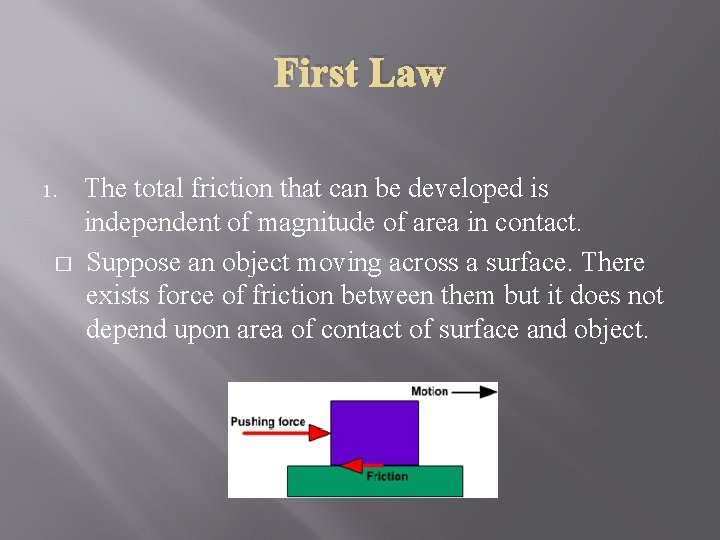
First Law 1. � The total friction that can be developed is independent of magnitude of area in contact. Suppose an object moving across a surface. There exists force of friction between them but it does not depend upon area of contact of surface and object.
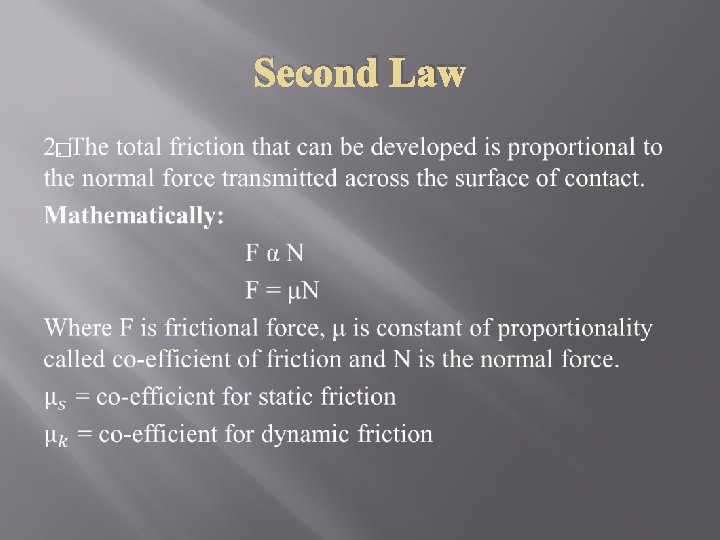
Second Law �
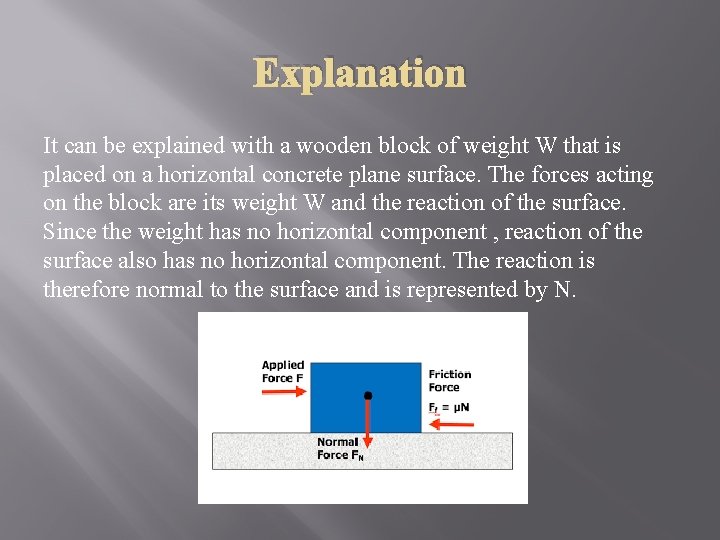
Explanation It can be explained with a wooden block of weight W that is placed on a horizontal concrete plane surface. The forces acting on the block are its weight W and the reaction of the surface. Since the weight has no horizontal component , reaction of the surface also has no horizontal component. The reaction is therefore normal to the surface and is represented by N.
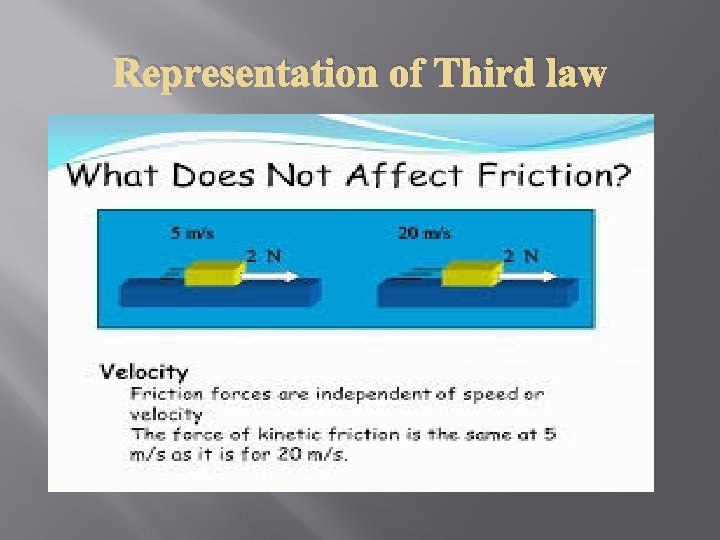
Third Law 3. For low velocities, total amount of frictional force is independent of velocity. � In this case, frictional force does not depend upon velocity when the object has very low velocity or it just start moving. � But when the object is moving with some velocity v, then the frictional force will depend upon velocity.
Representation of Third law