
Lawrence Berkeley National Laboratory Micro Systems Laboratory U
Lawrence Berkeley National Laboratory Micro. Systems Laboratory U. S. Department of Energy Detector R&D Review July 8 th, 2009 S. Holland
MSL Overview • The LBNL Micro. Systems Lab has facilities and expertise that are unique within the DOE National Laboratories • The MSL’s primary mission is the development of advanced detectors for x-ray/UV/visible/near IR imaging, and charged particle detection • The MSL also has production capability for modest-scale sensor fabrication to meet the needs of DOE science projects 2
Outline • Facilities, Personnel • Advanced CCDs - technology, applications • Major Accomplishments • Beyond HEP - other applications • Future R&D Directions • Conclusion 3
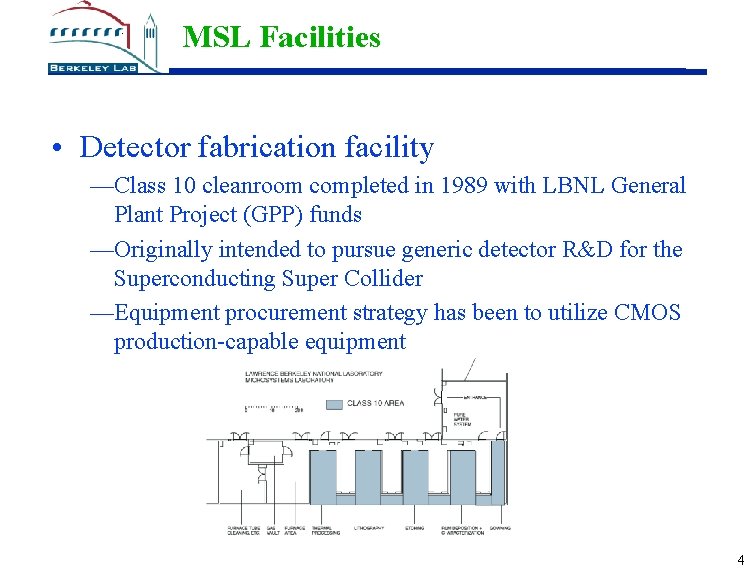
MSL Facilities • Detector fabrication facility —Class 10 cleanroom completed in 1989 with LBNL General Plant Project (GPP) funds —Originally intended to pursue generic detector R&D for the Superconducting Super Collider —Equipment procurement strategy has been to utilize CMOS production-capable equipment 4
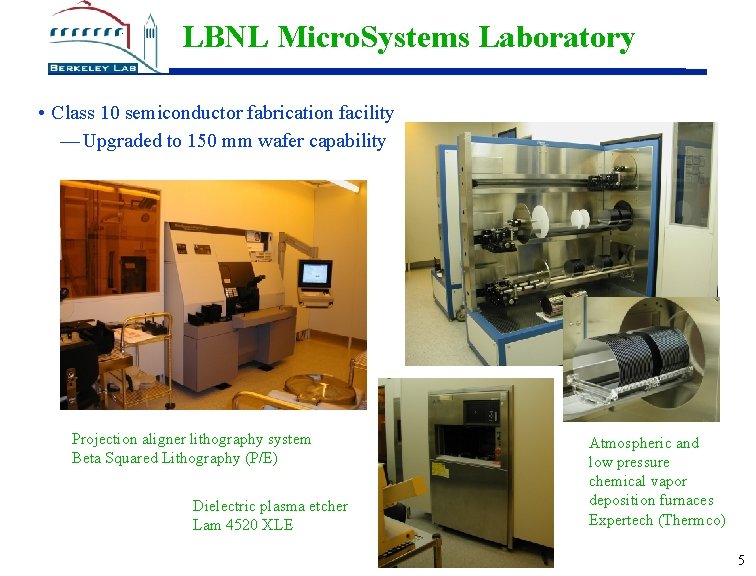
LBNL Micro. Systems Laboratory • Class 10 semiconductor fabrication facility — Upgraded to 150 mm wafer capability Projection aligner lithography system Beta Squared Lithography (P/E) Dielectric plasma etcher Lam 4520 XLE Atmospheric and low pressure chemical vapor deposition furnaces Expertech (Thermco) 5

MSL Facilities (cont’) • MSL also includes the CCD Testing Laboratory — 5 test dewars & associated electronics, light projection systems etc —Quantum efficiency test equipment —Pinhole projector for charge diffusion measurement —Class 1000 cleanroom with wirebonder for packaging —Cold probe station for wafer level testing prior to dicing and packaging —Wafer dicing facility 6
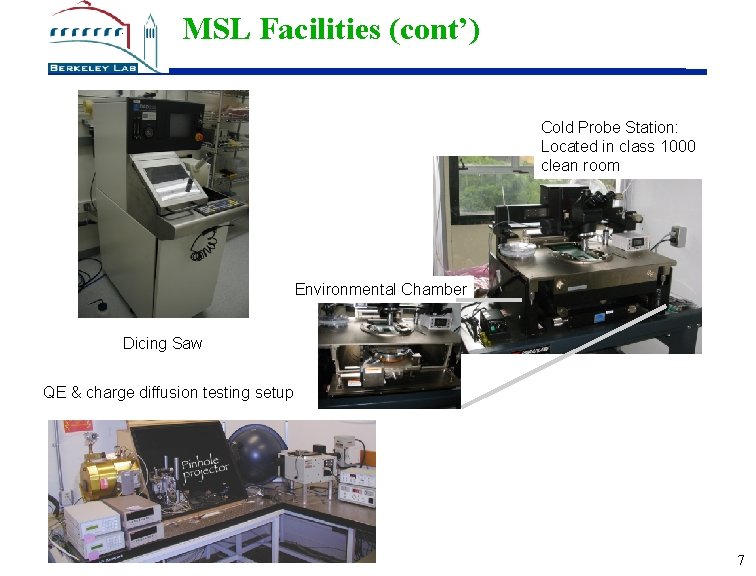
MSL Facilities (cont’) Cold Probe Station: Located in class 1000 clean room Environmental Chamber Dicing Saw QE & charge diffusion testing setup 7
Additional MSL Infrastructure • CCD mask layout and design rule checking software — Including access to advanced tools used by the IC design group • 2 -D semiconductor process and device simulation tools — Absolutely essential for the challenging device-design projects undertaken at the MSL • High-voltage compatible CCDs that can operate at large substrate bias voltages • In progress, R&D on single-photon counting CCDs utilizing holeinitiated impact ionization • Dedicated 8 -CPU Linux computer that can run up to 7 process/device simulations simultaneously 8
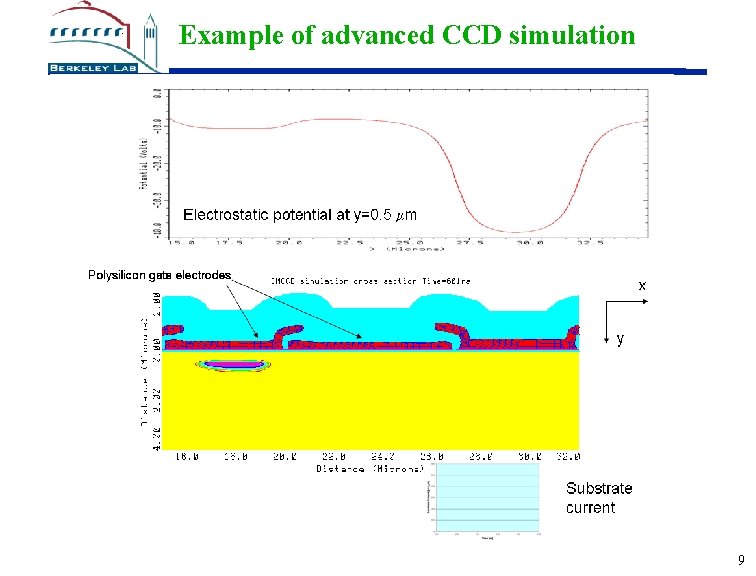
Example of advanced CCD simulation 9
MSL Head Count FY 09 • MSL Group Leader: N. Roe — Past leaders – H. Spieler, M. Levi, C. Bebek • CCD Design & Processing: — — Dr. Steve Holland: device & process design Nick Palaio: facility manager, process engineer Guobin Wang: device processing, testing Co Tran: device processing • CCD Packaging and Testing: — — — Dr. Bill Kolbe(ret): CCD test & characterization Julie Lee: CCD testing & cold probing Armin Karcher: electronics engineer John Emes: technician (packaging, cold probing) Yvette Irwin (SSL): part-time technical support Sharon Jelinsky (SSL): part-time mechanical tech • Postdocs and Students – typically 1 -2 of each • The MSL is supported by a combination of KA-15 as well as other sources of funding 10
Outline • Facilities, Personnel • Advanced CCDs - technology, applications • Major Accomplishments • Beyond HEP - other applications • Future R&D Directions • Conclusion 11

Scientific CCD overview • Scientific CCDs used in astronomy achieve extraordinary performance, and improvements are still forthcoming —Back illumination to avoid light absorption in the front-side circuitry results in quantum efficiencies approaching 100% • Commercial digital camera imagers peak at ~ 40% —Operation at cryogenic temperatures results in dark currents measured in electrons/pixel-hour, enabling very long exposures to detect faint objects —Slow-scan readout results in read noise levels approaching 1 – 2 e- rms —Charge transfer inefficiencies less than 1 x 10 -5 allow for CCDs with millions of pixels, without image degradation during readout 12

Scientific CCD overview (cont’) —In terms of chip size, scientific CCDs are the largest integrated circuits in production • Low fabrication yields for high quality, large format devices still result in relatively high prices —Scientific CCD cameras used in astronomy have enabled significant discoveries for DOE science • Dark Energy: Discovered by the LBNL SCP group who pioneered digital CCD image subtractions to find supernovae • Baryon Acoustic Oscillation: First detected by the Sloan Digital Sky Survey, employing the largest focal plane of its time 13
Scientific CCD overview (cont’) —The ability to produce Gpixel camera systems is enabling Stage III and Stage IV generation cosmology experiments that complement accelerator-based particle physics (e. g. DES, LSST, JDEM) —Next generation spectroscopy projects are based on advances in QE, read noise (e. g. BOSS, Big. BOSS) 14
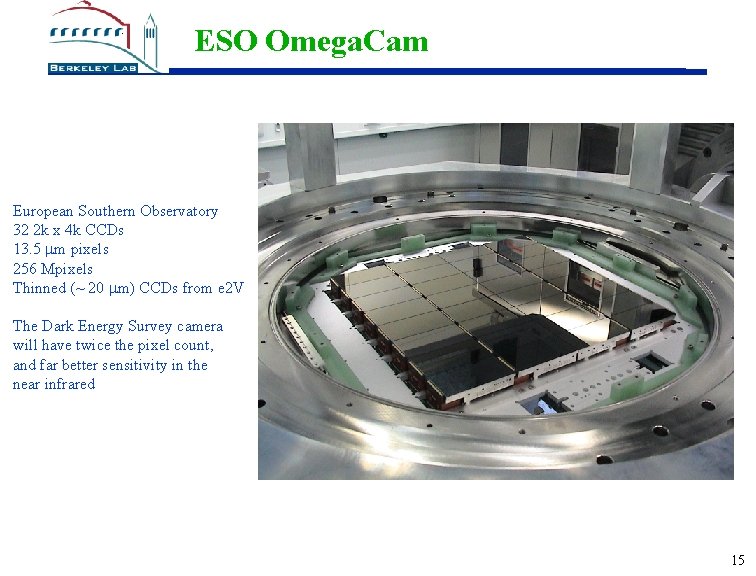
ESO Omega. Cam European Southern Observatory 32 2 k x 4 k CCDs 13. 5 mm pixels 256 Mpixels Thinned (~ 20 mm) CCDs from e 2 V The Dark Energy Survey camera will have twice the pixel count, and far better sensitivity in the near infrared 15
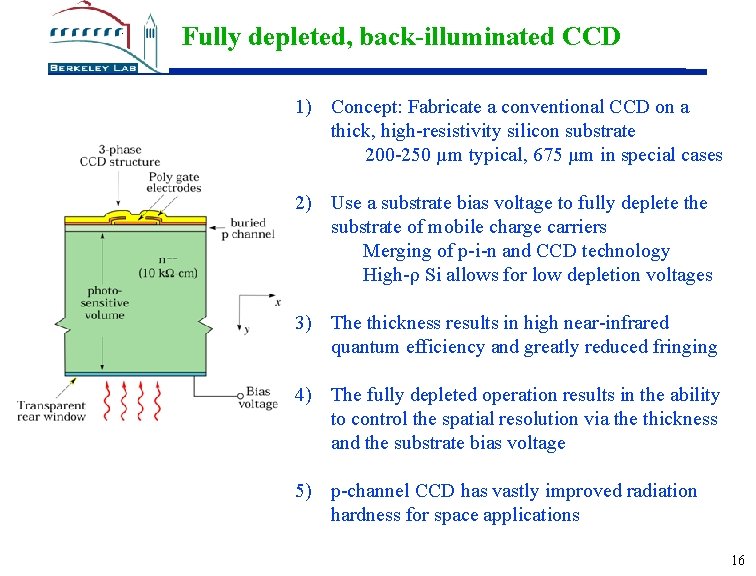
Fully depleted, back-illuminated CCD 1) Concept: Fabricate a conventional CCD on a thick, high-resistivity silicon substrate 200 -250 µm typical, 675 µm in special cases 2) Use a substrate bias voltage to fully deplete the substrate of mobile charge carriers Merging of p-i-n and CCD technology High-ρ Si allows for low depletion voltages 3) The thickness results in high near-infrared quantum efficiency and greatly reduced fringing 4) The fully depleted operation results in the ability to control the spatial resolution via the thickness and the substrate bias voltage 5) p-channel CCD has vastly improved radiation hardness for space applications 16
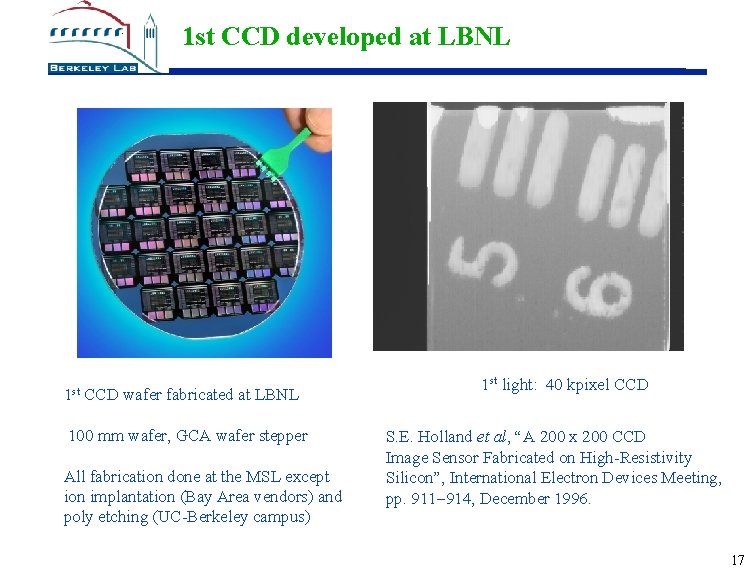
1 st CCD developed at LBNL 1 st CCD wafer fabricated at LBNL 100 mm wafer, GCA wafer stepper All fabrication done at the MSL except ion implantation (Bay Area vendors) and poly etching (UC-Berkeley campus) 1 st light: 40 kpixel CCD S. E. Holland et al, “A 200 x 200 CCD Image Sensor Fabricated on High-Resistivity Silicon”, International Electron Devices Meeting, pp. 911 914, December 1996. 17
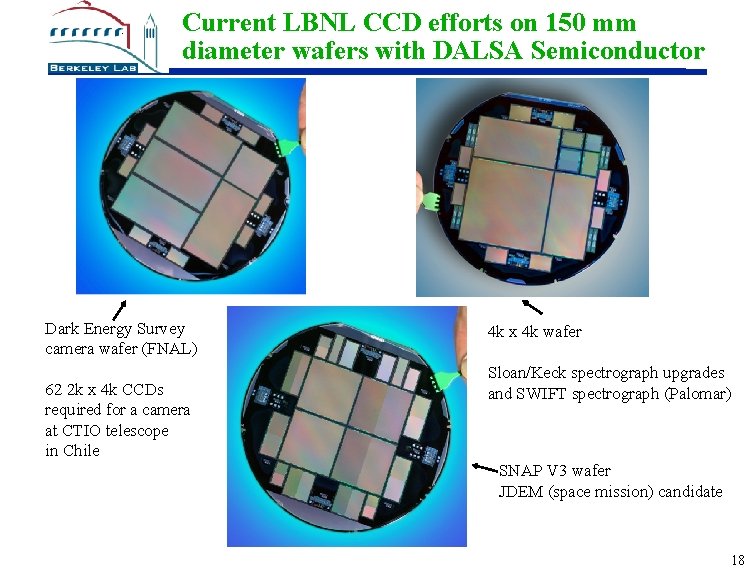
Current LBNL CCD efforts on 150 mm diameter wafers with DALSA Semiconductor Dark Energy Survey camera wafer (FNAL) 62 2 k x 4 k CCDs required for a camera at CTIO telescope in Chile 4 k x 4 k wafer Sloan/Keck spectrograph upgrades and SWIFT spectrograph (Palomar) SNAP V 3 wafer JDEM (space mission) candidate 18
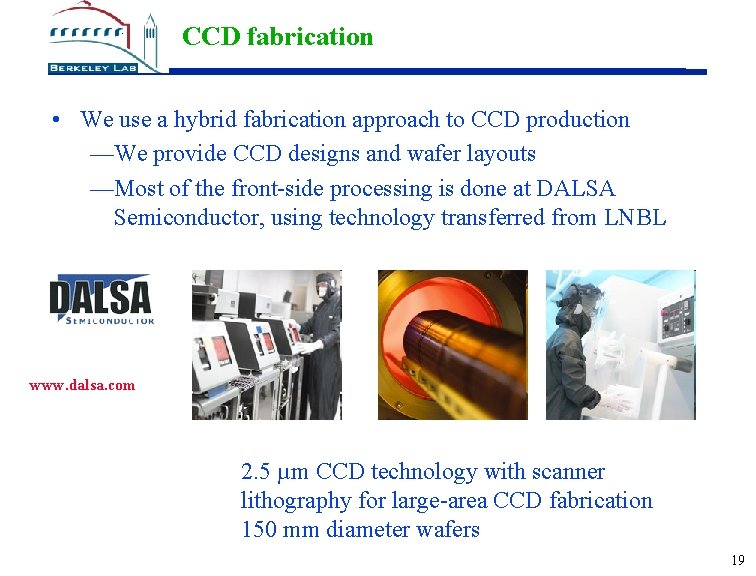
CCD fabrication • We use a hybrid fabrication approach to CCD production —We provide CCD designs and wafer layouts —Most of the front-side processing is done at DALSA Semiconductor, using technology transferred from LNBL www. dalsa. com 2. 5 µm CCD technology with scanner lithography for large-area CCD fabrication 150 mm diameter wafers 19
CCD fabrication • Hybrid fabrication approach to CCD production —The wafers are shipped to LBNL after completion of about 80% of the processing —The wafers are thinned to the final desired thickness, typically 200– 250 µm thick, at a commercial vendor —Processing of thinned wafers at the foundry is not feasible at this time, so the specialized steps on thinned wafers necessary to produce back-illuminated CCDs are done at LBNL • This is a much more efficient production model than the previous method where all CCD fabrication was done in the MSL • However, full production at the MSL was essential in proving the fully depleted CCD concept, and the fabrication experience gained is key to our ability to effectively interface with DALSA Semiconductor 20
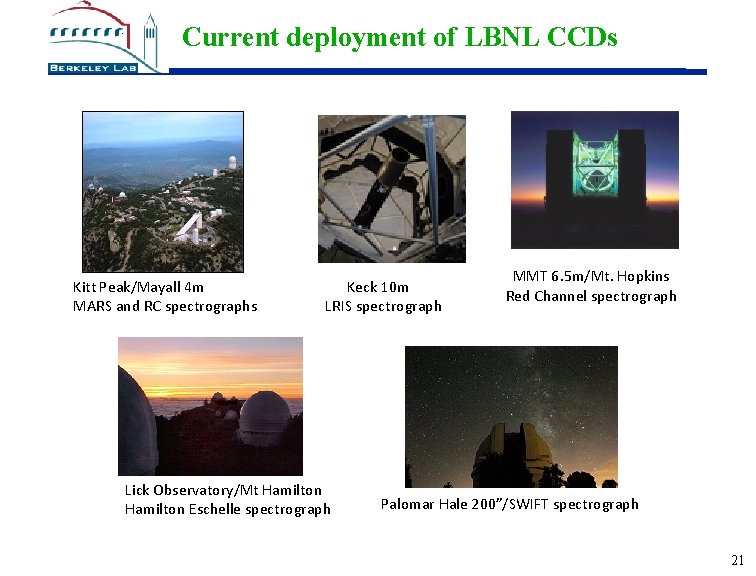
Current deployment of LBNL CCDs Kitt Peak/Mayall 4 m MARS and RC spectrographs Keck 10 m LRIS spectrograph Lick Observatory/Mt Hamilton Eschelle spectrograph MMT 6. 5 m/Mt. Hopkins Red Channel spectrograph Palomar Hale 200”/SWIFT spectrograph 21
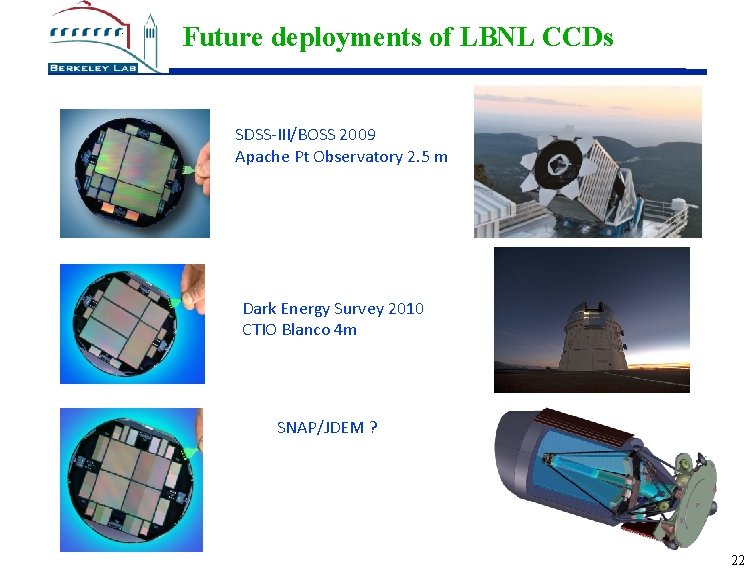
Future deployments of LBNL CCDs SDSS-III/BOSS 2009 Apache Pt Observatory 2. 5 m Dark Energy Survey 2010 CTIO Blanco 4 m SNAP/JDEM ? 22
Outline • Facilities, Personnel • Advanced CCDs - technology, applications • Major Accomplishments • Beyond HEP - other applications • Future R&D Directions • Conclusion 23
Major Accomplishments • • Production of CCDs for the Dark Energy Survey Delivery of 4 k x 4 k CCDs for BOSS Deployment of 2 k x 4 k CCDs on Keck Completion of device design and space qualification for SNAP CCDs • CCD technology transfer • Development and delivery of charged particle detectors for the Stereo and Themis space missions 24
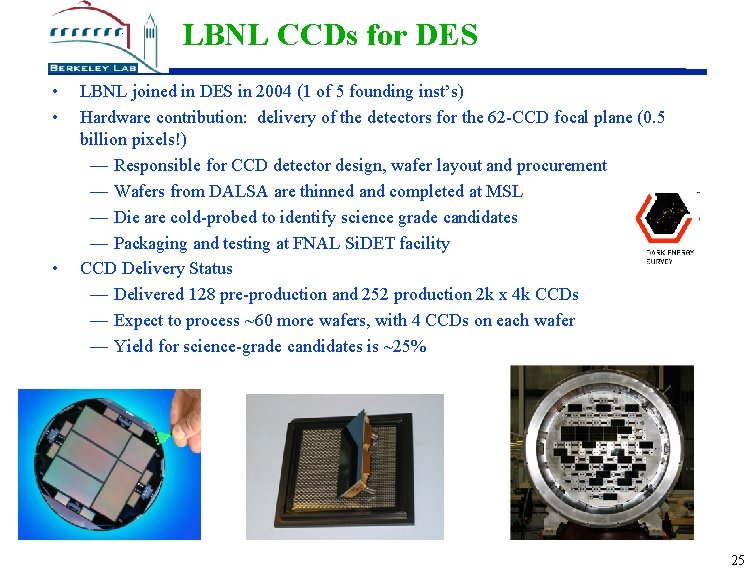
LBNL CCDs for DES • • • LBNL joined in DES in 2004 (1 of 5 founding inst’s) Hardware contribution: delivery of the detectors for the 62 -CCD focal plane (0. 5 billion pixels!) — Responsible for CCD detector design, wafer layout and procurement — Wafers from DALSA are thinned and completed at MSL — Die are cold-probed to identify science grade candidates — Packaging and testing at FNAL Si. DET facility CCD Delivery Status — Delivered 128 pre-production and 252 production 2 k x 4 k CCDs — Expect to process ~60 more wafers, with 4 CCDs on each wafer — Yield for science-grade candidates is ~25% 25
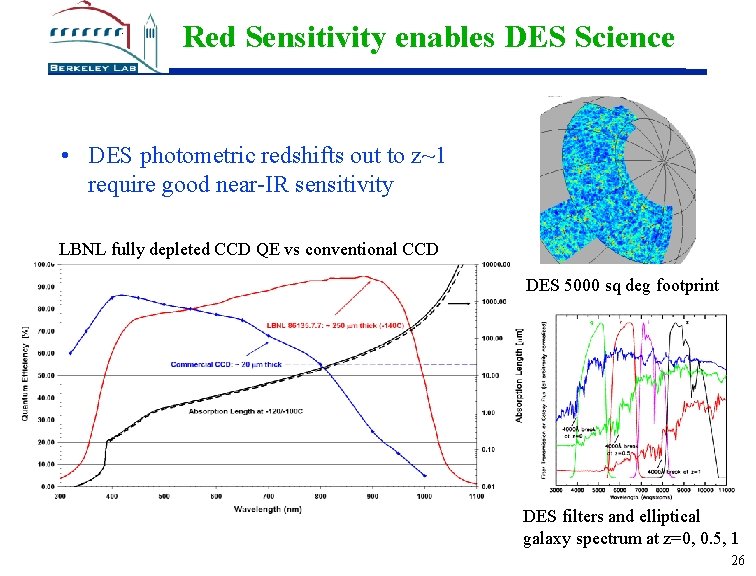
Red Sensitivity enables DES Science • DES photometric redshifts out to z~1 require good near-IR sensitivity LBNL fully depleted CCD QE vs conventional CCD DES 5000 sq deg footprint DES filters and elliptical galaxy spectrum at z=0, 0. 5, 1 26
Major Accomplishments • • Production of CCDs for the Dark Energy Survey Delivery of 4 k x 4 k CCDs for BOSS Deployment of 2 k x 4 k CCDs on Keck Completion of device design and space qualification for SNAP CCDs • CCD technology transfer • Development and delivery of charged particle detectors for the STEREO and THEMIS space missions 27
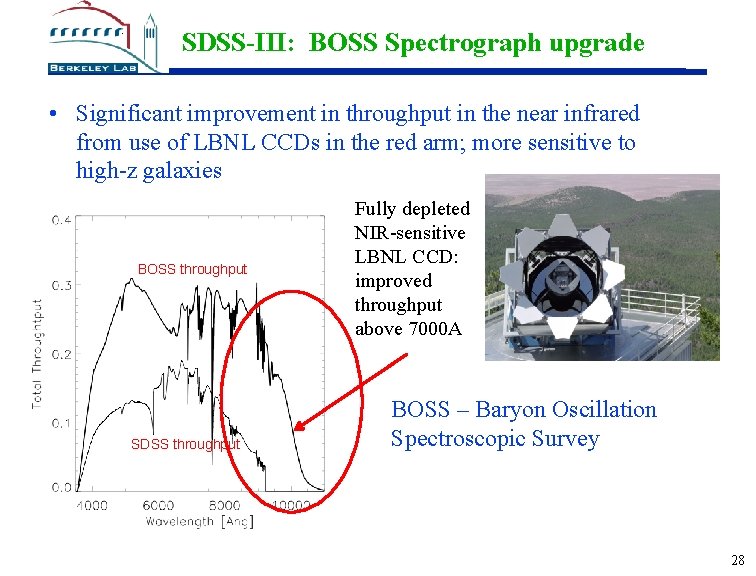
SDSS-III: BOSS Spectrograph upgrade • Significant improvement in throughput in the near infrared from use of LBNL CCDs in the red arm; more sensitive to high-z galaxies BOSS throughput SDSS throughput Fully depleted NIR-sensitive LBNL CCD: improved throughput above 7000 A BOSS – Baryon Oscillation Spectroscopic Survey 28
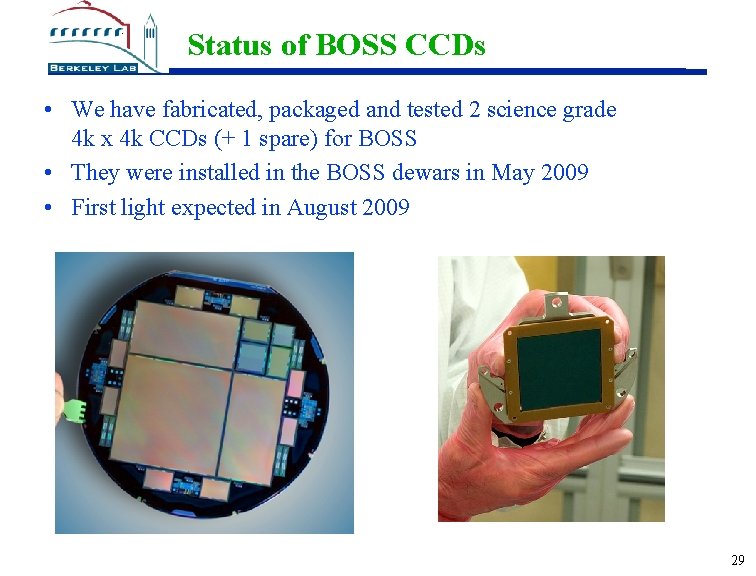
Status of BOSS CCDs • We have fabricated, packaged and tested 2 science grade 4 k x 4 k CCDs (+ 1 spare) for BOSS • They were installed in the BOSS dewars in May 2009 • First light expected in August 2009 29
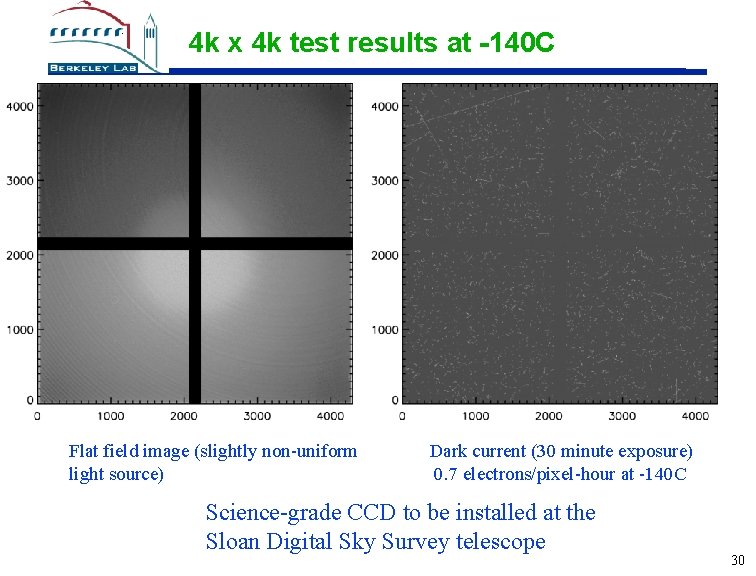
4 k x 4 k test results at -140 C Flat field image (slightly non-uniform light source) Dark current (30 minute exposure) 0. 7 electrons/pixel-hour at -140 C Science-grade CCD to be installed at the Sloan Digital Sky Survey telescope 30
Major Accomplishments • • Production of CCDs for the Dark Energy Survey Delivery of 4 k x 4 k CCDs for BOSS Deployment of 2 k x 4 k CCDs on Keck Completion of device design and space qualification for SNAP CCDs • CCD technology transfer • Development and delivery of charged particle detectors for the STEREO and THEMIS space missions 31
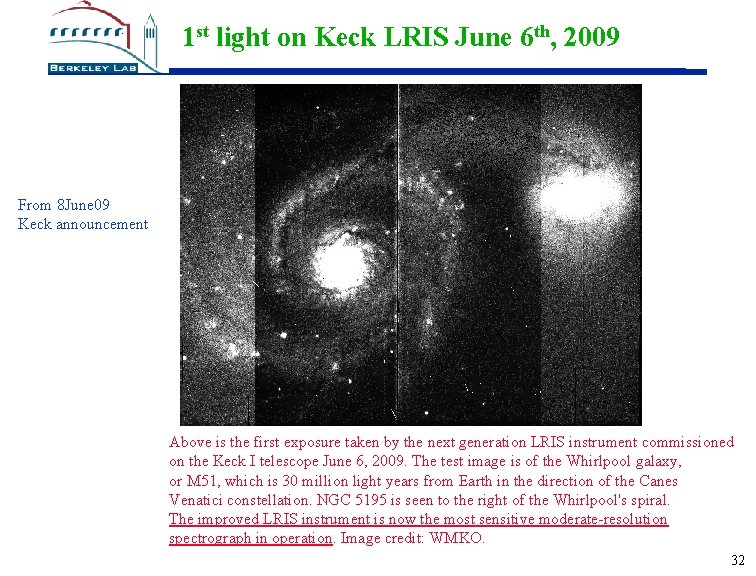
1 st light on Keck LRIS June 6 th, 2009 From 8 June 09 Keck announcement Above is the first exposure taken by the next generation LRIS instrument commissioned on the Keck I telescope June 6, 2009. The test image is of the Whirlpool galaxy, or M 51, which is 30 million light years from Earth in the direction of the Canes Venatici constellation. NGC 5195 is seen to the right of the Whirlpool's spiral. The improved LRIS instrument is now the most sensitive moderate-resolution spectrograph in operation. Image credit: WMKO. 32
Major Accomplishments • • Production of CCDs for the Dark Energy Survey Delivery of 4 k x 4 k CCDs for BOSS Deployment of 2 k x 4 k CCDs on Keck Completion of device design and space qualification for SNAP CCDs • CCD technology transfer • Development and delivery of charged particle detectors for the STEREO and THEMIS space missions 33
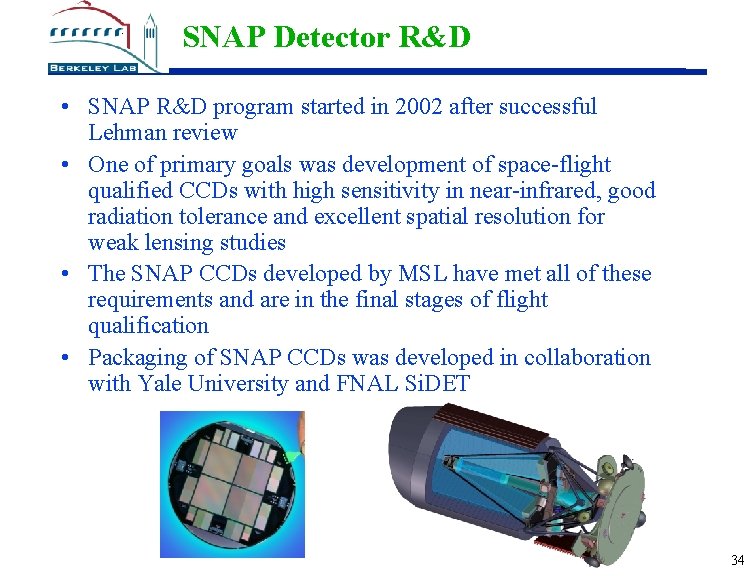
SNAP Detector R&D • SNAP R&D program started in 2002 after successful Lehman review • One of primary goals was development of space-flight qualified CCDs with high sensitivity in near-infrared, good radiation tolerance and excellent spatial resolution for weak lensing studies • The SNAP CCDs developed by MSL have met all of these requirements and are in the final stages of flight qualification • Packaging of SNAP CCDs was developed in collaboration with Yale University and FNAL Si. DET 34
SNAP Detector R&D • LBNL p-channel technology significantly more resistant to the effects of space protons when compared to the conventional n-channel CCDs —Not planned, a fortuitous side-effect from the early SSC detector development days when we observed that making detectors with low dark current was much easier on highresistivity n-type silicon —N-channel CCDs degrade due to the generation of phosphorus-vacancy defects that are efficient electron traps • Degrade charge transfer efficiency —For p-channel CCDs the dominant trap is the 2 nd order divacancy 35
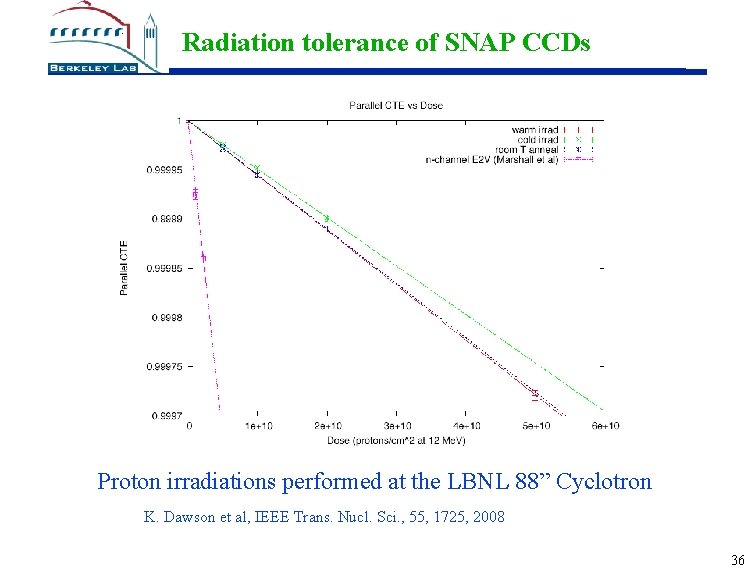
Radiation tolerance of SNAP CCDs Proton irradiations performed at the LBNL 88” Cyclotron K. Dawson et al, IEEE Trans. Nucl. Sci. , 55, 1725, 2008 36
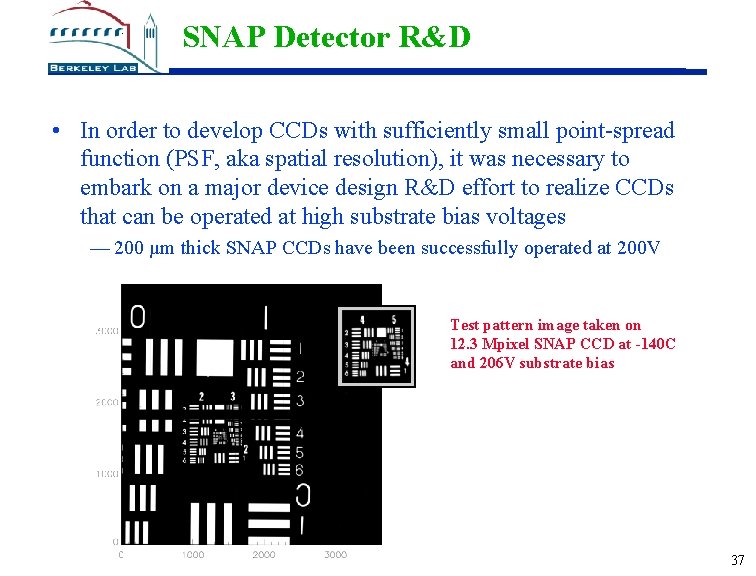
SNAP Detector R&D • In order to develop CCDs with sufficiently small point-spread function (PSF, aka spatial resolution), it was necessary to embark on a major device design R&D effort to realize CCDs that can be operated at high substrate bias voltages — 200 µm thick SNAP CCDs have been successfully operated at 200 V Test pattern image taken on 12. 3 Mpixel SNAP CCD at -140 C and 206 V substrate bias 37
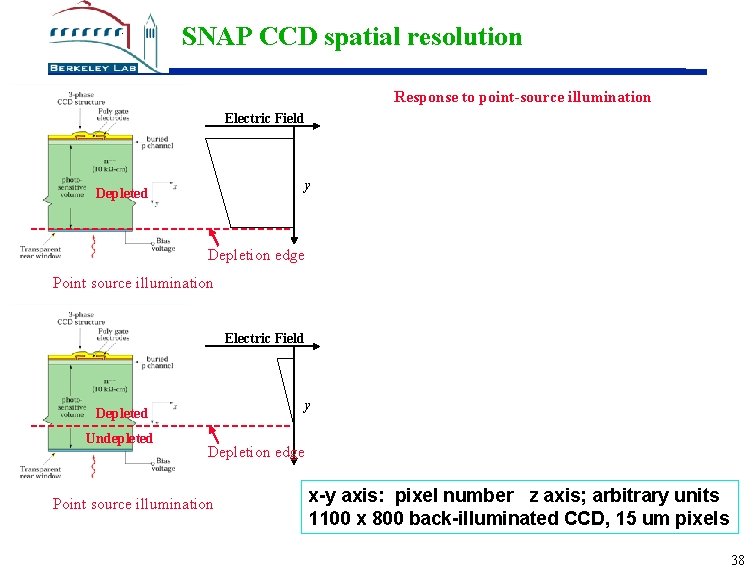
SNAP CCD spatial resolution Response to point-source illumination Electric Field y Depleted Depletion edge Point source illumination Electric Field y Depleted Undepleted Depletion edge Point source illumination x-y axis: pixel number z axis; arbitrary units 1100 x 800 back-illuminated CCD, 15 um pixels 38
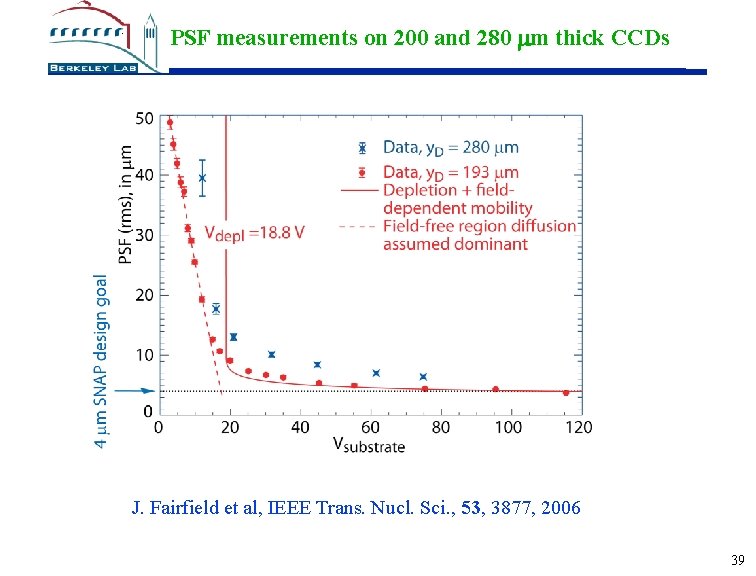
PSF measurements on 200 and 280 mm thick CCDs J. Fairfield et al, IEEE Trans. Nucl. Sci. , 53, 3877, 2006 39
SNAP Detector R&D • We are developing with DALSA Semiconductor a process flow that utilizes a refractory metal stack in place of the aluminum — Alternating layers of Ti and Ti. N • The order of the present process flow is; ~ 80% processing at DALSA, thinning, backside contact formation at 600– 650 C, contact mask/etch, aluminum metallization, anti-reflecting (AR) coatings — Al not compatible with 600 C process steps • The refractory metal process flow is; full completion at DALSA, thinning, backside contact formation at 600– 650 C, AR coatings • Potential advantages — Simpler process, less costly — Possibility of thinner detectors for improved charge diffusion — Less wafer handling reducing the incidence of “back-side defects” • Main drawback is higher sheet resistance of Ti/Ti. N compared to aluminum (~ 10 x) 40
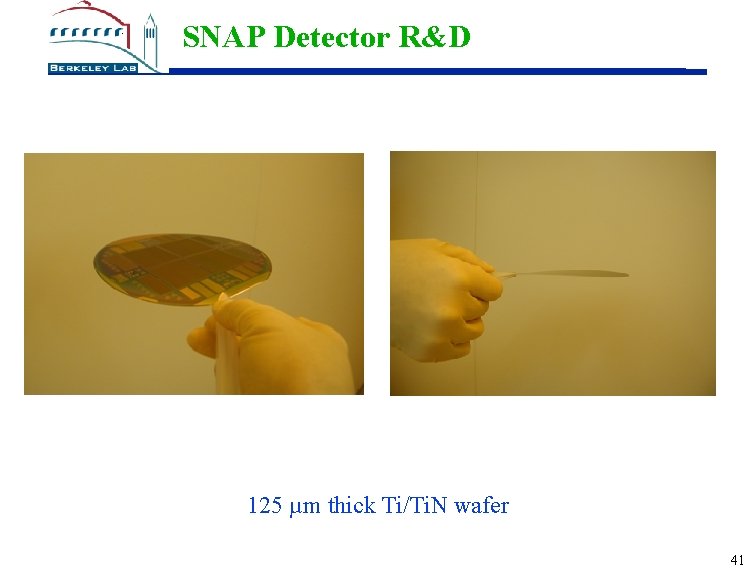
SNAP Detector R&D 125 µm thick Ti/Ti. N wafer 41
Major Accomplishments • • Production of CCDs for the Dark Energy Survey Delivery of 4 k x 4 k CCDs for BOSS Deployment of 2 k x 4 k CCDs on Keck Completion of device design and space qualification for SNAP CCDs • CCD technology transfer • Development and delivery of charged particle detectors for the STEREO and THEMIS space missions 42
Tranfer of CCD technology to industry • CCD technology transfer to industry is underway —Preferred method is through licensing of LBNL patents • U. S. Patent 6, 025, 585, “Low-resistivity photon-transparent window attached to photosensitive silicon detector, ” Feb. 15, 2000. • U. S. Patent 6, 259, 085, “Fully depleted back illuminated CCD, '' July 10 th, 2001. • U. S. Patent 7, 271, 468 B 2, “High-voltage compatible, full-depleted CCD, ” Sept. 18, 2007. —Patent 6, 025, 585 has been licensed successfully to Digirad Corporation, a supplier of solid-state gamma cameras for nuclear medical imaging applications – http: //www. digirad. com • High QE, low dark current LBNL back-illuminated photodiode arrays are a key technology in the portable SPECT gamma-ray camera developed by Digirad —Main application is cardiology • Also an enabling technology for the charged-particle detectors developed for space missions that are described later 43
Tranfer of CCD technology to industry • CCD technology transfer to industry is underway (cont’) —Detailed discussions were held with engineers from Fairchild Imaging • However, Fairchild chose to close their CCD fabrication facility and to go with a foundry business model —The less preferable technology transfer method, albeit the method that is working, is via LBNL publications and presentations • Hamamatsu is producing fully depleted, back-illuminated, pchannel CCDs for the Subaru telescope and for x-ray astronomy groups • e 2 V has described efforts in fully depleted CCD fabrication • MIT Lincoln Laboratory is producing 75 µm thick fully depleted CCDs for Pan-STARRS 44
Major Accomplishments • • Production of CCDs for the Dark Energy Survey Delivery of 4 k x 4 k CCDs for BOSS Deployment of 2 k x 4 k CCDs on Keck Completion of device design and space qualification for SNAP CCDs • CCD technology transfer • Development and delivery of charged particle detectors for the STEREO and THEMIS space missions 45
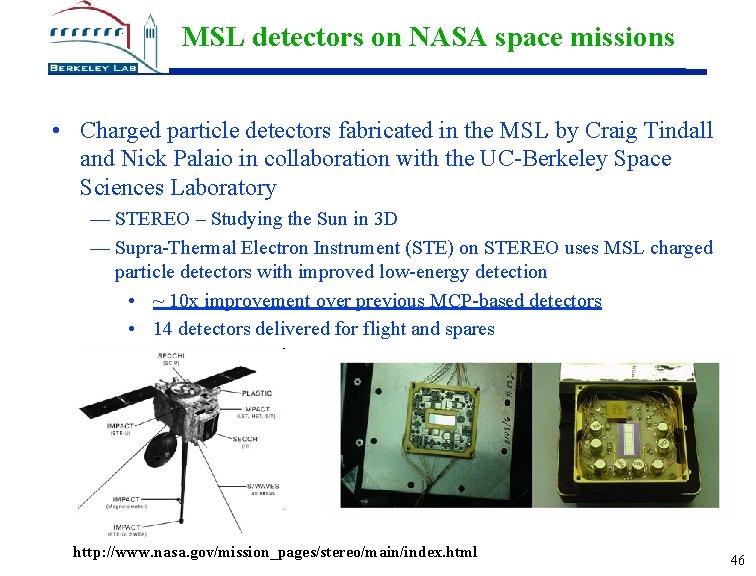
MSL detectors on NASA space missions • Charged particle detectors fabricated in the MSL by Craig Tindall and Nick Palaio in collaboration with the UC-Berkeley Space Sciences Laboratory — STEREO – Studying the Sun in 3 D — Supra-Thermal Electron Instrument (STE) on STEREO uses MSL charged particle detectors with improved low-energy detection • ~ 10 x improvement over previous MCP-based detectors • 14 detectors delivered for flight and spares http: //www. nasa. gov/mission_pages/stereo/main/index. html 46
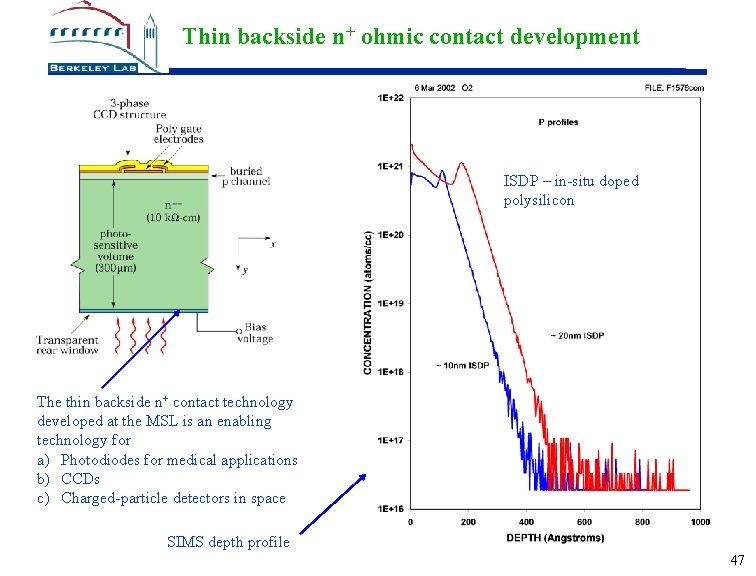
Thin backside n+ ohmic contact development ISDP – in-situ doped polysilicon The thin backside n+ contact technology developed at the MSL is an enabling technology for a) Photodiodes for medical applications b) CCDs c) Charged-particle detectors in space SIMS depth profile 47
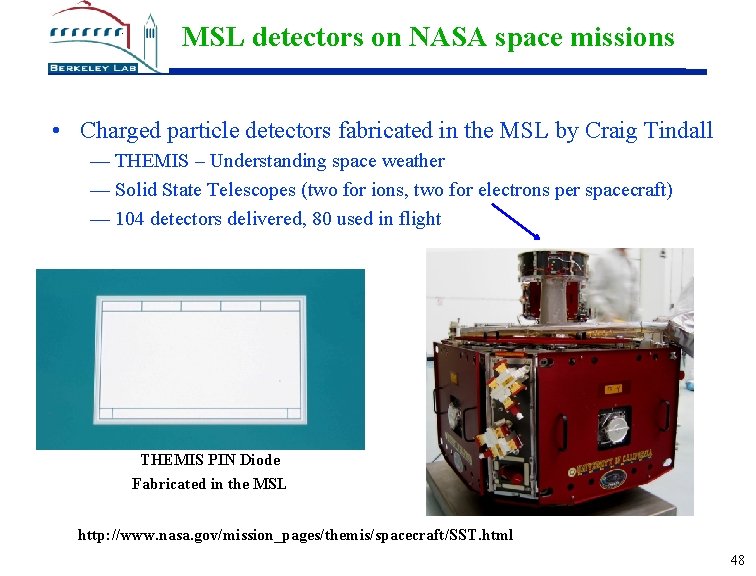
MSL detectors on NASA space missions • Charged particle detectors fabricated in the MSL by Craig Tindall — THEMIS – Understanding space weather — Solid State Telescopes (two for ions, two for electrons per spacecraft) — 104 detectors delivered, 80 used in flight THEMIS PIN Diode Fabricated in the MSL http: //www. nasa. gov/mission_pages/themis/spacecraft/SST. html 48
Major Accomplishments (cont’) • Publications: over 30 published papers, regular conference contributions (see complete list at www-ccd. lbl. gov) • Training of students and postdocs • Students: Julie Lundy, Jessamyn Fairfield, Juhi Saha, Koki Takasaki, Joanne Daniels, Jon Thacker, Ingo Grosshans, Timo Foerschler, Jochen Reith, Martin Kreis, Maximilian Fabricius, Markus Redelstab, Jens Steckert, Sebastian Kurz, Heiko Bertsch, Martin Wagner — Two of our former students are in Physics Ph. D programs (Fairfield and Fabricius) • Postdocs: Val Prasad, Stephen Bailey, Kyle Dawson, Nick Mostek — Note that the model for Postdocs has been to split time between MSL efforts and science work with the Super. Nova Cosmology Group 49
Outline • Facilities, Personnel • Advanced CCDs - technology, applications • Major Accomplishments • Beyond HEP - other applications • Future R&D Directions • Conclusion 50
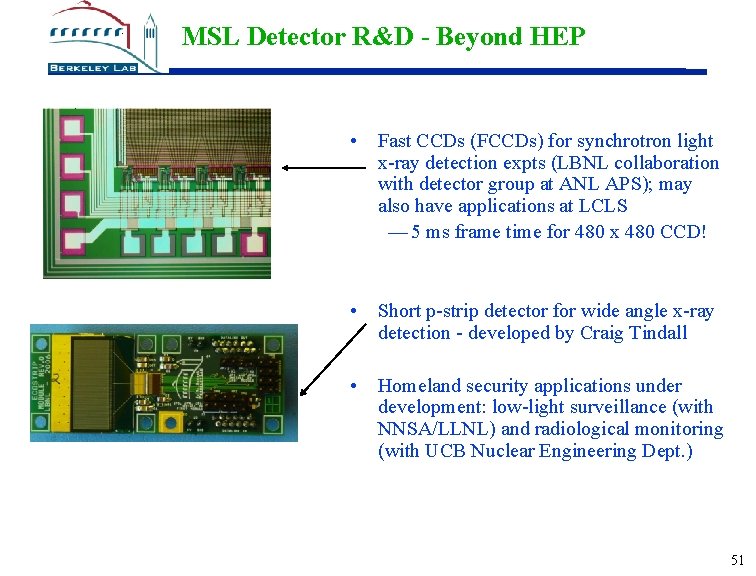
MSL Detector R&D - Beyond HEP • Fast CCDs (FCCDs) for synchrotron light x-ray detection expts (LBNL collaboration with detector group at ANL APS); may also have applications at LCLS — 5 ms frame time for 480 x 480 CCD! • Short p-strip detector for wide angle x-ray detection - developed by Craig Tindall • Homeland security applications under development: low-light surveillance (with NNSA/LLNL) and radiological monitoring (with UCB Nuclear Engineering Dept. ) 51
Outline • Facilities, Personnel • Advanced CCDs - technology, applications • Major Accomplishments • Beyond HEP - other applications • Future R&D Directions • Conclusion 52
MSL R&D Directions • A major near-term research direction for scientific CCDs is the development of imagers with • • Faster readout Lower noise Single-photon sensitivity Higher yield/lower cost • We are working with our industrial collaborator DALSA Semiconductor to explore advanced technology concepts to achieve these goals 53
MSL R&D Directions • Upcoming R&D fabrication run at DALSA includes — Methods to reduce parasitic capacitance at the output transistor to reduce noise • “Buried contact technology” — Charge multiplying CCD for single photon sensitivity • Seed funding from NASA Goddard, now funded through NNSA for Homeland Security • Exploration of novel technology steps — Higher speed readout with increased numbers of parallel readout channels and 2 -stage amplifiers for increased bandwidth • Mini-LSST CCD with 6 readouts • Will also be the starting point for ~ 16 Mpixel CCDs with 2– 4 frames/sec readout for day/night surveillance with NNSA/LLNL — Fast CCD with multiple outputs for x-ray detection at light sources (collaboration with Peter Denes of LBNL Eng. Div. and the ALS) — Refractory metal process for simplified processing, thinner devices, and potentially higher yield 54
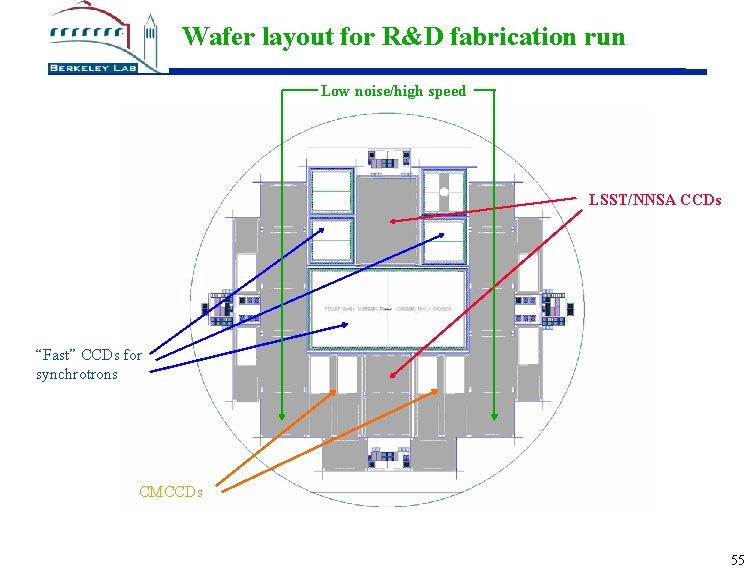
Wafer layout for R&D fabrication run Low noise/high speed LSST/NNSA CCDs “Fast” CCDs for synchrotrons CMCCDs 55
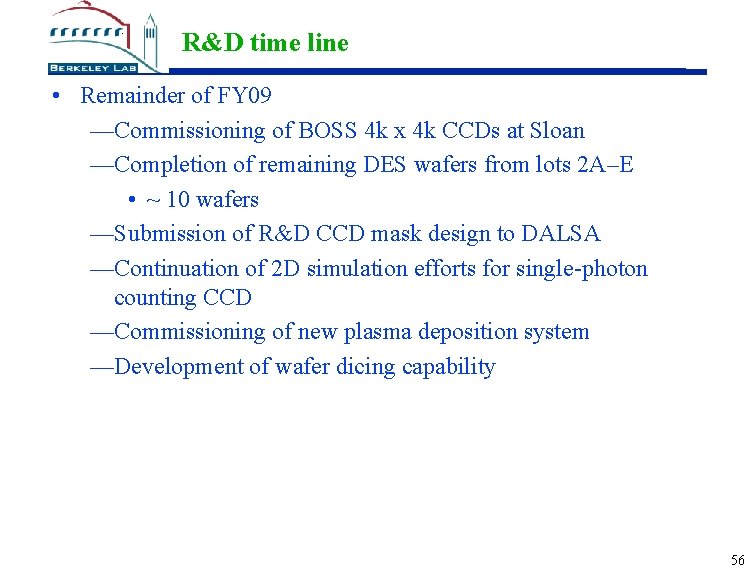
R&D time line • Remainder of FY 09 —Commissioning of BOSS 4 k x 4 k CCDs at Sloan —Completion of remaining DES wafers from lots 2 A–E • ~ 10 wafers —Submission of R&D CCD mask design to DALSA —Continuation of 2 D simulation efforts for single-photon counting CCD —Commissioning of new plasma deposition system —Development of wafer dicing capability 56
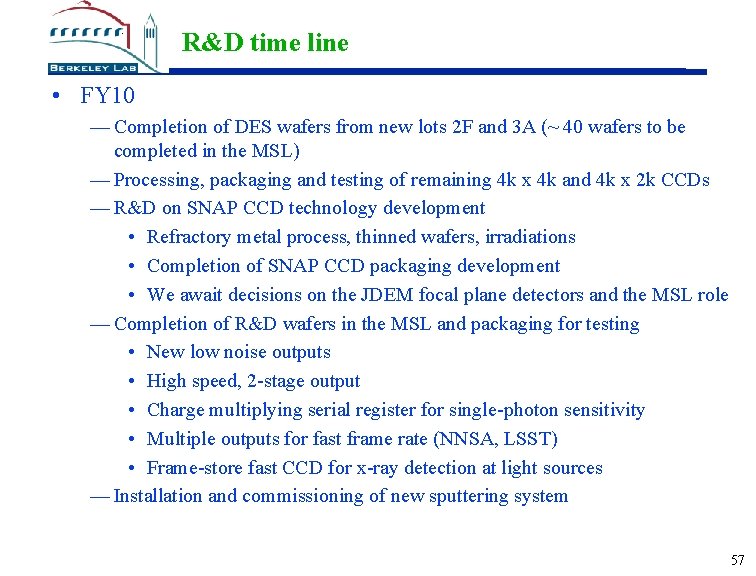
R&D time line • FY 10 — Completion of DES wafers from new lots 2 F and 3 A (~ 40 wafers to be completed in the MSL) — Processing, packaging and testing of remaining 4 k x 4 k and 4 k x 2 k CCDs — R&D on SNAP CCD technology development • Refractory metal process, thinned wafers, irradiations • Completion of SNAP CCD packaging development • We await decisions on the JDEM focal plane detectors and the MSL role — Completion of R&D wafers in the MSL and packaging for testing • New low noise outputs • High speed, 2 -stage output • Charge multiplying serial register for single-photon sensitivity • Multiple outputs for fast frame rate (NNSA, LSST) • Frame-store fast CCD for x-ray detection at light sources — Installation and commissioning of new sputtering system 57
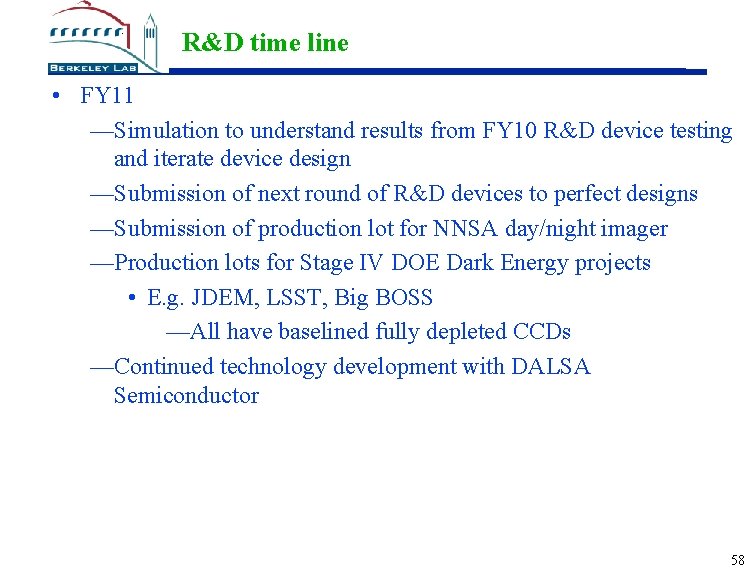
R&D time line • FY 11 —Simulation to understand results from FY 10 R&D device testing and iterate device design —Submission of next round of R&D devices to perfect designs —Submission of production lot for NNSA day/night imager —Production lots for Stage IV DOE Dark Energy projects • E. g. JDEM, LSST, Big BOSS —All have baselined fully depleted CCDs —Continued technology development with DALSA Semiconductor 58
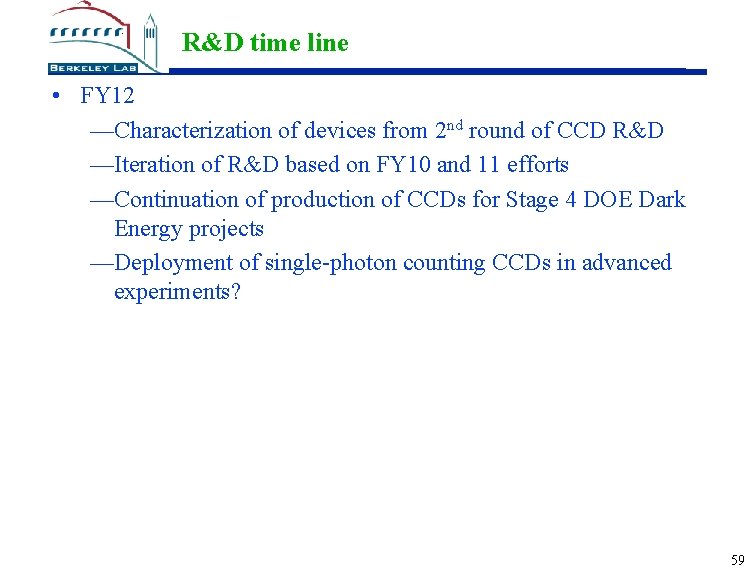
R&D time line • FY 12 —Characterization of devices from 2 nd round of CCD R&D —Iteration of R&D based on FY 10 and 11 efforts —Continuation of production of CCDs for Stage 4 DOE Dark Energy projects —Deployment of single-photon counting CCDs in advanced experiments? 59
MSL needs • CCD testing lab infrastructure improvements —Push towards higher readout rates with large numbers of output amplifiers and lower noise will require new approaches for readout electronics and software in the MSL CCD testing lab • Need to hire a new CCD test engineer able to address the issue raised above —Present staff consists of one retiree and one part time employee • MSL relies heavily on innovation in semiconductor device design and technology development —Need to augment staff with Ph. D-level expert in silicon device physics (Post doc to start with? ) 60
Community involvement • We actively collaborate with other DOE/NASA laboratories, Universities, and Observatories — FNAL – CCDs for the Dark Energy Survey project — Argonne – Fast CCD for x-ray synchrotron applications — LLNL – Day/night imaging project with NNSA — NASA JPL – Collaboration on technology development (delta-doping for CCDs, charged particle detectors) — NASA Goddard – Single-photon counting CCDs — University of California Observatories – Major contributors to early CCD effort, responsible for fielding LBNL CCDs on Keck — Lick Observatory, NOAO, APO, Keck, etc — UC-Berkeley Nuclear Engineering Department – Novel CCD detector with segmented back side for timing resolution — Yale University – SNAP CCD packaging development (and FNAL) — We are interested in providing fully depleted CCDs for LSST as part of a collaboration with FNAL (for packaging/test) and SLAC (lead on LSST focal plane) 61
Conclusions • MSL is a unique DOE facility that has developed innovative detectors that are a key enabling technology for HEP Dark Energy studies, solar physics space missions, & synchrotron radiation science • Ongoing R&D program is likely to result in additional breakthrough detectors for a variety of DOE science uses, as well as Homeland Security 62
- Slides: 62