
LAW RELATING TO BAILS PRESENTATION BY RAJASTHAN STATE

LAW RELATING TO BAILS PRESENTATION BY RAJASTHAN STATE LEGAL SERVICES AUTHORITY
LAW RELATING TO BAILS • The laws of bail balances two conflicting demands: • The requirements of the society for being shielded from the misadventures of accused person; and • Individual freedom
• Article 21 of the Constitution of India guarantees Fundamental Rights to life and personal liberty. • Cardinal principles which flow from this Fundamental Right: (i) Everyone is presumed to be innocent until proved guilty; and, (ii) Grant of bail is the rule and its denial, is an exception.
Arrest Does not violate Article 21 of the Constitution of India Kalyan Chandra Sarkar • “Under the criminal laws of this country, a person accused of offences which are nonbailable, is liable to be detained in custody during the pendency of Trial unless he is enlarged on bail in accordance with law. Such detention cannot be questioned as being violatative of Article 21 of the constitution, since the same is authorized by Law. ”

• The term ‘Bail’ does not find its definition in the code but chapter XXXIII of the Code of Criminal Procedure, 1973 titled “Provisions as to Bail and Bonds” deals with bail. Bailable Offences • Section 436 Cr. P. C. deals with ‘Bailable offences’ where bail cannot be refused. Rather, even the arresting officer himself may release such an accused on bail. • Accused may seek bail as a matter of right in bailable offence U/s 436 Cr. P. C.
Subsequent Absence of Accused • In case the accused fails to appear as per the terms of the bail bond, the Magistrate may refuse him Bail when he appears subsequently. (Section 436 (2) Cr. P. C. ) • In bailable offences indigent persons can be released without sureties proviso and relevant explanation to section 436(1) Cr. P. C. , in this regard, are as under: • “Provided that such officer or Court, if he or it thinks fit, may, and is unable to furnish
Explanation to Provision of Section 436(1) Cr. P. C. • “Where a person is unable to give bail within a week of the date of his arrest, it shall be a sufficient ground for the officer or the court to presume that he is an indigent person for the purposes of this proviso”.
Right to seek bail on serving more than one half of the maximum possible sentence • Under Section 436 A Cr. P. C. an under Trial Prisoner (UTP) has the right to seek bail on serving more than one half of the maximum possible sentence on their personal bond. • No person can be detained in prison as an under trial for a period exceeding the maximum possible sentence. • This provision is, however, not applicable for those who are charged with offences punishable with the death sentence.

Non-Bailable Offences • Merely because an offence comes in the category of non-bailable offences would not mean that Bail cannot be granted in such offence. • Under Section 437 and 439 of the code, it is discretion of the court to grant or not to grant Bail in non-bailable offences. • Such discretion is based upon various parameters which have been laid down by the Supreme Court of India in various
Difference between Section 437 and 439 of the Code of Criminal Procedure • Section 437 of the Code puts embargo on grant of bail in cases of offences punishable with death or imprisonment for life unless it is incredible that the accused is guilty. • Section 439 empowers the sessions court or High court to grant bail even in such cases.
Considerations for Grant of Bail • Nature and gravity of the circumstances in which the offence is committed; • Position and status of the accused with reference to the victim of the offences; • The likelihood, of the accused of fleeing from justice, of repeating the offence of jeopardizing his own life while faced with a grim prospect of possible conviction in the case; • Of tampering with witnesses; and, • The consideration of history of the case as
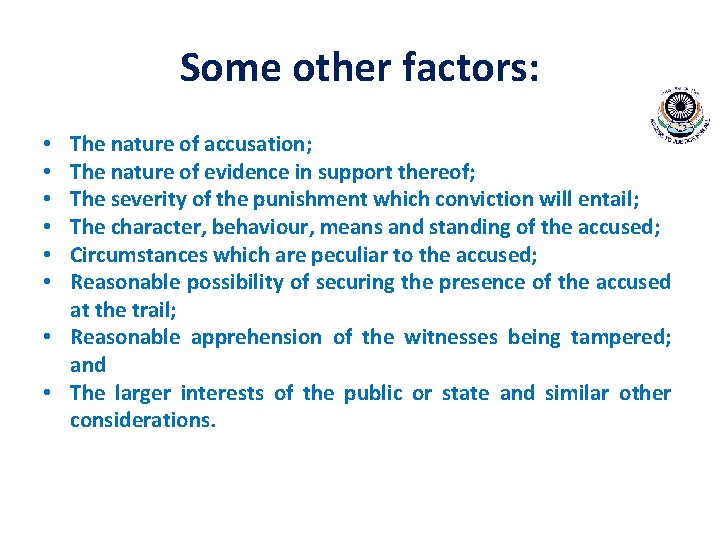
Some other factors: The nature of accusation; The nature of evidence in support thereof; The severity of the punishment which conviction will entail; The character, behaviour, means and standing of the accused; Circumstances which are peculiar to the accused; Reasonable possibility of securing the presence of the accused at the trail; • Reasonable apprehension of the witnesses being tampered; and • The larger interests of the public or state and similar other considerations. • • •

Thanks
- Slides: 13