
LAW OF TORTS II PCL 304 THE TORT




- Slides: 78
LAW OF TORTS II – PCL 304
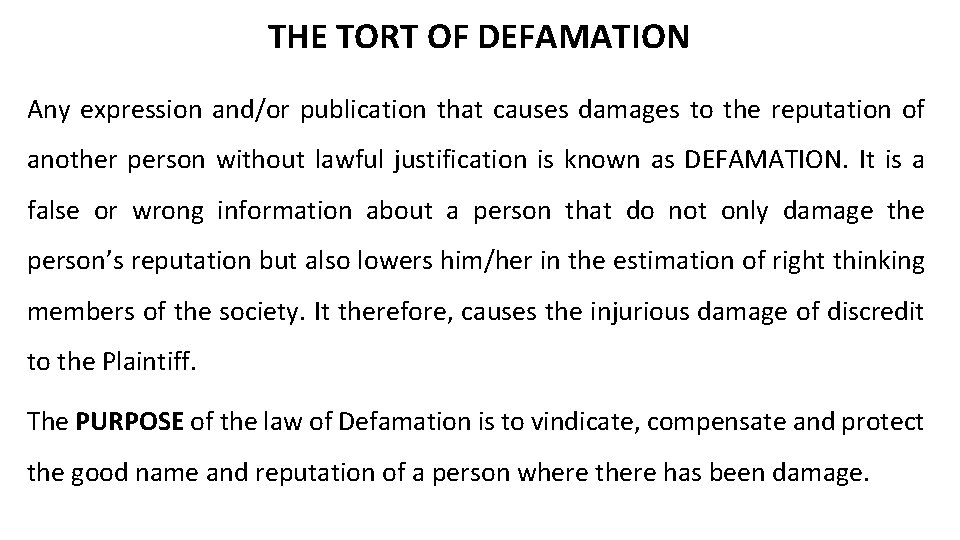
THE TORT OF DEFAMATION Any expression and/or publication that causes damages to the reputation of another person without lawful justification is known as DEFAMATION. It is a false or wrong information about a person that do not only damage the person’s reputation but also lowers him/her in the estimation of right thinking members of the society. It therefore, causes the injurious damage of discredit to the Plaintiff. The PURPOSE of the law of Defamation is to vindicate, compensate and protect the good name and reputation of a person where there has been damage.
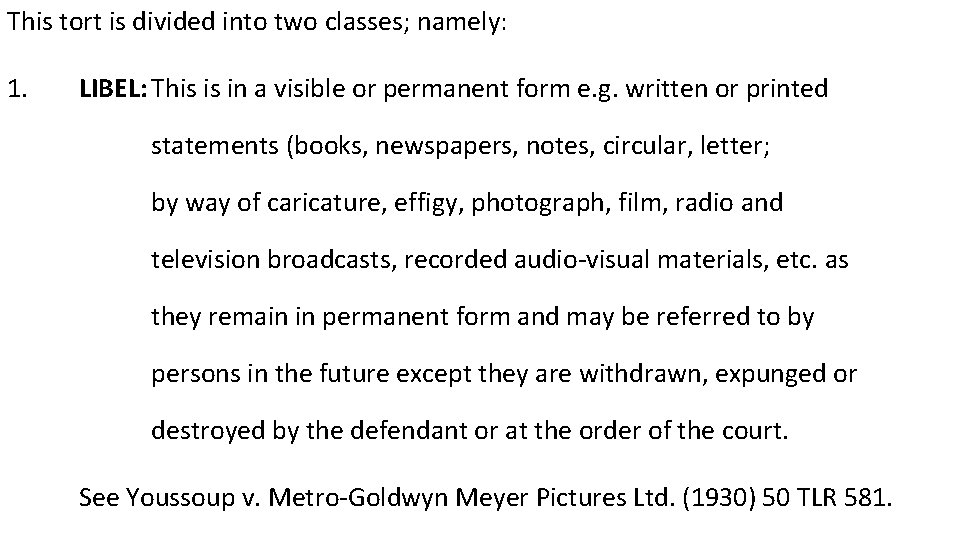
This tort is divided into two classes; namely: 1. LIBEL: This is in a visible or permanent form e. g. written or printed statements (books, newspapers, notes, circular, letter; by way of caricature, effigy, photograph, film, radio and television broadcasts, recorded audio-visual materials, etc. as they remain in permanent form and may be referred to by persons in the future except they are withdrawn, expunged or destroyed by the defendant or at the order of the court. See Youssoup v. Metro-Goldwyn Meyer Pictures Ltd. (1930) 50 TLR 581.
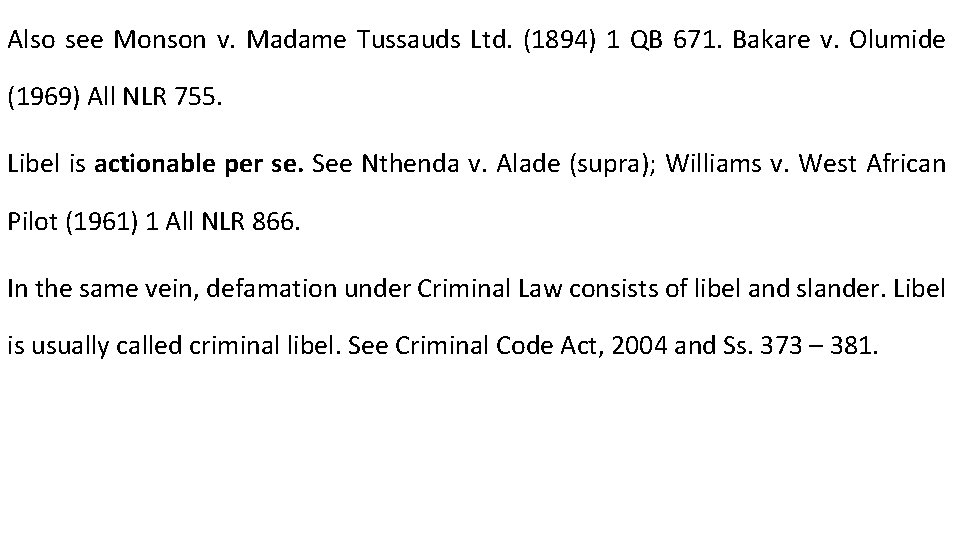
Also see Monson v. Madame Tussauds Ltd. (1894) 1 QB 671. Bakare v. Olumide (1969) All NLR 755. Libel is actionable per se. See Nthenda v. Alade (supra); Williams v. West African Pilot (1961) 1 All NLR 866. In the same vein, defamation under Criminal Law consists of libel and slander. Libel is usually called criminal libel. See Criminal Code Act, 2004 and Ss. 373 – 381.
(ii) SLANDER: This is in a transitory form usually by words, speech or gestures or in a combined form. The alleged defamatory words relied upon must be pleaded and proved in evidence by the Plaintiff. Slander is not actionable per se as damage must be proved unless in cases of imputation of a crime, contagious disease, unchastity and being unfit for an office. See Coward v. Wellington (1839) 173 ER 234; M’Pherson v. Daniels (1829) 109 ER 448; Storey v. Challands (1837) 173 ER 475.
Please Take Notice that defamatory statements must damage the Plaintiff in the minds of the general right thinking members of the society and not a mere or particular section of the public. Words are generally not defamatory however annoying they may be to a section of the community UNLESS the expression also damages the reputation of the person in the eyes of right thinking members, then it will be defamatory.
A statement is defamatory when it: 1. Lower the person in the estimation of right thinking members of society; 2. Exposes the person to hatred, contempt or ridicule; 3. Cause others to shun or avoid him; 4. Discredit him/her in his/her office, trade or profession; 5. Injures his/her financial credit; etc. See African Press Ltd. v. Ikejiani (1953) 14 WACA 386; Atoyebi v. Odudu (1990) 6 NWLR (Pt. 157) p. 384 SC; Nthenda v. Alade (1974) ECSLR 109; Scott v. Sampson (1882) 8 QBD 491 at 503; Sketch Publishing Co. Ltd. v. Ajagbe Mokeferi (1989) 1 NWLR Pt. 100 p. 678 SC.
See the definition of “A Particular Section of Society” and the Standard of the Right Thinking Members of Society in the case of Egbuna v. Amalgated Press of Nig. Ltd. (1976) All NLR 27. Also see Byrne v. Deane (1937) 1 KB 818 CA; Sim v. Stretch (1936) 2 All ER 1237 HL. Take Notice that an unbelievable statement and opinion may be defamatory. Furthermore, what is defamatory in another society may not be in another and as time passes and social attitudes change, some words may cease to be defamatory or become defamatory as the case may be. Take Further Notice that where words are ambiguous, meaningless or convey no definite imputation, allegation or charge then there is no defamation.
Where defamatory words are used in a foreign language or in the language the court do not understand, the libel or slander must be set out in that foreign language or in the language used and must be followed by a literal translation of it. Take Notice that Mere Vulgar Abuse (particularly words uttered during a fight) does not constitute defamation. See Bakare v. Ishola (1959) WNLR 106; compare with Ibeanu v. Uba (1972) ECSLR 194 at 195. Where it is published or written, the defence of mere vulgar abuse will not avail unless the words does not amount to defamation. Benson v. West African Pilot Ltd. (1966) NMLR 3.
When a person makes defamatory statements about another in a Press Conference, he/she is liable as the originator, publisher or author of the defamation and anyone who repeats (including members of the press if published) are liable for defamation. They are joint tort-feasors and may be sued jointly and/or severally. This also applies to internet publications. See Ejabulor v. Osha II (1990) 5 NWLR (Pt. 148) p. 1 SC; Slipper v. BBC (1991) 1 All ER 165. Where a reference letter containing malicious, disparaging or defamatory statements is published about the Plaintiff who is the subject of the reference, firm, company, institution or body then he is entitled to sue the writer of the reference and all those that took part in its publication or repetition. Same applies to Disclaimer Notices.
THE ELEMENTS OF DEFAMATION 1. That the statement was defamatory; Sketch Publishing Co. Ltd. v. Ajagbe Mokeferi (supra); Byrne v. Deane (supra); 2. That the statement referred to the Plaintiff; Dalumo v. The Sketch Publishing Co. Ltd. (1972) All NLR 567; BPPC v. Gwagwada (1989) 4 NWLR (Pt. 116) p. 439; and 3. That it was published; Ejabulor v. Osha (supra); Awoniyi v. Regd. Trustees of AMORC (1990) 6 NWLR (Pt. 154) p. 42 CA; Nsirim v. Nsirim (1990) 3 NWLR (Pt. 154) p. 42 CA.
Where a sealed letter of reference is given to a defamed person which he has an obligation to deliver to a third party, its delivery to the third party to whom the defamation is thereby published is NOT an act of communication by the Plaintiff who is defamed nor a consent by him to the publication. See Collerton v. Bream (1962) NZLR 1045; compare with Okotcha v. Olumese (1967) FNLR 47. Defendant will not be liable for publication to a person he did not intend publication and to whom a reasonable person could not have foreseen that the defamatory words would be published; Huth v. Huth (1915) 3 KB 32. But where it is addressed to a businessman, forwarded to his business address, opened and read by his secretary or clerk in the ordinary course of the business this amounts to publication unless it was marked “Personal”, “Private” or “Confidential. ” Riddick v. Thomes (1977) QB 881.
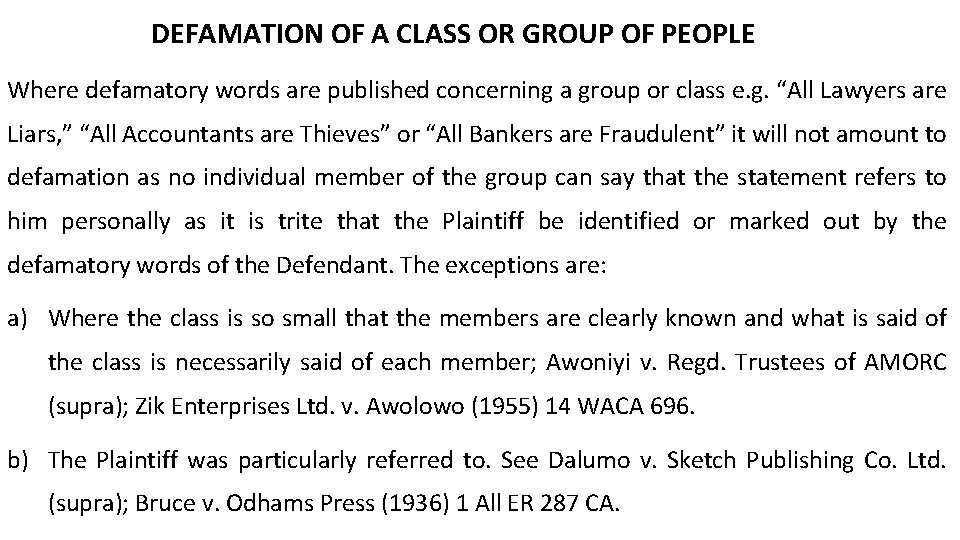
DEFAMATION OF A CLASS OR GROUP OF PEOPLE Where defamatory words are published concerning a group or class e. g. “All Lawyers are Liars, ” “All Accountants are Thieves” or “All Bankers are Fraudulent” it will not amount to defamation as no individual member of the group can say that the statement refers to him personally as it is trite that the Plaintiff be identified or marked out by the defamatory words of the Defendant. The exceptions are: a) Where the class is so small that the members are clearly known and what is said of the class is necessarily said of each member; Awoniyi v. Regd. Trustees of AMORC (supra); Zik Enterprises Ltd. v. Awolowo (1955) 14 WACA 696. b) The Plaintiff was particularly referred to. See Dalumo v. Sketch Publishing Co. Ltd. (supra); Bruce v. Odhams Press (1936) 1 All ER 287 CA.
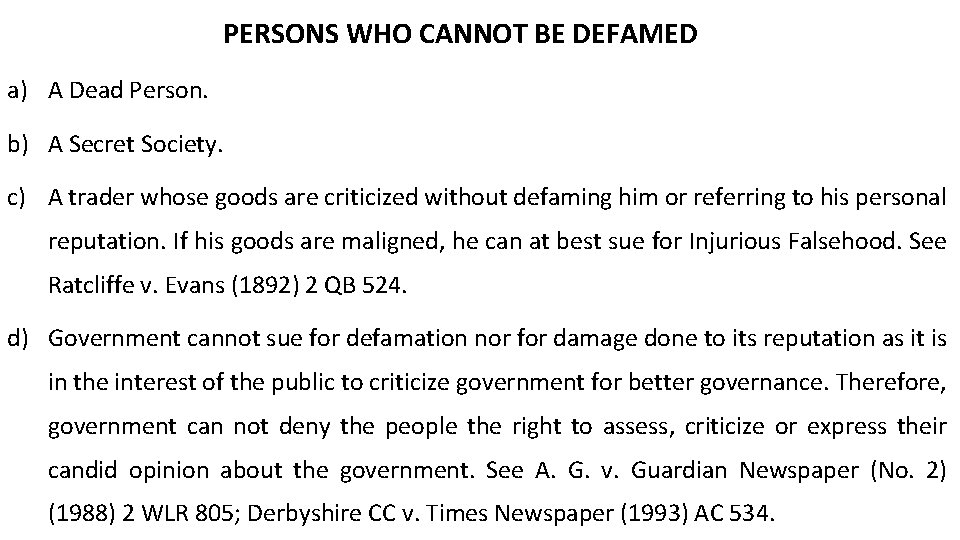
PERSONS WHO CANNOT BE DEFAMED a) A Dead Person. b) A Secret Society. c) A trader whose goods are criticized without defaming him or referring to his personal reputation. If his goods are maligned, he can at best sue for Injurious Falsehood. See Ratcliffe v. Evans (1892) 2 QB 524. d) Government cannot sue for defamation nor for damage done to its reputation as it is in the interest of the public to criticize government for better governance. Therefore, government can not deny the people the right to assess, criticize or express their candid opinion about the government. See A. G. v. Guardian Newspaper (No. 2) (1988) 2 WLR 805; Derbyshire CC v. Times Newspaper (1993) AC 534.
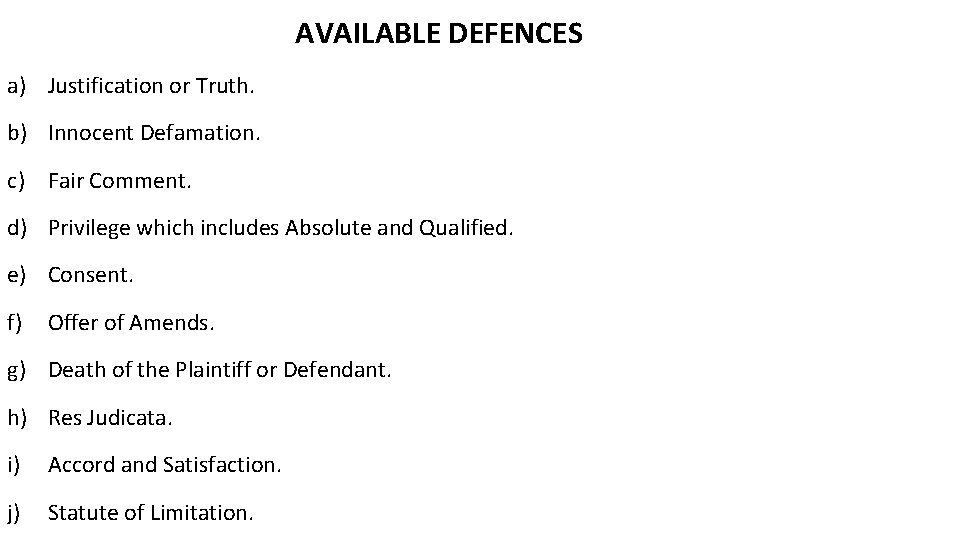
AVAILABLE DEFENCES a) Justification or Truth. b) Innocent Defamation. c) Fair Comment. d) Privilege which includes Absolute and Qualified. e) Consent. f) Offer of Amends. g) Death of the Plaintiff or Defendant. h) Res Judicata. i) Accord and Satisfaction. j) Statute of Limitation.
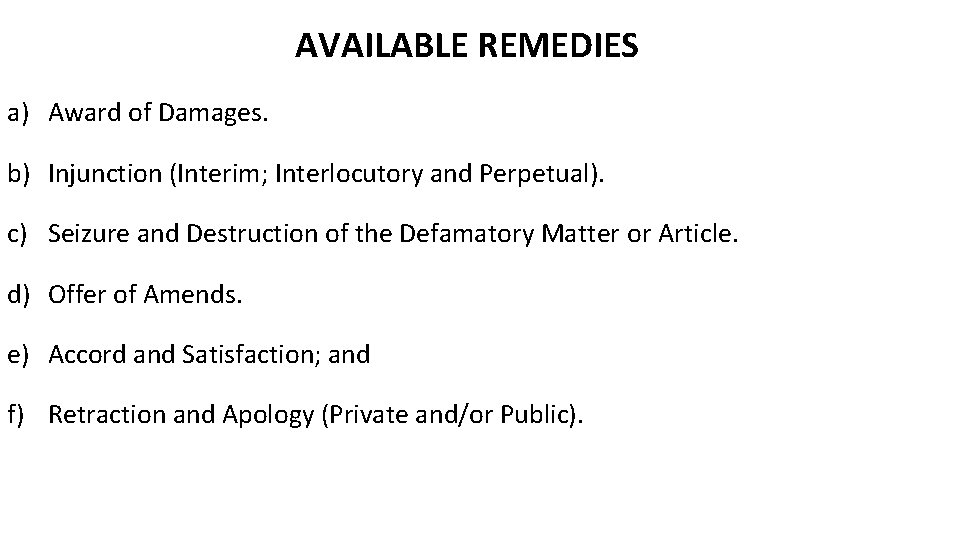
AVAILABLE REMEDIES a) Award of Damages. b) Injunction (Interim; Interlocutory and Perpetual). c) Seizure and Destruction of the Defamatory Matter or Article. d) Offer of Amends. e) Accord and Satisfaction; and f) Retraction and Apology (Private and/or Public).
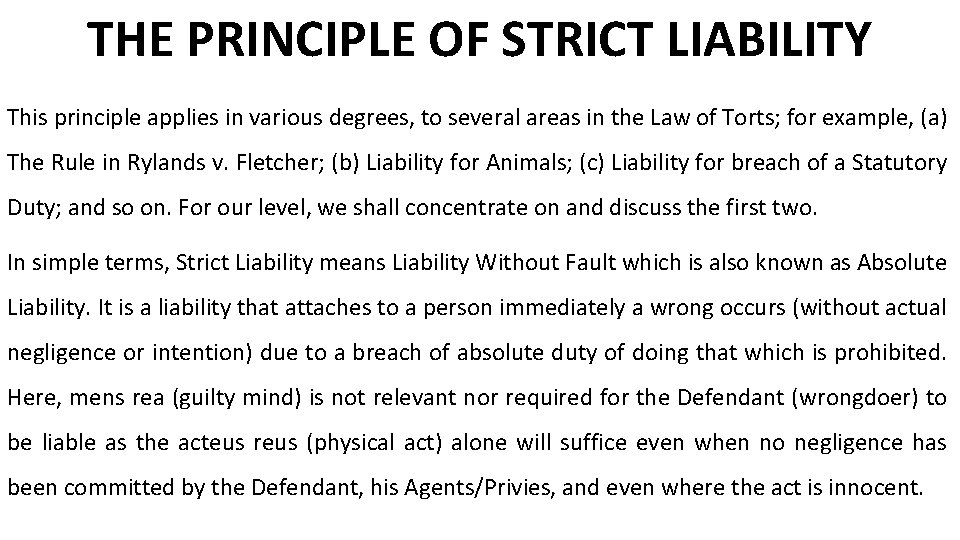
THE PRINCIPLE OF STRICT LIABILITY This principle applies in various degrees, to several areas in the Law of Torts; for example, (a) The Rule in Rylands v. Fletcher; (b) Liability for Animals; (c) Liability for breach of a Statutory Duty; and so on. For our level, we shall concentrate on and discuss the first two. In simple terms, Strict Liability means Liability Without Fault which is also known as Absolute Liability. It is a liability that attaches to a person immediately a wrong occurs (without actual negligence or intention) due to a breach of absolute duty of doing that which is prohibited. Here, mens rea (guilty mind) is not relevant nor required for the Defendant (wrongdoer) to be liable as the acteus reus (physical act) alone will suffice even when no negligence has been committed by the Defendant, his Agents/Privies, and even where the act is innocent.
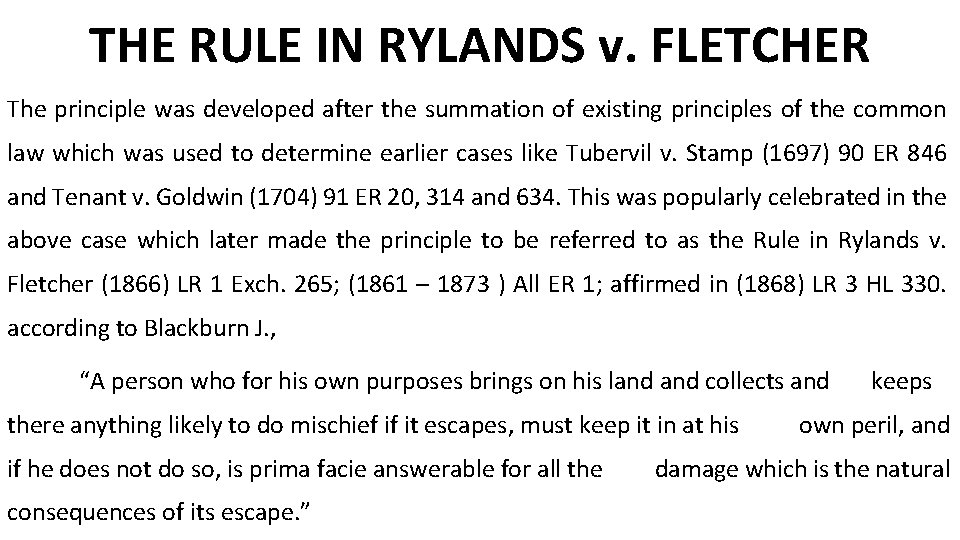
THE RULE IN RYLANDS v. FLETCHER The principle was developed after the summation of existing principles of the common law which was used to determine earlier cases like Tubervil v. Stamp (1697) 90 ER 846 and Tenant v. Goldwin (1704) 91 ER 20, 314 and 634. This was popularly celebrated in the above case which later made the principle to be referred to as the Rule in Rylands v. Fletcher (1866) LR 1 Exch. 265; (1861 – 1873 ) All ER 1; affirmed in (1868) LR 3 HL 330. according to Blackburn J. , “A person who for his own purposes brings on his land collects and there anything likely to do mischief if it escapes, must keep it in at his if he does not do so, is prima facie answerable for all the consequences of its escape. ” keeps own peril, and damage which is the natural
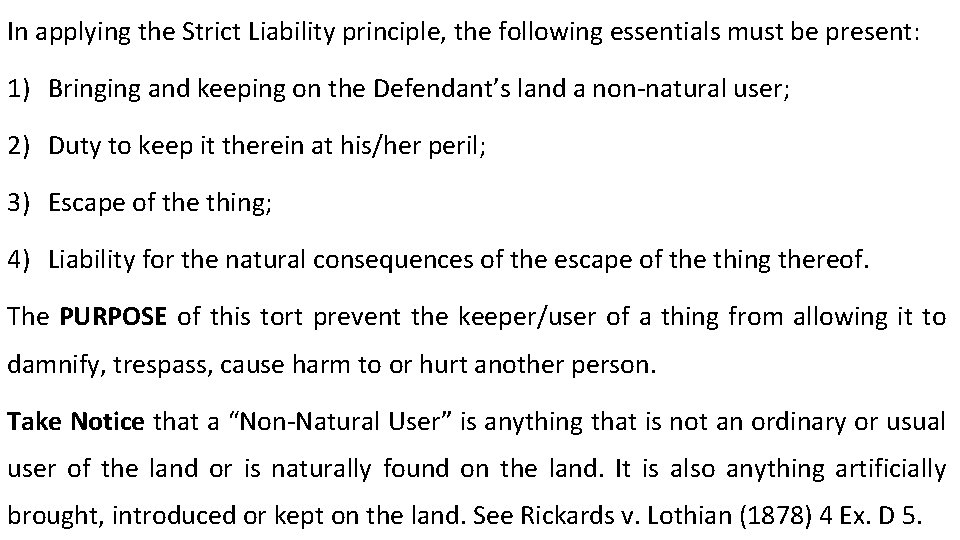
In applying the Strict Liability principle, the following essentials must be present: 1) Bringing and keeping on the Defendant’s land a non-natural user; 2) Duty to keep it therein at his/her peril; 3) Escape of the thing; 4) Liability for the natural consequences of the escape of the thing thereof. The PURPOSE of this tort prevent the keeper/user of a thing from allowing it to damnify, trespass, cause harm to or hurt another person. Take Notice that a “Non-Natural User” is anything that is not an ordinary or usual user of the land or is naturally found on the land. It is also anything artificially brought, introduced or kept on the land. See Rickards v. Lothian (1878) 4 Ex. D 5.
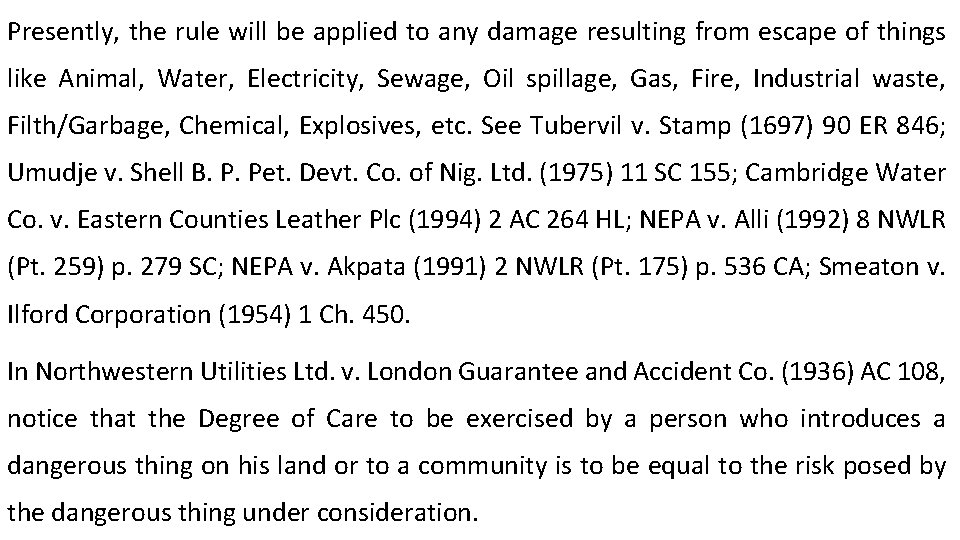
Presently, the rule will be applied to any damage resulting from escape of things like Animal, Water, Electricity, Sewage, Oil spillage, Gas, Fire, Industrial waste, Filth/Garbage, Chemical, Explosives, etc. See Tubervil v. Stamp (1697) 90 ER 846; Umudje v. Shell B. P. Pet. Devt. Co. of Nig. Ltd. (1975) 11 SC 155; Cambridge Water Co. v. Eastern Counties Leather Plc (1994) 2 AC 264 HL; NEPA v. Alli (1992) 8 NWLR (Pt. 259) p. 279 SC; NEPA v. Akpata (1991) 2 NWLR (Pt. 175) p. 536 CA; Smeaton v. Ilford Corporation (1954) 1 Ch. 450. In Northwestern Utilities Ltd. v. London Guarantee and Accident Co. (1936) AC 108, notice that the Degree of Care to be exercised by a person who introduces a dangerous thing on his land or to a community is to be equal to the risk posed by the dangerous thing under consideration.
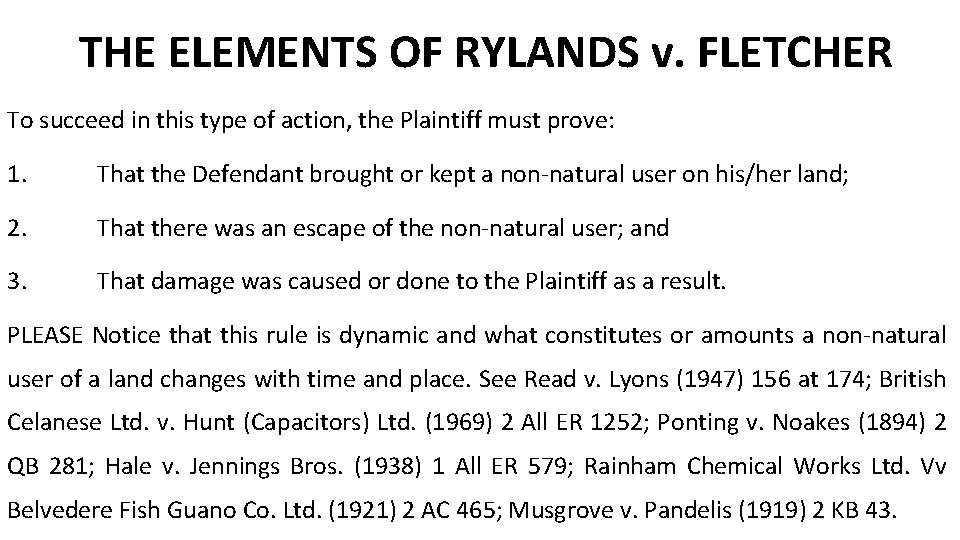
THE ELEMENTS OF RYLANDS v. FLETCHER To succeed in this type of action, the Plaintiff must prove: 1. That the Defendant brought or kept a non-natural user on his/her land; 2. That there was an escape of the non-natural user; and 3. That damage was caused or done to the Plaintiff as a result. PLEASE Notice that this rule is dynamic and what constitutes or amounts a non-natural user of a land changes with time and place. See Read v. Lyons (1947) 156 at 174; British Celanese Ltd. v. Hunt (Capacitors) Ltd. (1969) 2 All ER 1252; Ponting v. Noakes (1894) 2 QB 281; Hale v. Jennings Bros. (1938) 1 All ER 579; Rainham Chemical Works Ltd. Vv Belvedere Fish Guano Co. Ltd. (1921) 2 AC 465; Musgrove v. Pandelis (1919) 2 KB 43.
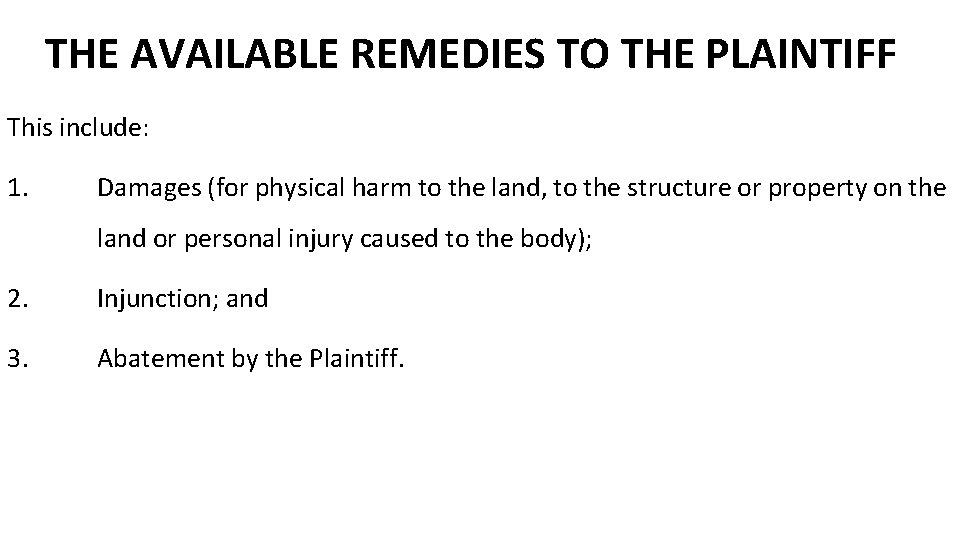
THE AVAILABLE REMEDIES TO THE PLAINTIFF This include: 1. Damages (for physical harm to the land, to the structure or property on the land or personal injury caused to the body); 2. Injunction; and 3. Abatement by the Plaintiff.
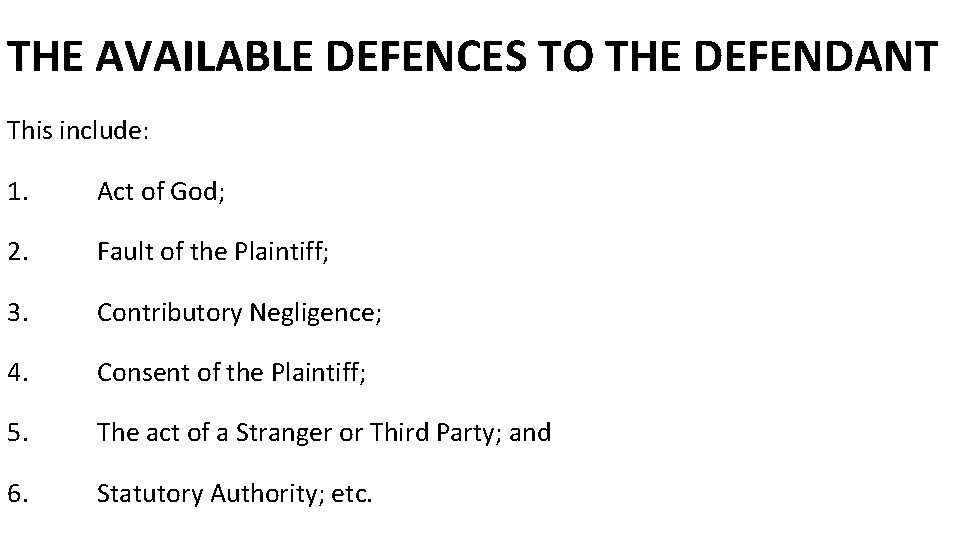
THE AVAILABLE DEFENCES TO THE DEFENDANT This include: 1. Act of God; 2. Fault of the Plaintiff; 3. Contributory Negligence; 4. Consent of the Plaintiff; 5. The act of a Stranger or Third Party; and 6. Statutory Authority; etc.
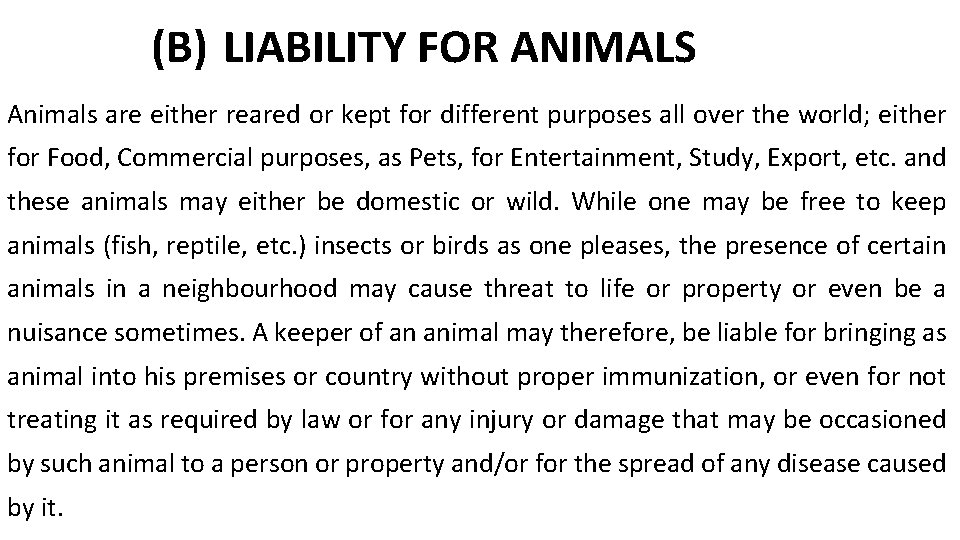
(B) LIABILITY FOR ANIMALS Animals are either reared or kept for different purposes all over the world; either for Food, Commercial purposes, as Pets, for Entertainment, Study, Export, etc. and these animals may either be domestic or wild. While one may be free to keep animals (fish, reptile, etc. ) insects or birds as one pleases, the presence of certain animals in a neighbourhood may cause threat to life or property or even be a nuisance sometimes. A keeper of an animal may therefore, be liable for bringing as animal into his premises or country without proper immunization, or even for not treating it as required by law or for any injury or damage that may be occasioned by such animal to a person or property and/or for the spread of any disease caused by it.
The general rule is that a person keeps an animal at his own risk and is liable for any injury or damage done by it thereby its liability STRICT. See Rapier v. London Tramways Co. (1893) 2 Ch. 588; Gomberg v. Smith (1962) 1 All ER 725. There are basically two classes of animals; namely: (i) Domestic Animals; and (ii) Wild Animals. For the purpose of tortious liabilities however, they are further divided into three: i) Livestock; e. g. Cattle, Sheep, Pigs, Goats, Poultry, Horses, Donkeys, etc. ; ii) Dangerous/Wild Animals; e. g. Wild dogs, Wolf, Snake, Lion, Tiger, etc;
For livestock liability, see Cox v. Burbridge (1869) 143 ER 171 at 174; Aldham v. United Dairies Ltd. (1939) 4 All ER 522; Cunningham v. Wheelan (1917) 52 Ir LT 67 Ireland; Curtis v. Betts (1990) 1 WLR 459 CA; Leeman v. Montague (1936) 2 All ER 1677; Abiola v. Ijoma (1970) All NLR 569. Dangerous/Wild animals are also known as animals ferae naturae (of wild nature) and a legal action for liability can be brought as a “scienter action. ” The general rule of common law with respect to dangerous animals is that a keeper of a dangerous animal must keep it securely from causing damage where he knows or ought to know of its mischievous propensity or disposition and is liable for any damage caused by it as a keeper keeps such animal at his peril. See Smith v. Ainger
Non-Dangerous animals are also known as animals mansuetae naturae (tame by nature) and are naturally domesticated. Also, a wild animal that has been tamed may also be referred to as domesticated. For the Plaintiff/Owner to be liable for an act done by the animal, the Defendant must establish two things: (i) That there was damage; (ii) That the particular animal in question had a savage disposition. Notice that liability may arise for the act of an animal through Trespass to Land, Chattel, The Person, The Rule in Rylands v. Fletcher, Nuisance, Neglegence, etc. See Cresswell v. Sirl (1947) 2 All ER 730; Daryani v. Njoku (1965) 2 All NLR 53 at
THE AVAILABLE REMEDIES TO THE PLAINTIFF This include: 1. Damages; 2. Injunction; 3. Abatement. 4. Isolation; 5. Self Defence; 6. Beating or Chasing the animal away;
7. Defence of Property; 8. Restitution of damaged goods or payment of its market value; 9. Release into the wild; 10. Arrest, Seizure or confinement in a zoo. 11. Repatriation; and 12. Slaughter especially where it is diseased.
THE AVAILABLE DEFENCES TO THE DEFENDANT This include: 1. Fault of the Plaintiff; 2. Contributory Negligence; 3. Consent; 4. Act of a Third Party; and 5. Act of God.
Take Notice of the Rule in Searle v. Wallbank (1947) AC 341 : A keeper of animals on a landed property adjoining a highway is not under a duty to fence his domestic animals from straying into the highway to cause accidents unless or except : 1. If the animal had gone to the road so frequently such as where a dog has run to the road so often that it was “more like a missile than a dog; ” 2. Where a keeper or his agent actually drives the animals on the road (Herdsmen), such persons owes a duty to exercise reasonable care to see that the animals do not cause harm to other persons while there. Also Take Notice that what is “Reasonable Care” is a matter of fact with regard to the environment or community (country, urban or suburban) under consideration.
ECONOMIC TORTS
As the name implies, Economic Torts are mainly economic losses that inflict financial losses or injury on the Plaintiff. This tort occurs mainly in the economic, commercial or business sector of life and it includes the torts of Passing Off; Breach of Intellectual Property Rights; Injurious Falsehood; Interference with Contracts; Conspiracy to Interfere (Civil Conspiracy); and so on. Passing Off could also be said to take place when the Defendant pretends that his goods or business are those of the Plaintiff so as to capture the patronage of the Plaintiff’s customers and thereby enjoy the goodwill the Plaintiff’s business has gained over time or over the years.
THE TORT OF PASSING OFF
The tort of Passing Off occurs when the Defendant carries on his business or sells his goods under a name, trademark, description or imitation of the Plaintiff’s product in order to deceive the public into patronizing such goods or products, thereby unfairly enjoying the Plaintiff’s reputation and goodwill which has been built over years as if it were his own; that is, the Defendant’s. See Niger Chemists v. Nigeria Chemists (1961) All NLR 171; Bolinger v. Costa Brava Wine Co. (1960) Ch. 262. In the words of Lord Kingsdown in Leather Cloth Co. v. American Leather Cloth Co. (1865) 11 HL Cas. 523 at 538; (1865) 11 ER 1435, “The fundamental rule is that one man has no right to put off his goods for sale as the goods of a rival trader. ”
This tort usually involves one form of deceit, misrepresentation or the other which thereby makes or induces the public to patronize such goods, products or business and it is very common in competitive business community or economy. An action lies in Passing Off for Damages, An Account for Profits made, Seizure of the Products and even Injunction to Restrain the Defendant from Continuing the act in the future. The Purpose of this tort is to protect business interests, reputation and goodwill that has been built over the years by the Plaintiff from the unfair trade and sharp practices of the Defendant. See Leather Cloth Co. v. American Leather Cloth Co. (Supra); Perry v. Truefitt (1842) 49 ER 749 at 725; Draper v. Trist (1939) 3 All ER 513.
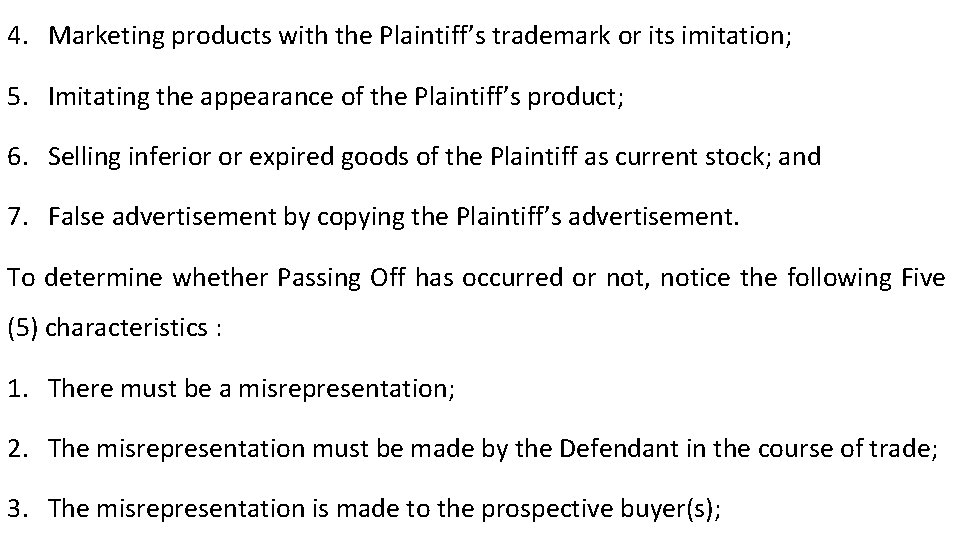
Take Notice that the tort of Passing Off is actionable per se on its occurrence and the Plaintiff need not prove damages in order to succeed in an action as an action lies against the Defendant even though no damage has been suffered nor proved; the probability of damage occurring is enough proof for the Plaintiff to get remedy. Some common forms includes of Passing Off : 1. Trading with a name resembling that of the Plaintiff; 2. Marketing a fake product as that of the Plaintiff by using the Plaintiff’s label or design; 3. Marketing a product with a name resembling that of the Plaintiff;
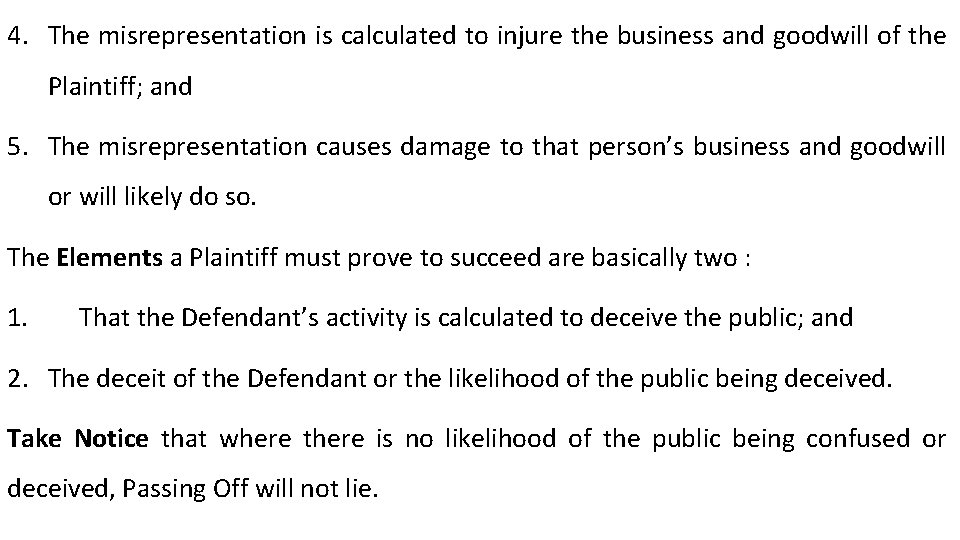
4. Marketing products with the Plaintiff’s trademark or its imitation; 5. Imitating the appearance of the Plaintiff’s product; 6. Selling inferior or expired goods of the Plaintiff as current stock; and 7. False advertisement by copying the Plaintiff’s advertisement. To determine whether Passing Off has occurred or not, notice the following Five (5) characteristics : 1. There must be a misrepresentation; 2. The misrepresentation must be made by the Defendant in the course of trade; 3. The misrepresentation is made to the prospective buyer(s);
4. The misrepresentation is calculated to injure the business and goodwill of the Plaintiff; and 5. The misrepresentation causes damage to that person’s business and goodwill or will likely do so. The Elements a Plaintiff must prove to succeed are basically two : 1. That the Defendant’s activity is calculated to deceive the public; and 2. The deceit of the Defendant or the likelihood of the public being deceived. Take Notice that where there is no likelihood of the public being confused or deceived, Passing Off will not lie.
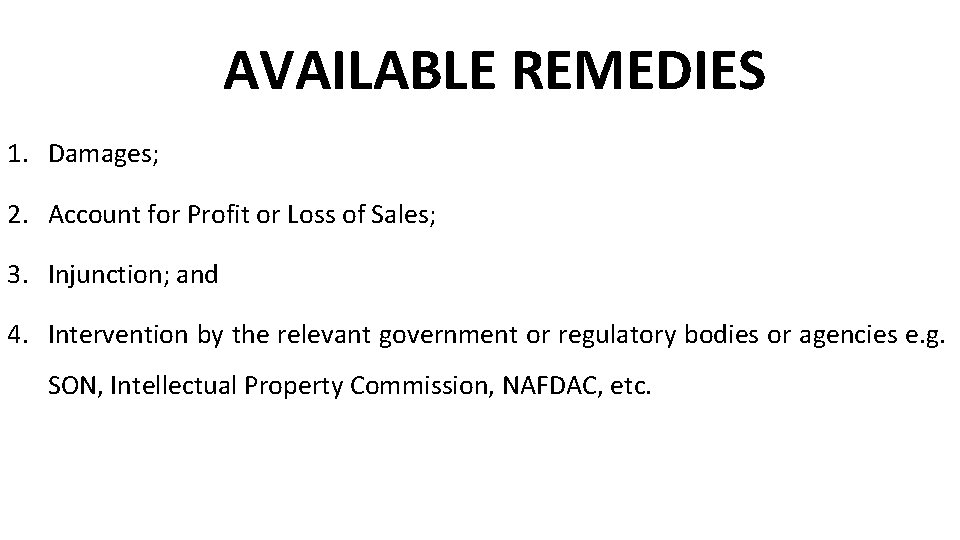
AVAILABLE REMEDIES 1. Damages; 2. Account for Profit or Loss of Sales; 3. Injunction; and 4. Intervention by the relevant government or regulatory bodies or agencies e. g. SON, Intellectual Property Commission, NAFDAC, etc.
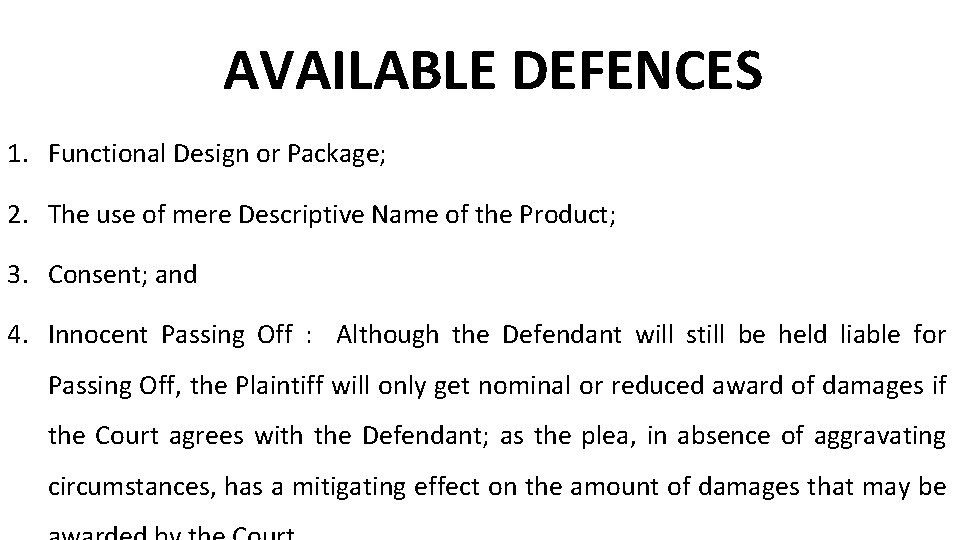
AVAILABLE DEFENCES 1. Functional Design or Package; 2. The use of mere Descriptive Name of the Product; 3. Consent; and 4. Innocent Passing Off : Although the Defendant will still be held liable for Passing Off, the Plaintiff will only get nominal or reduced award of damages if the Court agrees with the Defendant; as the plea, in absence of aggravating circumstances, has a mitigating effect on the amount of damages that may be
THE TORT OF INJURIOUS/MALICIOUS FALSEHOOD
This is any oral or written statement of falsehood maliciously published or act by the Defendant which discredits the product, service or business of the Plaintiff causing customers to stop or not to patronize the business; thereby occasioning financial loss to the Plaintiff. It is a commercial defamation which involves a slander or libel of the Plaintiff’s tittle, goods, services or business thereby disparaging him and causing him damage. This tort is not actionable per se. The falsehood may be aimed at or consist of the following : 1. Slander of Title; 2. Slander of Goods; and 3. Slander of Title and Goods.
The Purpose of this tort is to protect the goodwill and reputation of the Plaintiff’s business, products or services and offer remedy where loss has been suffered due to disparagement of the business. See Ratcliffe v. Evans (1892) 2 QB 524; Wren v. Nield (1869) LR 4 QB 730; Western Counties Manure Co. v. Lawes Chemical Manure Co. (1874) LR 9 Exch. 218; Shapiro v. La Morta (1923) 130 LT 622 CA; Balden v. Shorter (1933) All ER 249; Joyce v. Motor Surveys Ltd. (1948) Ch. 252. The Elements a Plaintiff must prove to succeed are : 1. That the Defendant’s statement was discrediting/disparaging/damaging; 2. That the Defendant’s statement was false; 3. That the Defendant’s statement was published; and
4. That the Plaintiff suffered damage. Take Notice that Mere Advertisement or Sales Boast do not amount to Injurious? Malicious Falsehood. See White v. Mellin (1895) AC 154 HL. AVAILABLE REMEDIES 1. Damages; 2. Account for Profit or Loss of Sales; 3. Injunction; and 4. Intervention by the relevant government or regulatory bodies or agencies e. g.
AVAILABLE DEFENCES 1. Justification or Truth; 2. Legislative Immunity (Applicable in Parliamentary Proceedings); and 3. Absolute Privilege (Applicable to persons taking part in a Judicial proceedings). Take Further Notice that same defences applies to the Tort of Defamation; however, once malice is established it destroys the plea of qualified privilege.
DIFFERENCES BETWEEN INJURIOUS FALSEHOOD AND DEFAMATION 1. Main concern of Injurious Falsehood is to protect the goodwill and reputation of a business while the aim of Defamation is to protect a person’s good name and reputation. 2. Injurious Falsehood is not usually actionable per se while it is in Defamation. 3. Actions for Injurious Falsehood is a right in property (a right in rem or a right in business) which survives both the Plaintiff and the Defendant while Defamation is extinct upon the demise of either of the parties as the right is personal. 4. In Injurious Falsehood, the Plaintiff must prove or claim that the statement
THE TORT OF DECEIT
Deceit is simply defined as a false statement or misrepresentation (made either expressly or impliedly) by the Plaintiff willfully, deliberately, knowingly, recklessly or carelessly without even him or her believing in the truth of the representation or statement made, expected the receiver to rely on it, and which he or she actually did to his or her loss or detriment. Deceit cuts across many areas of law such as Contract, Criminal Law Torts, etc. Thus, false representations or misrepresentations may create concurrent rights of action in these areas; accordingly, a false representation may give rise to the right to rescind a contract as the contract was induced by deceit or fraud.
This tort is also known as “Fraudulent Misrepresentation” in the Law of Contract and is some cases, criminal prosecution may be brought against a defendant where the deceit amounts to a criminal offence e. g. Obtaining by False Pretences under S. 419 of the Criminal Code. The essence of the Defendant’s deceit is to deceive, dupe or defraud the Plaintiff to his or her detriment thereby, occasioning a loss. Take Notice that it is not necessary that the Defendant benefitted or did not benefit from the deceit or that he did collude or did not collude with the person who benefited from it. See Parsley v. Freeman (1789) 100 ER 450.
The tort of Deceit dates back to the decision held in the cases of Parsley v. Freeman (Supra) and Hedley Byrne v. Heller Partners Ltd. (1984) 3 WLR 350. Also Take Notice that the Plaintiff must prove damage to succeed in this tort is as it is not actionable per se; see Mullet v. Mason (1866) LR 1 CP 559; Dickes v. Fenne (1639) 32 ER 411. However, damage need not be proved to obtain an Order for rescission of a contract induced by deceit. See Foucard v. Sinclair (1918) 1 KB 180 at 192; Archer v. Brown (1984) 2 All ER 276. The Essential Ingredients : These are basically two : 1. Deliberately making a false representation or misrepresentation;
2. The Plaintiff was induced to rely on the statement made to his detriment. THE ELEMENTS OF DECEIT : The Plaintiff must prove the following in order to succeed in an action for the tort of Deceit; 1. That the Defendant made a false representation; 2. That the Defendant knew that the representation was false; 3. That the Defendant intended the Plaintiff should rely on the information; 4. That the Plaintiff relied on the information; and 5. That the Plaintiff did suffer damage.
SILENCE Generally, mere silence or non-disclosure is not actionable here because silence alone does not amount to fraud except where it has been expressly stated by a statute or law that certain disclosures are mandatory; however, active concealment is a sufficient ground for a legal action in the tort of Deceit. At common law, whenever there is silence the applicable rule will be caveat emptor (buyer beware). This is commonly applied to goods transactions. For consumer goods, the applicable rule is caveat venditor (seller beware). Take Notice that this rule does not apply to leases and contracts that require utmost good faith e. g.
Failure to disclose all or relevant information may render contracts ubberimea fidei (utmost good faith) voidable, unenforceable, etc. The instances where silence may amount to deceit include situations where: 1. It distorts a positive representation; 2. There is active concealment of a fact; 3. There is a change of fact, then there is a duty to inform the other party; 4. There is a statutory duty to disclose; and 5. It is a statement of an intention or opinion.
AVAILABLE REMEDIES This include : 1. Award of Damages; 2. Restitution of any property that may have passed between the parties; and 3. Criminal Prosecution, where the deceit also amounts to crime.
AVAILABLE DEFENCES This include : 1. That the Defendant honestly believed the representation was true; 2. That the Plaintiff did not rely on the misrepresentation in taking the action that caused him damage; 3. That the Plaintiff actually knew that the representation was false and could not have been acting on it; 4. That the Plaintiff had constructive notice of the incorrectness of the misrepresentation;
5. That if the independent contractor hired by the Plaintiff to investigate the veracity of the representation had done it properly, the Plaintiff would have known that representation was not correct; and 6. That the Agent of the Defendant who made the representation did not do so in the course of employment and has no actual or ostensible authority to make the representation therefore, the Defendant who is his employer cannot be vicariously liable for the misrepresentation.
THE TORT OF INTERFERENCE WITH CONTRACTS
The Tort of Interference with Contract is the intentional inducement of a contracting party to break his contract with another person thereby causing damage to that other party. Here, the Plaintiff does not have to prove that an unlawful means was used to induce the other party to breach the contract. This tort dates back to well over a century in the locus classicus case of Lumley v. Gye (1853) 118 ER 749, 1083. Practically, all kinds of contracts are covered as the tort has gone beyond contracts of service which is strictly between an employee and an employer; thus, once a contract is valid and enforceable an action for inducing a breach of contract or interference may be brought against a person who induces a party to breach it.
Evidence of the terms of the contract will be sufficient in proving it. However, where a contract is void an action for interference cannot be brought. For instance, contracts of illegality, immorality, crime, public policy, infancy mistake, being in restraint of trade, and so on. Elements a Plaintiff must prove are that: 1. There was a breach of contract; 2. The Defendant knowingly interfered with the contract; and 3. Damage was suffered by the Plaintiff as a result of this. See the cases of Torquay Hotel Co. Ltd. v. Cousins (1969) 2 Ch. 106; Jones Brothers
TAKE NOTICE of the Four (4) forms the tort of interference with contracts may take or committed as enumerated by Jekins LJ in the case of Thomson & Co. Ltd. v. Deakin (1952) Ch 646 at 687 thus: 1. Direct persuasion to breach or direct procurement to breach; 2. Direct intervention to cause breach; 3. Indirect procurement of breach; and 4. Inconsistent dealings. See Thomson & Co. Ltd. v. Deakin (Supra); Daily Mirror Newspapers v. Gardner (1968) 2 All ER 163 CA; GWK Ltd. v. Dunlop Rubber Co. Ltd. (1926) 42 TLR 376; J. T.
ALSO TAKE NOTICE that under direct persuasion to breach or direct procurement to breach, the state of mind of the Defendant is important as it will be sufficient if it is proved that the Defendant intended to cause a breach of contract in the first place. If he does an act which he is aware will potentially cause a breach of contract and such breach takes place, he will be presumed to intend the breach except he leads evidence to rebut the presumption. It is also not relevant that the Defendant should act with malice (spite or ill will) but good faith is not a defence to a claim for interference with a contract. TAKE FURTHER NOTICE that an act of negligence resulting in interference does not amount to the Tort of Interference and does not give a right of action to sue.
DEFENCES 1. The illegality or immorality of the contract; and 2. Justification. REMEDIES 1. Damages; and 2. Injunction.
CIVIL CONSPIRACY
The Tort of Conspiracy is an agreement between two or more persons (Defendants) or a combination of businesses of the Defendants in order to eliminate, restrain, limit, interfere or damage the business of the Plaintiff without any lawful justification thereby eliminating competition, create monopoly, artificially raise prices which will adversely affect a free market economy. The tort is illegal but may be permitted if the act is in the best interest of all the parties (particularly the general public) or for proper regulation of standard in such business. This tort may also be a crime if unlawful means are used and once it is so, it is usually treated as a separate offence of criminal conspiracy. In Criminal Law, a con-
spiracy ends when the unlawful act has been committed or abandoned; however, a conspiracy does not necessarily end if the object of the conspiracy is defeated as the conspirators may revive and attempt the object of conspiracy again. TAKE NOTICE that Mergers, Acquisitions, Takeovers, Mere Competitions or Mere Trade Combinations do not lie in conspiracy as they are part of life. See Mogul Steamship Co. v. Mc. Gregor Gow & Co. (1892) AC 25 HL; (1889) 23 QBD 598 at 616 CA 620. Since Conspiracy is a matter of fact, the Plaintiff must prove his case before the Court can decide in his favour as the Court must be cautious when deciding what amounts to the tort of conspiracy in order not to restrict and destroy the freedom
of business action and competition which are necessary for a free market economy, and of business economic growth which may stifle the advancement of the society. See the statement of Lord Wright in the case of Crofter Hand Woven Harris Tweed Co. Ltd. v. Veitch (1942) 1 All ER 142 HL. ALSO TAKE NOTICE that directors and their companies are counted as distinct persons and may therefore, be held liable for conspiracy. See Belmont Finance Corp. v. William Furniture Ltd. (1979) Ch 250; 1 All ER 118. This also applies to husband wife as they may be individually liable for conspiracy contrary to the principle of law that deems husband wife as one person. See Midland Bank Trust Co. v. Green (No. 3) (1981) 3 All ER 744.
Elements a Plaintiff must prove are that: 1. A willfull combination of two or more persons to injure the Plaintiff’s trade or business. See Sorrell v. Smith (1925) AC 700 HL; Quinn v. Leathem (1901) AC 495 HL; Reynolds v. Shipping Federation Ltd. (1924) 1 Ch 28; White v. Riley S(1921) 1 Ch 1 CA; Gregory v. Duke of Brunswick (1884) 134 ER 866. 2. That damage was done or inflicted on the Plaintiff’s trade or business. See Crofter Hand Woven Harris Tweed Co. Ltd. v. Veitch (Supra; Lonrho Ltd. v. Shell Pet. Co. Ltd. (No. 2) (1981) 2 All ER 456; (1982) AC 173 HL.
REMEDIES 1. Damages; 2. Injuction; and 3. Any other remedy as may be appropriate. DEFENCES 1. Justification; and 2. The Plaintiff did not suffer any damage.
THE TORT OF INTIMIDATION
The Tort of Intimidation is established where the Defendant makes a demand backed by a coercive and unlawful threat on the Claimant to act or refrain from acting on something wich is to his or a third party's detriment, and which the Claimant complies with thereby causing the Claimant loss and/or damage to his business or trade. TAKE NOTICE that it is the intention of the Defendant from the outset to cause loss and damage to the Claimant. ALSO TAKE NOTICE that the key requirement of the tort of intimidation is that there must be a threat to act unlawfully. However, a threat to do something one is legally entitled to do will not amount to the tort of intimidation.
See Hardie and Lane Ltd. vs. Chilton where it was held that a threat by A, a trading Association to put B, one of its members, on a stop list which would prevent B from getting goods from the members of the association unless B paid a sum of money for having broken a rule of the Association was not a tort. Compare this case with Rookes vs. Barnard where the House of Lords held that the tort of intimidation extends to threats made by A to break his contract with B.
Elements a Plaintiff must prove are : 1. There must be a demand made by the Defendant; 2. The demand must be backed by an unlawful threat or coercion; 3. The Claimant complied and suffered a loss or damage. AVAILABLE REMEDIES 1. Damages.
JOINT TORTS
In the Law of Tort, a wrongdoer is known as a tortfeasor. A tort may be committed by two or more persons acting together, that is jointly; for example, when a person is beaten up by more than one person or by someone acting as an agent of another person. Joint tort therefore, is a situation where two or more persons willfully or negligently, in a cause or event causes damages to another person. The tortfeasors are jointly and severally liable for the damages; this simply means that any of them can be responsible to pay the entire amount, no matter how unequal the negligence or responsibility of each party to the tort. The Plaintiff may sue one or
all of them as Defendants, and may recover the full amount of his claim from only one or all. The liability of joint tortfeasors is said to be “joint and several. ” However, where damages was recovered from only one joint feasor, he may in turn recover contribution from the others. S. 17 Law Reform (Torts) Law of Lagos State, 2003. TAKE NOTICE that some jurisdictions now apportion the liability by percentages of the negligence among the tortfeasors and the injured parties. The amount to be paid by each tortfeasor is usually determined by a Court on the basis of what is just and equitable, given the responsibility of each of the Defendants for the tort in question. One way of determining whether joint liability arises in tort is to see
support an action against each person, then they would be held as joint tort feasors. See Eze v. George (1993) 2 NWLR Pt. 273 at Pg. 86; Okonkwo v. Okolo (1988) 2 NWLR Pt. 79 at Pg. 632 SC; Ashton v. Turner (1980) 3 All ER 870; Petrie v. Lamont (1841) 174 ER 424. Persons who may be jointly or severally liable include an Employer who authorizes or ratifies a tort committed by his Employee; an Agent who commits a tort on behalf of his Principal; an Employer who authorized or ratified the tort of his Independent Contractor; Persons whose respective share in the commission of a tort are done in furtherance of a common purpose; Partners and Partnerships; and so on.
Persons whose legal capacity varies as joint tortfeasors, as they may sue but cannot be successfully sued due to their legal immunity, incapacity or because they enjoy some legal protection include Judges (Judicial Immunity); Diplomats (Diplomatic Immunity); Legal Practitioners (Matters relating to the cases being handled); Witnesses (as they were called to testify); Foreign Governments and Rulers; Trade Unions; Persons of Unsound Mind; Aliens; Minors (due to minority or under age); Executors; and the President and Governors (due to Immunity but can be sued in their official capacity in respect of their official duties under the Constitution).