
Law of Sines AAS SSA ASA ONE SOLUTION
- Slides: 4
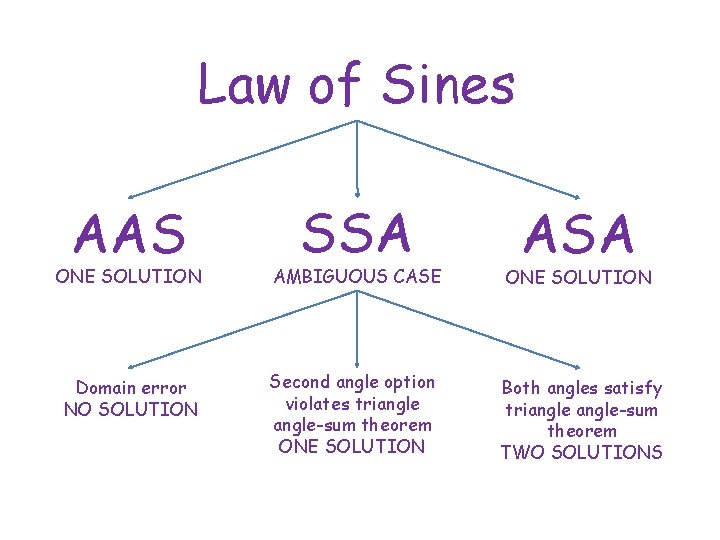
Law of Sines AAS SSA ASA ONE SOLUTION AMBIGUOUS CASE ONE SOLUTION Domain error NO SOLUTION Second angle option violates triangle-sum theorem ONE SOLUTION Both angles satisfy triangle-sum theorem TWO SOLUTIONS
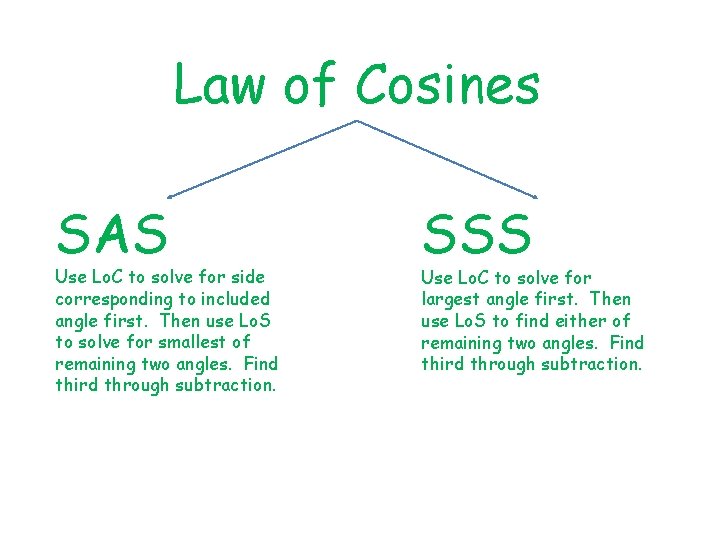
Law of Cosines SAS Use Lo. C to solve for side corresponding to included angle first. Then use Lo. S to solve for smallest of remaining two angles. Find third through subtraction. SSS Use Lo. C to solve for largest angle first. Then use Lo. S to find either of remaining two angles. Find third through subtraction.
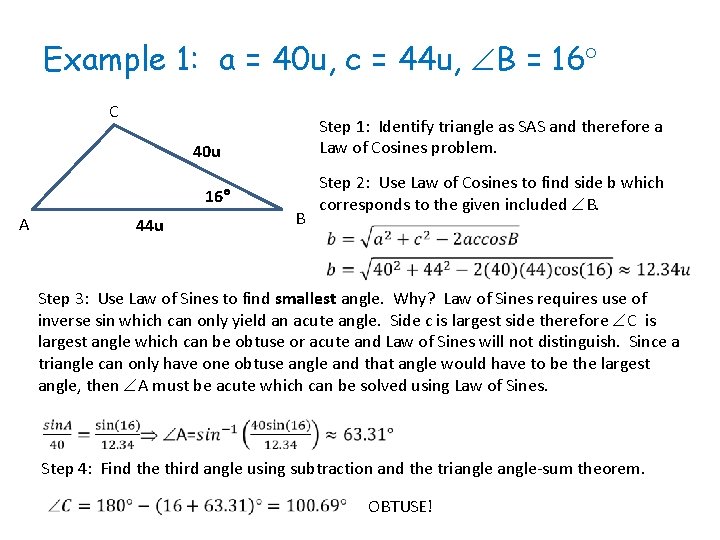
Example 1: a = 40 u, c = 44 u, B = 16 C Step 1: Identify triangle as SAS and therefore a Law of Cosines problem. 40 u 16 A 44 u B Step 2: Use Law of Cosines to find side b which corresponds to the given included B. Step 3: Use Law of Sines to find smallest angle. Why? Law of Sines requires use of inverse sin which can only yield an acute angle. Side c is largest side therefore C is largest angle which can be obtuse or acute and Law of Sines will not distinguish. Since a triangle can only have one obtuse angle and that angle would have to be the largest angle, then A must be acute which can be solved using Law of Sines. Step 4: Find the third angle using subtraction and the triangle-sum theorem. OBTUSE!
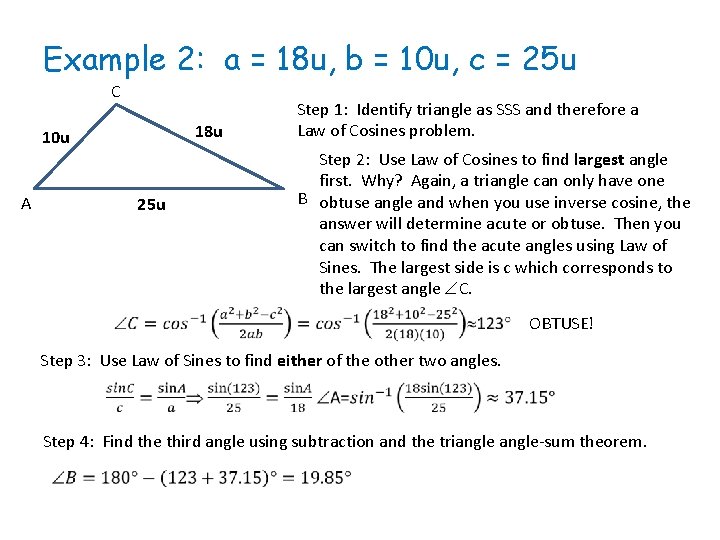
Example 2: a = 18 u, b = 10 u, c = 25 u C 18 u 10 u A 25 u Step 1: Identify triangle as SSS and therefore a Law of Cosines problem. Step 2: Use Law of Cosines to find largest angle first. Why? Again, a triangle can only have one B obtuse angle and when you use inverse cosine, the answer will determine acute or obtuse. Then you can switch to find the acute angles using Law of Sines. The largest side is c which corresponds to the largest angle C. OBTUSE! Step 3: Use Law of Sines to find either of the other two angles. Step 4: Find the third angle using subtraction and the triangle-sum theorem.