
Law of Demand ASSUMPTIONS EXPLANATION AND UPWARD SLOPING



- Slides: 19
Law of Demand ASSUMPTIONS, EXPLANATION AND UPWARD SLOPING REASONS
Law of Demand This law states that, "A rise in the price of a commodity or service is followed by a reduction in demand, and a fall in price is followed by an increase in demand, if conditions of demand remain constant. " In other words, as the price of a commodity falls, demand rises and as price increases, demand contracts/decreases. This is based on the assumption that the factors such as price of related goods, income of consumers, preferences, etc. remain constant. This means that the quantity purchased varies inversely with price. That is the higher the price, the lower is the quantity demanded.
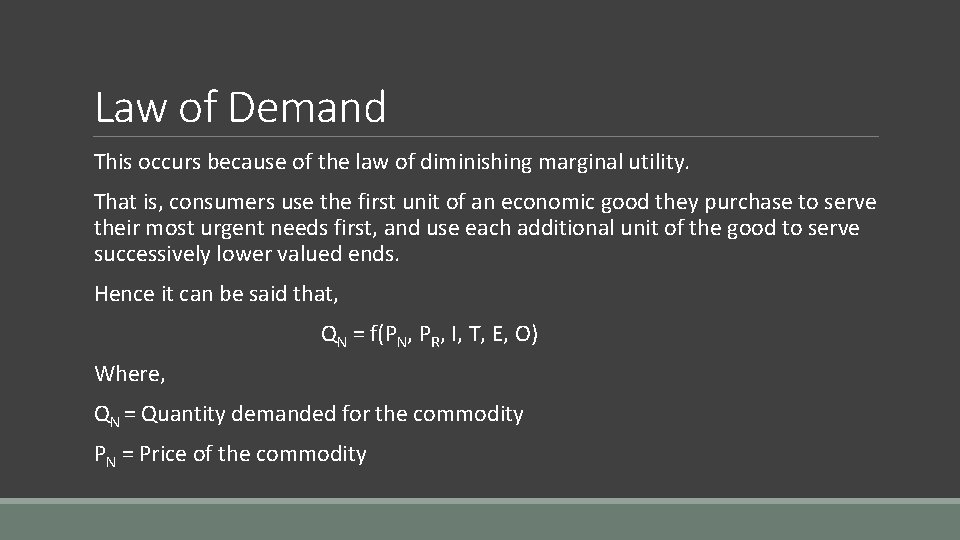
Law of Demand This occurs because of the law of diminishing marginal utility. That is, consumers use the first unit of an economic good they purchase to serve their most urgent needs first, and use each additional unit of the good to serve successively lower valued ends. Hence it can be said that, QN = f(PN, PR, I, T, E, O) Where, QN = Quantity demanded for the commodity PN = Price of the commodity
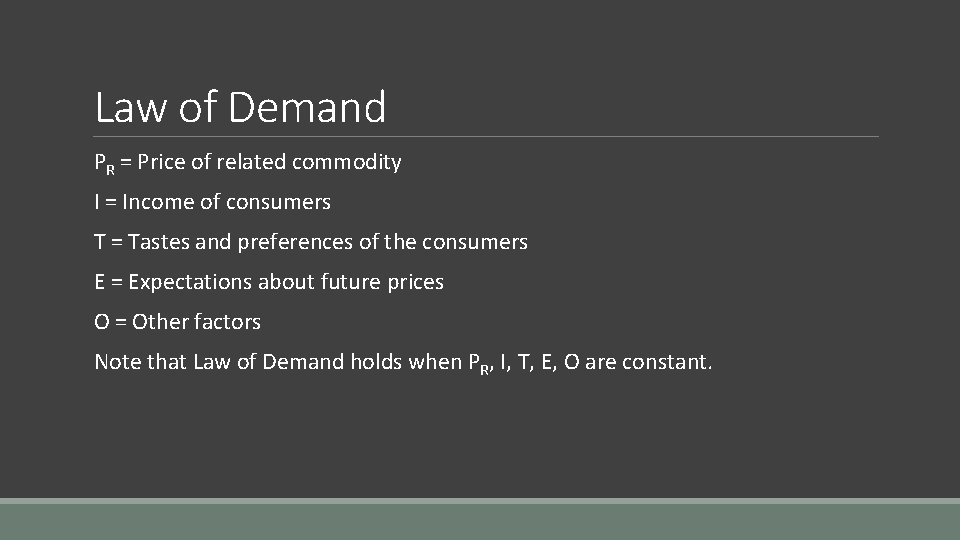
Law of Demand PR = Price of related commodity I = Income of consumers T = Tastes and preferences of the consumers E = Expectations about future prices O = Other factors Note that Law of Demand holds when PR, I, T, E, O are constant.
Assumptions ASSUMPTIONS IN THE LAW OF DEMAND
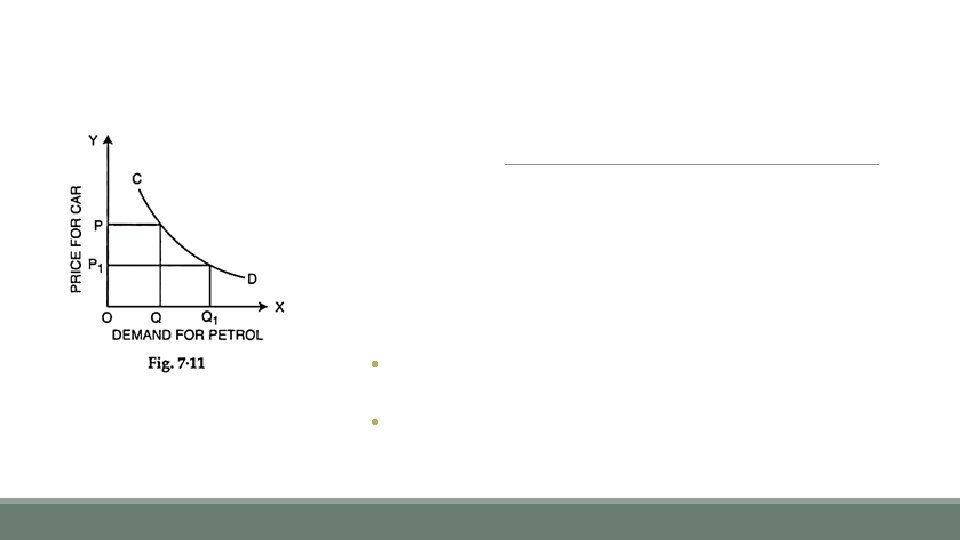
Assumptions The Law of Demand assumes that the following factors remain constant. 1. Price of related goods Complimentary goods – the goods which are used together to satisfy a want. E. g. tea and sugar, automobiles and petrol. • A fall in the price of a commodity raises the demand for its complimentary goods. • The demand curve for price of car vs the demand for petrol is shown.
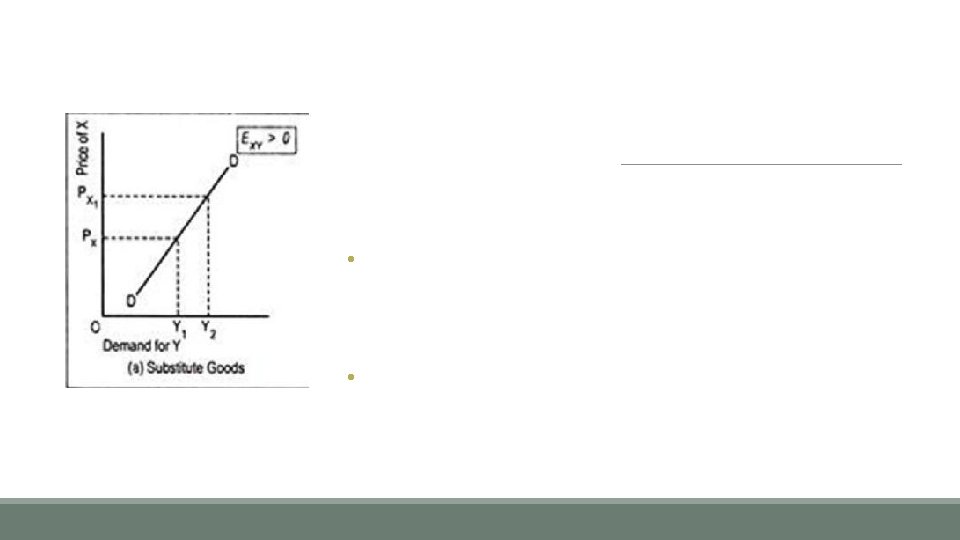
Assumptions Substitute goods – the goods which can be used in place of others. E. g. tea and coffee, scooter and motorcycle. • Fall in the price of a commodity results in lowered demand for its substitute, and increase in price of a commodity results in increase in demand of its substitute. • The demand curve for price of tea vs the demand for coffee is shown.
Assumptions 2. Tastes and preferences of consumer - Over a period of time, the preference of people for a particular product may increase, which in turn, will affect the demand. • E. g. - if the number of diabetic people increases, the demand for sugar-free products also increases. 3. Expectations about future prices – If consumers expect the price of certain good to rise in near future, they tend to demand more for it in the present even at increasing prices. 4. Other factors - • Size and distribution of population – the more the consumers, greater is the demand.
Assumptions • Composition of population – various age groups and genders have their own requirements and so the demand changes. • Distribution of income – Equitable distribution of income leads to increase in demand whereas unequal distribution leads to decrease in demand. • Taxation - Higher tax on a commodity lowers its demand. • Advertisement effects - Advertisements and publicity affect the preferences of the consumers. • Technological advancements • Weather and Climate
Explanation DEMAND SCHEDULE AND DEMAND CURVE
Demand Schedule It refers to a tabular representation of the relationship between price and quantity demanded. It demonstrates quantity of a product demanded by an individual or group of individuals at specific price and time. Two types - • Individual demand schedule • Market demand schedule
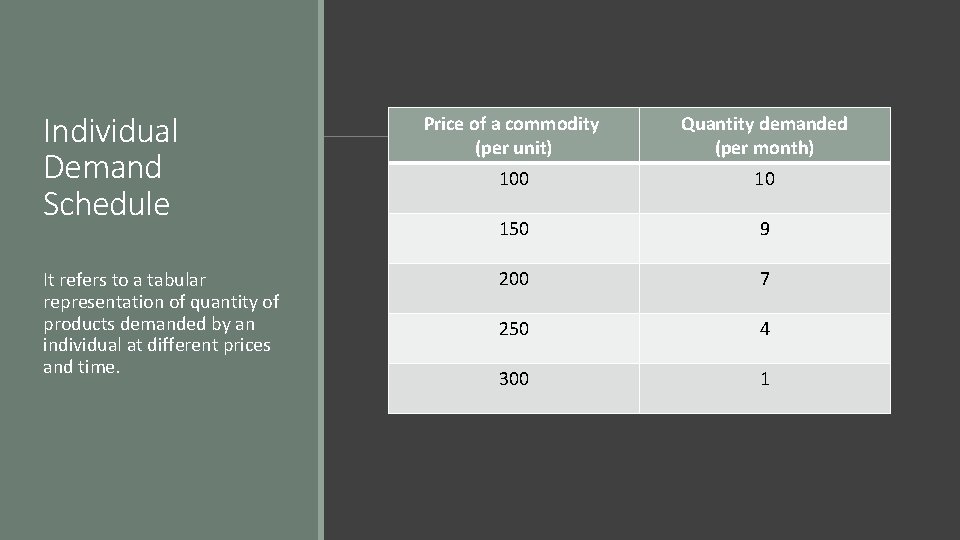
Individual Demand Schedule It refers to a tabular representation of quantity of products demanded by an individual at different prices and time. Price of a commodity (per unit) Quantity demanded (per month) 100 10 150 9 200 7 250 4 300 1
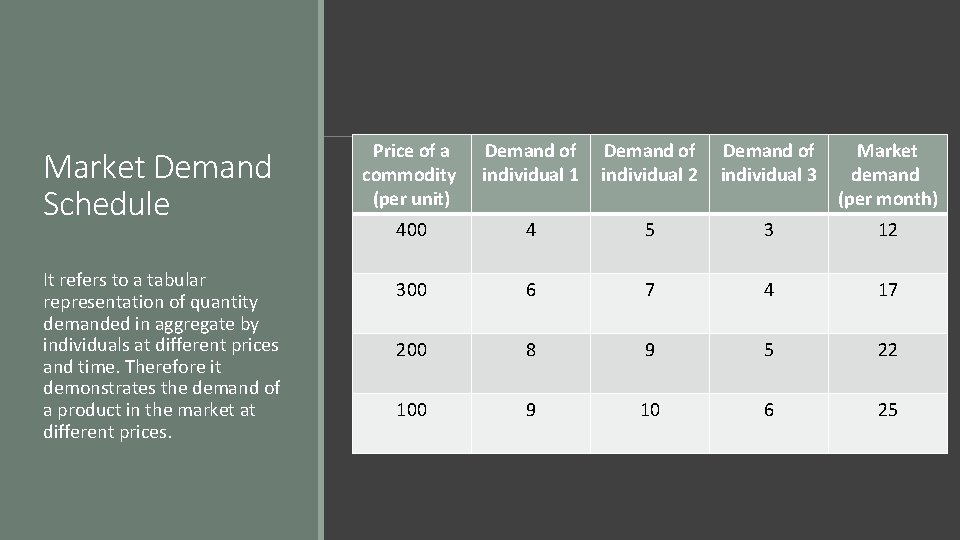
Market Demand Schedule Price of a commodity (per unit) Demand of individual 1 Demand of individual 2 Demand of individual 3 Market demand (per month) 400 4 5 3 12 It refers to a tabular representation of quantity demanded in aggregate by individuals at different prices and time. Therefore it demonstrates the demand of a product in the market at different prices. 300 6 7 4 17 200 8 9 5 22 100 9 10 6 25
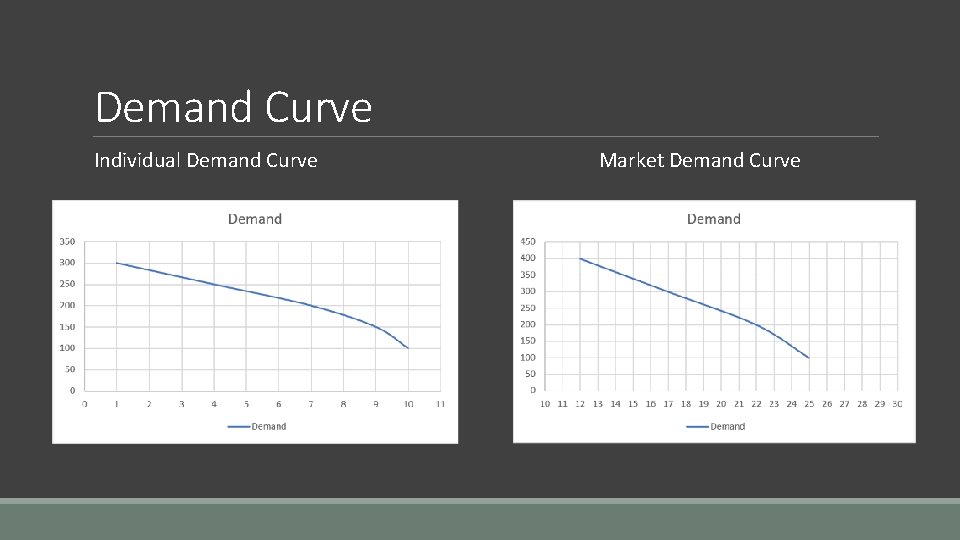
Demand Curve Individual Demand Curve Market Demand Curve
Upward Sloping Demand Curve EXCEPTIONS TO THE LAW OF DEMAND
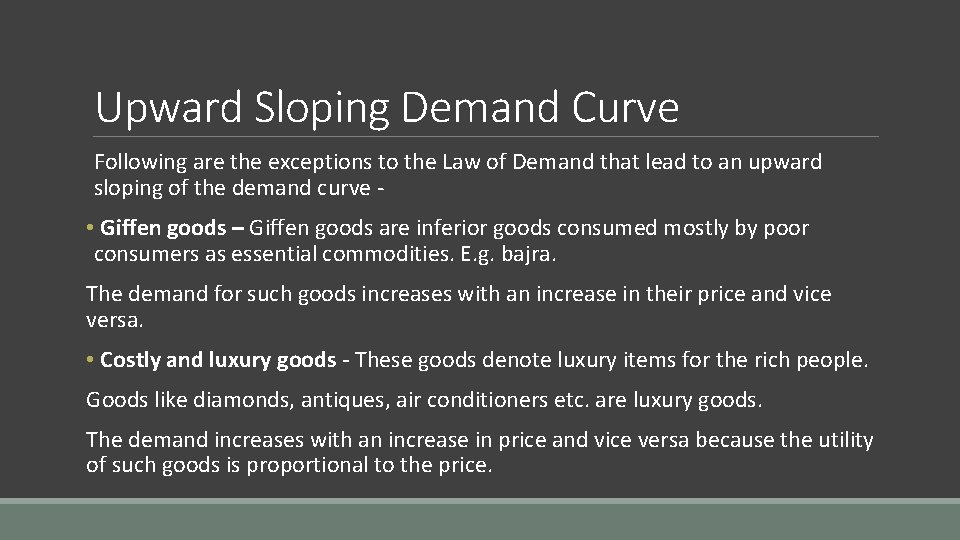
Upward Sloping Demand Curve Following are the exceptions to the Law of Demand that lead to an upward sloping of the demand curve - • Giffen goods – Giffen goods are inferior goods consumed mostly by poor consumers as essential commodities. E. g. bajra. The demand for such goods increases with an increase in their price and vice versa. • Costly and luxury goods - These goods denote luxury items for the rich people. Goods like diamonds, antiques, air conditioners etc. are luxury goods. The demand increases with an increase in price and vice versa because the utility of such goods is proportional to the price.
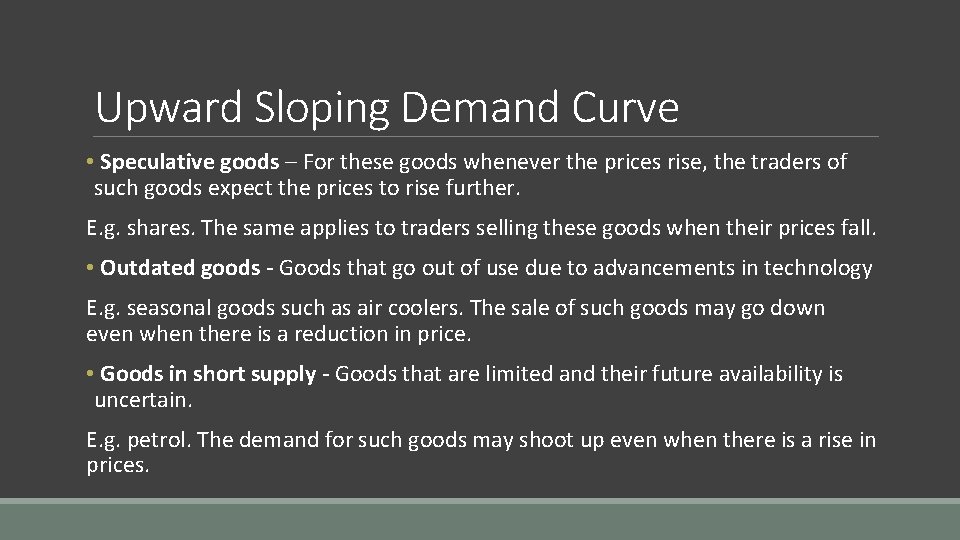
Upward Sloping Demand Curve • Speculative goods – For these goods whenever the prices rise, the traders of such goods expect the prices to rise further. E. g. shares. The same applies to traders selling these goods when their prices fall. • Outdated goods - Goods that go out of use due to advancements in technology E. g. seasonal goods such as air coolers. The sale of such goods may go down even when there is a reduction in price. • Goods in short supply - Goods that are limited and their future availability is uncertain. E. g. petrol. The demand for such goods may shoot up even when there is a rise in prices.
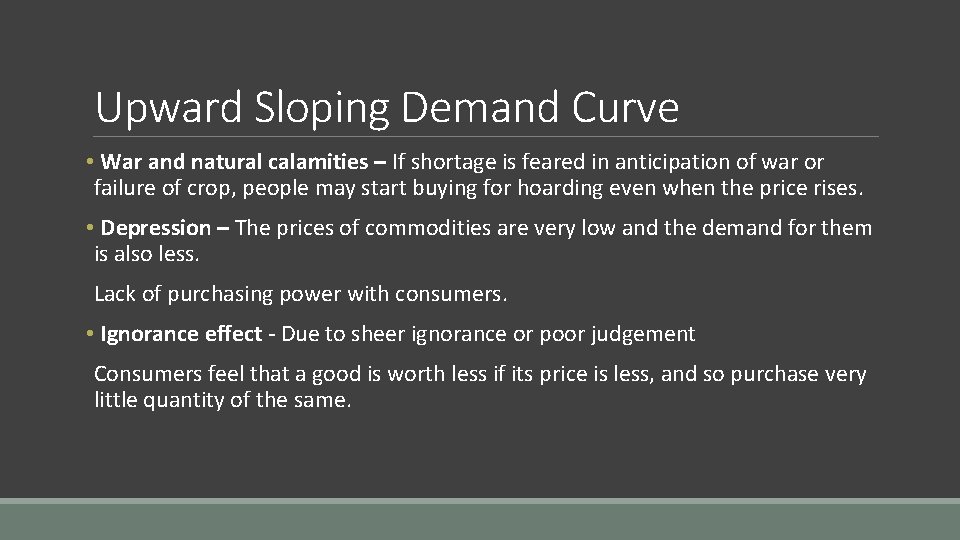
Upward Sloping Demand Curve • War and natural calamities – If shortage is feared in anticipation of war or failure of crop, people may start buying for hoarding even when the price rises. • Depression – The prices of commodities are very low and the demand for them is also less. Lack of purchasing power with consumers. • Ignorance effect - Due to sheer ignorance or poor judgement Consumers feel that a good is worth less if its price is less, and so purchase very little quantity of the same.
Thank You