
Law of Conservation of Matter Objective SWBAT Compare
Law of Conservation of Matter
Objective � SWBAT – Compare and contrast physical and chemical changes. � SWBAT: Analyze the law of conservation of matter and explain how we proved it in our series of labs.
Conservation of Matter � What is matter? � What are the phases of matter? � What’s the difference between physical and chemical changes? � What does the law of conservation of matter state? � What does it mean? � What are sources of error? � What are laws of nature?
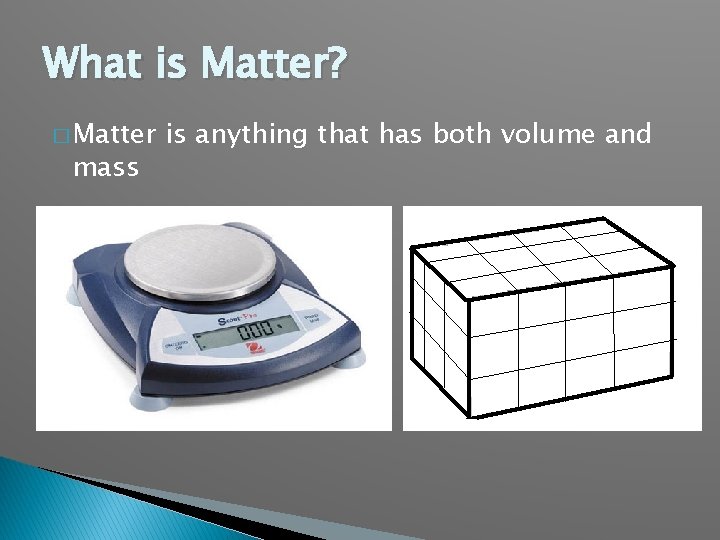
What is Matter? � Matter mass is anything that has both volume and
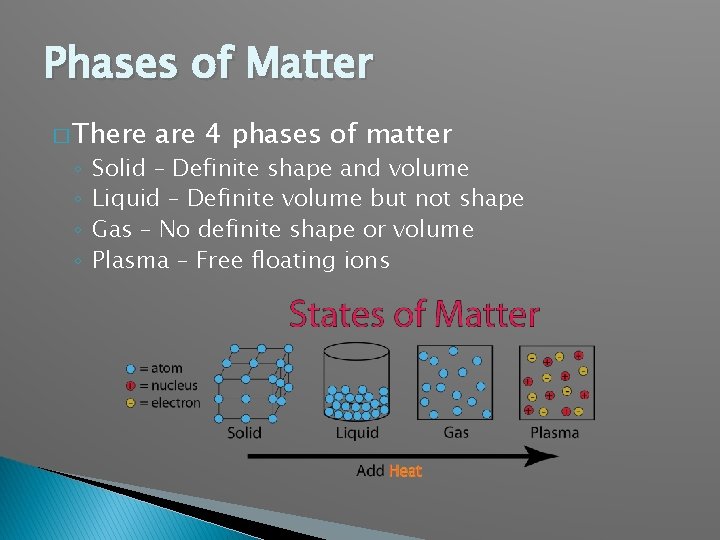
Phases of Matter � There ◦ ◦ are 4 phases of matter Solid – Definite shape and volume Liquid – Definite volume but not shape Gas – No definite shape or volume Plasma – Free floating ions
Types of Changes � What’s the difference between a physical and a chemical change?
Physical Changes � What is a physical change? ◦ No new substance is created � 3 Ways to identify physical changes 1. A change of STATE! �When we go from a solid to a liquid or a liquid to a gas or a gas to a plasma or the other way around 2. A change of SHAPE! �Paper being cut 3. Substances are dissolved �Salt in water
Chemical Changes � What is a chemical change? ◦ One or more NEW substances are created ◦ The new substance is DIFFERENT than the starting materials � 4 1. 2. 3. 4. Pieces of Evidence of a chemical change A gas is produced A precipitate is formed Energy is released There is a color change. � Most chemical reactions are irreversible �Cake mix becomes cake �Bike rusts �Paper is burned
Conservation of Matter � The Law of Conservation of Matter states that matter cannot be created nor destroyed, but can be rearranged. � Mass will be exactly conserved (the same) provided nothing is added or allowed to escape. � Chemical and physical changes allow the matter to change from one form of matter to another, BUT matter never created or destroyed.
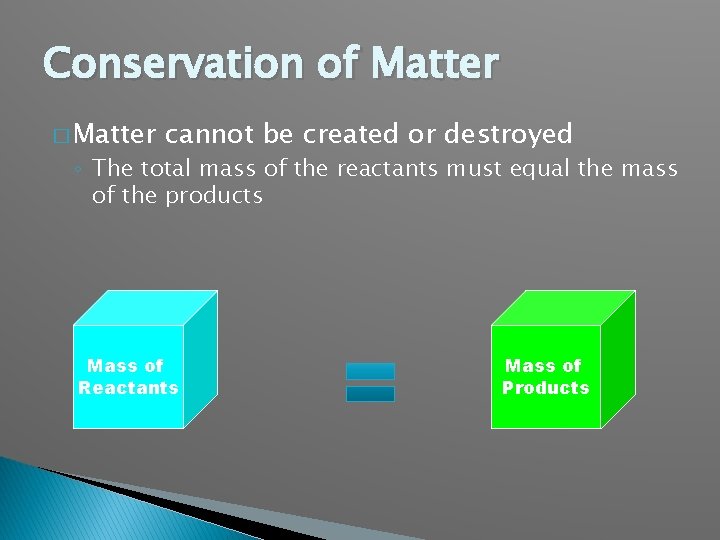
Conservation of Matter � Matter cannot be created or destroyed ◦ The total mass of the reactants must equal the mass of the products Mass of Reactants Mass of Products
Conservation of Mass � In a CLOSED system mass is the same whethere’s a chemical change or a physical change � Matter that changes phases is still in the system. ◦ In experiments that we did, which were chemical changes and which were physical?
Conservation of Mass � In an OPEN system, the substances are exposed to the atmosphere and might be able to escape, therefore mass is NOT the same – it’s lost to the atmosphere. � However, mass is conserved because the matter is changing its phase. ◦ Think about the alka-seltzer in the open bag.
Sources of Error � Sources of Error for Experimental Data 1. Equipment Errors �Problems with balances not being reliable �Our balances accuracy ranges from -0. 01 g to +0. 01 g 2. Human Errors �Humans aren’t perfect 3. Experimental Errors �Sometimes things don’t work out because of the experiment.
Laws of Nature �Generalizations in science that are based on experiments and experimental data. ◦ Example – When a solid is placed in water, the water level rises.
- Slides: 14