
Law Its Purpose and History Rules vs Laws

- Slides: 11
Law: Its Purpose and History
Rules vs. Laws? Rule A norm for behaviour - rules of a game or an organization apply only to participants in the game or members of the organization. Law A rule to govern action - a rule of conduct established by government for society to follow and obey; applies to all members of society at all times
Laws as Opposed to Rules • Laws are mandatory; whereas rules may be optional • Laws entail a formal system of procedures for enforcement • Law impose a system of punishment and remedies
Why Do We Need Laws? • As an instrument of society; so lots of people can live together in harmony • As a mechanism for resolving disputes • To protect our person, property and rights • To provide order in society
The Early History of Law The Code of Hammurabi • Created by Hammurabi 3800 years ago • 300 laws carved on columns of stone • Organized under various headings (ex – family, criminal, business etc. ) • Retribution was key • “An eye for an eye, a tooth for a tooth”
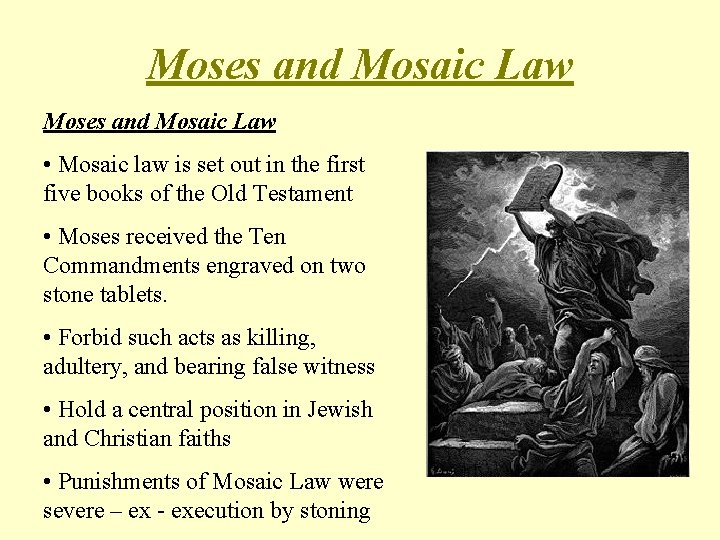
Moses and Mosaic Law • Mosaic law is set out in the first five books of the Old Testament • Moses received the Ten Commandments engraved on two stone tablets. • Forbid such acts as killing, adultery, and bearing false witness • Hold a central position in Jewish and Christian faiths • Punishments of Mosaic Law were severe – ex - execution by stoning
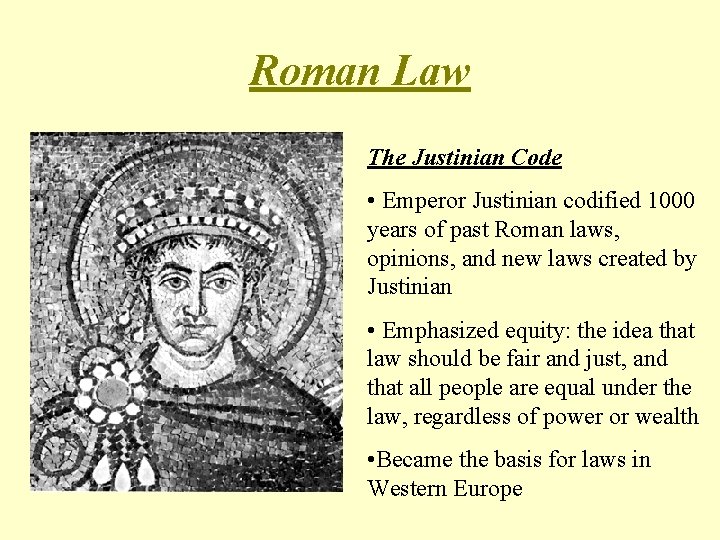
Roman Law The Justinian Code • Emperor Justinian codified 1000 years of past Roman laws, opinions, and new laws created by Justinian • Emphasized equity: the idea that law should be fair and just, and that all people are equal under the law, regardless of power or wealth • Became the basis for laws in Western Europe
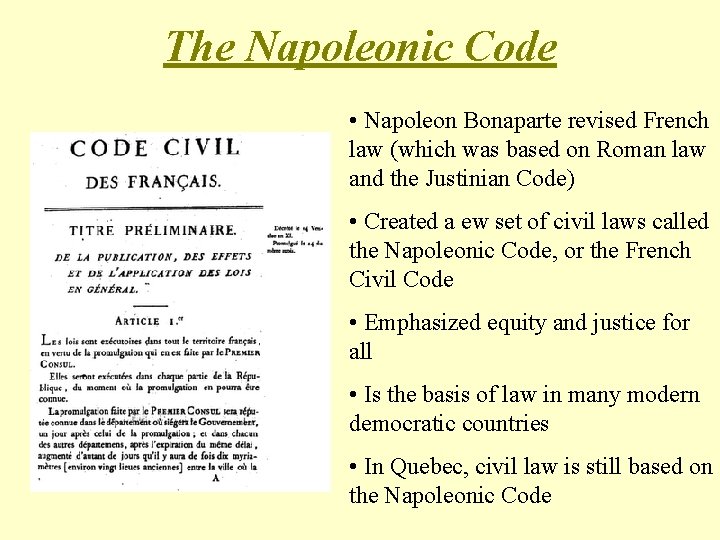
The Napoleonic Code • Napoleon Bonaparte revised French law (which was based on Roman law and the Justinian Code) • Created a ew set of civil laws called the Napoleonic Code, or the French Civil Code • Emphasized equity and justice for all • Is the basis of law in many modern democratic countries • In Quebec, civil law is still based on the Napoleonic Code
Common Law • In early England, the • Punishments varied King owned all the and were unequal, so land divided it up the king appointed among his lords and judges to travel around nobles (called and resolve disputes feudalism) • Judges met regularly • Lords loyal to king, to discuss cases and in exchange could • Common-law system run his manor/estate as developed and it based he saw fit (i. e. Was the on precedent judge) (examples)
The Development of Canadian Law • Canadian law is based on the laws of France and England (the countries that colonized Canada) • Quebec – Civil Law • Rest of Canada – Common Law (often called Case Law) • Aboriginal influences are having a greater impact on Canadian law today
Other important developments in law • 1215 -King John forced to sign the Magna Carta (“The Great Charter”)—document recognized the principle of the rule of law (equality before the law; disputes settled in peaceful and timely means; guaranteed the right of habeas corpus, or, protection against unlawful detention • 1265—first parliament formed; job to help make laws; by 1688 the monarch’s power was lessened and parliament represented the people