
Law concerning the Protection and Control of Animals








- Slides: 23
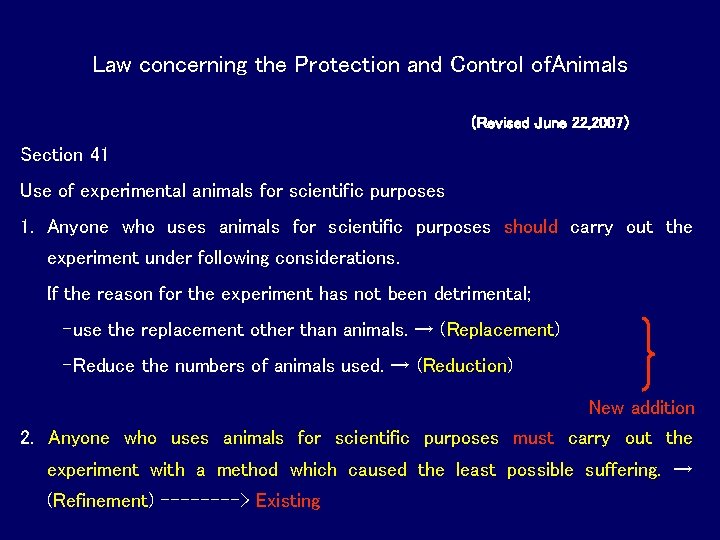
Law concerning the Protection and Control of. Animals (Revised June 22, 2007) Section 41 Use of experimental animals for scientific purposes 1. Anyone who uses animals for scientific purposes should carry out the experiment under following considerations. If the reason for the experiment has not been detrimental; – use the replacement other than animals. → (Replacement) – Reduce the numbers of animals used. → (Reduction) New addition 2. Anyone who uses animals for scientific purposes must carry out the experiment with a method which caused the least possible suffering. → (Refinement) ----> Existing
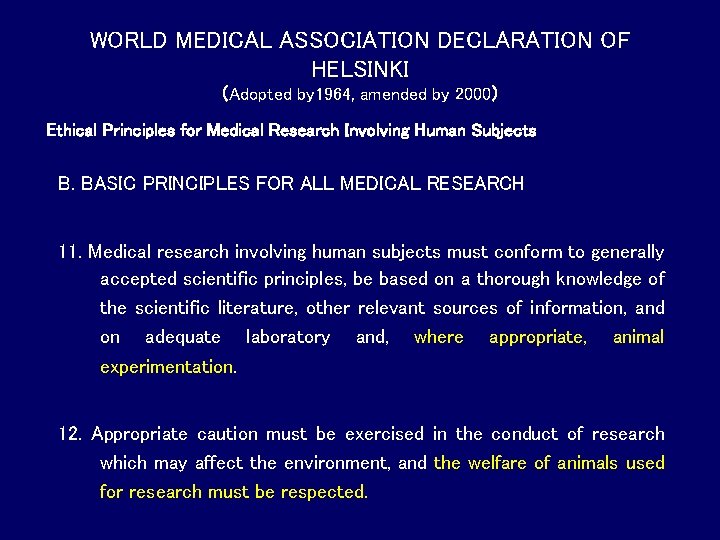
WORLD MEDICAL ASSOCIATION DECLARATION OF HELSINKI (Adopted by 1964, amended by 2000) Ethical Principles for Medical Research Involving Human Subjects B. BASIC PRINCIPLES FOR ALL MEDICAL RESEARCH 11. Medical research involving human subjects must conform to generally accepted scientific principles, be based on a thorough knowledge of the scientific literature, other relevant sources of information, and on adequate laboratory and, where appropriate, animal experimentation. 12. Appropriate caution must be exercised in the conduct of research which may affect the environment, and the welfare of animals used for research must be respected.
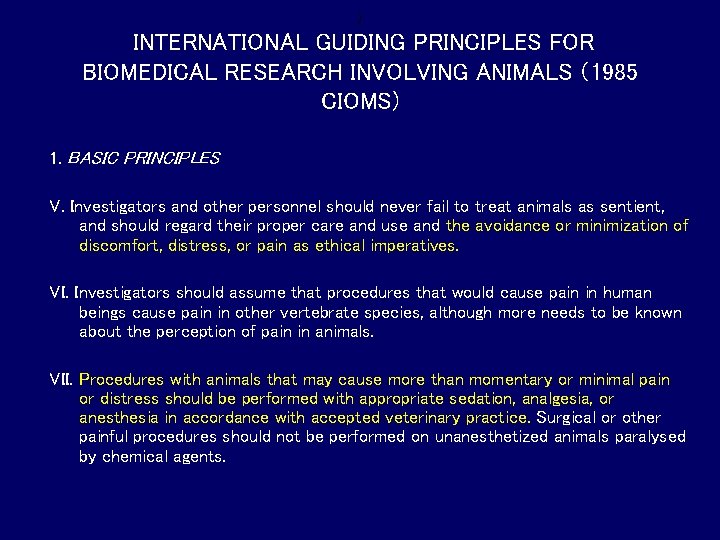
) INTERNATIONAL GUIDING PRINCIPLES FOR BIOMEDICAL RESEARCH INVOLVING ANIMALS (1985 CIOMS) 1. BASIC PRINCIPLES V. Investigators and other personnel should never fail to treat animals as sentient, and should regard their proper care and use and the avoidance or minimization of discomfort, distress, or pain as ethical imperatives. VI. Investigators should assume that procedures that would cause pain in human beings cause pain in other vertebrate species, although more needs to be known about the perception of pain in animals. VII. Procedures with animals that may cause more than momentary or minimal pain or distress should be performed with appropriate sedation, analgesia, or anesthesia in accordance with accepted veterinary practice. Surgical or other painful procedures should not be performed on unanesthetized animals paralysed by chemical agents.
EU Directive:Council Directive 86/609/EEC(1986) Article 1. The aim of this Directive is to ensure that where animals are used for experimental or other scientific purposes the provisions laid down by law, regulation or administrative provisions in the Member States… EU MEMBER STATES 25 1. 2. 3. 4. 5. 6. 7. 8. 9. 10. 11. 12. 13. Austria Belgium Cyprus Czech Republic Denmark Estonia Germany Greece Finland France Hungary Ireland Italy 14. 15. 16. 17. 18. 19. 20. 21. 22. 23. 24. 25. Latvia Lithuania Luxembourg Malta Poland Portugal Slovakia Slovenia Spain Sweden Netherlands United Kingdom (2004 new member)
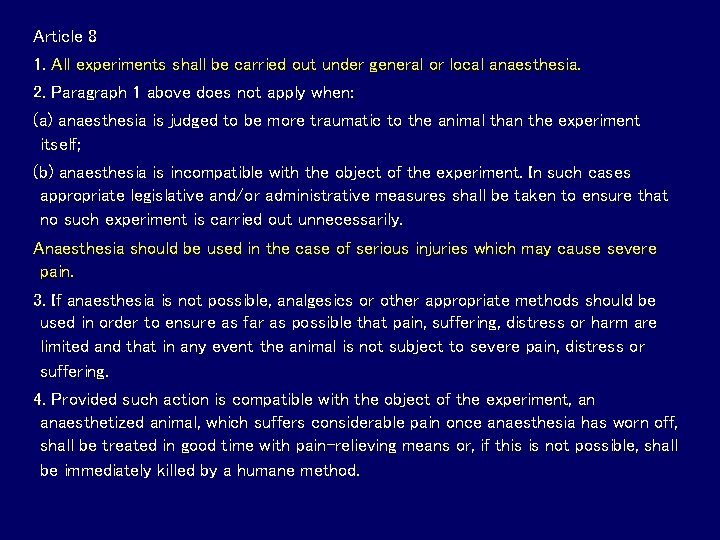
Article 8 1. All experiments shall be carried out under general or local anaesthesia. 2. Paragraph 1 above does not apply when: (a) anaesthesia is judged to be more traumatic to the animal than the experiment itself; (b) anaesthesia is incompatible with the object of the experiment. In such cases appropriate legislative and/or administrative measures shall be taken to ensure that no such experiment is carried out unnecessarily. Anaesthesia should be used in the case of serious injuries which may cause severe pain. 3. If anaesthesia is not possible, analgesics or other appropriate methods should be used in order to ensure as far as possible that pain, suffering, distress or harm are limited and that in any event the animal is not subject to severe pain, distress or suffering. 4. Provided such action is compatible with the object of the experiment, an anaesthetized animal, which suffers considerable pain once anaesthesia has worn off, shall be treated in good time with pain-relieving means or, if this is not possible, shall be immediately killed by a humane method.
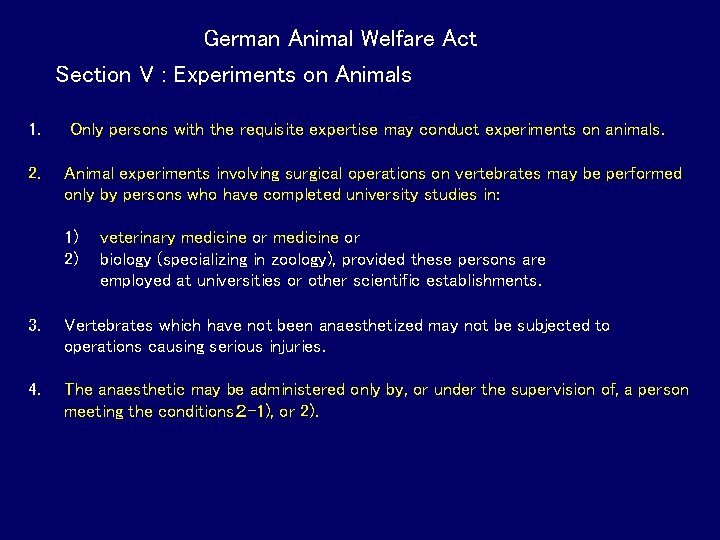
German Animal Welfare Act Section V : Experiments on Animals 1. 2. Only persons with the requisite expertise may conduct experiments on animals. Animal experiments involving surgical operations on vertebrates may be performed only by persons who have completed university studies in: 1) 2) veterinary medicine or biology (specializing in zoology), provided these persons are employed at universities or other scientific establishments. 3. Vertebrates which have not been anaesthetized may not be subjected to operations causing serious injuries. 4. The anaesthetic may be administered only by, or under the supervision of, a person meeting the conditions2 -1), or 2).
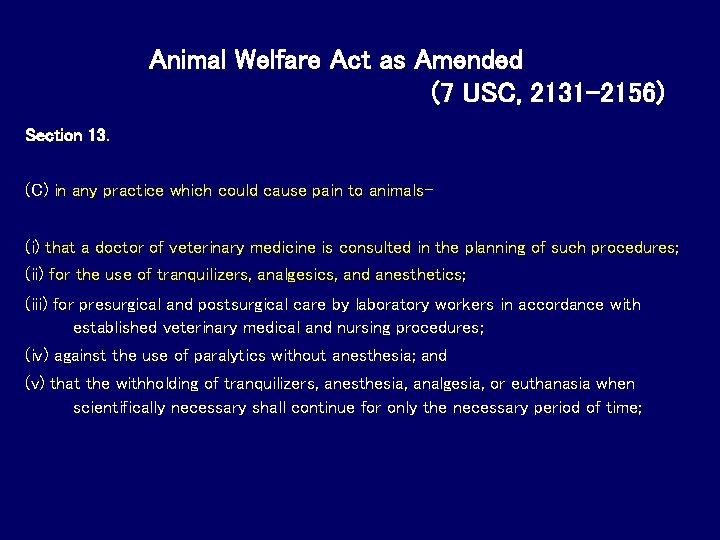
Animal Welfare Act as Amended (7 USC, 2131 -2156) Section 13. (C) in any practice which could cause pain to animals(i) that a doctor of veterinary medicine is consulted in the planning of such procedures; (ii) for the use of tranquilizers, analgesics, and anesthetics; (iii) for presurgical and postsurgical care by laboratory workers in accordance with established veterinary medical and nursing procedures; (iv) against the use of paralytics without anesthesia; and (v) that the withholding of tranquilizers, anesthesia, analgesia, or euthanasia when scientifically necessary shall continue for only the necessary period of time;
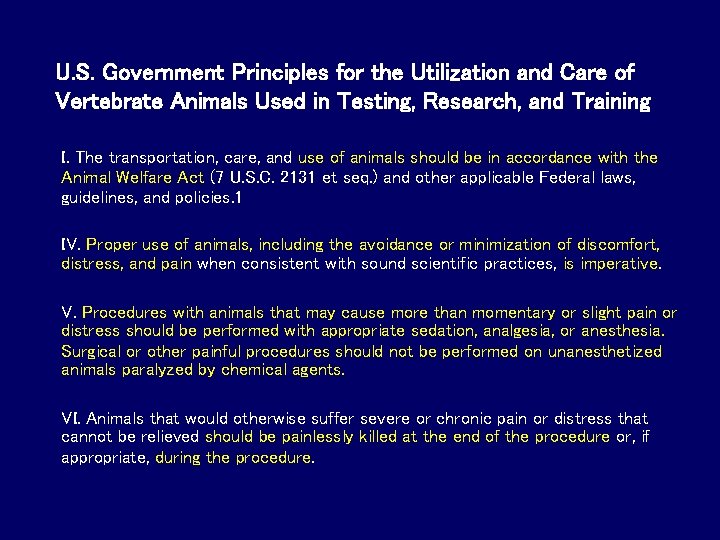
U. S. Government Principles for the Utilization and Care of Vertebrate Animals Used in Testing, Research, and Training I. The transportation, care, and use of animals should be in accordance with the Animal Welfare Act (7 U. S. C. 2131 et seq. ) and other applicable Federal laws, guidelines, and policies. 1 IV. Proper use of animals, including the avoidance or minimization of discomfort, distress, and pain when consistent with sound scientific practices, is imperative. V. Procedures with animals that may cause more than momentary or slight pain or distress should be performed with appropriate sedation, analgesia, or anesthesia. Surgical or other painful procedures should not be performed on unanesthetized animals paralyzed by chemical agents. VI. Animals that would otherwise suffer severe or chronic pain or distress that cannot be relieved should be painlessly killed at the end of the procedure or, if appropriate, during the procedure.
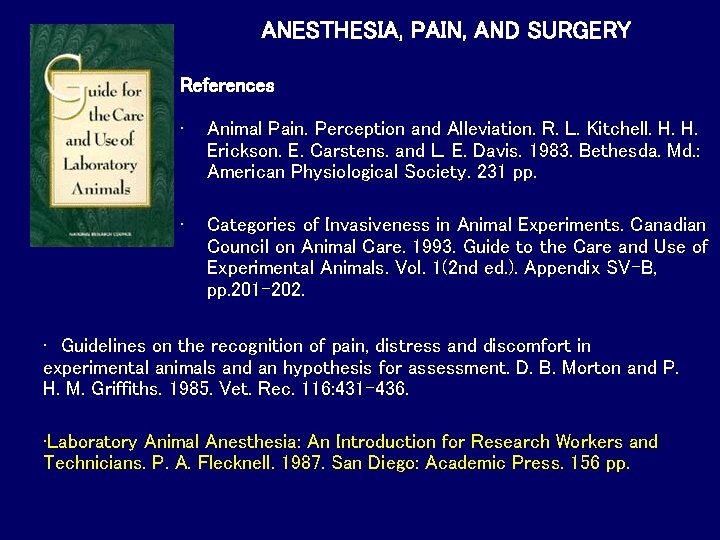
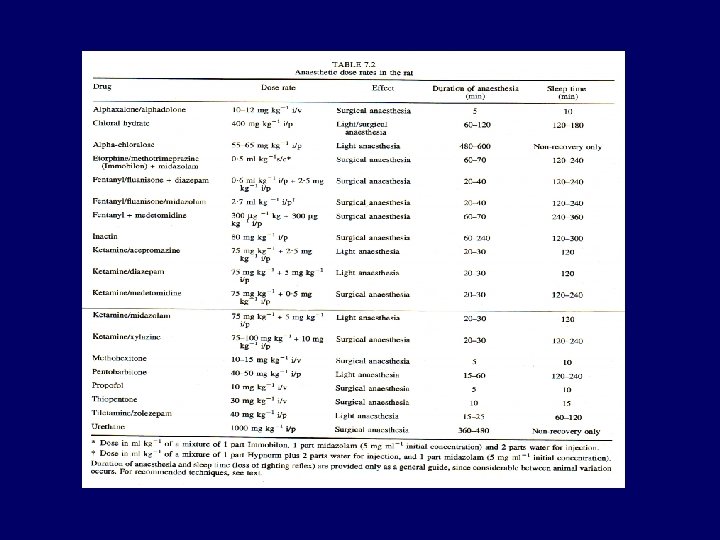
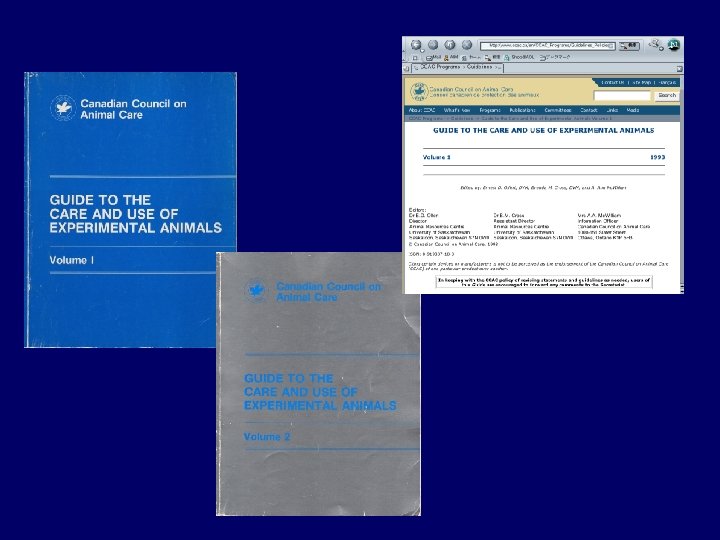
ANESTHESIA, PAIN, AND SURGERY References • Animal Pain. Perception and Alleviation. R. L. Kitchell. H. H. Erickson. E. Carstens. and L. E. Davis. 1983. Bethesda. Md. : American Physiological Society. 231 pp. • Categories of Invasiveness in Animal Experiments. Canadian Council on Animal Care. 1993. Guide to the Care and Use of Experimental Animals. Vol. 1(2 nd ed. ). Appendix SV-B, pp. 201 -202. • Guidelines on the recognition of pain, distress and discomfort in experimental animals and an hypothesis for assessment. D. B. Morton and P. H. M. Griffiths. 1985. Vet. Rec. 116: 431 -436. • Laboratory Animal Anesthesia: An Introduction for Research Workers and Technicians. P. A. Flecknell. 1987. San Diego: Academic Press. 156 pp.
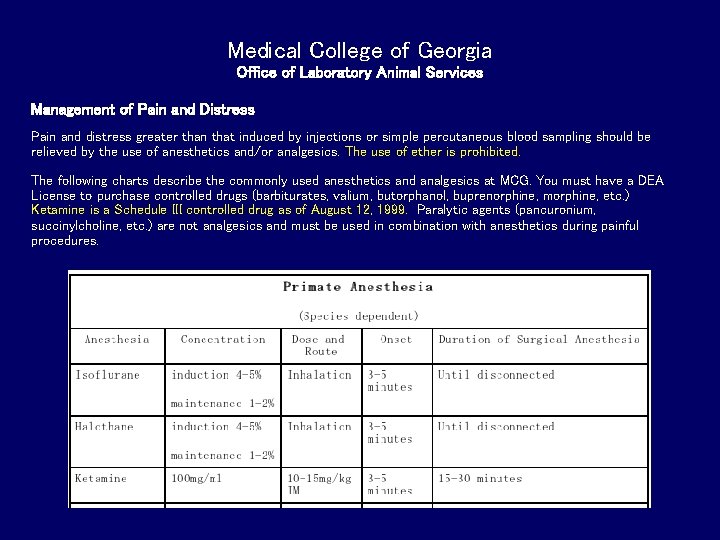
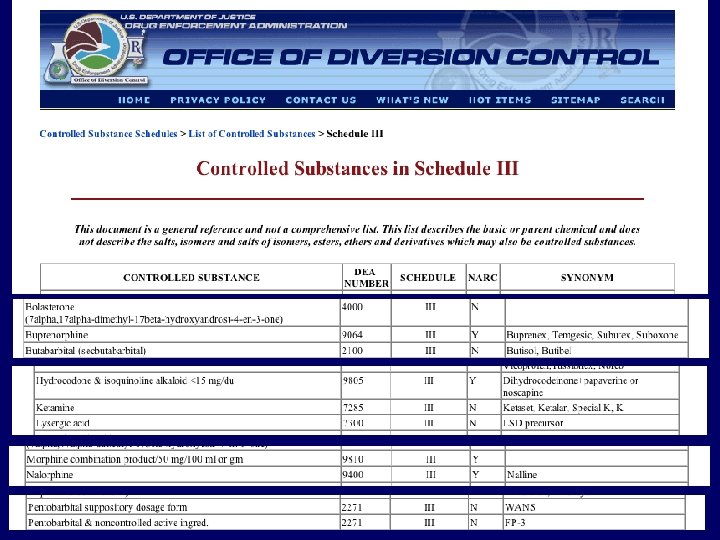
Medical College of Georgia Office of Laboratory Animal Services Management of Pain and Distress Pain and distress greater than that induced by injections or simple percutaneous blood sampling should be relieved by the use of anesthetics and/or analgesics. The use of ether is prohibited. The following charts describe the commonly used anesthetics and analgesics at MCG. You must have a DEA License to purchase controlled drugs (barbiturates, valium, butorphanol, buprenorphine, morphine, etc. ) Ketamine is a Schedule III controlled drug as of August 12, 1999. Paralytic agents (pancuronium, succinylcholine, etc. ) are not analgesics and must be used in combination with anesthetics during painful procedures.
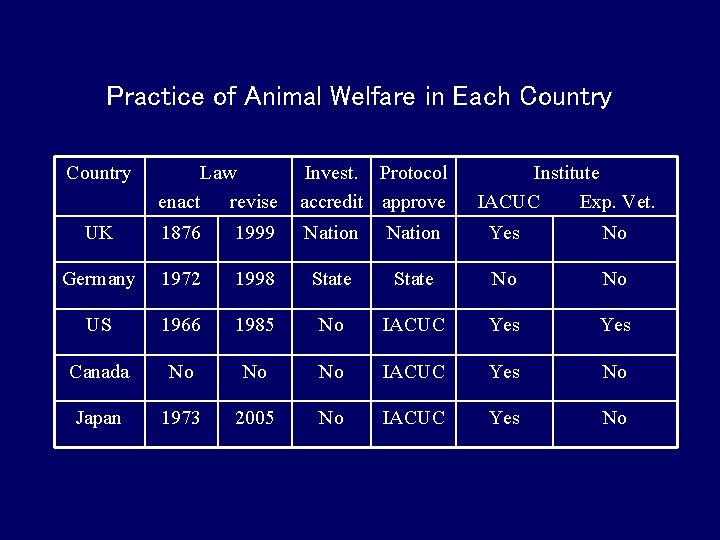
Practice of Animal Welfare in Each Country Law enact revise Invest. Protocol accredit approve Institute IACUC Exp. Vet. UK 1876 1999 Nation Yes No Germany 1972 1998 State No No US 1966 1985 No IACUC Yes Canada No No No IACUC Yes No Japan 1973 2005 No IACUC Yes No
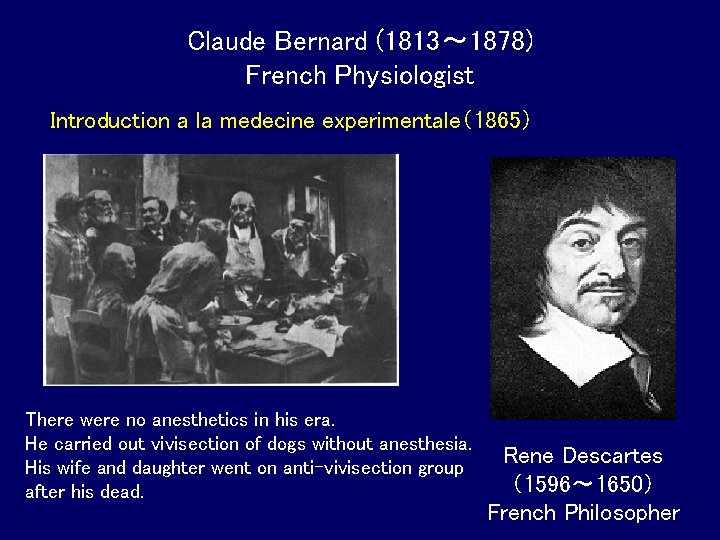
Claude Bernard (1813~ 1878) French Physiologist Introduction a la medecine experimentale(1865) There were no anesthetics in his era. He carried out vivisection of dogs without anesthesia. His wife and daughter went on anti-vivisection group after his dead. Rene Descartes (1596~ 1650) French Philosopher
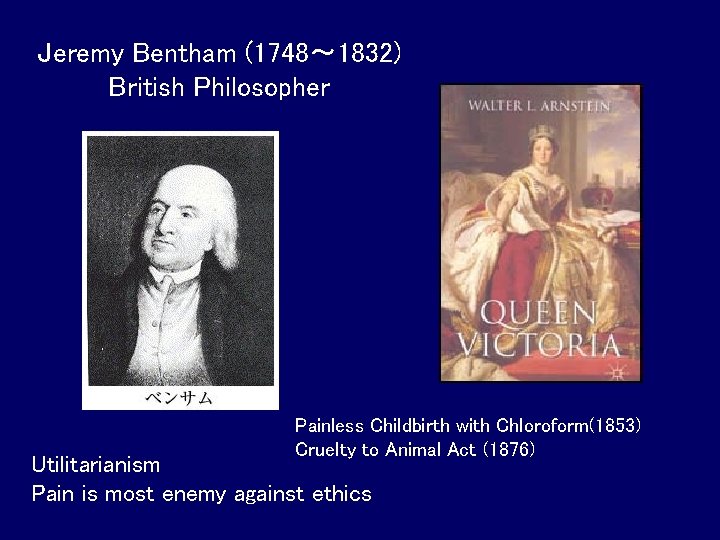
Jeremy Bentham (1748~ 1832) British Philosopher Painless Childbirth with Chloroform(1853) Cruelty to Animal Act (1876) Utilitarianism Pain is most enemy against ethics