
Law and Violence Against Women Deepa Mattoo Probono
Law and Violence Against Women Deepa Mattoo Pro-bono Project Coordinator
About Abuse: Guiding Principles The following principles are guidelines for work on men's violence against women: • VIOLENCE AGAINST WOMEN IS NEVER JUSTIFIED OR ACCEPTABLE. IT IS A CRIME.
Violence: • is life threatening. In Ontario between 3 -6 women are murdered each month by their current or former male partner. • has no place in the family or in the community. • is learned behaviour. It can, therefore, be changed. • is a choice. • is a power issue.
Violence: • is never justified. No behavior of any woman justifies or provokes violence. • is never the responsibility of the woman being abused. • Responsibility for violence rests with the batterer. • does not stem from "loss of control". • Control is what the batterer wants • occurs in all classes, races, and cultural groups. .
The issue of violence is complex • We need to understand the social, personal, economic, political, cultural, and religious dimensions of violence in a multicultural context. • Immigrant women and children face specific problems, such as: • racism • immigration policy/laws • language barriers • service access/lack of availability • lack of experience with social services • distrust of the judicial system • isolation • low economic status.

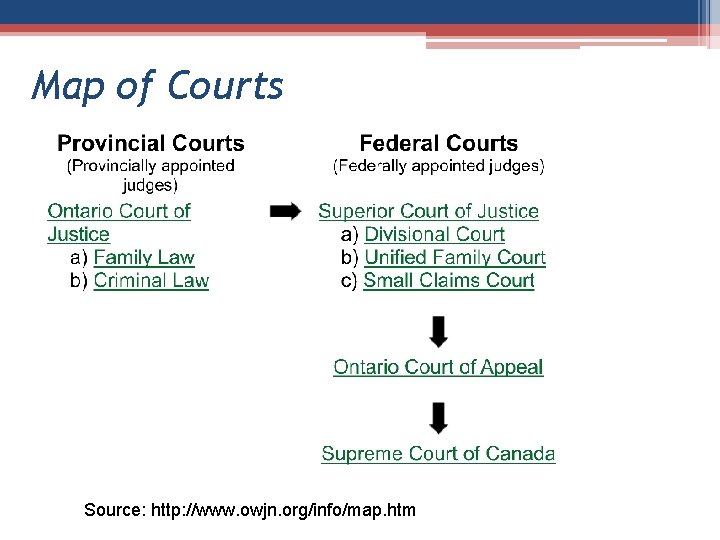
Map of Courts Source: http: //www. owjn. org/info/map. htm
Dialing 911 (Case Discussion) Response Mandatory Charges RESTRAINING ORDER • Where domestic abuse • For your safety – prevents partner from coming near you • If he still follows, he will get criminally charged by police
The Victim Witness Assistance Program • (VWAP) is available in most criminal couts in Ontario. VWAP can support you by telling you about court and helping you get ready for cross-examination. VWAP works with the Crown and will tell the Crown what you tell them. • (To find out more about VWAP, ask the police or your local women's organization)
The Criminal Justice System -sexual assault (rape or any other unwanted sex acts, like touching or grabbing) -assault (hitting, beating, etc. ) or the threat of assault -criminal harassment (stalking) These crimes are dealt with through the criminal law system. The laws about these crimes are the same everywhere in Canada and affect everyone.
Names for People • • victim. complainant. suspect. accused. witness. defendant. defense. alleged perpetrator.
Partner Assault Response (PAR) • Partner Assault Response (PAR) program staff and community agencies, work together to ensure priority is given to the safety and needs of domestic assault victims and their children. • An operational DVC includes the following components: A Domestic Violence Court Advisory Committee Specially trained domestic violence Crowns, VWAP staff, and interpreters Specialized evidence collection and investigation procedures by police Case management procedures to coordinate prosecutions and ensure early intervention
A Partner Assault Response intervention program • Expanded training for police, Crowns, VWAP staff, court staff, Probation and Parole staff, and interpreters The Ontario government is investing $21 million annually in this program. • Since 1996, the Ontario government has introduced the domestic violence court program to 30 court sites and is committed to expanding this program province-wide over the next few years. Domestic Violence Court programs currently operate in: Barrie, Brampton, Belleville, Brockville, Halton, Hamilton, Kenora/Sioux Lookout, Kingston, Kitchener, London, L'Orignal, Newmarket, Niagara, North Bay, Ottawa, Oshawa, Owen Sound, Pembroke, Picton, Sault Ste. Marie, St. Catharines, Sudbury, Thunder Bay, Walkerton, Windsor, and in Toronto at the College Park, Etobicoke, North York, Old City Hall and Scarborough court locations. http: //www. gov. on. ca/MBS/english/myontarioweb/abuse. html.
Family violence • Old age abuse • Child abuse
Involvement of Children's Aid Society (CAS) : • When will they get involved? • What will they inquire? • What is their role?
Case Discussion - Immigration - Refugee - Legal Aid
Immigration and Violence • Permanent resident status: • DO NOT have permanent resident status: Can not be remove. • get legal advice right away, before making any decisions about leaving your partner as you may be at risk of being removed from Canada. • You can pursue an application to remain in Canada on humanitarian and compassionate grounds ("H&C" application).
Do not have Status : • If immigration approves of application "in principle", you are eligible to apply for a work permit. • If you have made a claim for refugee protection based on your partner's situation, you will need to establish your own claim based on your fear of being abused in your own country or on country conditions there. You should talk to your own lawyer. • If a removal order has already been made against you, you cannot make a refugee claim, but you can make a pre-removal risk assessment (PRRA) application. • If you are a live-in caregiver and need to leave because you are being abused, you must find another job. Under this program, you have to work for a total of 24 months over a three-year period in order to qualify for permanent resident status. You do not need permission from your employer to take a job with a different employer, but you do need to apply for a new work permit before starting the new job.
WHAT IS AN H&C APPLICATION? • This is the short title for an "Immigration Application Made in Canada on Humanitarian and Compassionate Grounds". Immigration policies specifically address domestic violence and require immigration officers to be sensitive to women in these situations.
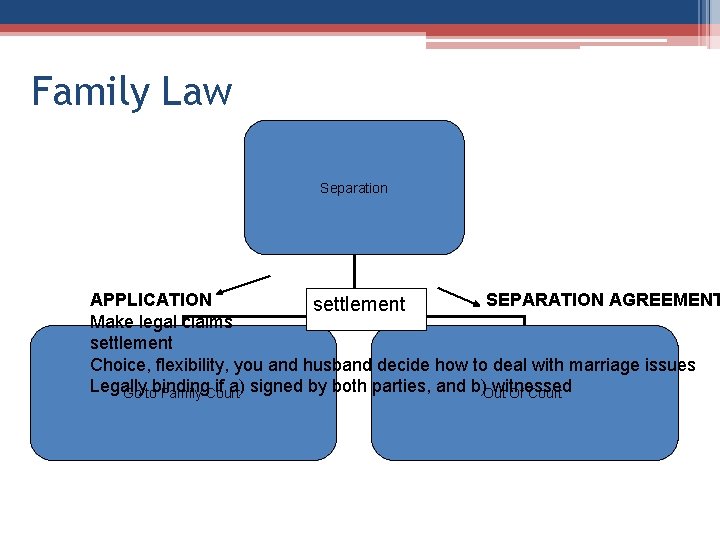
Family Law Separation APPLICATION SEPARATION AGREEMENT settlement Make legal claims settlement Choice, flexibility, you and husband decide how to deal with marriage issues Legally if a) signed by both parties, and b)Out witnessed Go tobinding Family Court Of Court
CHILD SUPPORT • Based on father’s/partner’s GROSS income and number of children • Special expenses - Do you need child care, school fees for extracurricular activities?
SPOUSAL SUPPORT • Needs vs. Means -You do NOT have enough Husband’s ability to pay – -money to pay for your expenses -Net - income after his expenses
CHILDREN CUSTODY • Child lives with you • Full vs. supervised vs. ▫ ▫ vs. ACCESS (visitation) joint custody unsupervised Domestic abuse Child abuse At access center for max. 2 hrs/week Get NON-REMOVAL ORDER (threat of child abduction)
DIVISION OF PROPERTY • Talk to lawyer if Husband has investments, mutual funds, RRSPs, owns real estate (including matrimonial home), cars, owns business (is shareholder), bank accounts, other valuable assets, etc. • Get FINANCIAL DISCLOSURE • Must make property claim either a) within 4 years after separation, or b) within 2 years of Divorce
DIVORCE • Need if want to remarry • Only 3 reasons allowed: a) adultery; b) cruel or intolerable treatment (abuse, ect. ); c) living separate for more than 1 year • Can make COROLLARY RELIEF CLAIMS – only for Child and Spousal Support (NO PROPERTY ISSUES)
CHANGE PREVIOUS COURT ORDER • Must show a MATERIAL CHANGE IN CIRCUMSTANCE (i. e. Husband’s income increased, you have become disabled, etc)
Resources: • Legal Aid Clinics • Community Legal Clinics • Family Law Office • Duty Counsel
Sources: • http: //www. owjn. org/info/imm-issues. htm • Shabana Khan (Family law Lawyer) • http: //www. cleo. on. ca/english/pub/onpub/PDF /familyresource. pdf
- Slides: 28