
Law and Justice Chapter 4 Settling Disputes Conflict
- Slides: 9
Law and Justice: Chapter 4 Settling Disputes
Conflict n A Conflict is a natural part of everyday life. n But consider that conflicts can be productive when managed responsibly!
Conflict Disadvantages of going to court to settle conflicts: n Time consuming n Expensive n General Health Concern: Anger and Bitterness (victims do not want to relive the bad moment or episode in their lives in court/ they might have moved on emotionally).
Informal Talk n n The least formal way to resolve a conflict is through informal talk. Involves two people talking out the problem with no help from others n Examples: Disagreements with parents, teachers, friends. . .
Negotiation n Negotiation is when people try to resolve the conflict by reaching a solution that is acceptable to all. Negotiation is important because the skills involved in handling conflict responsibly are used everyday by people in all aspects of life. A GIVE AND TAKE FROM BOTH PARTIES! Each needs to give something up.
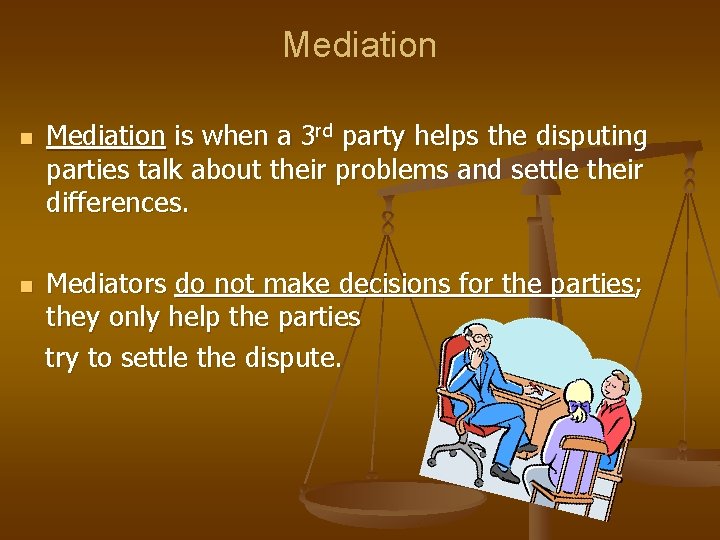
Mediation n n Mediation is when a 3 rd party helps the disputing parties talk about their problems and settle their differences. Mediators do not make decisions for the parties; they only help the parties try to settle the dispute.
Arbitration n n Arbitration is when both parties agree to have a 3 rd party listen to their arguments and make a decision for them. Decisions made by an arbitrator are legally binding. Arbitrators have authority similar to judges. Arbitration hearings are common in: n Employment disputes & credit card disputes.
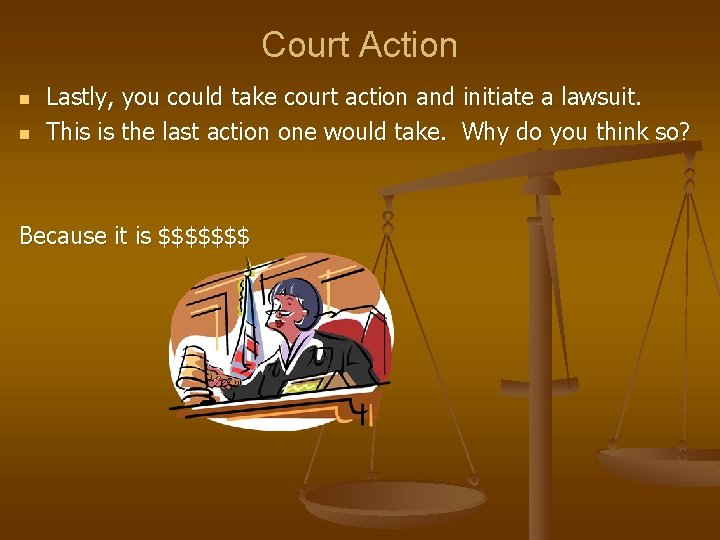
Court Action n n Lastly, you could take court action and initiate a lawsuit. This is the last action one would take. Why do you think so? Because it is $$$$$$$
Goal The ultimate goal of conflict is to reach a “settlement” also known as an “agreement” between the parties, regardless which dispute resolution method you use.