
Launch Structure Your task was to build the
Launch Structure • Your task was to build the lightest weight thrust structure that will withstand the force of launch to orbit at least three times. • Launch to orbit is defined as propelling a 1 liter bottle of water approximately 1 meter into the air.
Launch Structure • During static loading tests you looked for: – Structural members buckling – Unstable glue joints – Structure unsteady when moved side to side
Launch Structure • Path of force? • Balanced load = an evenly distributed support will evenly divide the force of the launch • What type of force is acting on the structure? – Before launch – During launch • What is the amount of force exerted on the structure during launch? What weight does the structure have to support?
Launch Structure • When the rocket presses down on the launch structure, the structure transfers this force to the lever supporting it. • The structure also pushes down on the lever. • What is the total compressive force on the structure at rest? – When a force is exerted down on an object that is resting on a surface, the compressive force is the size of the downward force.
Launch Structure • Calculating g-force on the structure: – Find the weight of the bottle (1. 3313 kg). This is the force in the equation. – m = the mass of your structure. – a = F/m – Then divide the acceleration the structure experiences by 9. 81 to find the g’s. • Less mass in structure means greater acceleration.
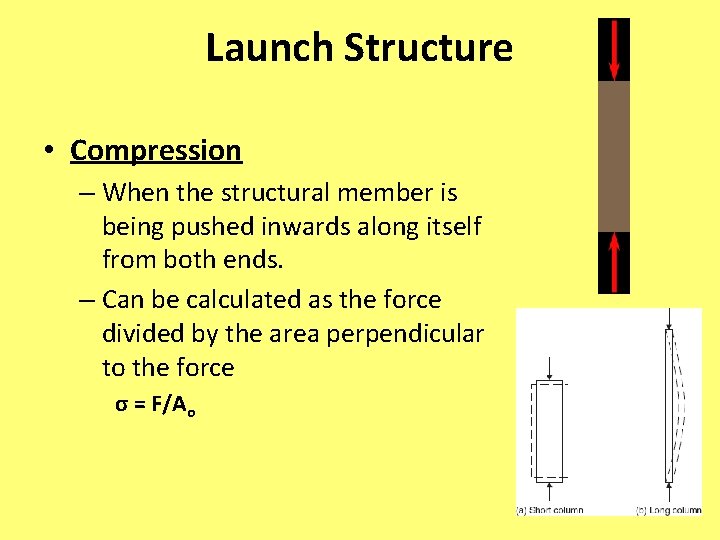
Launch Structure • Compression – When the structural member is being pushed inwards along itself from both ends. – Can be calculated as the force divided by the area perpendicular to the force σ = F/Ao
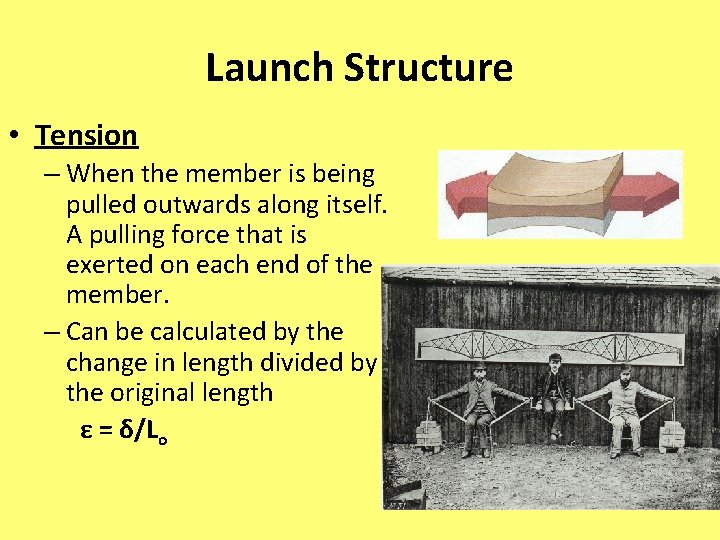
Launch Structure • Tension – When the member is being pulled outwards along itself. A pulling force that is exerted on each end of the member. – Can be calculated by the change in length divided by the original length ε = δ/Lo
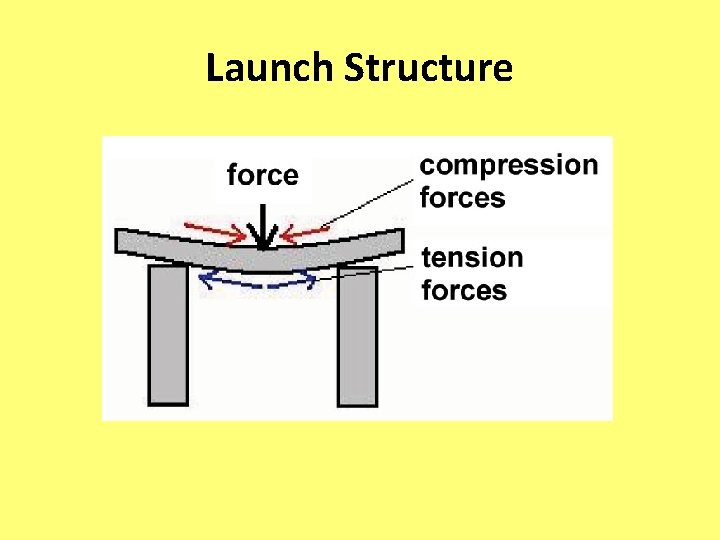
Launch Structure
Launch Structure • To identify tension and compression members in your structure: – If the member is vertical and the live load is vertically placed, that member is in compression. – The member adjacent and joined to the compression member is under tension (the sum of forces at the joints must equal zero). – Non-vertical members beyond the compression zone must be in tension or compression, alternately distributed.

- Slides: 10