
Lattice Boltzmann Simulation of Water Transport in Gas
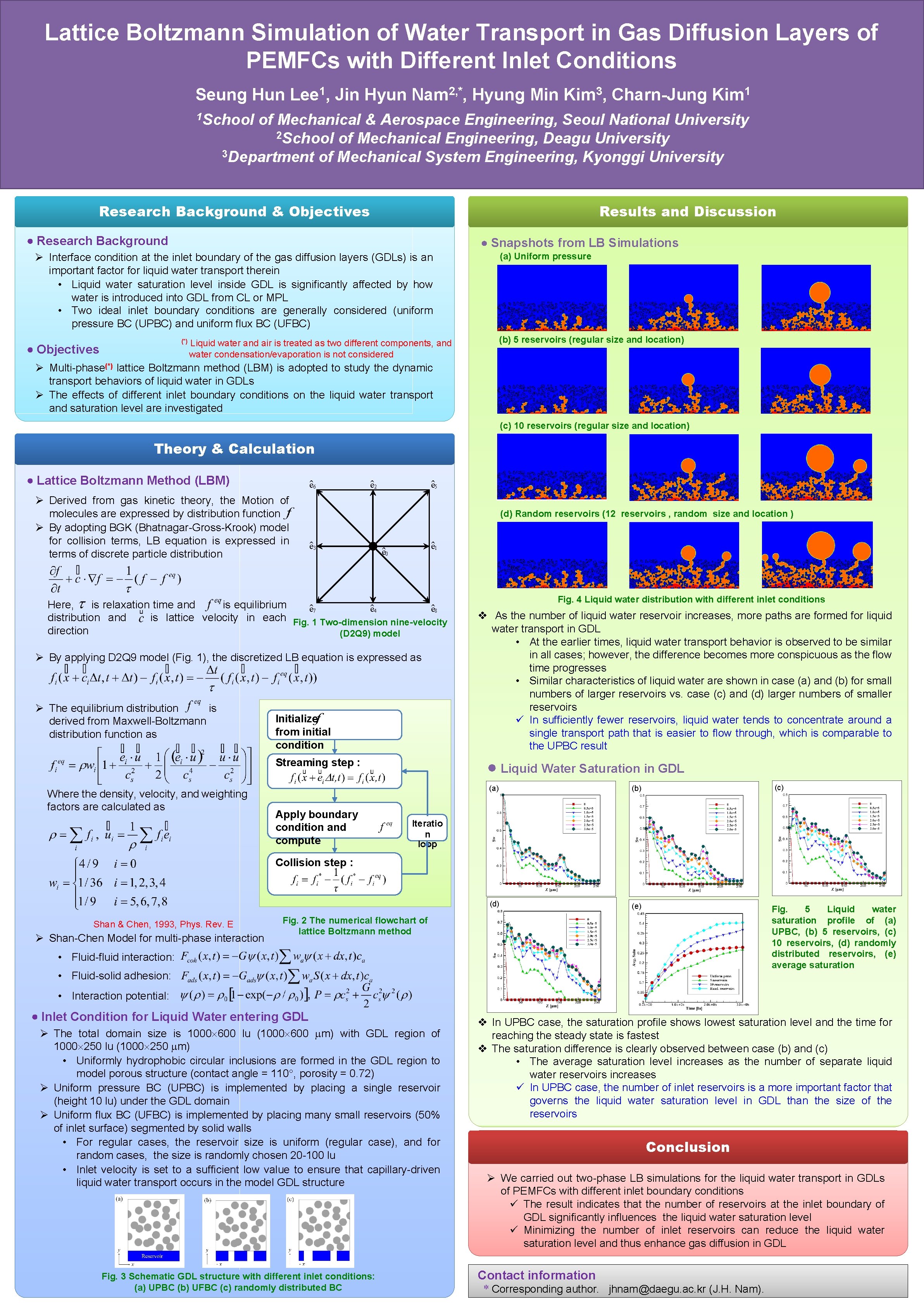
Lattice Boltzmann Simulation of Water Transport in Gas Diffusion Layers of PEMFCs with Different Inlet Conditions Seung Hun Lee 1, Jin Hyun Nam 2, *, Hyung Min Kim 3, Charn-Jung Kim 1 1 School of Mechanical & Aerospace Engineering, Seoul National University 2 School of Mechanical Engineering, Deagu University 3 Department of Mechanical System Engineering, Kyonggi University Research Background & Objectives Results and Discussion Research Background Snapshots from LB Simulations Ø Interface condition at the inlet boundary of the gas diffusion layers (GDLs) is an important factor for liquid water transport therein • Liquid water saturation level inside GDL is significantly affected by how water is introduced into GDL from CL or MPL • Two ideal inlet boundary conditions are generally considered (uniform pressure BC (UPBC) and uniform flux BC (UFBC) (*) Objectives (a) Uniform pressure (b) 5 reservoirs (regular size and location) Liquid water and air is treated as two different components, and water condensation/evaporation is not considered Ø Multi-phase(*) lattice Boltzmann method (LBM) is adopted to study the dynamic transport behaviors of liquid water in GDLs Ø The effects of different inlet boundary conditions on the liquid water transport and saturation level are investigated (c) 10 reservoirs (regular size and location) Theory & Calculation Lattice Boltzmann Method (LBM) e 6 Ø Derived from gas kinetic theory, the Motion of molecules are expressed by distribution function Ø By adopting BGK (Bhatnagar-Gross-Krook) model for collision terms, LB equation is expressed in terms of discrete particle distribution e 2 e 5 (d) Random reservoirs (12 reservoirs , random size and location ) e 3 e 1 e 0 Here, is relaxation time and is equilibrium e 7 e 4 e 8 distribution and is lattice velocity in each Fig. 1 Two-dimension nine-velocity direction (D 2 Q 9) model Ø By applying D 2 Q 9 model (Fig. 1), the discretized LB equation is expressed as Ø The equilibrium distribution is derived from Maxwell-Boltzmann distribution function as Initialize from initial condition Apply boundary condition and compute v As the number of liquid water reservoir increases, more paths are formed for liquid water transport in GDL • At the earlier times, liquid water transport behavior is observed to be similar in all cases; however, the difference becomes more conspicuous as the flow time progresses • Similar characteristics of liquid water are shown in case (a) and (b) for small numbers of larger reservoirs vs. case (c) and (d) larger numbers of smaller reservoirs ü In sufficiently fewer reservoirs, liquid water tends to concentrate around a single transport path that is easier to flow through, which is comparable to the UPBC result Liquid Water Saturation in GDL Streaming step : Where the density, velocity, and weighting factors are calculated as Fig. 4 Liquid water distribution with different inlet conditions (a) (b) (d) (e) (c) Iteratio n loop Collision step : Shan & Chen, 1993, Phys. Rev. E Ø Shan-Chen Model for multi-phase interaction Fig. 5 Liquid water saturation profile of (a) UPBC, (b) 5 reservoirs, (c) 10 reservoirs, (d) randomly distributed reservoirs, (e) average saturation Fig. 2 The numerical flowchart of lattice Boltzmann method • Fluid-fluid interaction: • Fluid-solid adhesion: • Interaction potential: Inlet Condition for Liquid Water entering GDL Ø The total domain size is 1000 600 lu (1000 600 m) with GDL region of 1000 250 lu (1000 250 m) • Uniformly hydrophobic circular inclusions are formed in the GDL region to model porous structure (contact angle = 110 , porosity = 0. 72) Ø Uniform pressure BC (UPBC) is implemented by placing a single reservoir (height 10 lu) under the GDL domain Ø Uniform flux BC (UFBC) is implemented by placing many small reservoirs (50% of inlet surface) segmented by solid walls • For regular cases, the reservoir size is uniform (regular case), and for random cases, the size is randomly chosen 20 -100 lu • Inlet velocity is set to a sufficient low value to ensure that capillary-driven liquid water transport occurs in the model GDL structure Fig. 3 Schematic GDL structure with different inlet conditions: (a) UPBC (b) UFBC (c) randomly distributed BC v In UPBC case, the saturation profile shows lowest saturation level and the time for reaching the steady state is fastest v The saturation difference is clearly observed between case (b) and (c) • The average saturation level increases as the number of separate liquid water reservoirs increases ü In UPBC case, the number of inlet reservoirs is a more important factor that governs the liquid water saturation level in GDL than the size of the reservoirs Conclusion Ø We carried out two-phase LB simulations for the liquid water transport in GDLs of PEMFCs with different inlet boundary conditions ü The result indicates that the number of reservoirs at the inlet boundary of GDL significantly influences the liquid water saturation level ü Minimizing the number of inlet reservoirs can reduce the liquid water saturation level and thus enhance gas diffusion in GDL Contact information * Corresponding author. jhnam@daegu. ac. kr (J. H. Nam).
- Slides: 1