
Latin One Chapter Two First and Second Conjugation
- Slides: 17
Latin One: Chapter Two First and Second Conjugation Verbs Principal Parts Properties of Verbs: Number, Person, Tense, and Stem The Infinitive Subject and Verb Agreement
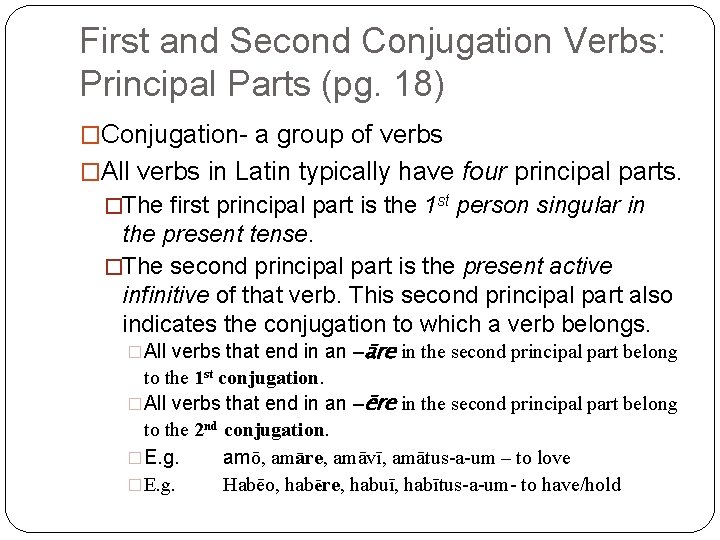
First and Second Conjugation Verbs: Principal Parts (pg. 18) �Conjugation- a group of verbs �All verbs in Latin typically have four principal parts. �The first principal part is the 1 st person singular in the present tense. �The second principal part is the present active infinitive of that verb. This second principal part also indicates the conjugation to which a verb belongs. �All verbs that end in an –āre in the second principal part belong to the 1 st conjugation. �All verbs that end in an –ēre in the second principal part belong to the 2 nd conjugation. �E. g. amō, amāre, amāvī, amātus-a-um – to love �E. g. Habēo, habēre, habuī, habītus-a-um- to have/hold
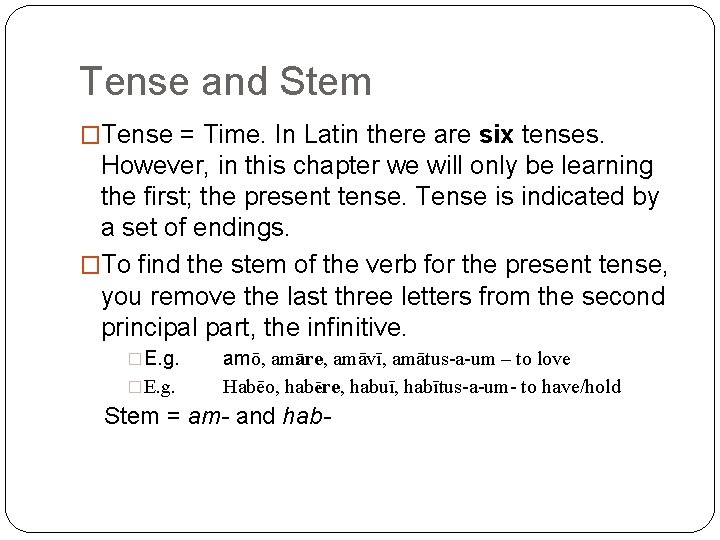
Tense and Stem �Tense = Time. In Latin there are six tenses. However, in this chapter we will only be learning the first; the present tense. Tense is indicated by a set of endings. �To find the stem of the verb for the present tense, you remove the last three letters from the second principal part, the infinitive. �E. g. amō, amāre, amāvī, amātus-a-um – to love Habēo, habēre, habuī, habītus-a-um- to have/hold Stem = am- and hab-
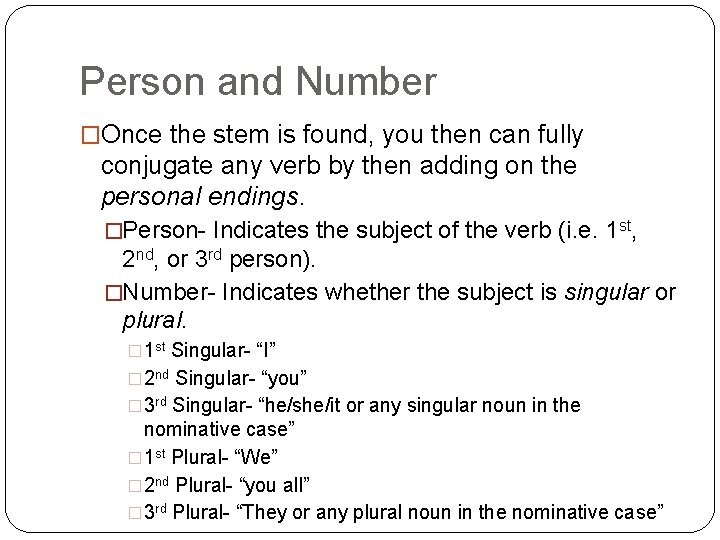
Person and Number �Once the stem is found, you then can fully conjugate any verb by then adding on the personal endings. �Person- Indicates the subject of the verb (i. e. 1 st, 2 nd, or 3 rd person). �Number- Indicates whether the subject is singular or plural. � 1 st Singular- “I” � 2 nd Singular- “you” � 3 rd Singular- “he/she/it or any singular noun in the nominative case” � 1 st Plural- “We” � 2 nd Plural- “you all” � 3 rd Plural- “They or any plural noun in the nominative case”
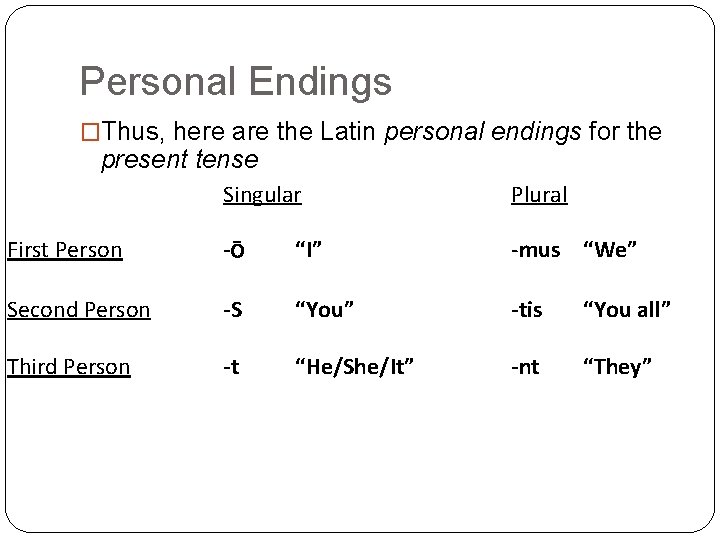
Personal Endings �Thus, here are the Latin personal endings for the present tense Singular Plural First Person -ō “I” -mus “We” Second Person -S “You” -tis “You all” Third Person -t “He/She/It” -nt “They”
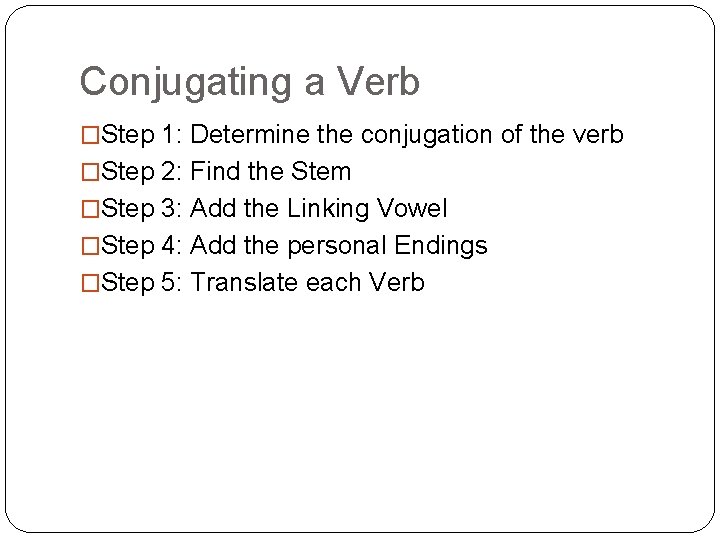
Conjugating a Verb �Step 1: Determine the conjugation of the verb �Step 2: Find the Stem �Step 3: Add the Linking Vowel �Step 4: Add the personal Endings �Step 5: Translate each Verb
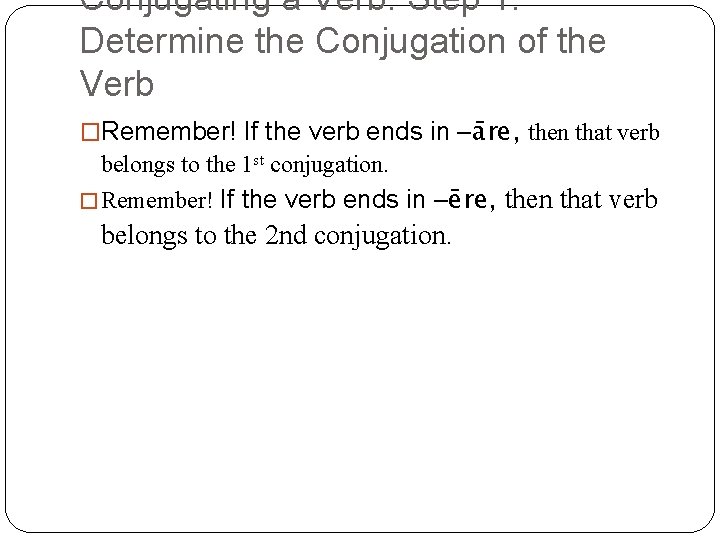
Conjugating a Verb: Step 1: Determine the Conjugation of the Verb �Remember! If the verb ends in –āre, then that verb belongs to the 1 st conjugation. � Remember! If the verb ends in –ēre, then that verb belongs to the 2 nd conjugation.
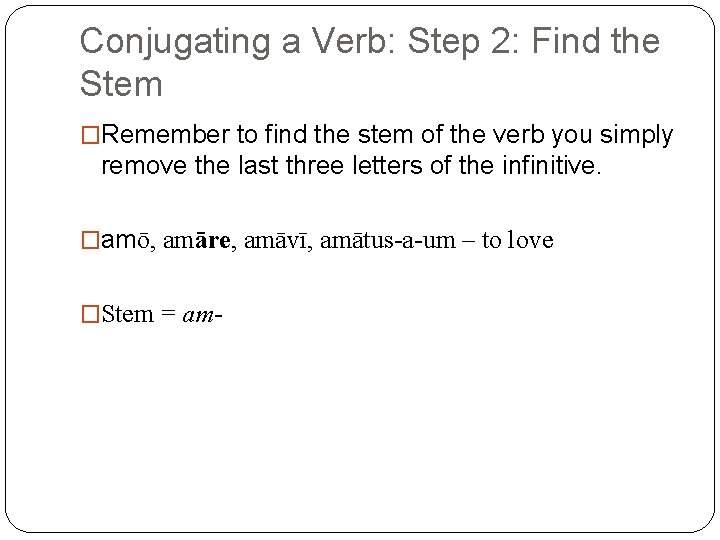
Conjugating a Verb: Step 2: Find the Stem �Remember to find the stem of the verb you simply remove the last three letters of the infinitive. �amō, amāre, amāvī, amātus-a-um – to love �Stem = am-
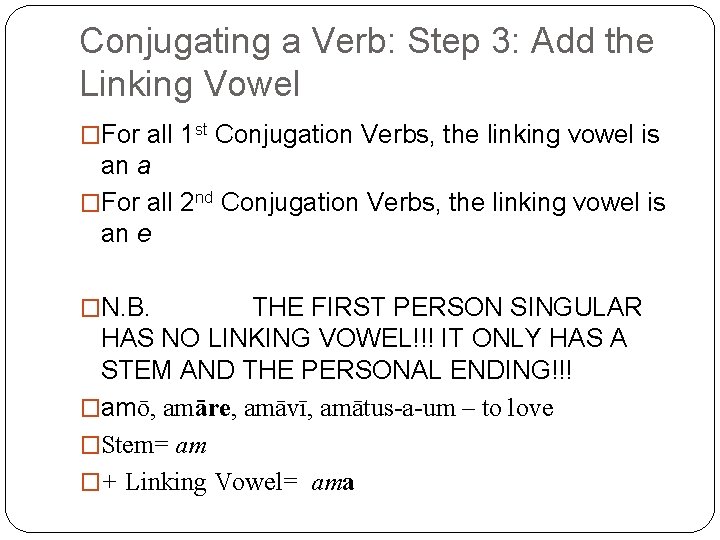
Conjugating a Verb: Step 3: Add the Linking Vowel �For all 1 st Conjugation Verbs, the linking vowel is an a �For all 2 nd Conjugation Verbs, the linking vowel is an e �N. B. THE FIRST PERSON SINGULAR HAS NO LINKING VOWEL!!! IT ONLY HAS A STEM AND THE PERSONAL ENDING!!! �amō, amāre, amāvī, amātus-a-um – to love �Stem= am �+ Linking Vowel= ama
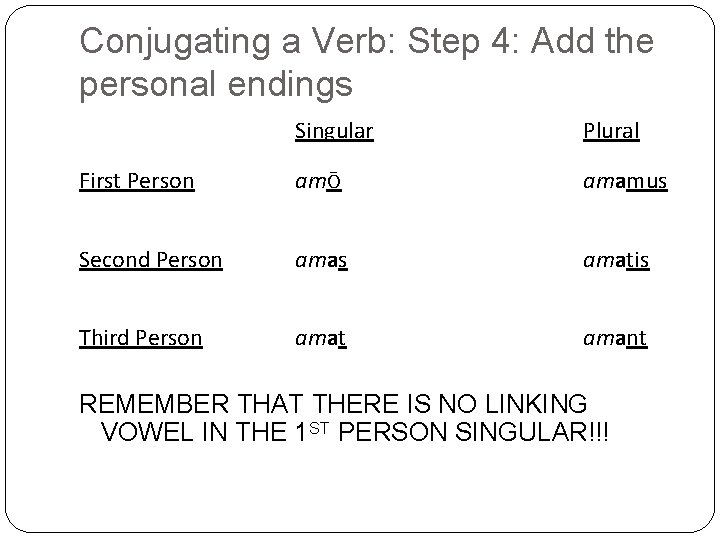
Conjugating a Verb: Step 4: Add the personal endings Singular Plural First Person amō amamus Second Person amas amatis Third Person amat amant REMEMBER THAT THERE IS NO LINKING VOWEL IN THE 1 ST PERSON SINGULAR!!!
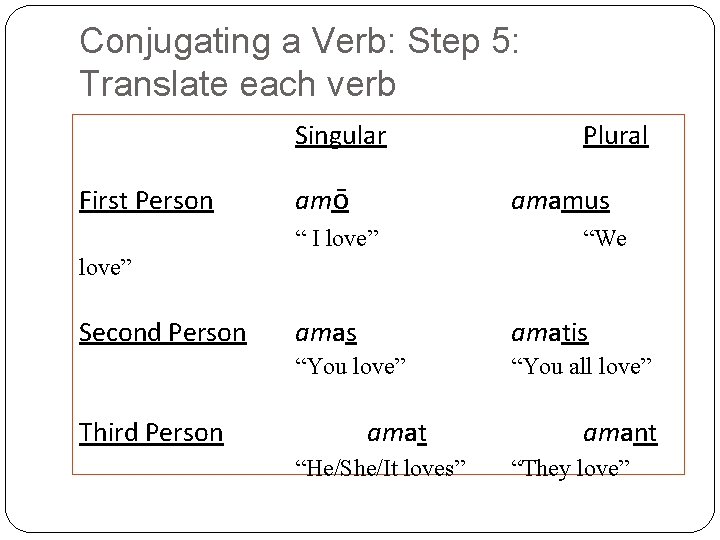
Conjugating a Verb: Step 5: Translate each verb Singular First Person amō Plural amamus “ I love” “We love” Second Person Third Person amas amatis “You love” “You all love” amat “He/She/It loves” amant “They love”
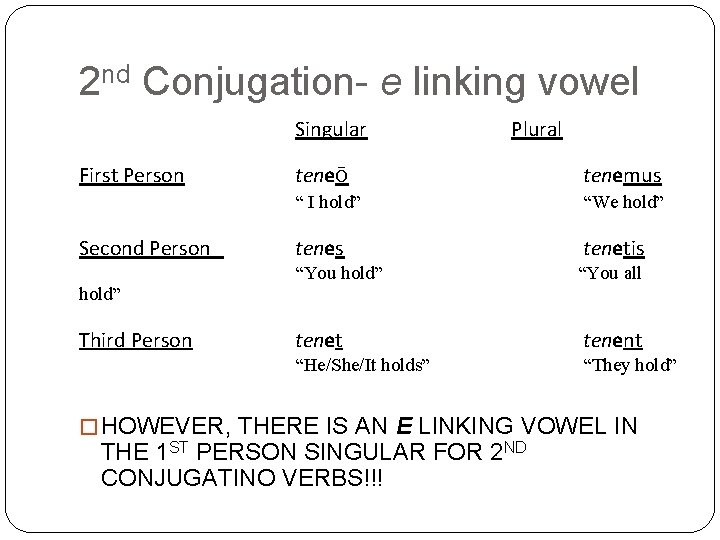
2 nd Conjugation- e linking vowel Singular First Person Second Person Plural teneō tenemus “ I hold” “We hold” tenes tenetis “You hold” “You all tenet tenent “He/She/It holds” “They hold” Third Person � HOWEVER, THERE IS AN E LINKING VOWEL IN THE 1 ST PERSON SINGULAR FOR 2 ND CONJUGATINO VERBS!!!
Translating the Present Tense �There are several ways that you can translate a present tense verb from Latin into English �E. g. Amō = I love, I am loving, I do love
The Infinitive �Remember that the infinitive is the second principal part of the verb. It is used to determine the conjugation of the verb and its stem. �However, the infinitive also has a grammatical function. In English, an infinitive is simply to + verb. �E. g. to love, to swim, to read, etc. �Thus, amāre would be translated as to love.
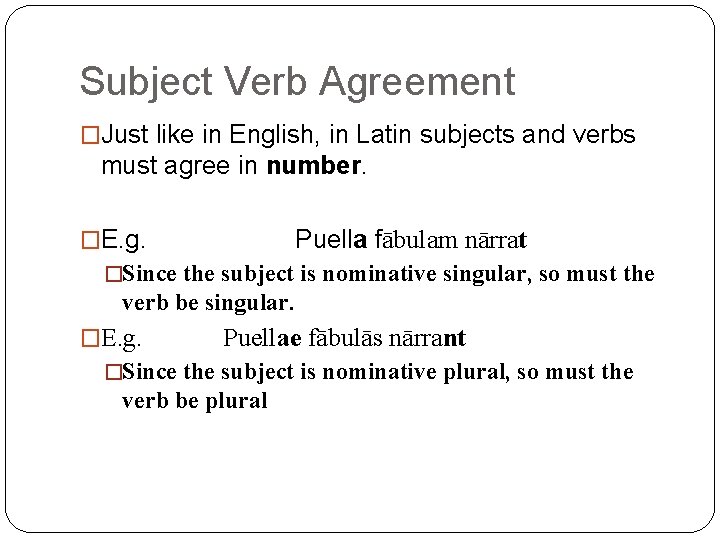
Subject Verb Agreement �Just like in English, in Latin subjects and verbs must agree in number. �E. g. Puella fābulam nārrat �Since the subject is nominative singular, so must the verb be singular. �E. g. Puellae fābulās nārrant �Since the subject is nominative plural, so must the verb be plural
The Subject is always in the Verb �Remember that in Latin the subject is always found in the verb which is indicated by the personal endings. �The only time that you can have a noun in the nominative case as the subject in the sentence is if the verb is 3 rd person.
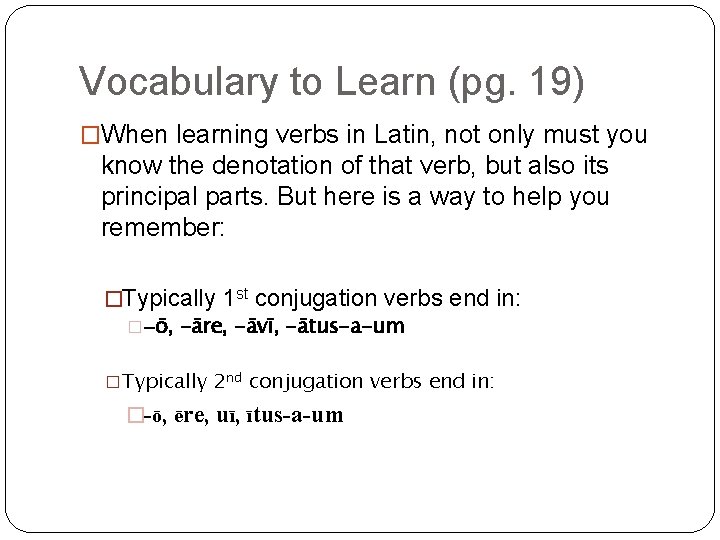
Vocabulary to Learn (pg. 19) �When learning verbs in Latin, not only must you know the denotation of that verb, but also its principal parts. But here is a way to help you remember: �Typically 1 st conjugation verbs end in: �–ō, -āre, -āvī, -ātus-a-um �Typically 2 nd conjugation verbs end in: �-ō, ēre, uī, ītus-a-um