
Latin Grammar Perfect and Future Infinitives Grammar 4


- Slides: 14
Latin Grammar Perfect and Future Infinitives (Grammar 4 A, pp. 199 -201)
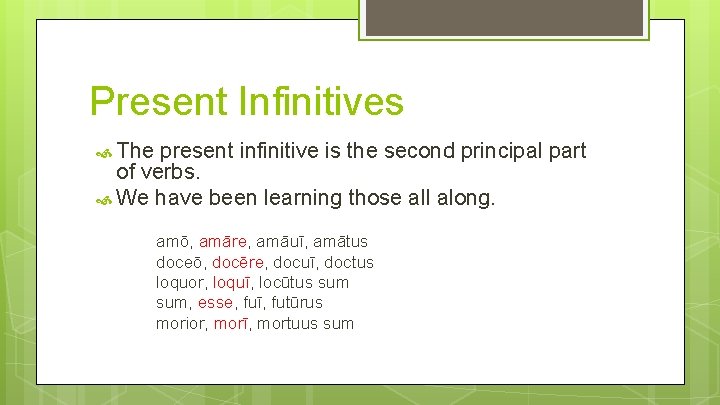
Present Infinitives The present infinitive is the second principal part of verbs. We have been learning those all along. amō, amāre, amāuī, amātus doceō, docēre, docuī, doctus loquor, loquī, locūtus sum, esse, fuī, futūrus morior, morī, mortuus sum
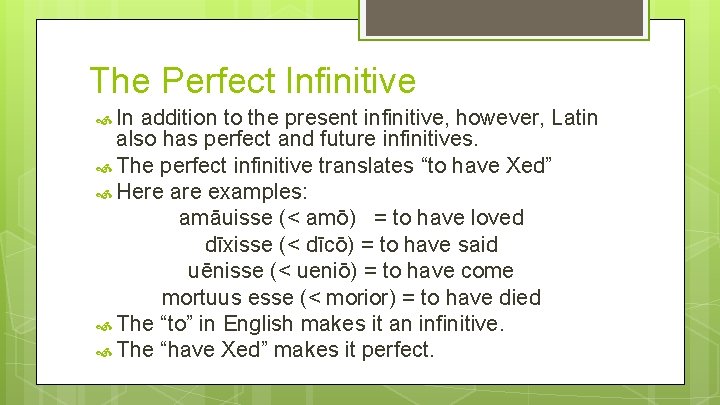
The Perfect Infinitive In addition to the present infinitive, however, Latin also has perfect and future infinitives. The perfect infinitive translates “to have Xed” Here are examples: amāuisse (< amō) = to have loved dīxisse (< dīcō) = to have said uēnisse (< ueniō) = to have come mortuus esse (< morior) = to have died The “to” in English makes it an infinitive. The “have Xed” makes it perfect.
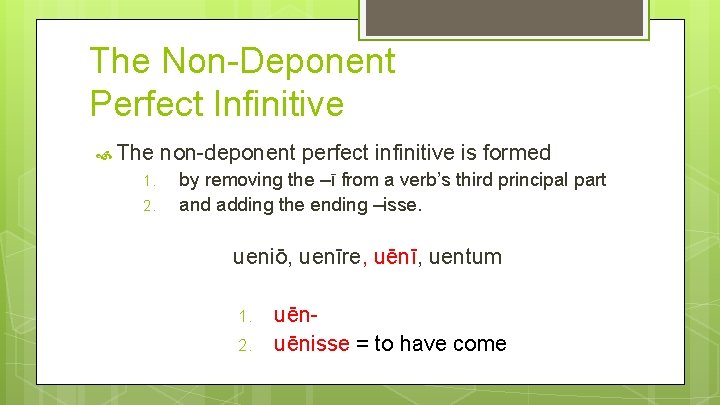
The Non-Deponent Perfect Infinitive The 1. 2. non-deponent perfect infinitive is formed by removing the –ī from a verb’s third principal part and adding the ending –isse. ueniō, uenīre, uēnī, uentum 1. 2. uēnuēnisse = to have come
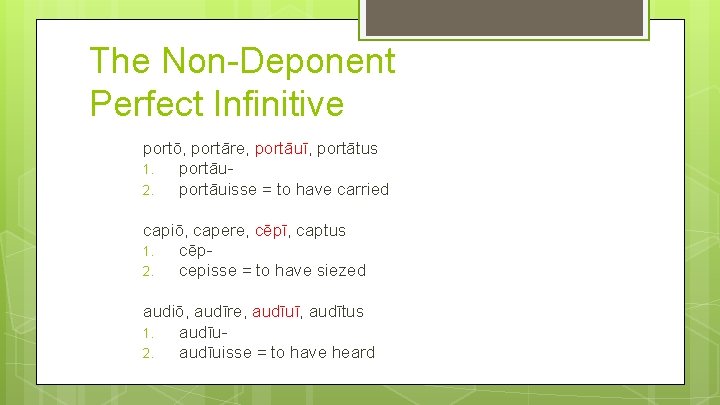
The Non-Deponent Perfect Infinitive portō, portāre, portāuī, portātus 1. portāu 2. portāuisse = to have carried capiō, capere, cēpī, captus 1. cēp 2. cepisse = to have siezed audiō, audīre, audīuī, audītus 1. audīu 2. audīuisse = to have heard
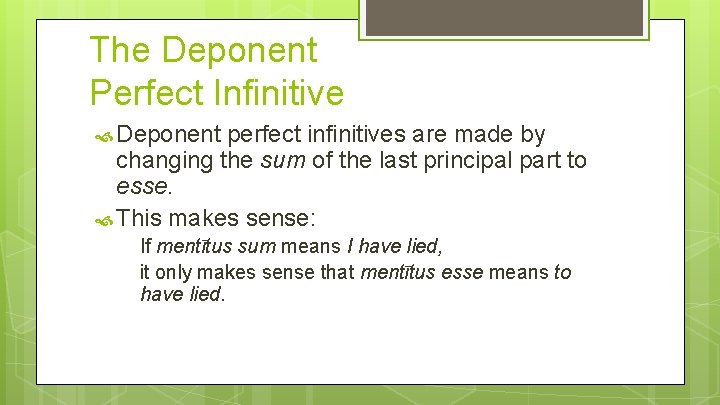
The Deponent Perfect Infinitive Deponent perfect infinitives are made by changing the sum of the last principal part to esse. This makes sense: If mentītus sum means I have lied, it only makes sense that mentītus esse means to have lied.
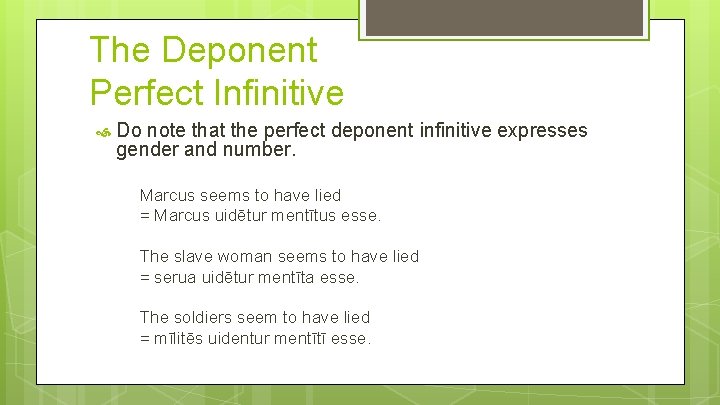
The Deponent Perfect Infinitive Do note that the perfect deponent infinitive expresses gender and number. Marcus seems to have lied = Marcus uidētur mentītus esse. The slave woman seems to have lied = serua uidētur mentīta esse. The soldiers seem to have lied = mīlitēs uidentur mentītī esse.
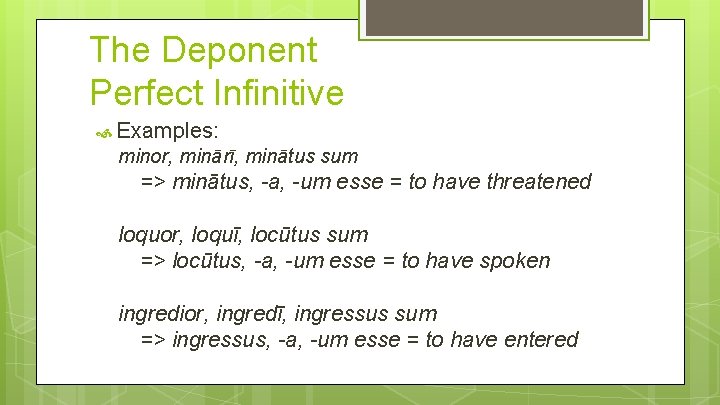
The Deponent Perfect Infinitive Examples: minor, minārī, minātus sum => minātus, -a, -um esse = to have threatened loquor, loquī, locūtus sum => locūtus, -a, -um esse = to have spoken ingredior, ingredī, ingressus sum => ingressus, -a, -um esse = to have entered
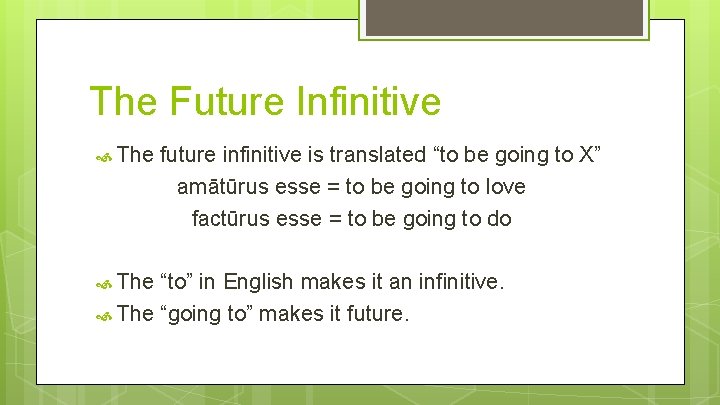
The Future Infinitive The future infinitive is translated “to be going to X” amātūrus esse = to be going to love factūrus esse = to be going to do “to” in English makes it an infinitive. The “going to” makes it future.
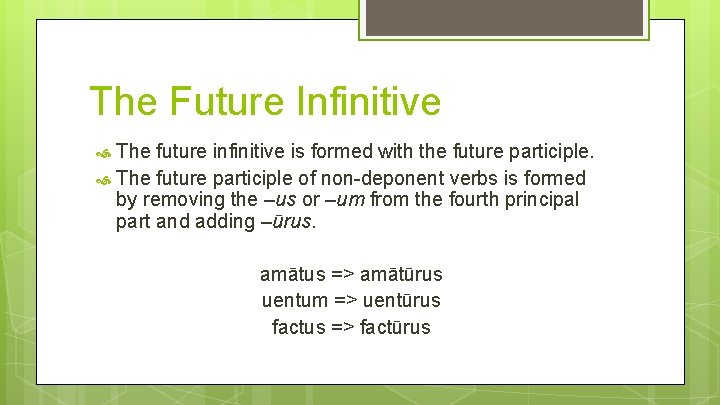
The Future Infinitive The future infinitive is formed with the future participle. The future participle of non-deponent verbs is formed by removing the –us or –um from the fourth principal part and adding –ūrus. amātus => amātūrus uentum => uentūrus factus => factūrus
The Future Infinitive The future participle of deponent verbs is formed by removing the –us from the perfect deponent participle and adding –ūrus. (The perfect deponent participle is really the same form as the fourth principal part in non-deponent verbs. ) ēgredior, ēgredī, ēgressus sum => ēgressūrus minor, minārī, minātus sum => minātūrus
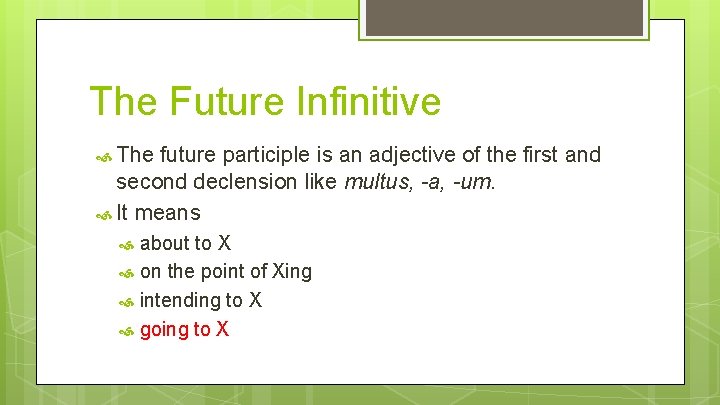
The Future Infinitive The future participle is an adjective of the first and second declension like multus, -a, -um. It means about to X on the point of Xing intending to X going to X
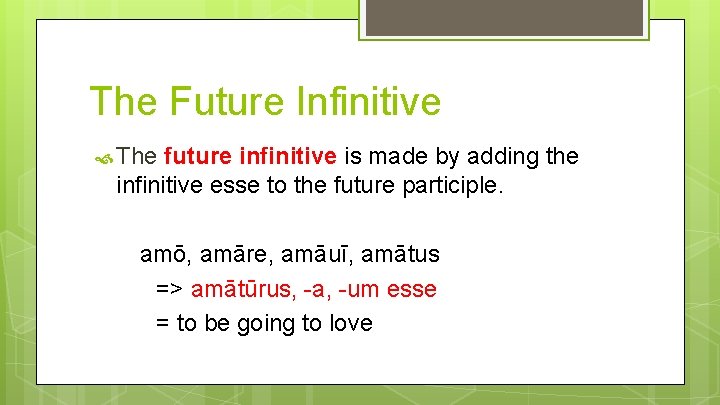
The Future Infinitive The future infinitive is made by adding the infinitive esse to the future participle. amō, amāre, amāuī, amātus => amātūrus, -a, -um esse = to be going to love
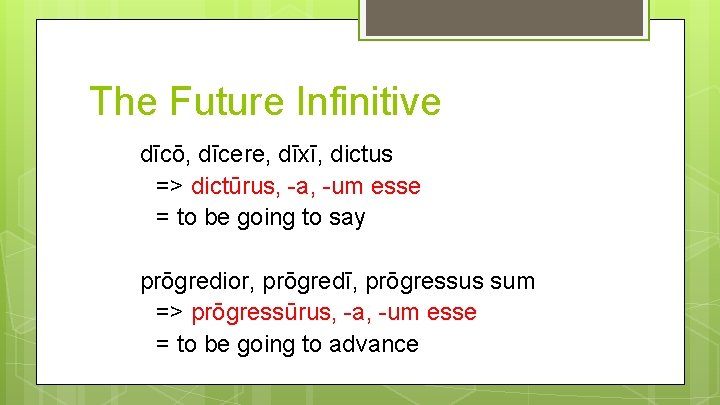
The Future Infinitive dīcō, dīcere, dīxī, dictus => dictūrus, -a, -um esse = to be going to say prōgredior, prōgredī, prōgressus sum => prōgressūrus, -a, -um esse = to be going to advance