
LATIN AMERICA Where is Latin America Find Mexico




- Slides: 40
LATIN AMERICA
Where is Latin America? • Find Mexico on a World Map. . . …and move southward
Latin America
WHY is it called Latin America? And Spanish • Latin Portuguese is a language just about is spoken everywhere • The two widely spoken in Brazil else!!! languages are Latin-based
What physical characteristics do we need to know? CLIMATE • In Central America and northern South America, it is TROPICAL In northern Mexico and southern South America, it is TEMPERATE
Along with climate, • In the Southern Hemisphere: • Remember that SEASONS are REVERSED: desrever
• When it is winter in the USA. . . …it is summer in South America (and southern Africa & Australia & Antarctica)
Weather and Climate • Caribbean and Central America – Hurricanes • El Nino: cyclical climate event that involves the movement of large masses of warm water across the Pacific. Causes change in rainfall patterns.
Physical Features • Mountains in Latin America: • Sierra Madres split along Mexico’s coasts • Andes along west coast of South America • Just like the west coast of the USA, the Andes mountains are VOLCANIC
Mountains in Latin America can be split into agricultural “zones” as you move higher up the mountain. This is called “vertical zonation” Snow caps Sierra Madres Tierra Fria no crops, just grazing Tierra Templada ANDES MOUNTAINS: crops that like The long. Latin America temperate land Mt. Aconcagua: Tallest Maps - Due Fridayest Mountain in the region: chain and 2 nd highest Tierra Caliente 23, 000 ft mountains in the world!! crops that like hot temperatures
Another look at Vertical Zonation in the Andes Mts.
Mountains affect on Mexico City • Higher elevation = colder temperatures for latitude • Very Heavily Polluted – Altitude contributes to amount of pollution – Mountains prevent pollution from leaving
• Along with volcanoes, western But California can handle the earthquakes MUCH and betterparts of South America because of building codes and Central America experience earthquake-proof structures that are built in the states. Unfortunately, Chile, Peru, and other countries in Latin America don’t follow any type of codes and whole duevillages tobuilding the constant motion can be wiped out in an Earth’s tectonic platesearthquake!!! EARTHQUAKES of the Just like in California!!
Greater (Bigger) Antilles More Physical Features: • There are MANY islands in Latin America • The Caribbean Islands are called Lesser (Smaller) Antilles the “West Indies” or the “Greater and Lesser Antilles” • The Caribbean Islands are well known for their agriculture and tourism
• The Galapagos Islands (off the west coast of Ecuador) are known for their Tortoises and other scientific studies of plants and animals. Ga-LAP-ah-goes Islands Does Charles Darwin ring a bell?
• The Falkland Islands are controlled by the United Kingdom • The British defeated the Argentines in “Falkland Islands the Falkland Island War of 1982 (Isla Malvinas) • These islands have a HUGE Administered by military advantage of the location to thebecause UK (claimed the Straitby of Argentina)” Magellan. . . • . . . esp. if the Panama Canal is blocked during wartime
Other Physical Chars. Grasslands: huge, flat plains in Latin America- known for agriculture • The Llanos are in Venezuela; the Gran Chaco are in Paraguay; and the most famous are the Pampas in Argentina
We’re usually found in grassland Or theranches…like Pampas of the Llanos in Venezuela Argentina…. where the best beef cattle in the world is raised!! Latin American Cowboys are called Gauchos Llanos Pampas
Unfortunately, we’re being cut down and set aflame to make room for interior farmland construction!!!! OUCH!!! This is called “Slash and Burn” Agriculture Rainforests: What climate factor is responsible for this climate Costa Rica and Brazil~ “Amazonia” is Amazonia (in Brazil) the largest in the world! http: //www. ran. org/info_center/about_rainforests. html
Rain Forest • Average Temp = 80 • Avg. Rainfall = 100 in • Found in tropics (low latitudes) • Thick vegetation
Location of Rainforest
Structure of a Rainforest • 3 layers – Emergent Level: crowns of the tallest trees (90120 ft) – Canopy: variety of broadleaf & evergreen trees (50 – 75 ft) – Understory: variety of shade tolerant trees (2040 ft) • All layers have vines and small plants growing on the branches
Structure of a Rainforest • Only 1 – 2 % of the sunlight reaches the ground due to the canopy – Eliminates small plants at ground level • The soil of a rainforest in almost completely void of nutrients – Trees get nutrients from small plants that grow and decay
Benefits of a Rainforest • • Home for a multitude of species Potential medicines Oxygen Unique human cultures: native people
Rainforest Facts • 25% of all prescription drugs in the US use chemicals derived from plants and animals • Everyday over 214, 000 acres of rainforest are destroyed • At the current rate of destruction, 25% of the Earth’s species will be extinct by the middle of the 21 st ce.
Deforestation • Cutting down of trees
Reasons for deforestation • • • Farmland Mining Animal grazing Logging Urbanization
Effects of Deforestation • • • Loss of species Loss of potential medicines Changes in weather patterns Contributes to global warming Soil erosion
Alternatives to Deforestation • • Responsible companies Ecotourism Reforestation Other means of economic development
• Coastal Deserts: West Coast of South America ATACAMA DESERT in Chile This clip art is actually “wrong” to use for the Atacama…there are cacti shown!! One of the hottest and driest But why can places be so dry? ? ? places on Earth. 1/16”/yr THIS is more like it!!! The “rain shadow” effect is part of the reason ww. uni-magdeburg. de/ abp/picturegallery. htm
RAIN SHADOW EFFECT Windward side of the mountains Leeward Side or A “protected” side N of the D ES mountains Pacific Ocean http: //www-cs-students. stanford. edu/~amitp/simblob/rain-shadow. png The Andes Mountains create rain shadows on leeward slopes and cause moisture to be blocked. That’s how we see such dry areas in Latin America. The Andes are so high that they block moisture from the ocean and create grasslands and deserts on the other side of the mountains.
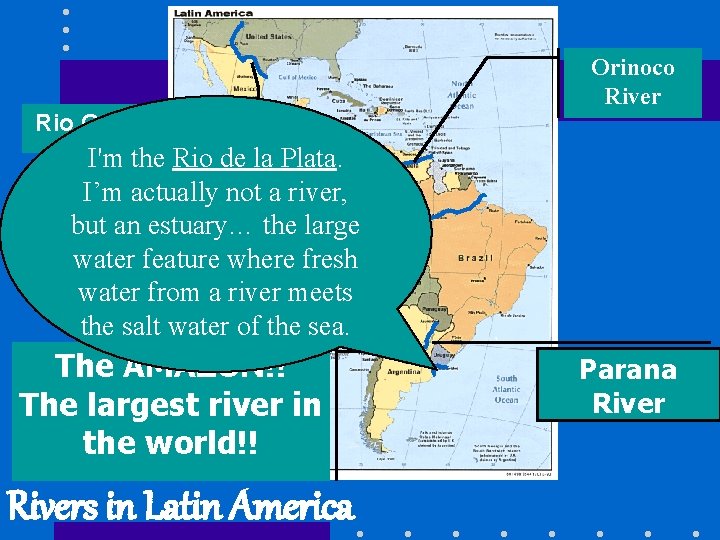
Orinoco River Rio Grande I'm the Rio de la Plata. I’m actually not a river, but an estuary… the large water feature where fresh water from a river meets the salt water of the sea. The AMAZON!! The largest river in the world!! Rivers in Latin America Parana River
Angel Falls- world highest uninterrupted waterfall Waterfalls and Lakes Lake Maracaibo: extension of Caribbean Sea; rich in oil reserves Lake Titicaca: world’s highest navigable lake Lakes in Latin America
Natural Resources • Oil found in Mexico and Venezuela • Gold, Silver and Copper in MX, Brazil and Chile • Forest Products in the Amazon
Panama Canal • Physical features make it hard to travel around. Magellan first European to sail around South America. The very southern most tip is called Cape Horn and its is famous for its severe storms • Shorter (thousands of miles shorter), safer route created with the Panama Canal.
Impact of Panama Canal • Brought change to Middle America • 75000 workers built what is still regarded as one of the engineering wonders of the world. • Completed in 1914, the canal made a huge impact on world trade.
Aerial View of the Canal
The canal works with a system of locks
IMPACTS of Physical Features? : • Location of urbanization? • People settle along coasts, • High population growth rate? • YES! Arable land means more food • Large cities are called: MEGACITIES • Sao Paulo Rio Mexico City
And the MOST important factor from Of course!!!! Latin America? ? ? Didn’t YOU think coffee too?