
LATG A Review of The Guide for the
- Slides: 65
LATG: A Review of The Guide for the Care and Use of Laboratory Animals Created by Marc S. Hulin, DVM, Dipl. ACLAM
History of The Guide n First published in 1963; 6 th revision n Current revision was written by ILAR n Purpose: assist institutions in caring for and using animals in ways judged to be scientifically, technically, and humanely appropriate n 6 th edition was supported by NIH, USDA, and Dept. VA
Introduction n Laboratory Animal: any vertebrate animal used in research, teaching or testing n Guide endorses: 9 US Government principles, AWA, PHS policy, other federal and state laws
Evaluation Criteria n Performance standards preferred over Engineering standards n performance: define an outcome in detail and provide criteria for assessing the outcome, but don’t limit methods to achieve outcome n “Must”: considered imperative n “Should”: strong recommendation
I. Institutional Policies and Responsibilities n IACUC membership: n DVM with lab animal experience n 1 practicing scientist with research experience with animals n 1 public member (non-affiliated) n Physical restraint: n use of manual or mechanical means to limit animal’s movement for examination, collection of samples, or drug administration
Physical Restraint n Prolonged restraint should be avoided unless it is essential for research objectives and approved by IACUC n Guidelines: not to be considered normal methods of housing n restraint period should be minimum time n animal should be trained n regular observations n veterinary care provided if lesions or illness n
Multiple Major Surgical Procedures n Major surgery: n penetrates and exposes a body cavity or produces substantial impairment of physical or physiologic function n Multiple major surgeries on a single animal are discouraged unless: scientifically justified n approved by the IACUC n related components of a research project n conserve scare animal resources n
Food or Fluid Restriction n If experimental protocols require restriction at least minimal quantities of food and fluid should be available n Restriction for research purposes should be scientifically justified n Highly preferred food or fluid as positive reinforcement, instead of restriction, is recommended
Veterinary Care n Adequate veterinary care must be provided, including access to all animals for evaluation of their health and well-being n Veterinarian must provide investigators with advice on use of sedatives, analgesics, or anesthetics in animals
Personnel Qualification & Training n Personnel caring for animals should be appropriately trained and the institution should provide formal or on-the-job training to facilitate effective implementation of the program and humane care and use of animals n Occupational Health and Safety program must be part of the overall animal care and use program
Preventative Medicine for Personnel n Development and Implementation of a program for medical evaluation should involve input from trained health professionals n Cercopithecine Herpesvirus 1 (Herpes B virus): n personnel who work with Macaques should have access to and be instructed in the use of bite and scratch emergency kits
Animal Environment, Housing, Management n Proper housing and management: n Animal well-being n Quality of research data n Health and safety of personnel n Animals should be housed with goal of maximizing species-specific behaviors and minimizing stress induced behavior
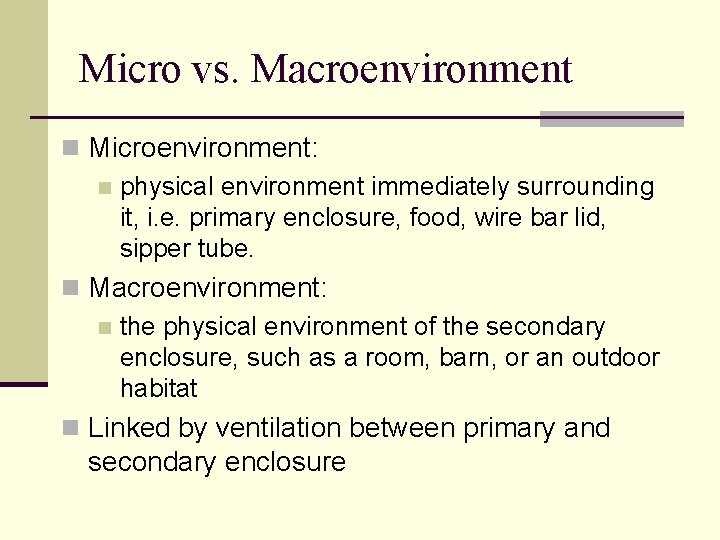
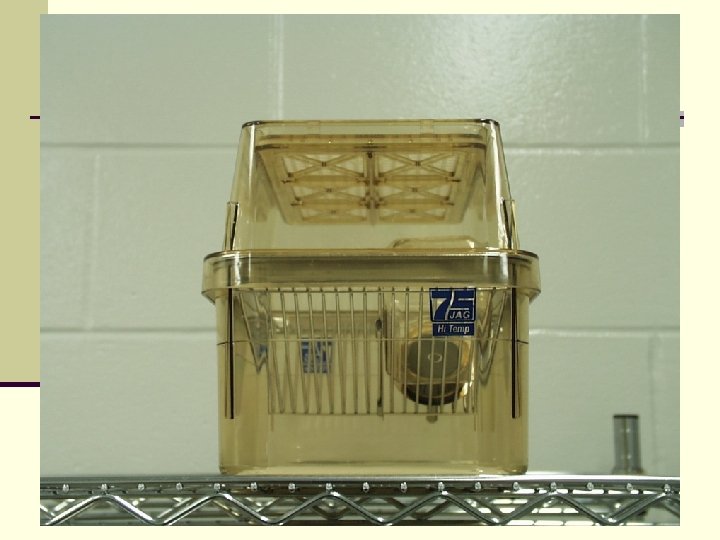
Micro vs. Macroenvironment n Microenvironment: n physical environment immediately surrounding it, i. e. primary enclosure, food, wire bar lid, sipper tube. n Macroenvironment: n the physical environment of the secondary enclosure, such as a room, barn, or an outdoor habitat n Linked by ventilation between primary and secondary enclosure
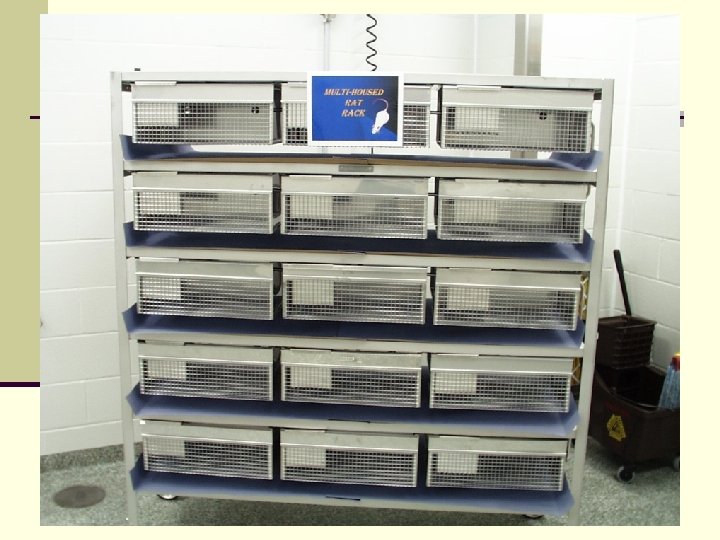
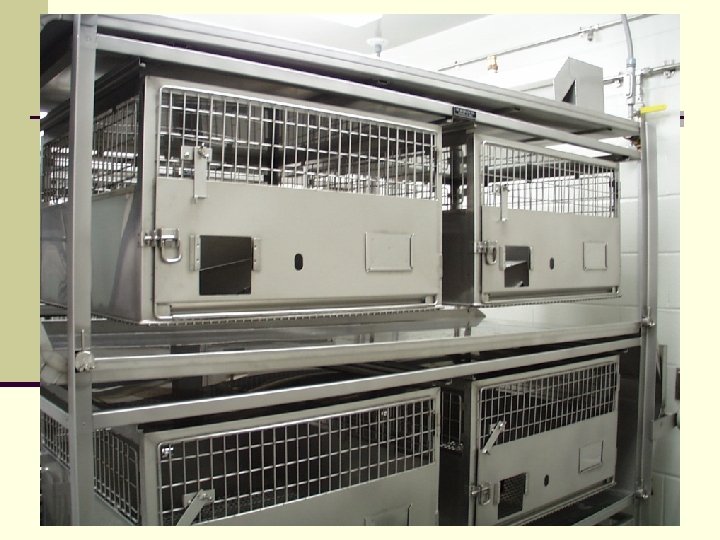
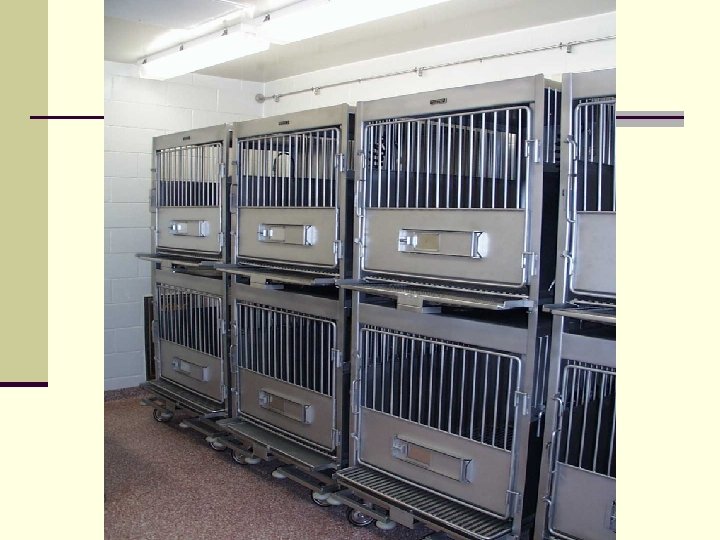
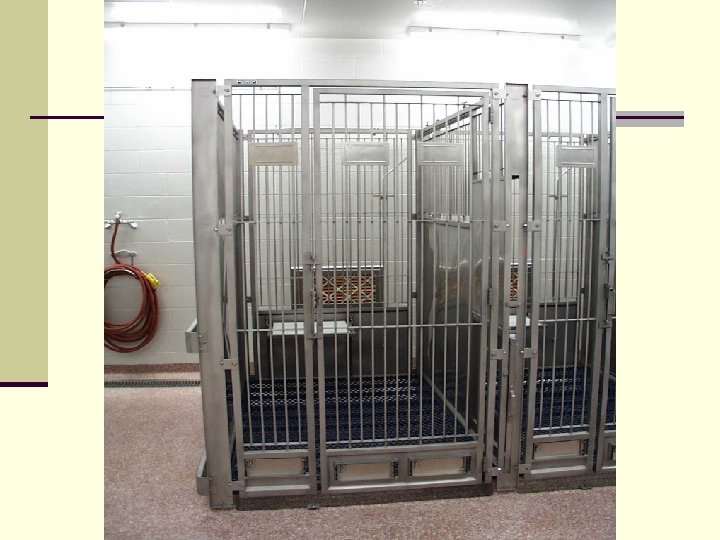
Primary Enclosures n Should be constructed with materials that balance the needs of the animal with the ability to provide sanitation n Solid-bottom caging, with bedding, is recommended for rodents
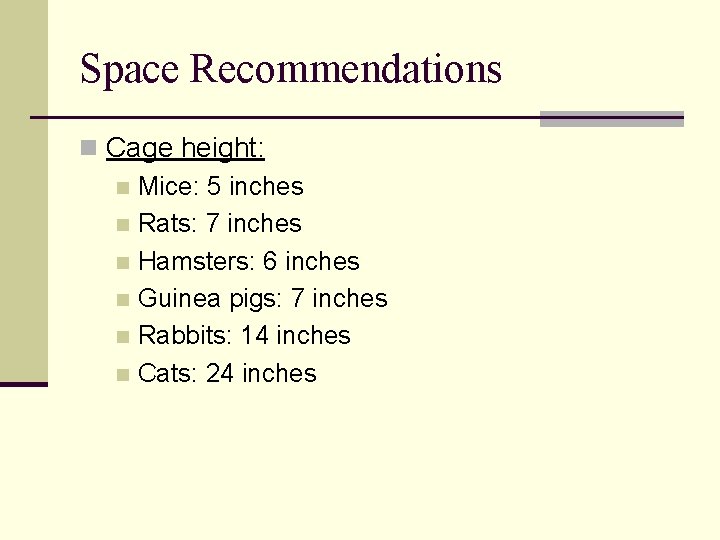
Space Recommendations n Based on professional judgment and experience n Thigmotactic: rodent species benefit more from wall space (stay along the walls in cages) n Animal must have enough space to turn around and express normal postural adjustments n Social animals should be housed in pairs or groups
Space Recommendations n Cage height: n Mice: 5 inches n Rats: 7 inches n Hamsters: 6 inches n Guinea pigs: 7 inches n Rabbits: 14 inches n Cats: 24 inches
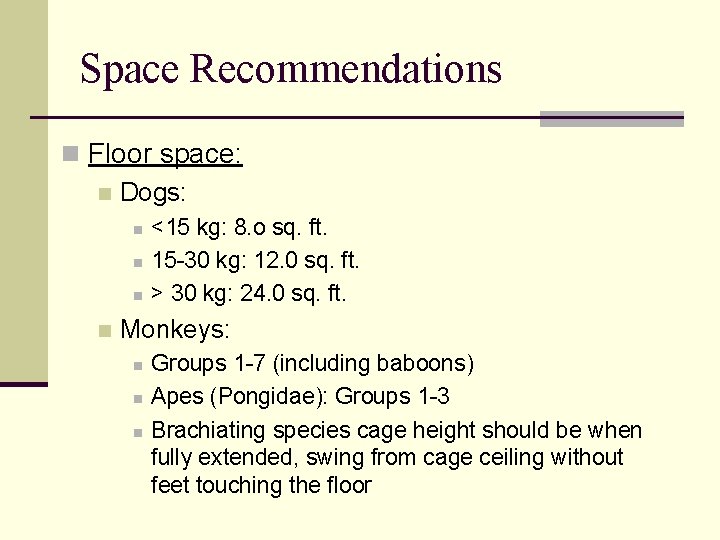
Space Recommendations n Floor space: n Dogs: n n <15 kg: 8. o sq. ft. 15 -30 kg: 12. 0 sq. ft. > 30 kg: 24. 0 sq. ft. Monkeys: n n n Groups 1 -7 (including baboons) Apes (Pongidae): Groups 1 -3 Brachiating species cage height should be when fully extended, swing from cage ceiling without feet touching the floor
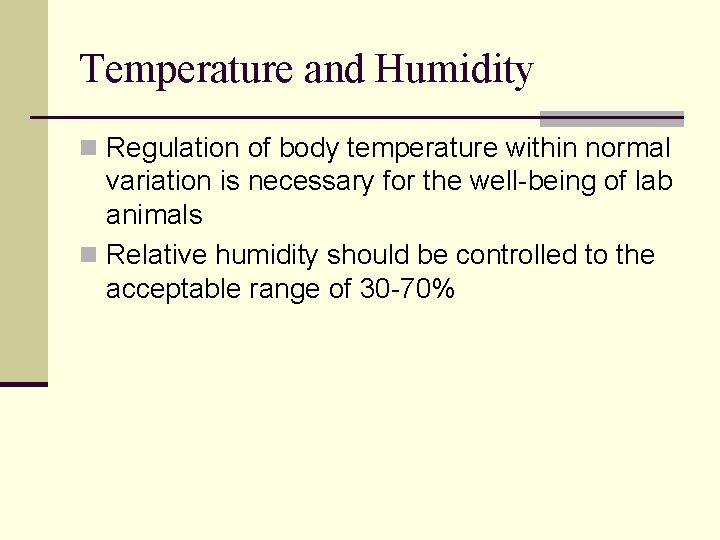
Temperature and Humidity n Regulation of body temperature within normal variation is necessary for the well-being of lab animals n Relative humidity should be controlled to the acceptable range of 30 -70%
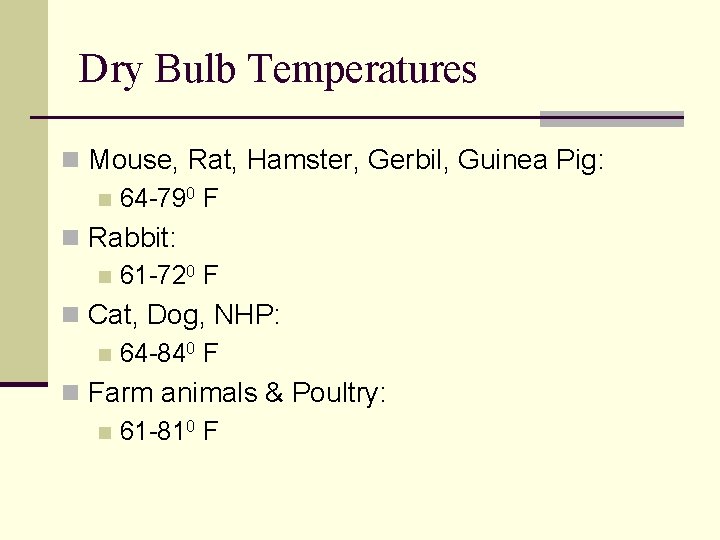
Dry Bulb Temperatures n Mouse, Rat, Hamster, Gerbil, Guinea Pig: n 64 -790 F n Rabbit: n 61 -720 F n Cat, Dog, NHP: n 64 -840 F n Farm animals & Poultry: n 61 -810 F
Ventilation n Supply adequate oxygen; remove thermal loads caused by animals and equipment n Use of computer modeling for designing facility ventilation (computational fluid dynamics) n 10 -15 fresh-air changes per hours for secondary enclosures is general standard n Recycled vs. Non-recycled air
Illumination n Light can affect the physiology, morphology, and behavior of various animals n Lighting should provide sufficient illumination: for well-being of the animals n allow good housekeeping practices n n Time-controlled lighting system should be used to ensure a regular diurnal cycle
Illumination n Light levels of 325 lux (30 ft-candles) about 1. 0 m above the floor appear to be sufficient for animal care and do not cause signs of phototoxic retinopathy in albino rats n Light at cage level for animal susceptible to phototoxic retinopathy should be between 130 -325 lux
Noise n Noisy animals (dogs, swine, etc. ) should be housed away from quieter animals, such as rodents, rabbits, and cats n Noise >85 d. B can have both auditory and non -auditory effects: eosinopenia n increased adrenal weights in rodents n reduced fertility in rodents n increased blood pressure in NHP n
Behavioral Management n Structural Environment: n primary enclosure- cage complexities, cage furniture, manipulanda n Social Environment: n physical contact and communication with conspecifics (members of same species) n Activity: n animals should have opportunities to exhibit species-typical activity patterns
Husbandry n Food: n unused, opened bags of food should be stored in vermin-proof containers n exposures to temp. > 700 F and humidity extremes hastens deterioration n dry lab animal diets stored for 6 months after manufacture n Vitamin C diets- 3 months shelf-life n Stabilized forms of Vitamin C extend shelf life
Bedding n Untreated softwood shavings and chips are contraindicated may affect animals’ metabolism n Cedar shavings are not recommended, because microsomal enzymes and cytotoxicity n Soiled bedding should be removed and replaced with fresh materials as often as is necessary to keep the animals clean and dry
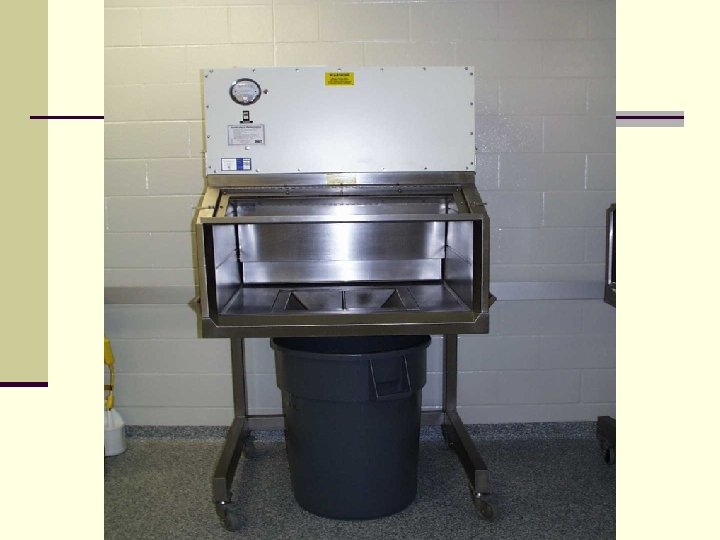
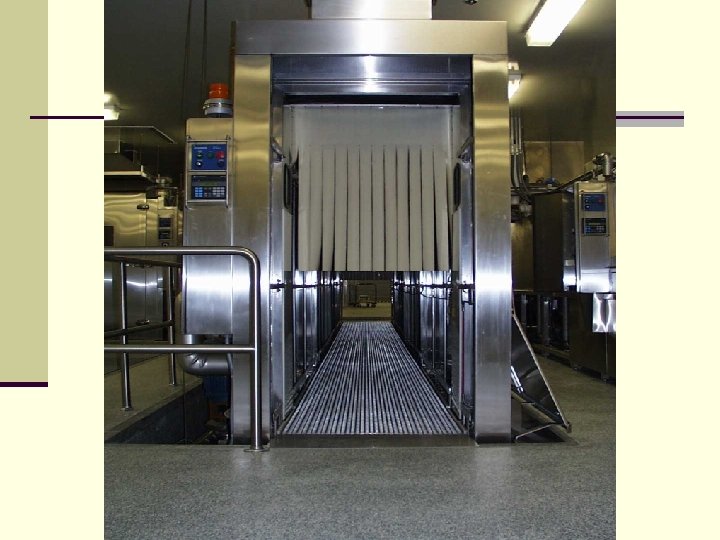
Cleaning and Disinfection of Primary Enclosures n If animal waste is to be removed by flushing- at least once daily (animals kept dry during flushing) n enclosures and accessories (tops) should be sanitized at least once every 2 weeks n Solid-bottom caging, bottles, and sipper tubes usually require sanitization at least once a week
Cleaning and Disinfection of Primary Enclosures n Effective disinfection can be achieved with wash & rinse water at 143 -1800 F n Traditional 1800 F for rinse water refers to the water in the tank or sprayer manifold n A regularly scheduled and documented pest control and monitoring should be implemented
Emergency, Weekend, and Holiday Care n Animals should be cared for by qualified personnel every day, including weekends and holidays n Emergency veterinary care should be available after work hrs. , weekends, and holidays n A disaster plan that takes into account both personnel and animals should be prepared as part of the overall safety plan for the animal facility
Identification and Records n Toe-clipping, for identification of small rodents: only when no other method is feasible n performed only on altricial rodents n n Clinical records for individual animals: n valuable for dogs, cats, NHP n contain pertinent clinical and diagnostic info. n dates of vaccinations, surgery, experimental use
Veterinary Medical Care n Adequate veterinary care consists of effective programs for: Preventative Medicine n Surveillance, Diagnosis, Treatment, and control of disease including Zoonosis n Management of protocol associated disease n Anesthesia and Analgesia n Surgery and Postsurgical care n Assessment of Animal Well-Being n Euthanasia n
Veterinary Medical Care n A veterinary care program is the responsibility of the attending veterinarian, who is certified or has training or experience in lab animal science and medicine n The veterinarian must provide guidance to investigators and all personnel involved in the care and use of animals
Animal Procurement & Transportation n All animals must be acquired lawfully n Dogs and cats from Class B dealers should be carefully inspected for special identification markers n Importation of NHP is regulated by PHS with specific guidelines for Tuberculin testing
Quarantine, Stabilization, and Separation n Effective quarantine program minimizes the chance for introduction pathogens into an established colony n Veterinary Medical staff should have procedures for evaluating the health and pathogen status of newly received animals
Quarantine, Stabilization, and Separation n Effective quarantine program for NHP: n limit exposure of humans to zoonotic infections n filoviral and mycobacterial infections in NHP have necessitated specific handling guidelines (CDC) n Newly received animals should be given a period for physiologic, psychologic, and nutritional stabilization before their use.
Quarantine, Stabilization, and Separation n Physical separation of animals by species is recommended to prevent interspecies disease transmission and conflict separate rooms n cubicles n laminar-flow units n cages that have filtered air or separate ventilation n isolators n
Quarantine, Stabilization, and Separation n Examples of need for separate housing by species: Bordetella bronchiseptica in rabbits- severe disease in guinea pigs n Simian Hemorrhagic Fever and SIV separate New World, Old World African, and Old World Asian n Squirrel monkey latently infected with Herpesvirus tamarinus which is fatal to Owl Monkeys n
Surveillance, Diagnosis, Etc. n All animals should be observed for signs of illness, injury, or abnormal behavior daily n Unexpected deaths and signs of illness should be reported promptly for appropriate veterinary medical care n The choice of medication or therapy should be made by the veterinarian in consultation with the investigator
Surveillance, Diagnosis, Etc. n Infectious agents that affect research: n Sendai, KRV, MHV, LCMV, and Mycoplasma pulmonis n The principal method for detecting viral infections is serologic testing n Transplantable tumors, hybridomas, cell lines, and other biologic materials should be tested for murine viruses n MAP (mouse antibody production) test, RAP, HAP used for monitoring for viral contamination
Surgery n Appropriate attention to presurgical planning, personnel training, aseptic and surgical technique n Use of antibiotics should never be considered as a replacement for aseptic procedures n PHS policy and AWA place responsibility with the IACUC for determining that personnel are qualified and trained for surgery
Surgery n Major survival surgery: n penetrates and exposes a body cavity or produces substantial impairment of physical or physiologic function n laparotomy, thoracotomy, craniotomy, joint replacement, limb amputation
Surgery n Minor survival surgery: n does not expose a body cavity and causes little or no physical impairment n wound suturing, peripheral-vessel cannulation, castration, prolapse repair, skin biopsy n most procedures routinely done on an “outpatient” basis in veterinary clinical practice
Surgery n Nonsurvival surgery: n animal is euthanized before recovery from anesthesia n does not require aseptic surgery n surgical site should be clipped, wear gloves, and clean instruments n Skin sutures, wound clips, or staples: n must be removed in timely manner n Veterinary medical standard: 10 -14 days
Surgery n Liquid chemical sterilants should be used with adequate contact times n Alcohol is neither a sterilant nor a high-level disinfectant n Nonrodent aseptic surgery should be conducted only in designated surgical facility n PI and veterinarian share responsibility for ensuring that postsurgical care is appropriate
Pain, Analgesia, and Anesthesia n Fundamental to pain relief is ability to recognize clinical signs in specific species: vocalization, depression, behavioral changes, immobility, abnormal posture n “Anthropomorphic concept” n n Neuromuscular blocking drugs do not provide pain relief: n paralyzes muscle; animal feels pain but unable to move
Euthanasia n The act of killing animals by methods that induce rapid unconsciousness and death without pain or distress n Methods should be consistent with 2000 Report of the AVMA Panel on Euthanasia n Avoid animal distress: n other animals should not be present when euthanasia is performed
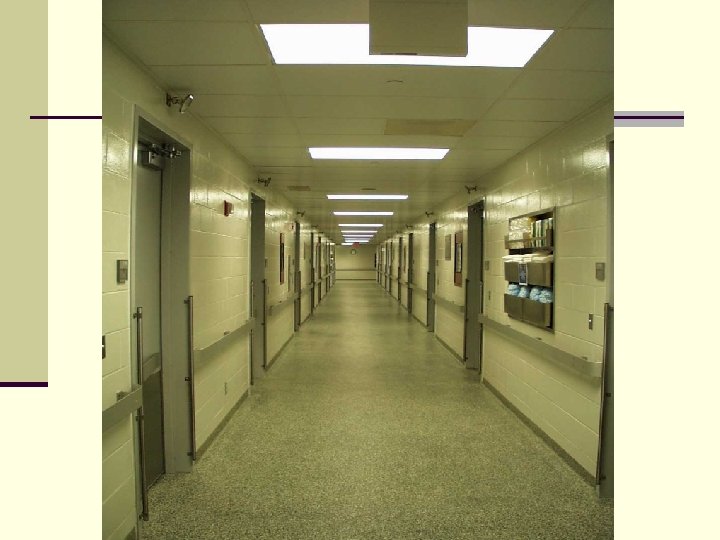
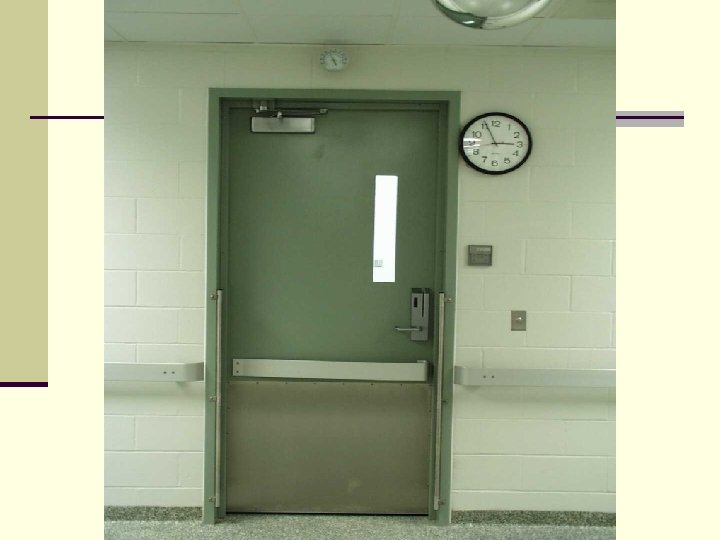
Construction Guidelines n Corridors: n should be wide enough to facilitate the movement of personnel and equipment n 6 -8 ft. wide can accommodate most facilities n Animal-Room Doors: n should open into animal rooms n large enough for easy passage of racks and equipment n 42 x 84 inches
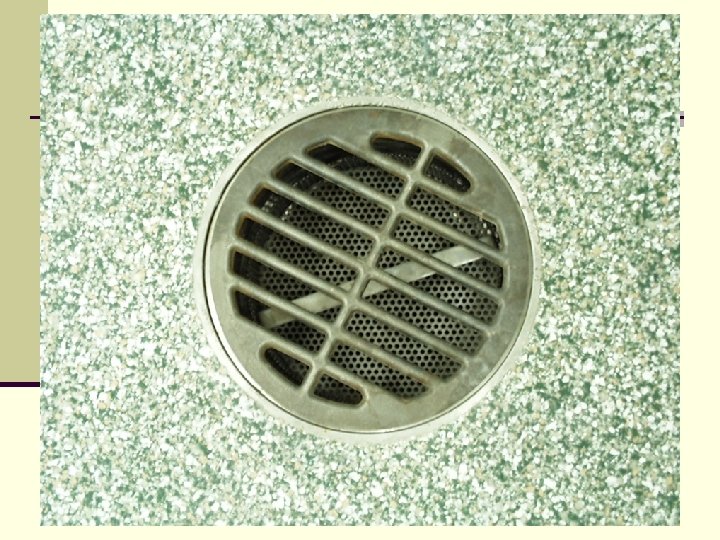
Construction Guidelines n Floors: n moisture-resistant, nonabsorbent, impactresistant, and smooth n Drainage: n if used should be sloped and drain traps kept filled with liquid n drainpipes should be at 4 inches in diameter n floor drains are not essential in all animal rooms
Construction Guidelines n HVAC systems: n capable of adjustments + or - 20 F n relative humidity: 30 -70% n temperature is best regulated by having thermostatic control for each room n regular monitoring of HVAC system done at room level n partial redundancy
Construction Guidelines n Power & Lighting: n in event of power failure an alternative or emergency power supply should be available to maintain critical services n recessed energy-efficient fluorescent light is most commonly used n time-controlled lighting system should be used to ensure a uniform diurnal lighting cycle
Construction Guidelines n Storage areas: n bedding and food should be stored in separate area from risk of contamination from toxic or hazardous n refrigerated storage kept below 70 C to reduce putrefaction of wastes and animal carcasses
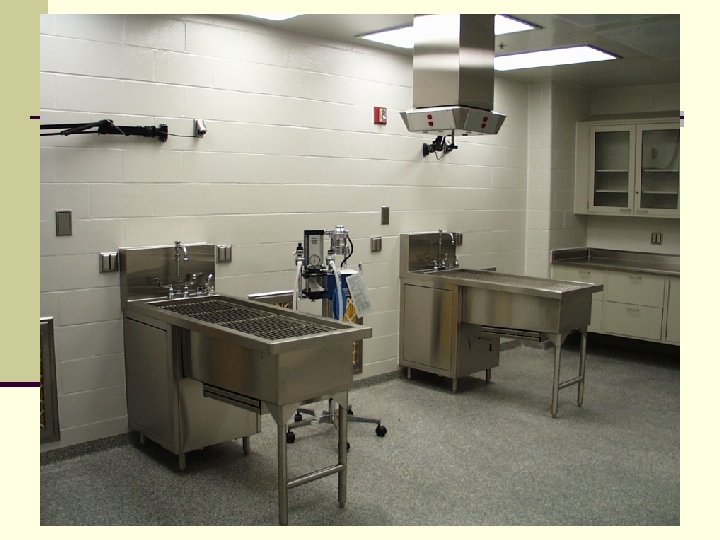
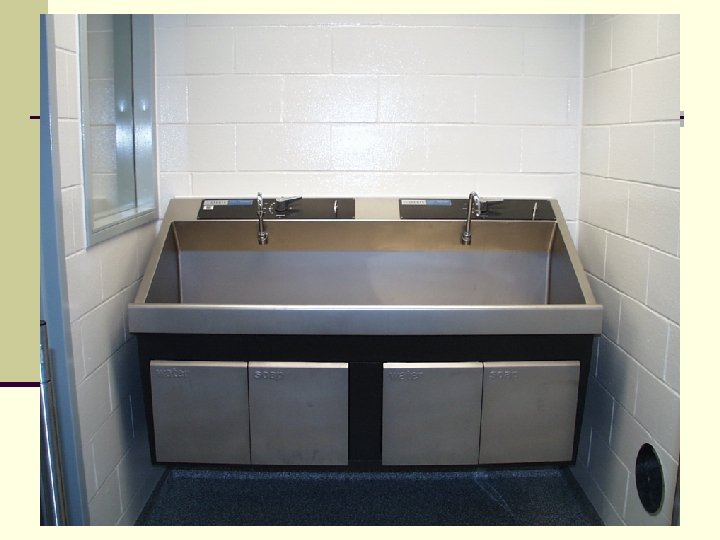
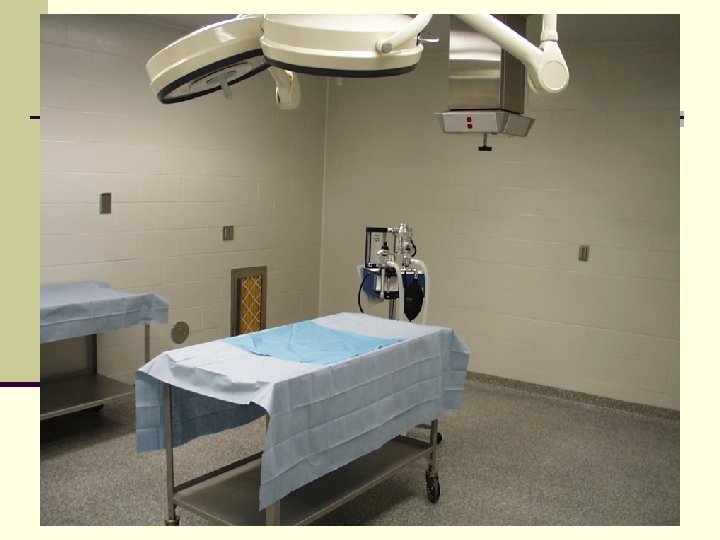
Facilities for Aseptic Surgery n Rodent surgery: n small simple; dedicated space in lab; minimize contamination during surgery n Large animal surgery: n surgical support, animal preparation, surgeon’s scrub, operating room, and postoperative recovery