
Latex Allergy What is Latex Natural rubber latex

Latex Allergy

What is Latex? • Natural rubber latex is a rubber harvested from the sap of the Hevea Brasiliensis tree, which grows in tropical climates in Asia & Africa • Qualities of latex make it useful in many products from automobile tires to gloves for healthcare workers

Latex Gloves • Latex gloves have the advantage of being thin & flexible enough to allow manual dexterity, while still allowing protection for patients and healthcare workers

Latex Allergy • Latex allergy is a response to proteins in natural rubber latex • Chemicals used in the processing of natural rubber latex can cause contact dermatitis • Allergic reactions can be triggered by direct contact with latex or by the inhalation of latex particles carried by glove powder

How do people become allergic to latex? • During a sensitization period the immune system of some individuals develops antibodies against allergens found in the proteins of natural rubber latex • The sensitization period can last several years • After sensitization occurs, exposure to latex allergens provokes an allergic reaction

Latex Allergy • Latex gloves have been used in healthcare for about 100 years. • Allergic reactions to latex were considered very rare before the 1990’s

Why Are We Seeing More Latex Allergy Cases Than in the Past? • First widespread reports of systemic latex allergy reactions occurred after the CDC-mandated implementation of universal precautions, spurred by the emergence of AIDS in the 1980’s • Efforts to prevent transmission AIDS led to greatly increased use of latex items (gloves, condoms) for barrier protection

Glove Power • Many gloves are powdered with cornstarch to make donning the gloves easier • Cornstarch absorbs latex proteins, then deposits them on skin, mucous membranes, in surgical wounds and is dispersed in the air as aerosolized particles
Items Likely to Contain Latex • • Gloves Adhesive Tape Ambu Bag Band-Aid ® brand similar bandages • Syringes • Bulb syringes • Foley catheters • Bite blocks • Electrode pads • Injection ports on IV tubing • Airways- oral & nasopharyngeal • Endotrachael Tubes • Rubber tops of medication vials
Items Likely to Contain Latex • Blood pressure cuffs • Ventilator hoses & bellows • Anesthesia masks • Tourniquets • Stethoscope tubing • Suction catheters • NG/OG tubes • • Many wound drains Stretcher Mattresses Rubber bands Latex balloons Pacifiers Condoms Diaphragms Rubber-backed Bathmats
FDA Regulations • Requires all medical devices containing natural rubber latex to carry the warning label: “Caution: This product contains natural rubber latex which may cause allergic reactions”

Custom Packs • In Cardinal Custom Packs all latexcontaining items are marked with an * on the list of contents • The only latex-containing item in the CVOR’s custom packs is gloves
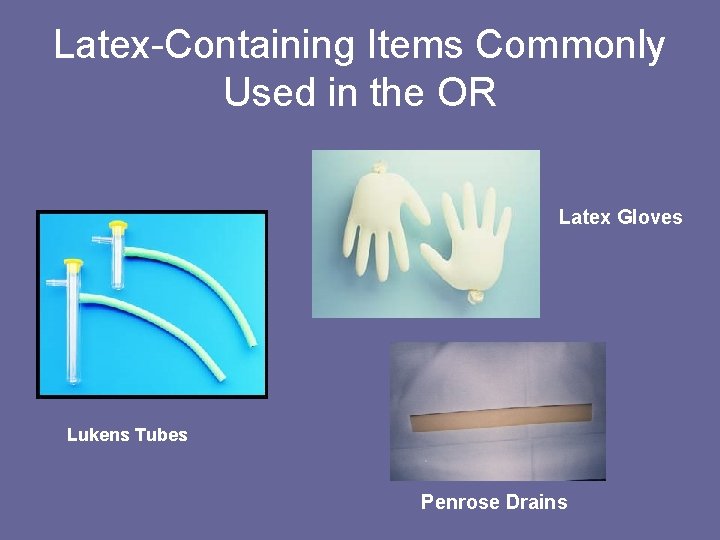
Latex-Containing Items Commonly Used in the OR Latex Gloves Lukens Tubes Penrose Drains
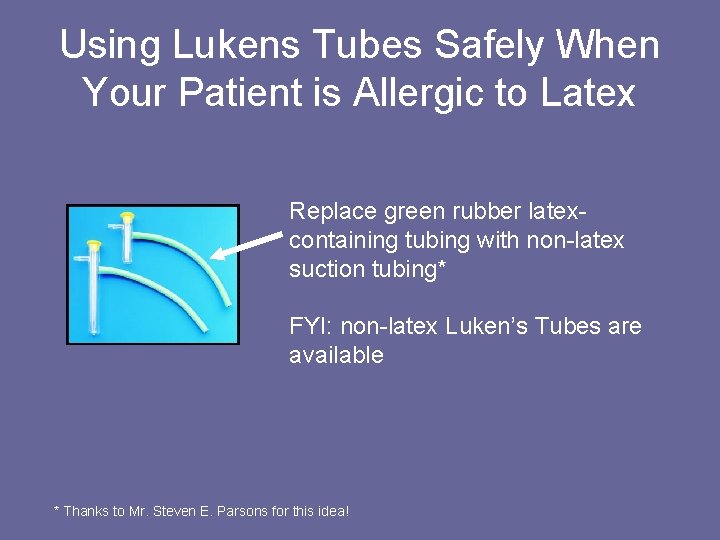
Using Lukens Tubes Safely When Your Patient is Allergic to Latex Replace green rubber latexcontaining tubing with non-latex suction tubing* FYI: non-latex Luken’s Tubes are available * Thanks to Mr. Steven E. Parsons for this idea!

Why use Latex? • Why not use synthetic alternatives to latex to avoid the possibility of allergic reactions? • Currently, there are no latex alternatives available that offer the tactile sensitivity, strength, elasticity, and viral barrier protection of natural rubber latex

At risk for serious latexrelated reactions: • Children with a history of multiple surgeries, particularly children with congenital neural tube defects (Spina Bifida, meningocele) or congenital GU malformations • Verifiable history of allergic reactions to latex
At risk for latex allergy: • Anyone who has occupational exposure to latex products, especially to powdered latex products • History of latex glove-associated contact dermatitis • History of allergy to foods known to cross react with latex: bananas, avocados, figs, kiwifruit, raw potatoes, papaya, chestnuts, “stone” fruits (peaches, papayas)

Who should be evaluated for latex allergy? • Anyone with a history of unexplained anaphylaxis, especially if occurred in a medical or dental setting • History of hives or itching after latex exposure (healthcare related, latex balloons, condoms, Band-Aids®) • History of multiple surgical procedures
Testing for Latex Allergy • There are blood tests available to detect the presence of antibodies to latex- these tests do have some false positives and negatives • Currently, there is no skin patch test available in the US • Skin prick testing is available, but carries the risk of inducing an anaphylactic response
Irritant Contact Dermatitis • Not an allergic reaction • Caused by skin damage from chemicals or by mechanical irritation from glove powder • Response can be either immediate or delayed
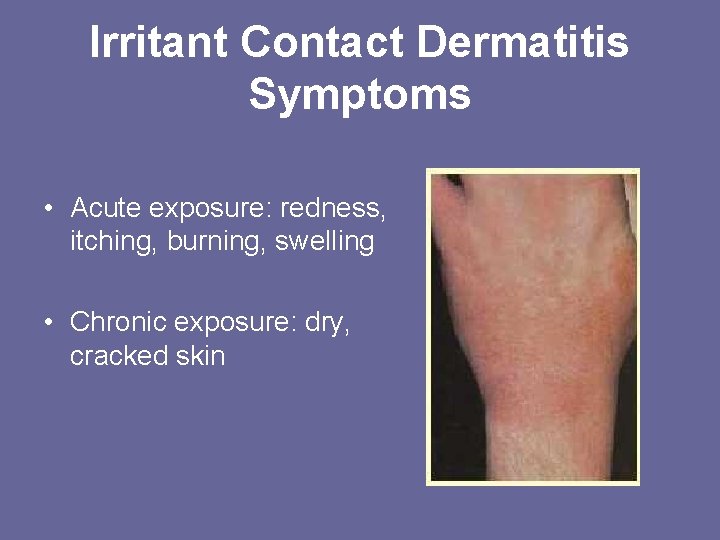
Irritant Contact Dermatitis Symptoms • Acute exposure: redness, itching, burning, swelling • Chronic exposure: dry, cracked skin
Irritant Contact Dermatitis: Treatment • Remove the irritant – wear powder-free gloves whenever possible • Change glove type • Change gloves frequently
Allergic Contact Dermatitis • Localized reaction • Delayed onset: reaction occurs from 18 to 48 hours after exposure • May precede a more serious allergic reaction
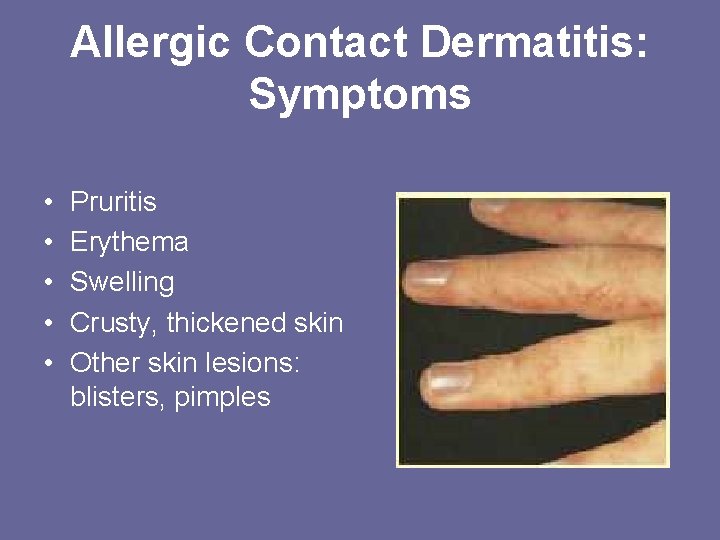
Allergic Contact Dermatitis: Symptoms • • • Pruritis Erythema Swelling Crusty, thickened skin Other skin lesions: blisters, pimples

Allergic Contact Dermatitis: Treatment • Use non-latex gloves LATEX
Latex Allergy • Immediate systemic reaction • Reaction occurs when latex contacts skin, mucous membranes, internal tissue • Reaction can occur after inhalation of latex particles carried in aerosolized glove powder

Latex Allergy Symptoms • • Rhinitis Conjunctivitis Urticaria (Hives) Angioedema (swelling beneath the skin, usually around eyes, lips, hands and feet) • • Laryngeal edema Bronchospasm Asthma Anaphylaxis
Anaphylaxis Symptoms: Awake Patient • • • Generalized pruritis “Itchy eyes” Shortness of breath “Chest tightness” Wheezing • Abdominal cramping • Feeling faint • Feeling of impending doom
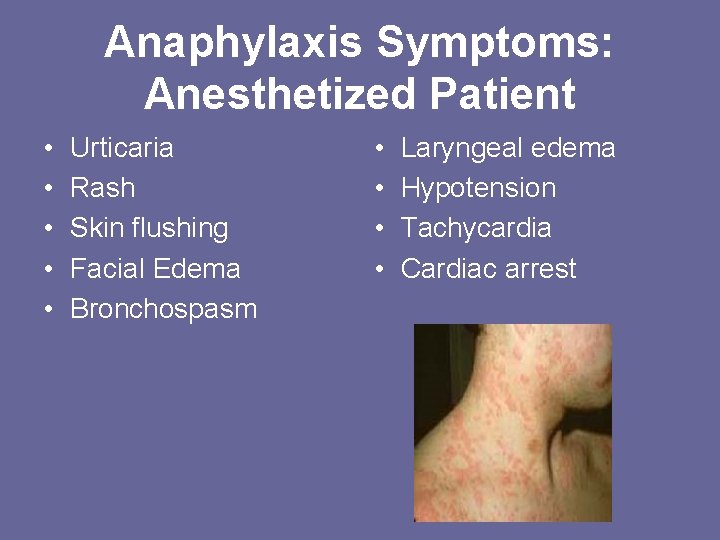
Anaphylaxis Symptoms: Anesthetized Patient • • • Urticaria Rash Skin flushing Facial Edema Bronchospasm • • Laryngeal edema Hypotension Tachycardia Cardiac arrest
The National Institute for Occupational Safety and Health (NIOSH) guidelines: • Healthcare workers not allergic to latex should wear low protein, powder-free latex gloves • Individuals allergic to latex should only wear synthetic gloves and avoid inhalation of airborne powder from natural rubber latex gloves
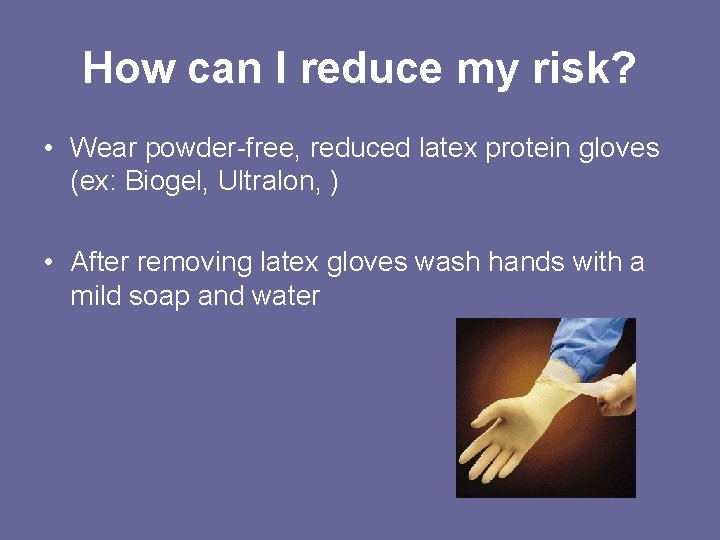
How can I reduce my risk? • Wear powder-free, reduced latex protein gloves (ex: Biogel, Ultralon, ) • After removing latex gloves wash hands with a mild soap and water
Latex Allergic/Sensitive Patient • Surgeon or his/her designee should notify the OR when scheduling the case that patient has latex allergy • Latex allergy should be noted on the surgery schedule – ideally patient will be scheduled as first case of the day • Verify that all personnel caring for patient should be aware of patient’s latex allergy
Latex Allergic/Sensitive Patient • Confirm allergies with patient on arrival to OR • Assess for latex allergy risk factors • Patient with history of latex-related reactionconfirm stimulus for reaction, and the severity of the reaction
Latex Allergic/Sensitive Patient • Patient’s chart should be flagged with allergy sticker • Patient should have latex-free cart ordered at time of admission which accompanies patient to the OR • Cart will accompany patient throughout hospitalization, from Same Day Admissions, to the OR, to PACU, to the Nursing Unit

Latex-Free Cart • Obtained from Central Services • Contains assortment of gloves (both sterile and non-sterile), latex-free Penrose drains, syringes and Foley catheters, all in an assortment of sizes • Also contains a latex-free ambu bag
Intraoperative Care • Place “Latex Allergy” sign on door of surgical suite • Remove all latex gloves from the room to prevent accidental use • Double check all supplies for latex • Communicate patient’s allergy status to PACU prior to transfer
Medication • Use medication with latex-free stoppers or in ampules if possible • If required medication is not available in an ampule or with latex-free stopper—remove rubber stopper from bottle before drawing up medication using filter needle
Suspected Latex Sensitivity • Employees who suspect they may be allergic to latex should report their suspicions to the Employee Health Office • Employee will be referred to UAB’s Occupational Medicine Clinic • Occupational Medicine physician will make recommendations regarding allergy testing and appropriate latex-avoidance practices
Employees with Latex Allergy • Should not wear latex gloves, or be exposed to aerosolized powder from latex gloves
References • Allegiance Healthcare Information Center Latex Allergy Guidelines accessed from the Cardinal web site at http: //www. cardinal. com/allegiance/hic • American College of Allergy, Asthma & Immunology (2002) Guidelines for the Management of Latex Allergies and Safe Latex Use in Health Care Facilities • AORN (2002) Standards, Recommended Practices and Guidelines • Ansell Healthcare web site: http: //www. ansellhealthcare. com/ • Allergy Links web site: Http: //www. latexallergylinks. org • Regent Medical: Latex Allergy Questions and Answers from web site: http: //www. regentmedical. com/ • UAB Hospital Standard: Latex Allergy
- Slides: 40