
Lateral Humeral Condyle Fractures in Children The Potential


- Slides: 30
Lateral Humeral Condyle Fractures in Children: The Potential Role of Initial Assessment in Decision-Making Prof. Mohamed M. Zamzam, MD Professor and Consultant Orthopaedic Surgeon College of Medicine, King Saud University Riyadh, Saudi Arabia
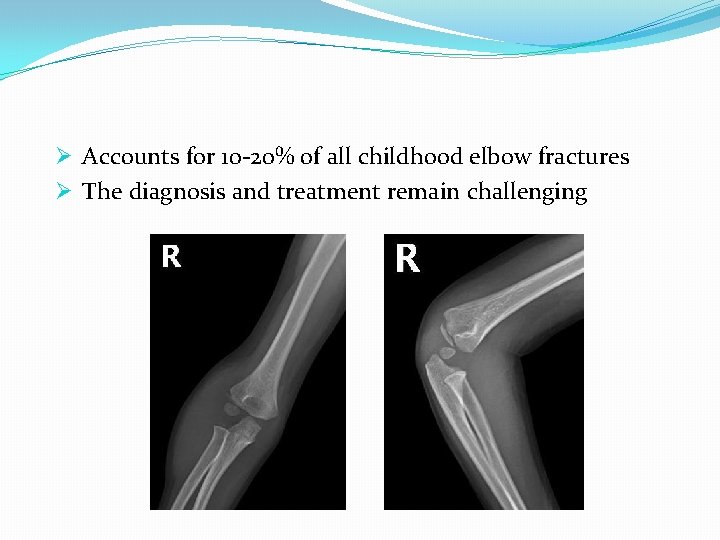
Ø Accounts for 10 -20% of all childhood elbow fractures Ø The diagnosis and treatment remain challenging
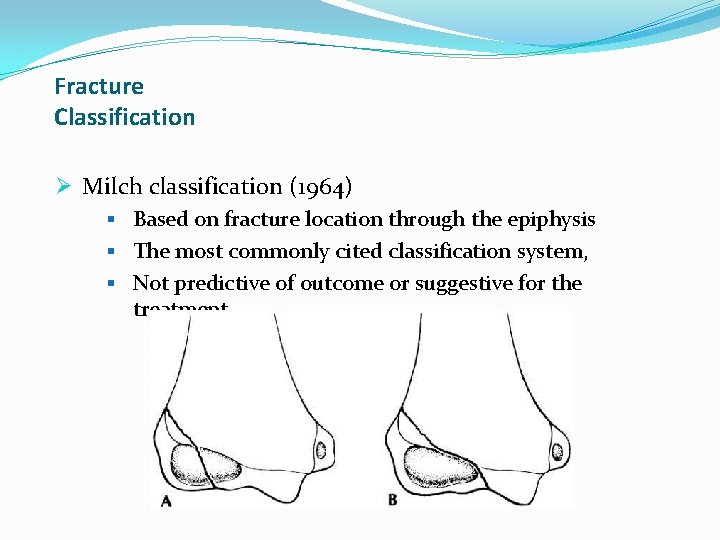
Fracture Classification Ø Milch classification (1964) § Based on fracture location through the epiphysis § The most commonly cited classification system, § Not predictive of outcome or suggestive for the treatment
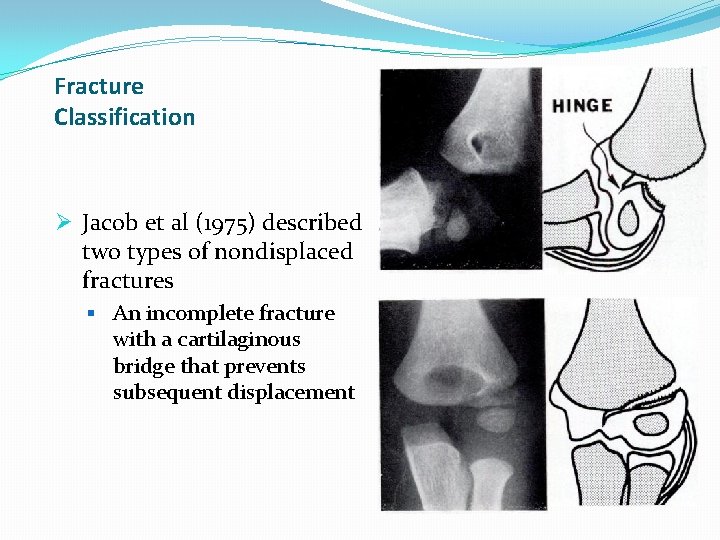
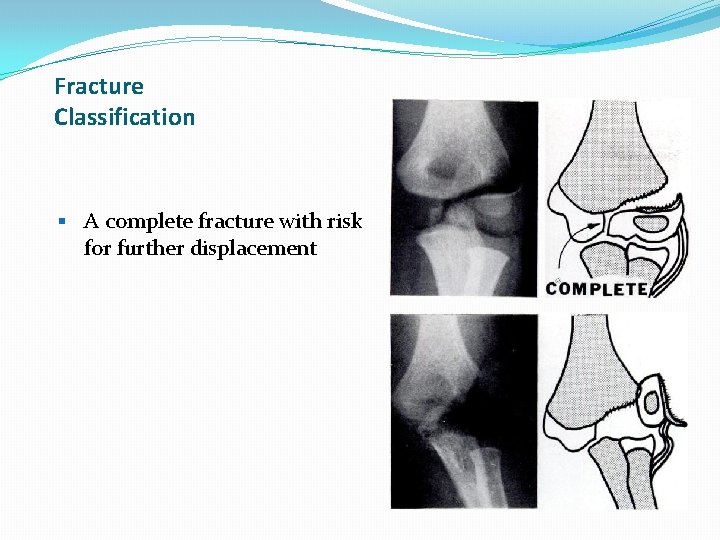
Fracture Classification Ø Jacob et al (1975) described two types of nondisplaced fractures § An incomplete fracture with a cartilaginous bridge that prevents subsequent displacement
Fracture Classification § A complete fracture with risk for further displacement
Fracture Classification Ø Song et al (2008)designed a comprehensive classification system that is linked to a treatment algorithm
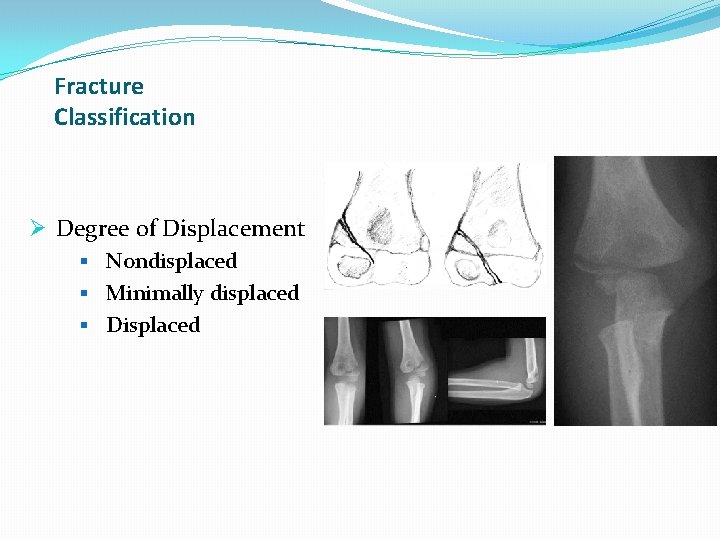
Fracture Classification Ø Degree of Displacement § Nondisplaced § Minimally displaced § Displaced
Imaging Ø All attempts for the differentiation are either invasive or expensive § Arthrography § MRI § Ultrasonography are frequently used
Treatment Ø There is consensus that the treatment of displaced fractures is closed or open reduction and internal fixation Ø The treatment of nondisplaced or minimally displaced fractures remains controversial
Treatment Ø The risk for subsequent displacement of these fractures has been reported as 11 -42% Ø Delayed surgery with attempts to mobilize the fragment by stripping soft tissues have often led to avascular necrosis Ø Some investigators have recommended closed reduction with percutaneous pinning for minimally displaced fractures
Purpose of the Study Our aim was Ø To recognize the impact of further displacement of nondisplaced and minimally displaced fractures on the outcome Ø To define the fracture displacement that necessitates primary surgical intervention Ø To ascertain which fractures need early follow up to avoid delayed surgery.
Patients Inclusion Criteria Ø From 2004 to 2010 Ø Complete information Ø Full radiographic examination Ø Follow up of at least four years
Patients Exclusion Criteria Ø Associated injury of the same limb Ø Neuromuscular disorders
Methodology The collected Data Include Ø Initial assessments Ø Treatment method Ø Operative data Ø Cast immobilization Ø Follow up Ø Complications Ø Healing
Methodology Ø The authors reviewed blindly all initial radiographs Ø Clinical practice pathway for paediatric lateral humeral condyle fracture § Hairline fracture is considered nondisplaced § A fracture gap ≤ 2 mm is minimally displaced § A fracture gap ˃ 2 mm is a displaced fracture
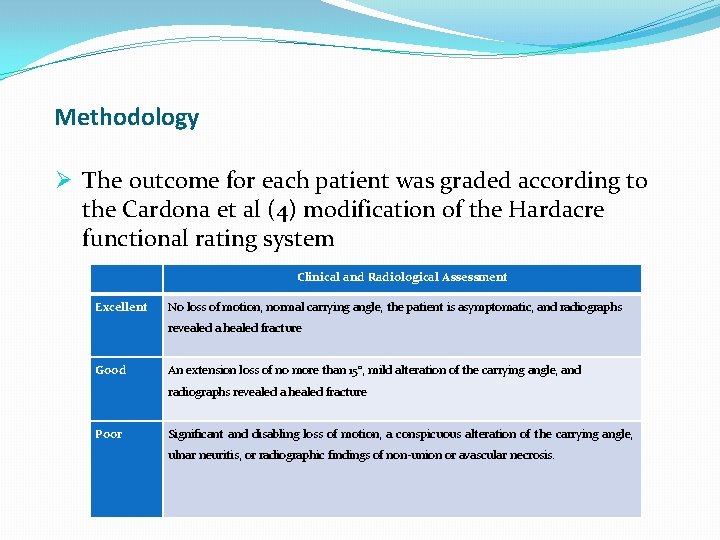
Methodology Ø The outcome for each patient was graded according to the Cardona et al (4) modification of the Hardacre functional rating system Excellent Clinical and Radiological Assessment No loss of motion, normal carrying angle, the patient is asymptomatic, and radiographs revealed a healed fracture Good An extension loss of no more than 15°, mild alteration of the carrying angle, and radiographs revealed a healed fracture Poor Significant and disabling loss of motion, a conspicuous alteration of the carrying angle, ulnar neuritis, or radiographic findings of non-union or avascular necrosis.
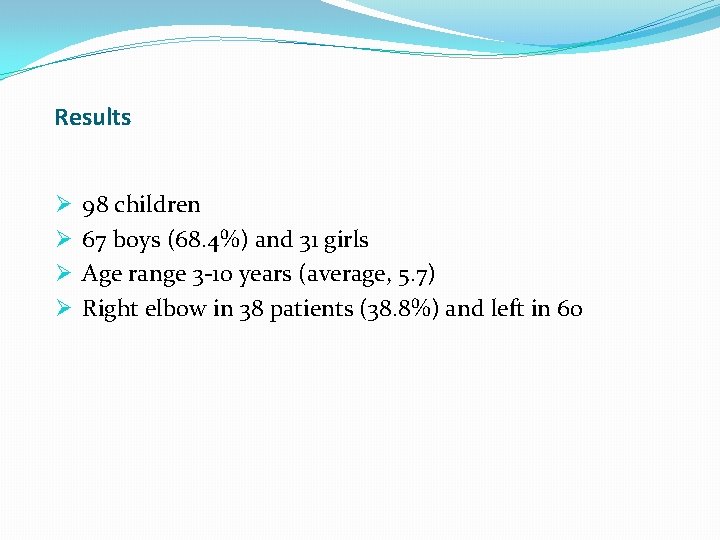
Results Ø Ø 98 children 67 boys (68. 4%) and 31 girls Age range 3 -10 years (average, 5. 7) Right elbow in 38 patients (38. 8%) and left in 60
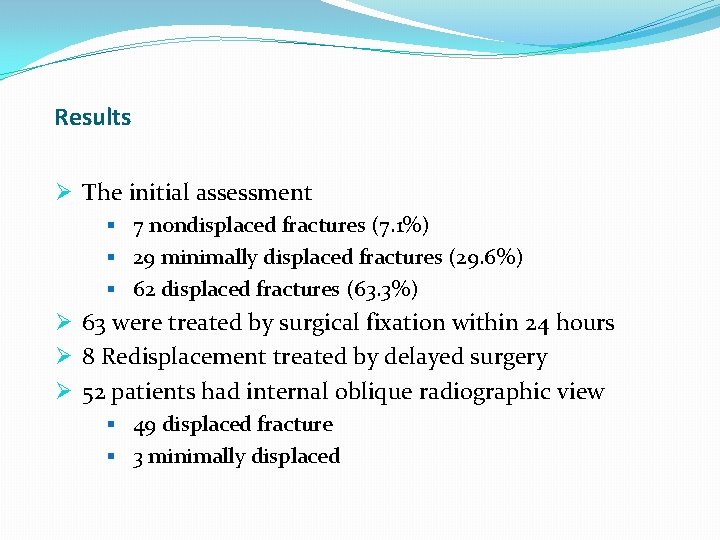
Results Ø The initial assessment § 7 nondisplaced fractures (7. 1%) § 29 minimally displaced fractures (29. 6%) § 62 displaced fractures (63. 3%) Ø 63 were treated by surgical fixation within 24 hours Ø 8 Redisplacement treated by delayed surgery Ø 52 patients had internal oblique radiographic view § 49 displaced fracture § 3 minimally displaced
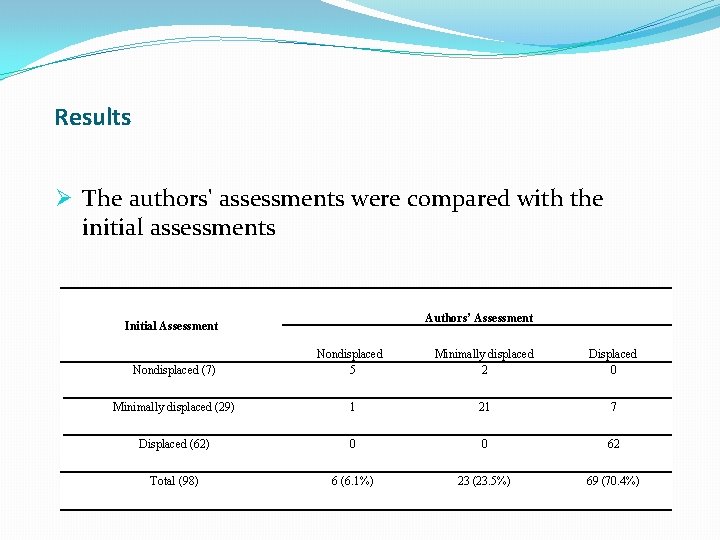
Results Ø The authors' assessments were compared with the initial assessments Authors’ Assessment Initial Assessment Nondisplaced (7) Nondisplaced 5 Minimally displaced 2 Displaced 0 Minimally displaced (29) 1 21 7 Displaced (62) 0 0 62 Total (98) 6 (6. 1%) 23 (23. 5%) 69 (70. 4%)
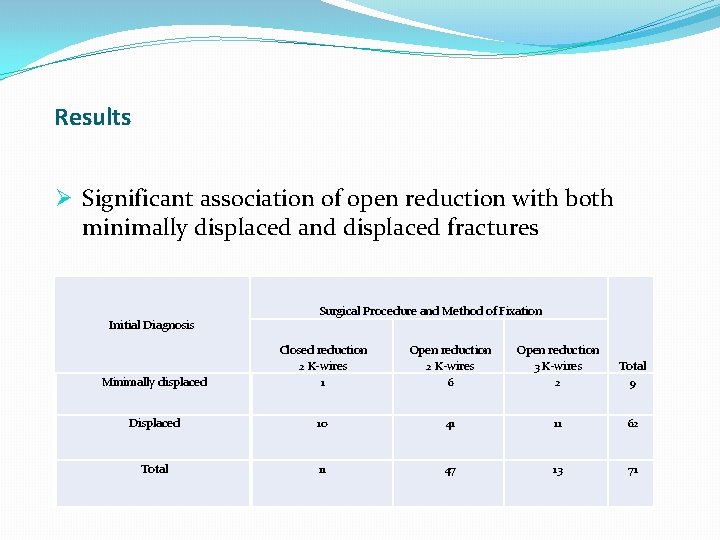
Results Ø Significant association of open reduction with both minimally displaced and displaced fractures Surgical Procedure and Method of Fixation Initial Diagnosis Minimally displaced Closed reduction 2 K-wires 1 Open reduction 2 K-wires 6 Open reduction 3 K-wires 2 Total 9 Displaced 10 41 11 62 Total 11 47 13 71
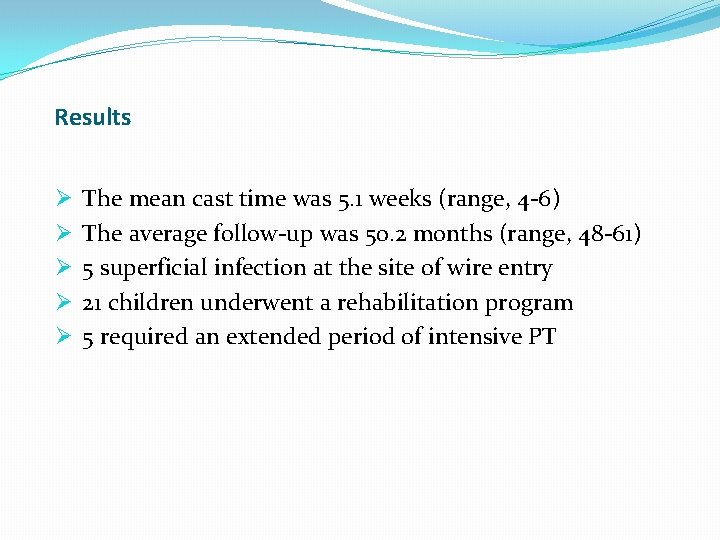
Results Ø Ø Ø The mean cast time was 5. 1 weeks (range, 4 -6) The average follow-up was 50. 2 months (range, 48 -61) 5 superficial infection at the site of wire entry 21 children underwent a rehabilitation program 5 required an extended period of intensive PT
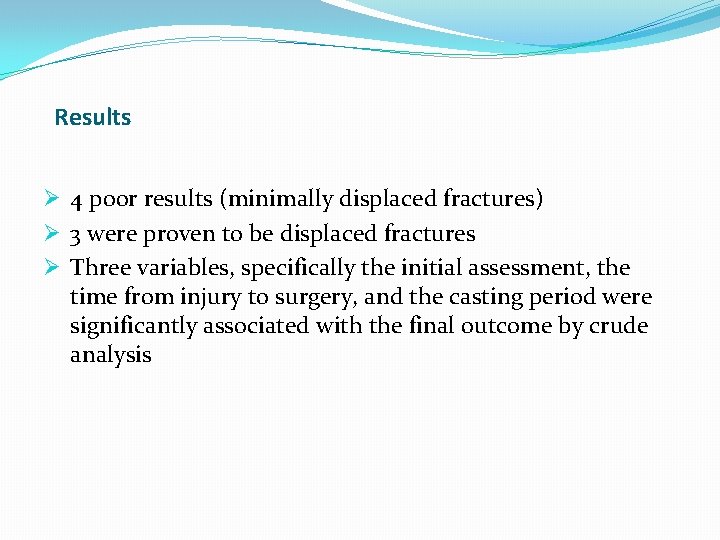
Results Ø 4 poor results (minimally displaced fractures) Ø 3 were proven to be displaced fractures Ø Three variables, specifically the initial assessment, the time from injury to surgery, and the casting period were significantly associated with the final outcome by crude analysis
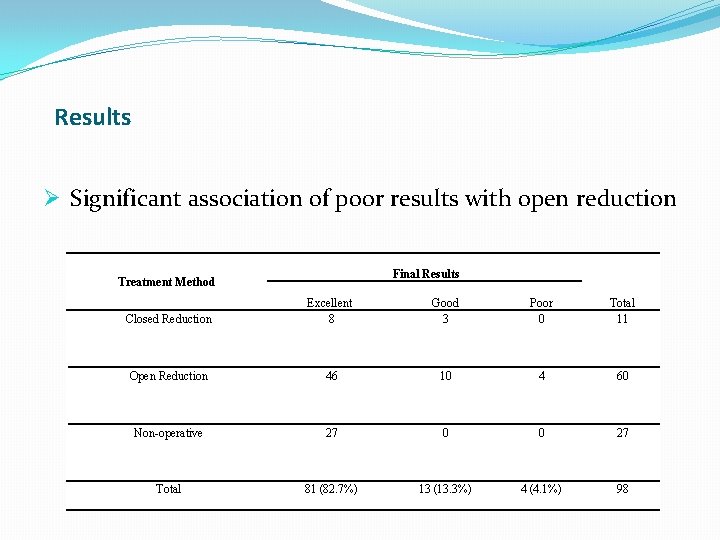
Results Ø Significant association of poor results with open reduction Final Results Treatment Method Closed Reduction Excellent 8 Good 3 Poor 0 Total 11 Open Reduction 46 10 4 60 Non-operative 27 0 0 27 Total 81 (82. 7%) 13 (13. 3%) 4 (4. 1%) 98
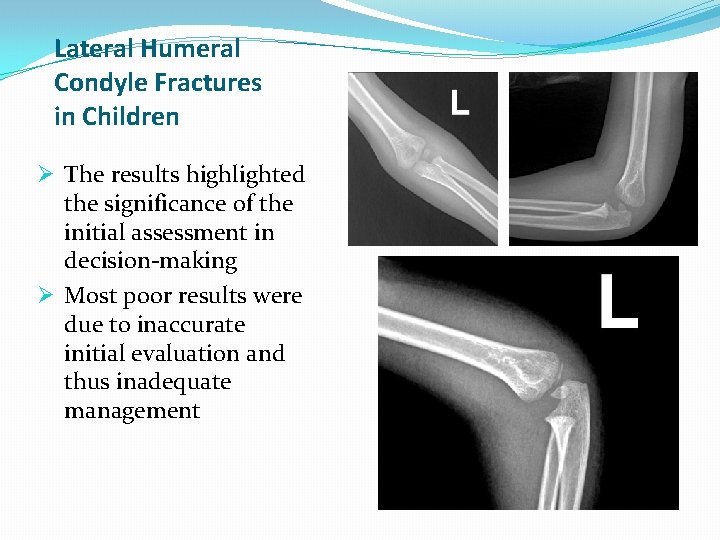
Lateral Humeral Condyle Fractures in Children Ø The results highlighted the significance of the initial assessment in decision-making Ø Most poor results were due to inaccurate initial evaluation and thus inadequate management
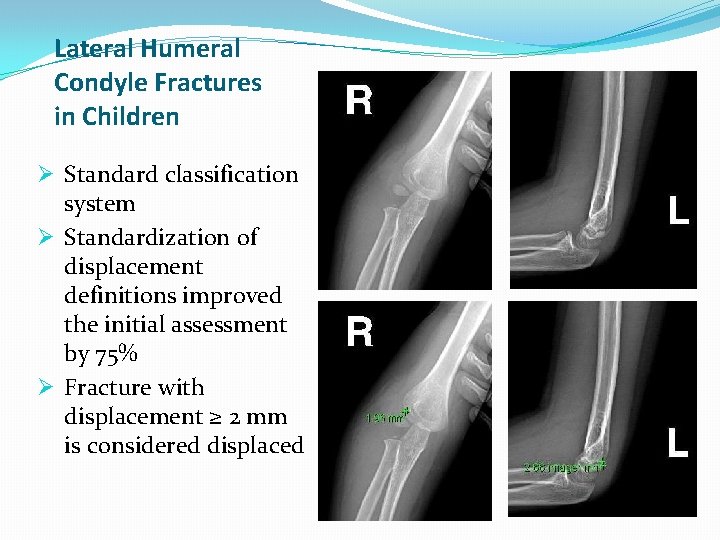
Lateral Humeral Condyle Fractures in Children Ø Standard classification system Ø Standardization of displacement definitions improved the initial assessment by 75% Ø Fracture with displacement ≥ 2 mm is considered displaced
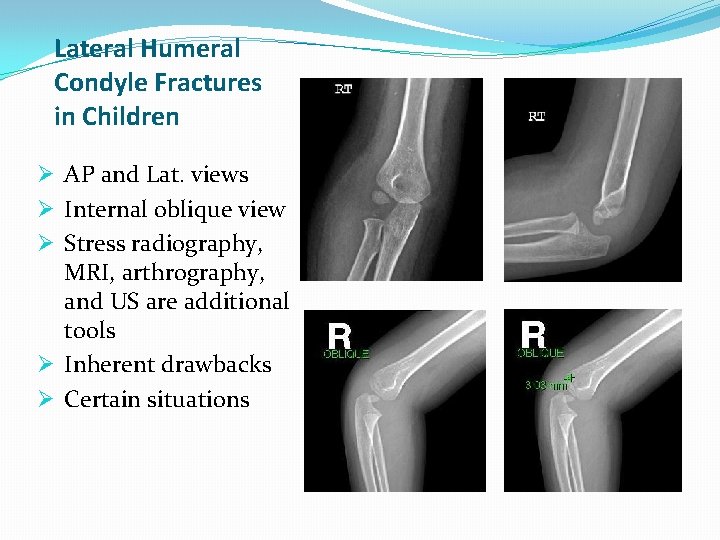
Lateral Humeral Condyle Fractures in Children Ø AP and Lat. views Ø Internal oblique view Ø Stress radiography, MRI, arthrography, and US are additional tools Ø Inherent drawbacks Ø Certain situations
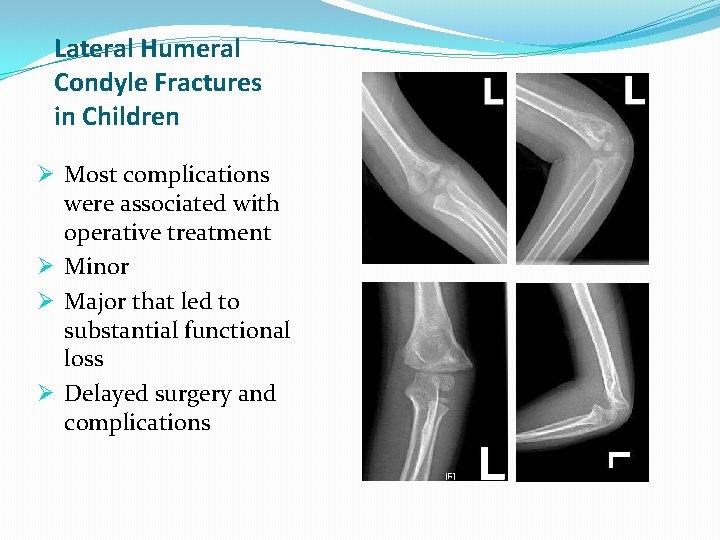
Lateral Humeral Condyle Fractures in Children Ø Most complications were associated with operative treatment Ø Minor Ø Major that led to substantial functional loss Ø Delayed surgery and complications
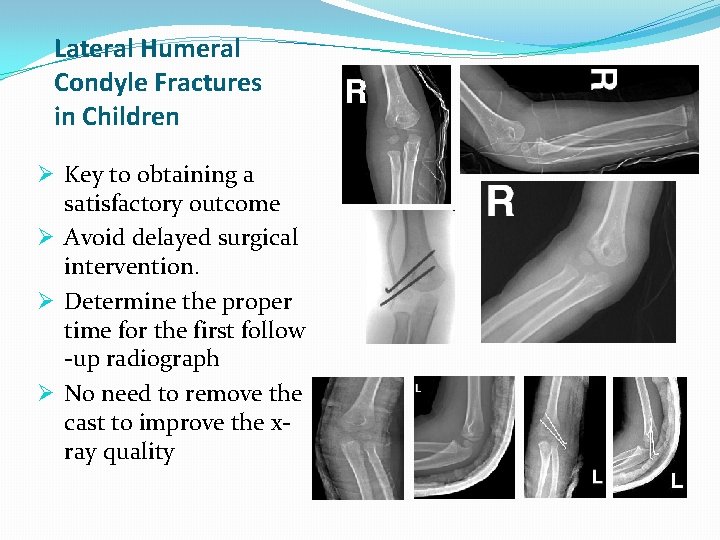
Lateral Humeral Condyle Fractures in Children Ø Key to obtaining a satisfactory outcome Ø Avoid delayed surgical intervention. Ø Determine the proper time for the first follow -up radiograph Ø No need to remove the cast to improve the xray quality
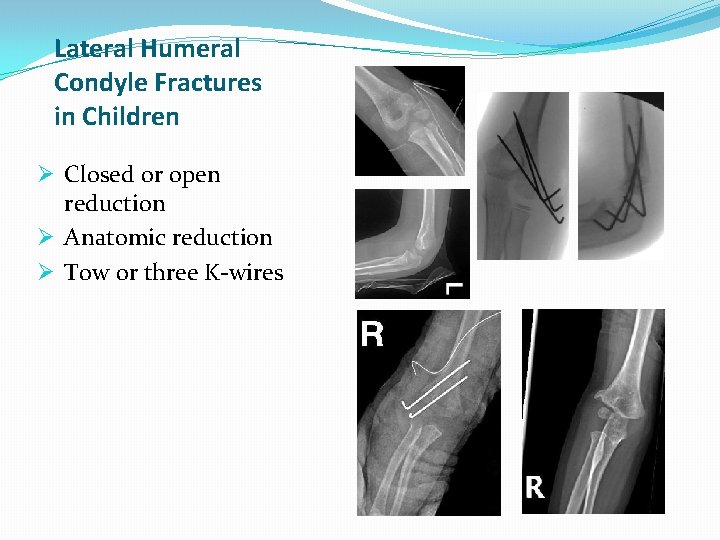
Lateral Humeral Condyle Fractures in Children Ø Closed or open reduction Ø Anatomic reduction Ø Tow or three K-wires
Conclusion Ø Careful initial assessment using the IO view in addition to standard x-ray views is crucial for adequate treatment Ø Fractures with ≥ 2 mm displacement should be primarily treated by surgical fixation Ø Fractures with < 2 mm displacement must be reviewed 4 -6 days after cast application Ø If the patient's compliance with early follow up is not guaranteed and the fracture is not hairline, then primary closed reduction and percutaneous fixation is indicated.