
Later life widowhood and loneliness Dr Tracy Collins

- Slides: 26
Later life widowhood and loneliness Dr Tracy Collins
Ph. D study with older women experiencing widowhood • Managing transition: a longitudinal study of personal communities in later life widowhood • Context of the study • Study design • Main findings
Context of the study • Widowhood in later life is more common for older women than older men (Hirst & Corden, 2010) • Social networks and social support are thought to help buffer such events and ease subsequent transitions (Momtaz et al. , 2009)
Context of the study • Lack of longitudinal qualitative research exploring the personal communities of older widows experiencing transition in contemporary Britain (Collins, 2011) • I was particularly interested in older women’s personal communities and social practices and if and how they change during widowhood
Study design • Methodological approach – qualitative framework, longitudinal design • Purposive sample – 26 older widows, widowed between 1 and 3 years (transitional phase) • Method – series of three in depth interviews conducted over eighteen months, including the use of personal community diagrams to identify the structure of social networks, and Christmas cards to further explore social relationships and practices • Analysis – thematic analysis of interview transcripts and content analysis of diagrams
Main findings • Four types of personal community among the older widows in the study, comprising different combinations of family, friends and others. ‘Concentrated family’, ‘Diluted family’, ‘Friend with family centrality’ and ‘Friend with mixed centrality’ • The diverse, complex, and often-paradoxical nature of personal relationships within structurally similar social network types is often compounded by multiple transitions associated with ageing in addition to widowhood itself
Main findings • The continuity and discontinuity of social relationships, as well as the re-arrangement of family and friendship practices, demonstrate the multifaceted and ever-shifting characteristics of social networks during the transition of widowhood • The management of transition incorporates not only social relations, but also personal agency, and flexibility. These combined factors appear to be more important to adaptation during later life widowhood than social network type
Negative experiences of Christmas • • Christmas can be an isolating and excluding experience for some older widows, compounded by multiple challenges such as: family friction personal dependence increasing frailty a growing sense of passivity as established roles and relationships alter or are lost (Collins, 2014)
Social exclusion For Mary, family friction between her four adult children, compounded by her being housebound, culminated in her spending Christmas alone at home: ‘I was here all on my own on Christmas day…and the same with new year. I didn’t go anywhere, I was here, you know, so I was glad when they’d both gone…Christmas and the new year, you know. So I just had the television on, to pass the time away, you know. ’
Cultural exclusion Mary’s social and cultural exclusion was starkly illustrated as she described her Christmas meal, which is vastly different to that which many people in Britain enjoy on Christmas Day: ‘…I had a tin of vegetable soup on Christmas day for my dinner, with a mince pie, and I had a tin of tomato soup and a mince pie on Boxing day. ’
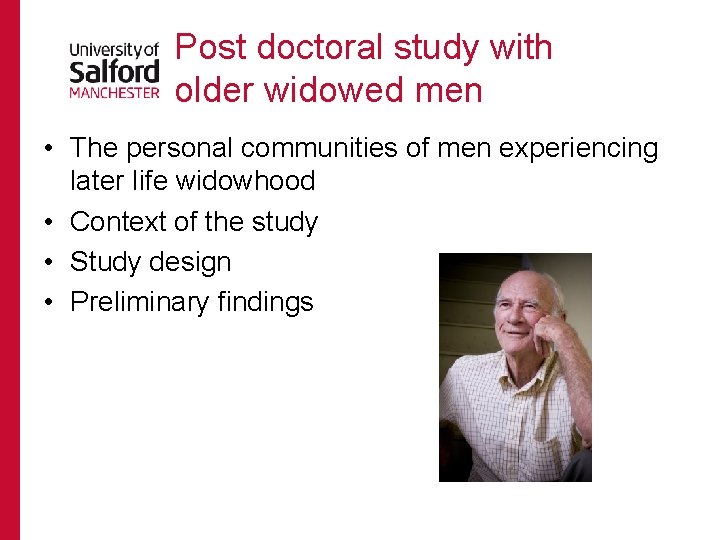
Post doctoral study with older widowed men • The personal communities of men experiencing later life widowhood • Context of the study • Study design • Preliminary findings
Context of the study • Although the incidence of widowhood is still greater for older women than it is for older men, this ratio has decreased over recent years, due in part to the increased life expectancy of men (Hirst and Corden, 2010) • Furthermore gender differences in the experience of widowhood in later life continues to be an area of academic (Collins, 2011) and public (Bunyan, 2012; Collins, 2012 a; Collins, 2012 b) interest
Context of the study • Existing widowhood research has examined gender differences in terms of partnership choice (Davidson, 2001) and psychological adjustment (Bennett, Hughes and Smith, 2005) • However there remains a lack of qualitative research exploring gender differences in terms of the types and characteristics of social relationships and support during the transition (Collins, 2011)
Study design • Methodological approach – qualitative framework, cross sectional design • Purposive sample – 7 older widowers, widowed between 1 and 3 years (transitional phase) • Method – one in depth interview, including the use of personal community diagrams to identify the structure of social networks. Although this smaller study did not include a study of Christmas and Christmas cards the interview schedule included questions about Christmas and birthday celebrations etc. • Analysis – thematic analysis of interview transcripts and content analysis of diagrams
Preliminary findings • Four types of personal community among the older widowers in the study, comprising different combinations of family, friends and others. ‘Concentrated family’, ‘Friends and others with family centrality’, ‘Family and friends with family centrality’ and ‘Friends only’ • One of the older widowers included just two people (friends) in his personal community diagram. His estranged son, daughter in law and grandchildren live in Australia
Preliminary findings • The older widowers ties with organisations and subsequent friendships tend to be ‘task or career-focused’ e. g. Veteran’s club, rather than ‘social’ • The majority of the older widowers had been long term carers, many of the men talked about friendships and connections ending even before their wives had died. For example, Arthur, whose wife had dementia:
Social isolation ‘…your independence has gone…you don’t become er a social person anymore, you become introverted and life is for…unless you go out shopping, and that was it. So…we used to go out playing dominoes…at least once a week, well that went. And then erm slowly but surely because of the condition, I couldn’t leave her, they obviously didn’t want that sort of erm thrust upon them so…so we became isolated so erm. ’
Recommendations for policy and practice • Policy makers and practitioners should be aware that in addition to widowhood, older people may be experiencing multiple and parallel transitions associated with ageing and the life course, such as changes in health and the additional loss of relationships with family and friends
Recommendations for policy and practice • Practitioners should seek out opportunities to explore the deeper content of relationships with family, friends and others when working with older widows and widowers, for example during initial assessments and when planning discharges from hospital, or from other settings, to home. Although an individual’s personal community may appear to be stable and robust on the surface, it may not necessarily offer ongoing tangible support
Recommendations for policy and practice • Some older people are likely to face social exclusion over the Christmas period. This has implications for practitioners working in hospitals, or other settings, as attempts are often made to discharge service users prior to the Christmas period with the assumption that they would rather be at home with the support of family, friends and others. In reality this is not a viable option for all older people
Recommendations for policy and practice • It is important to consider gender differences and preferences when designing services for older people • Services should consider the ‘social’ needs of long term carers; social isolation and loneliness often begins long before the death of a spouse
References Bennett, K. , Hughes, G. and Smith, P. 2005. ‘Psychological response to later life widowhood: coping and the effects of gender’ Omega, Vol. 51, 1, 33 -52. Bunyan, N. 2012, 28 February. ‘Merry widows’ enjoy fulfilling life with friends. The Daily Telegraph, p. 3. Collins, T. 2011. Managing transition: a longitudinal study of personal communities in later life widowhood. Ph. D, Keele University. Available at http: //usir. salford. ac. uk/15823/
References Collins, T. Interview. ‘Lunchtime with Mark Patterson’ BBC Radio Foyle. 28 February 2012 a. Collins, T. Interview. ‘Breakfast with Beswick’ BBC Radio Manchester. 29 February 2012 b. Collins, T. 2013. Remembering the past, looking to the future: Christmas as a symbol of change in later life widowhood. Ageing and Society, Available on CJO 2013 DOI: 10. 1017/SO 144686 X 13000329
References Collins, T. 2014. Managing widowhood in later life: the challenges encountered. International Journal of Therapy and Rehabilitation, Vol. 21, Iss. 2, 05 Feb 2014, pp 69 – 76. Davidson, K. 2001. ‘Late life widowhood, selfishness and new partnership choices: a gendered perspective’ Ageing and Society, Vol. 21, 3, 297317.
References Hirst, M. and Corden, A. 2010 ‘Change in living arrangements following death of a partner in England Wales, 1971 -2001’ Population Trends, nr 141 Autumn. Available at http: //www. statistics. gov. uk/articles/population_trends/11 -poptrends 141 -hirst. pdf Accessed on 22 nd April 2011, 12. 25 pm. Momtaz, Y. , Hamid, T. , Yahaya, N. and Ibrahim, R. 2009. ‘Widowhood and psychological well-being among older Malaysians: mediating effect of social network’ Indian Journal of Social Work, 70, 3, 375 -390.
Any questions? T. Collins@salford. ac. uk