
Latent Semantic Indexing Adapted from Lectures by Prabhaker
Latent Semantic Indexing Adapted from Lectures by Prabhaker Raghavan, Christopher Manning and Thomas Hoffmann Prasad L 18 LSI 1
Today’s topic n Latent Semantic Indexing Term-document matrices are very large n But the number of topics that people talk about is small (in some sense) n Clothes, movies, politics, … n Can we represent the term-document space by a lower dimensional latent space? n Prasad L 18 LSI 2

Linear Algebra Background Prasad L 18 LSI 3
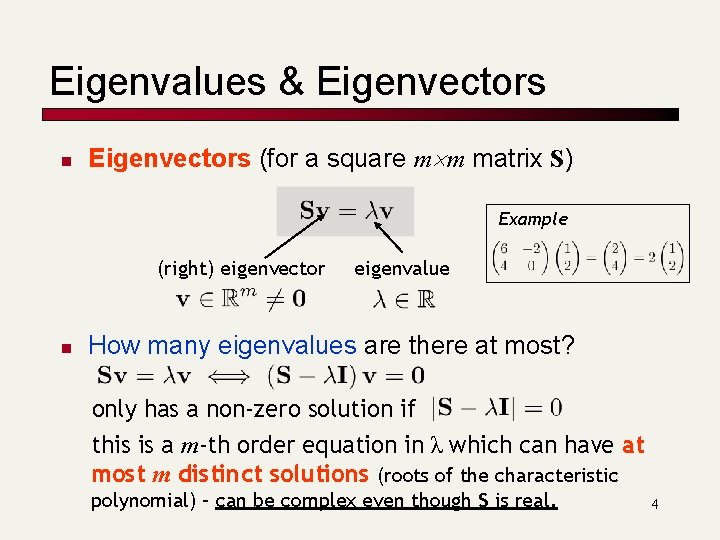
Eigenvalues & Eigenvectors n Eigenvectors (for a square m m matrix S) Example (right) eigenvector n eigenvalue How many eigenvalues are there at most? only has a non-zero solution if this is a m-th order equation in λ which can have at most m distinct solutions (roots of the characteristic polynomial) – can be complex even though S is real. 4

Matrix-vector multiplication has eigenvalues 30, 20, 1 with corresponding eigenvectors On each eigenvector, S acts as a multiple of the identity matrix: but as a different multiple on each. Any vector (say x= the eigenvectors: ) can be viewed as a combination of x = 2 v 1 + 4 v 2 + 6 v 3
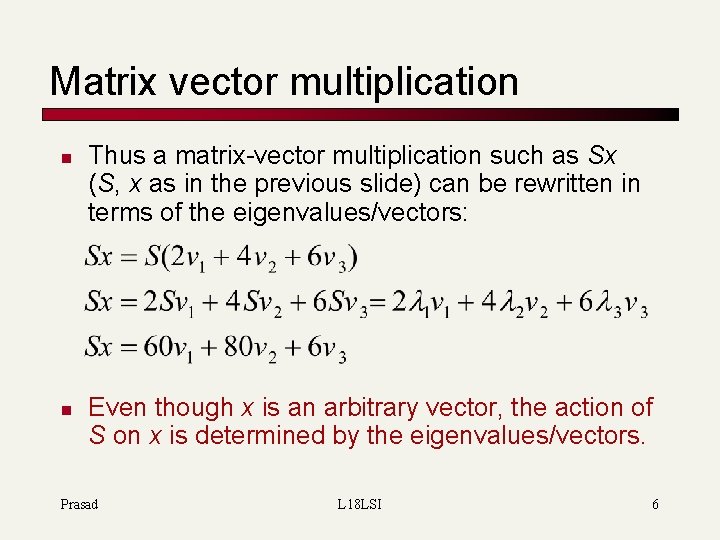
Matrix vector multiplication n n Thus a matrix-vector multiplication such as Sx (S, x as in the previous slide) can be rewritten in terms of the eigenvalues/vectors: Even though x is an arbitrary vector, the action of S on x is determined by the eigenvalues/vectors. Prasad L 18 LSI 6
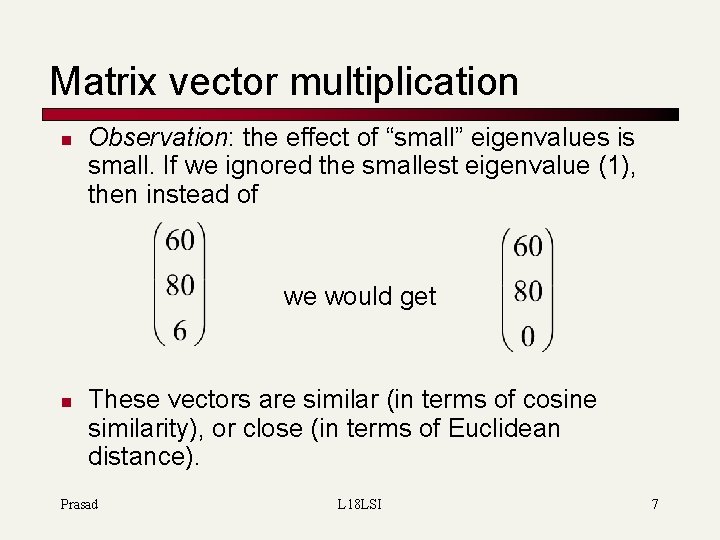
Matrix vector multiplication n Observation: the effect of “small” eigenvalues is small. If we ignored the smallest eigenvalue (1), then instead of we would get n These vectors are similar (in terms of cosine similarity), or close (in terms of Euclidean distance). Prasad L 18 LSI 7
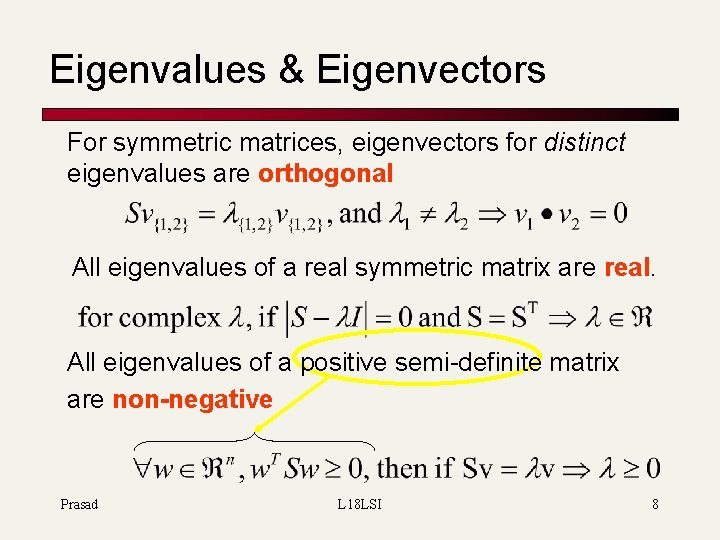
Eigenvalues & Eigenvectors For symmetric matrices, eigenvectors for distinct eigenvalues are orthogonal All eigenvalues of a real symmetric matrix are real. All eigenvalues of a positive semi-definite matrix are non-negative Prasad L 18 LSI 8
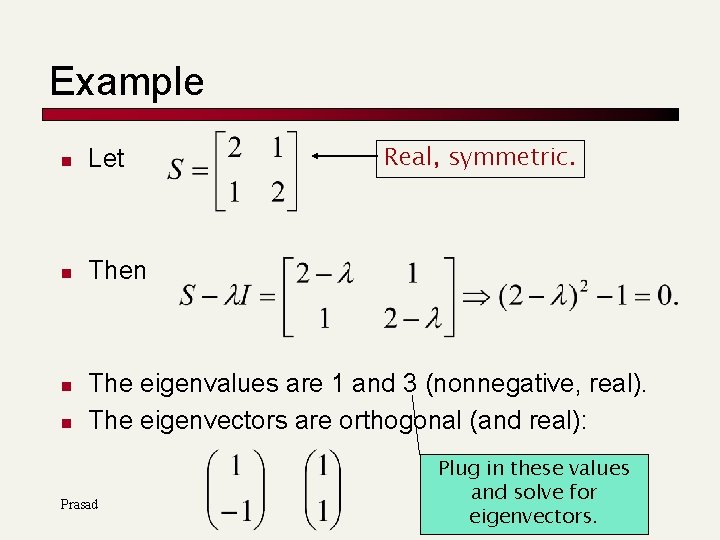
Example n Let n Then n n Real, symmetric. The eigenvalues are 1 and 3 (nonnegative, real). The eigenvectors are orthogonal (and real): Prasad Plug in these values and solve for eigenvectors.
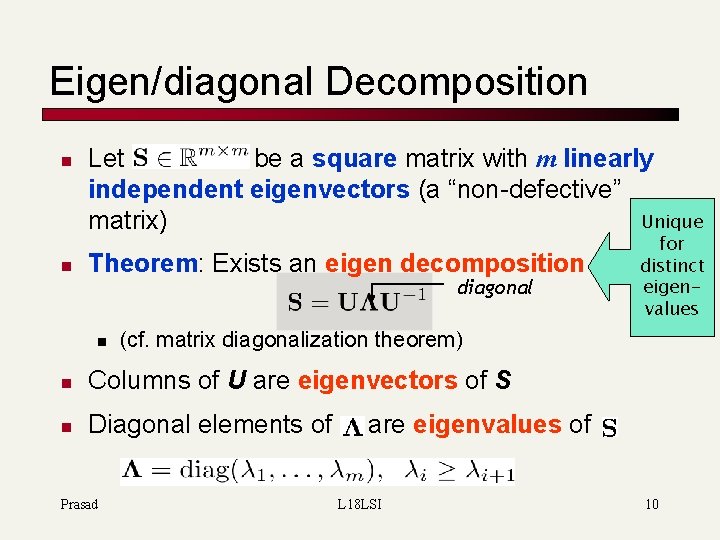
Eigen/diagonal Decomposition n n Let be a square matrix with m linearly independent eigenvectors (a “non-defective” Unique matrix) Theorem: Exists an eigen decomposition diagonal n (cf. matrix diagonalization theorem) n Columns of U are eigenvectors of S n Diagonal elements of Prasad for distinct eigenvalues are eigenvalues of L 18 LSI 10
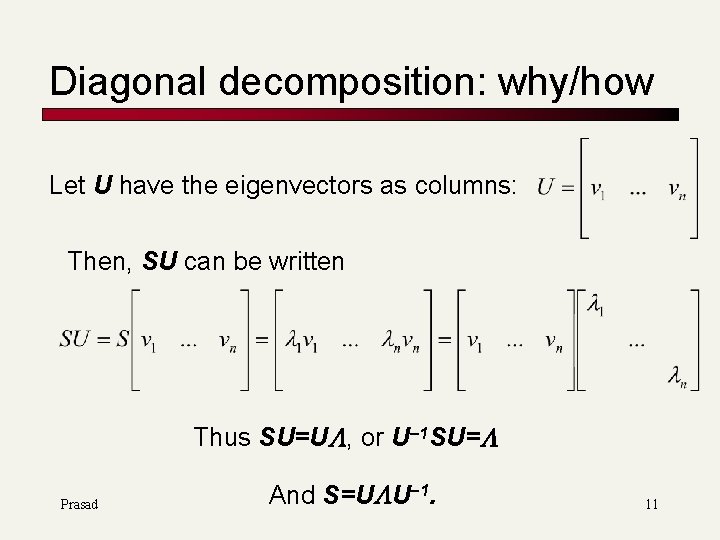
Diagonal decomposition: why/how Let U have the eigenvectors as columns: Then, SU can be written Thus SU=U , or U– 1 SU= Prasad And S=U U– 1. 11
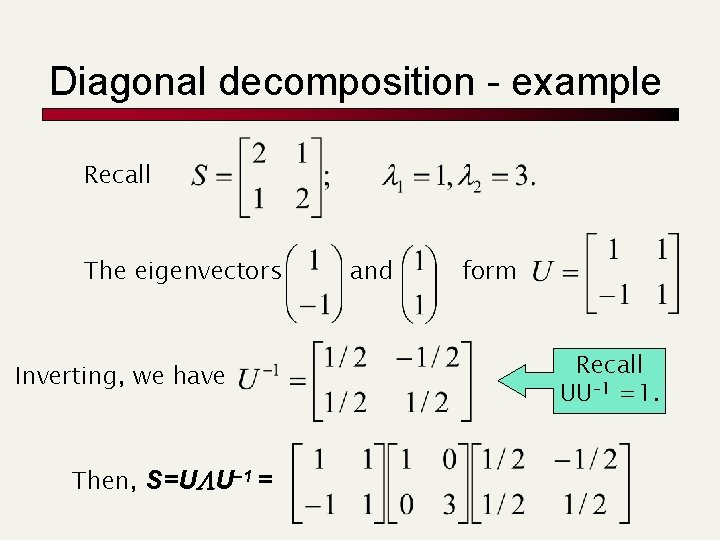
Diagonal decomposition - example Recall The eigenvectors Inverting, we have Then, S=U U– 1 = and form Recall UU– 1 =1.
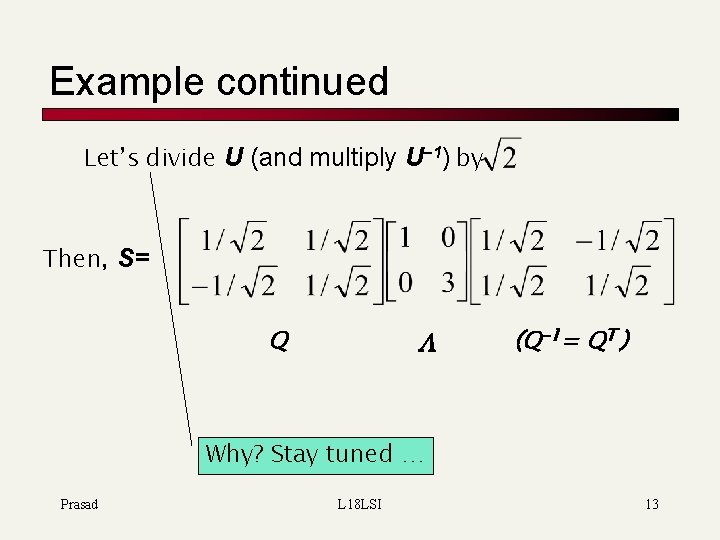
Example continued Let’s divide U (and multiply U– 1) by Then, S= Q (Q-1= QT ) Why? Stay tuned … Prasad L 18 LSI 13
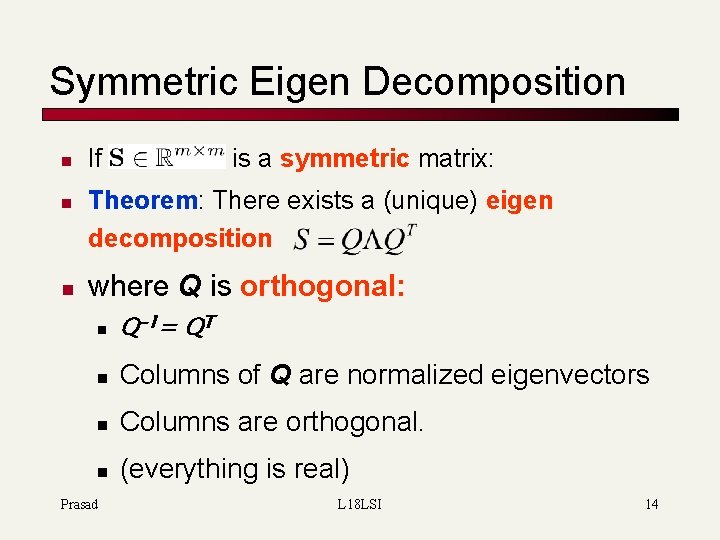
Symmetric Eigen Decomposition n If is a symmetric matrix: Theorem: There exists a (unique) eigen decomposition where Q is orthogonal: n Q-1= QT n Columns of Q are normalized eigenvectors n Columns are orthogonal. n (everything is real) Prasad L 18 LSI 14
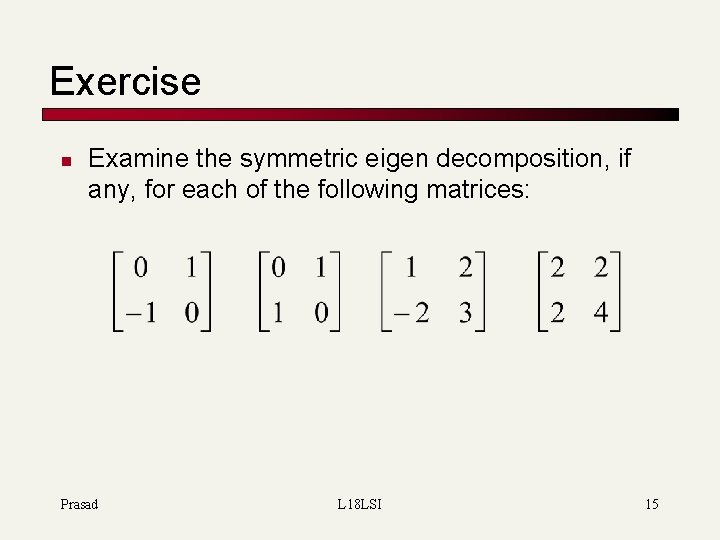
Exercise n Examine the symmetric eigen decomposition, if any, for each of the following matrices: Prasad L 18 LSI 15
Time out! n I came to this class to learn about text retrieval and mining, not have my linear algebra past dredged up again … n n But if you want to dredge, Strang’s Applied Mathematics is a good place to start. What do these matrices have to do with text? Recall M N term-document matrices … But everything so far needs square matrices – so … Prasad L 18 LSI 16
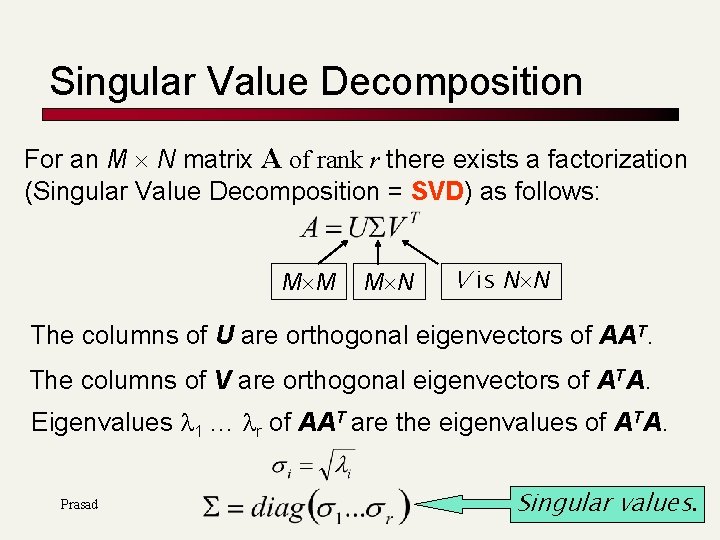
Singular Value Decomposition For an M N matrix A of rank r there exists a factorization (Singular Value Decomposition = SVD) as follows: M M M N V is N N The columns of U are orthogonal eigenvectors of AAT. The columns of V are orthogonal eigenvectors of ATA. Eigenvalues 1 … r of AAT are the eigenvalues of ATA. Prasad Singular values.
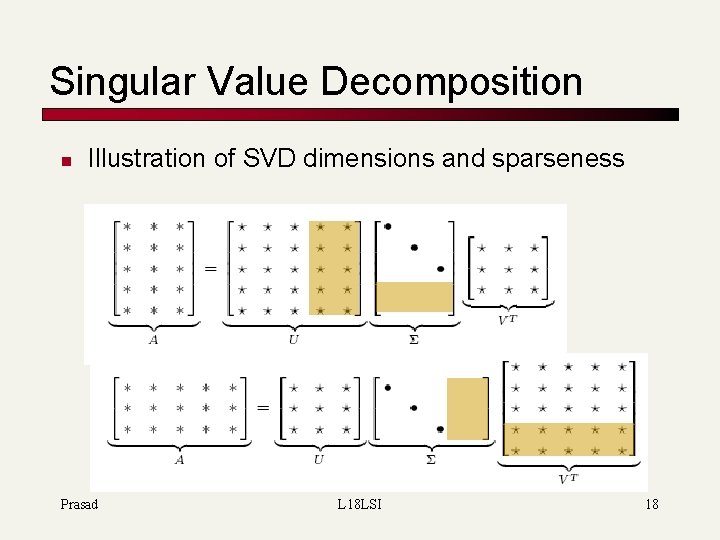
Singular Value Decomposition n Illustration of SVD dimensions and sparseness Prasad L 18 LSI 18
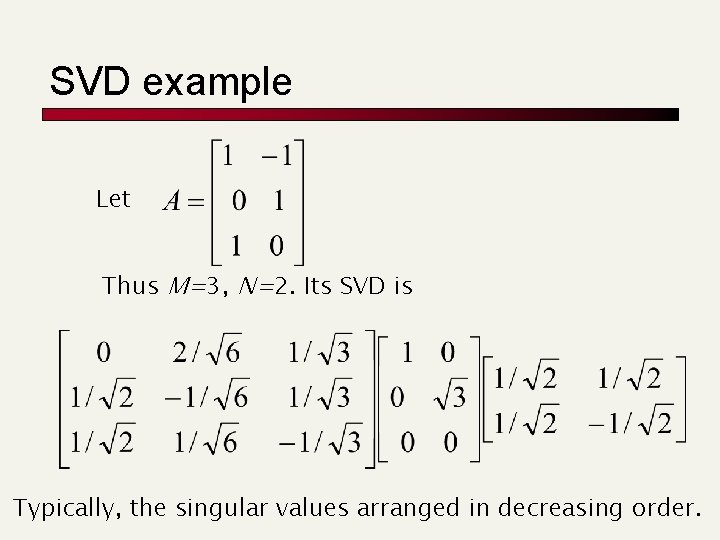
SVD example Let Thus M=3, N=2. Its SVD is Typically, the singular values arranged in decreasing order.
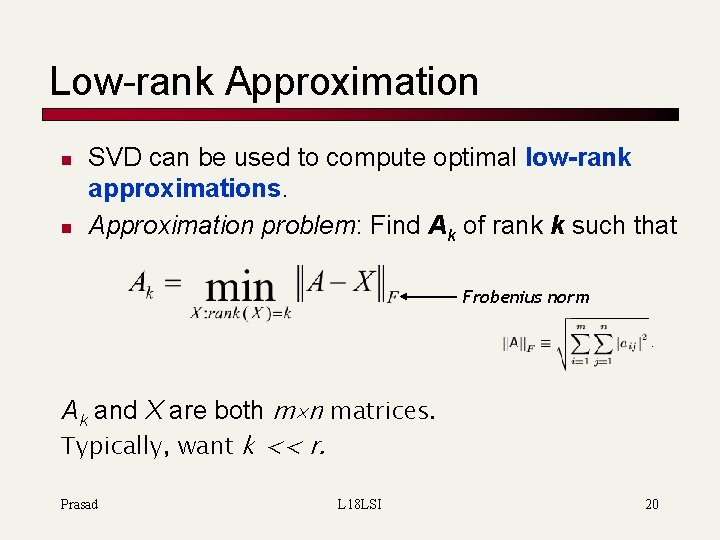
Low-rank Approximation n n SVD can be used to compute optimal low-rank approximations. Approximation problem: Find Ak of rank k such that Frobenius norm Ak and X are both m n matrices. Typically, want k << r. Prasad L 18 LSI 20
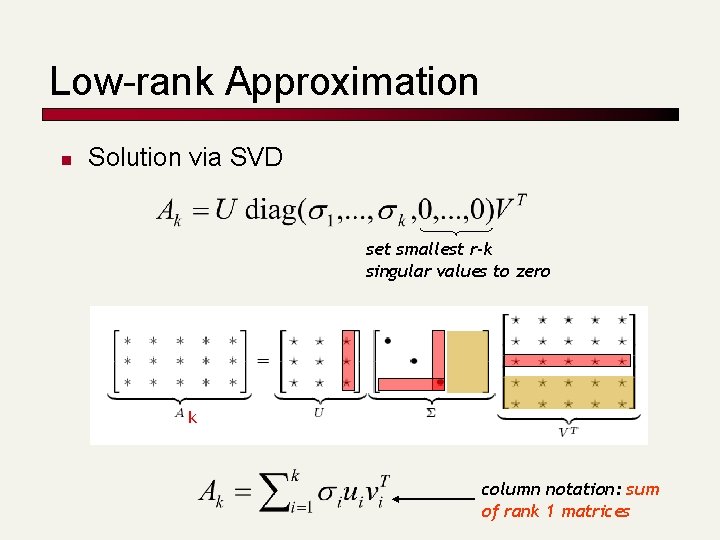
Low-rank Approximation n Solution via SVD set smallest r-k singular values to zero k column notation: sum of rank 1 matrices
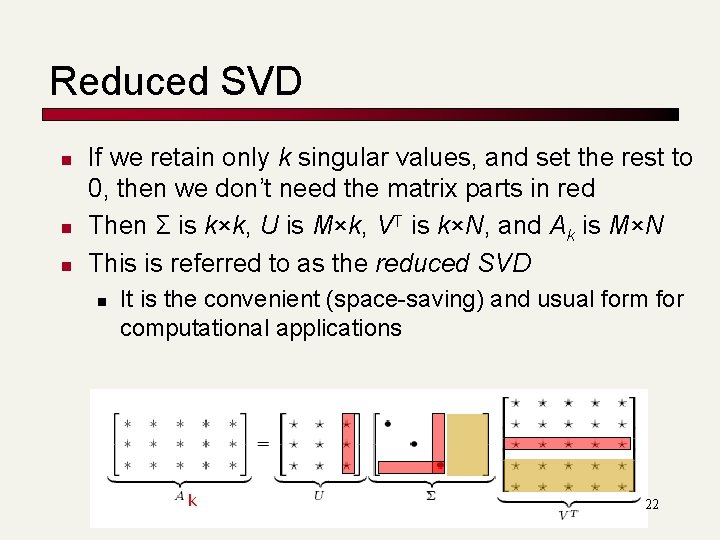
Reduced SVD n n n If we retain only k singular values, and set the rest to 0, then we don’t need the matrix parts in red Then Σ is k×k, U is M×k, VT is k×N, and Ak is M×N This is referred to as the reduced SVD n It is the convenient (space-saving) and usual form for computational applications k 22
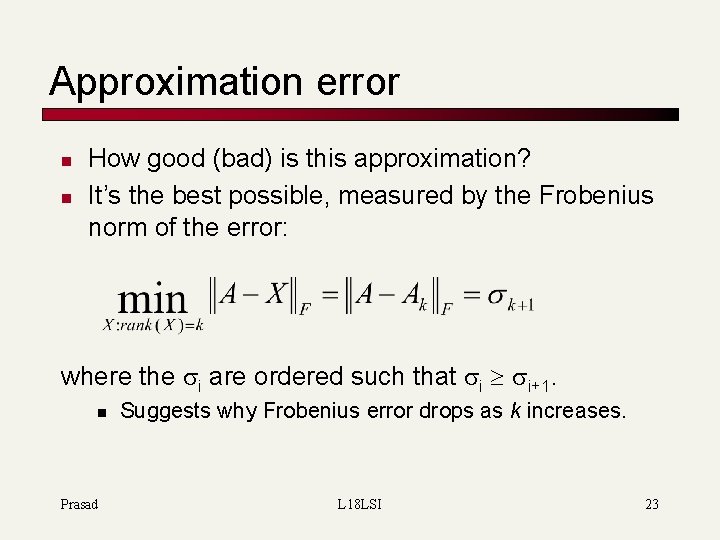
Approximation error n n How good (bad) is this approximation? It’s the best possible, measured by the Frobenius norm of the error: where the i are ordered such that i i+1. n Prasad Suggests why Frobenius error drops as k increases. L 18 LSI 23
SVD Low-rank approximation n n Whereas the term-doc matrix A may have M=50000, N=10 million (and rank close to 50000) We can construct an approximation A 100 with rank 100. n n n Of all rank 100 matrices, it would have the lowest Frobenius error. Great … but why would we? ? Answer: Latent Semantic Indexing C. Eckart, G. Young, The approximation of a matrix by another of lower rank. Psychometrika, 1, 211 -218, 1936.

Latent Semantic Indexing via the SVD Prasad L 18 LSI 25
What it is n n From term-doc matrix A, we compute the approximation Ak. There is a row for each term and a column for each doc in Ak Thus docs live in a space of k<<r dimensions n These dimensions are not the original axes But why? Prasad L 18 LSI 26
Vector Space Model: Pros n n Automatic selection of index terms Partial matching of queries and documents (dealing with the case where no document contains all search terms) n Ranking according to similarity score (dealing with large result sets) n Term weighting schemes (improves retrieval performance) n Various extensions n n n Document clustering Relevance feedback (modifying query vector) Geometric foundation Prasad L 18 LSI 27
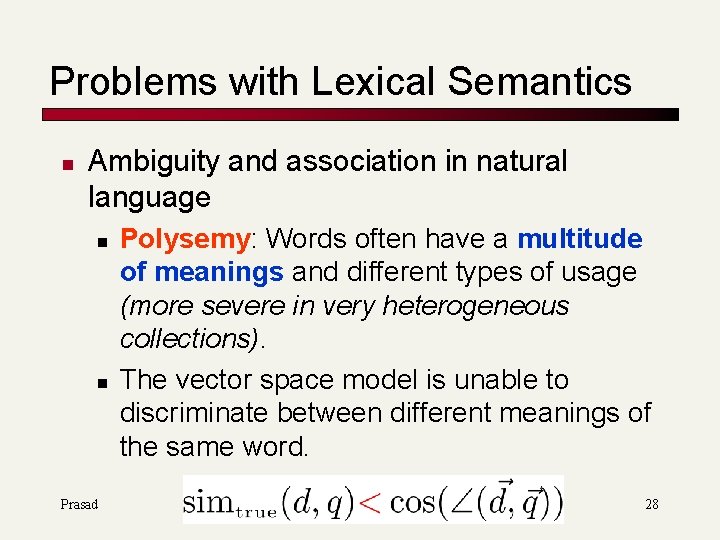
Problems with Lexical Semantics n Ambiguity and association in natural language n n Prasad Polysemy: Words often have a multitude of meanings and different types of usage (more severe in very heterogeneous collections). The vector space model is unable to discriminate between different meanings of the same word. 28
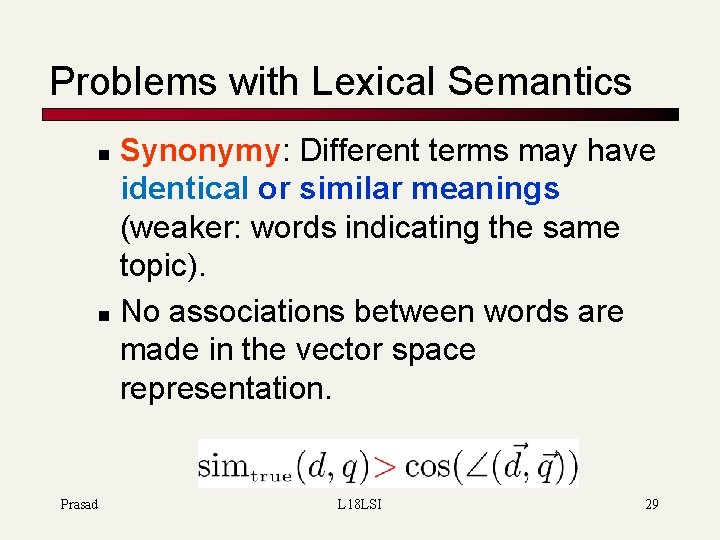
Problems with Lexical Semantics Synonymy: Different terms may have identical or similar meanings (weaker: words indicating the same topic). n No associations between words are made in the vector space representation. n Prasad L 18 LSI 29
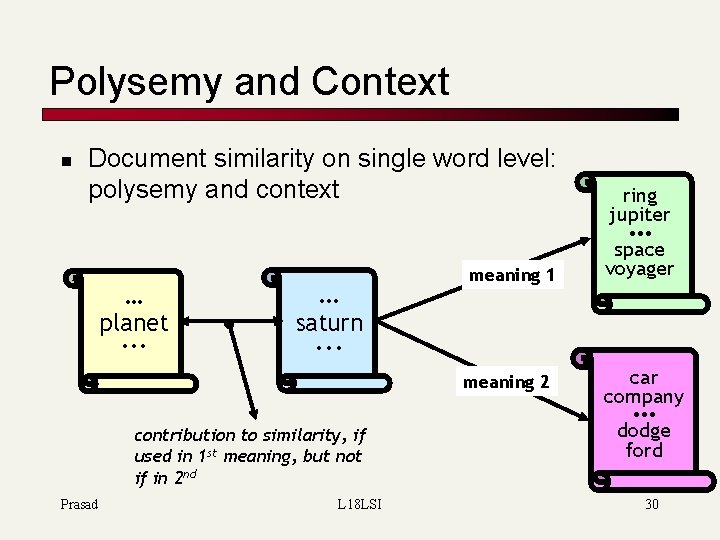
Polysemy and Context n Document similarity on single word level: polysemy and context ring jupiter • • • … planet. . . … meaning 1 space voyager saturn . . . meaning 2 car company • • • contribution to similarity, if used in 1 st meaning, but not if in 2 nd Prasad L 18 LSI dodge ford 30
Latent Semantic Indexing (LSI) n n Perform a low-rank approximation of document-term matrix (typical rank 100 -300) General idea n n n Prasad Map documents (and terms) to a low-dimensional representation. Design a mapping such that the low-dimensional space reflects semantic associations (latent semantic space). Compute document similarity based on the inner product in this latent semantic space L 18 LSI 31
Goals of LSI n n Similar terms map to similar location in low dimensional space Noise reduction by dimension reduction Prasad L 18 LSI 32
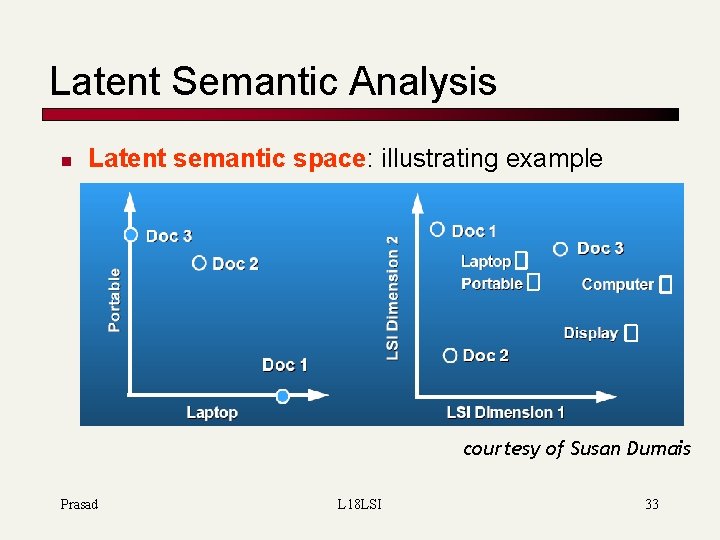
Latent Semantic Analysis n Latent semantic space: illustrating example courtesy of Susan Dumais Prasad L 18 LSI 33
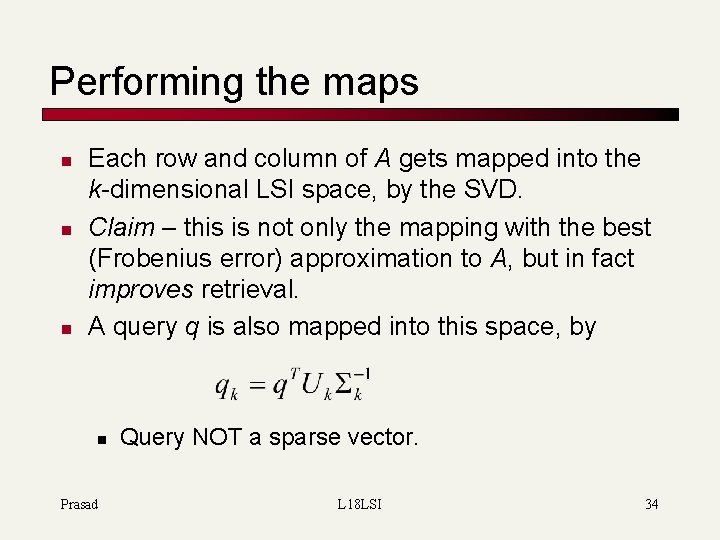
Performing the maps n n n Each row and column of A gets mapped into the k-dimensional LSI space, by the SVD. Claim – this is not only the mapping with the best (Frobenius error) approximation to A, but in fact improves retrieval. A query q is also mapped into this space, by n Prasad Query NOT a sparse vector. L 18 LSI 34
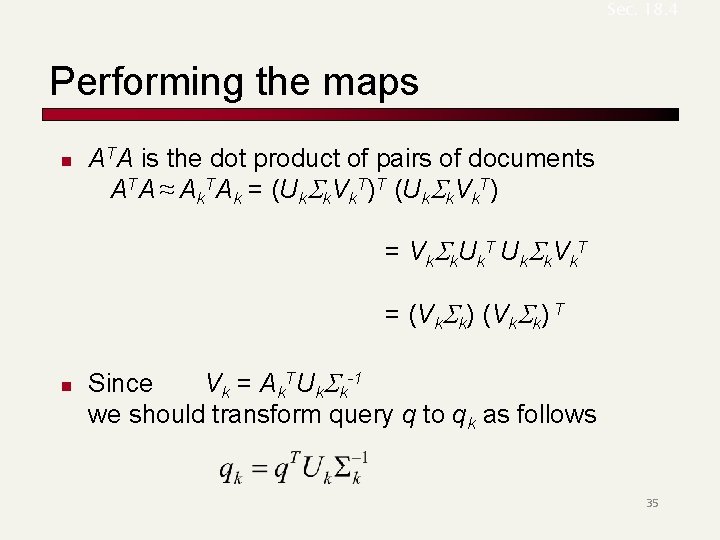
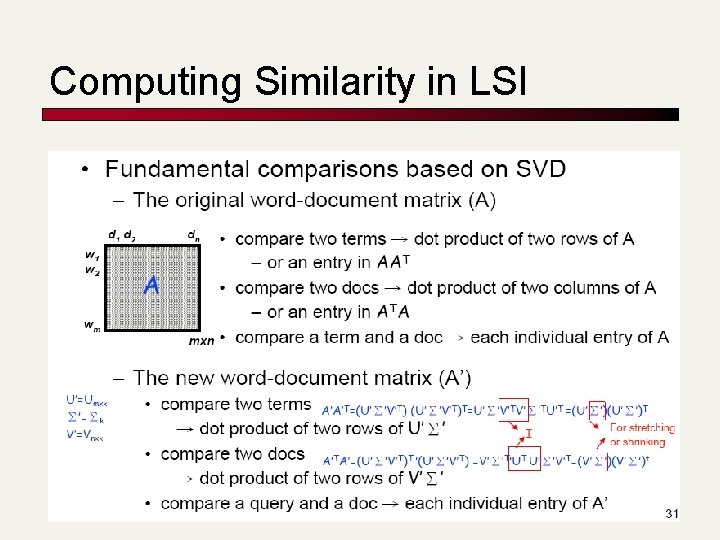
Sec. 18. 4 Performing the maps n ATA is the dot product of pairs of documents ATA ≈ Ak. TAk = (Uk. Sk. Vk. T)T (Uk. Sk. Vk. T) = Vk. Sk. Uk. T Uk. Sk. Vk. T = (Vk. Sk) T n Since Vk = Ak. TUk. Sk-1 we should transform query q to qk as follows 35
Empirical evidence n n Experiments on TREC 1/2/3 – Dumais Lanczos SVD code (available on netlib) due to Berry used in these expts n n Dimensions – various values 250 -350 reported. Reducing k improves recall. n n Running times of ~ one day on tens of thousands of docs [still an obstacle to use] (Under 200 reported unsatisfactory) Generally expect recall to improve – what about precision? L 18 LSI 36
Empirical evidence n Precision at or above median TREC precision n Top scorer on almost 20% of TREC topics Slightly better on average than straight vector spaces Effect of dimensionality: Dimensions Precision Prasad L 18 LSI 250 300 346 0. 367 0. 371 0. 374 37
Failure modes n Negated phrases n n Boolean queries n n TREC topics sometimes negate certain query/terms phrases – automatic conversion of topics to As usual, freetext/vector space syntax of LSI queries precludes (say) “Find any doc having to do with the following 5 companies” See Dumais for more. 38
But why is this clustering? n n n We’ve talked about docs, queries, retrieval and precision here. What does this have to do with clustering? Intuition: Dimension reduction through LSI brings together “related” axes in the vector space. Prasad L 18 LSI 39
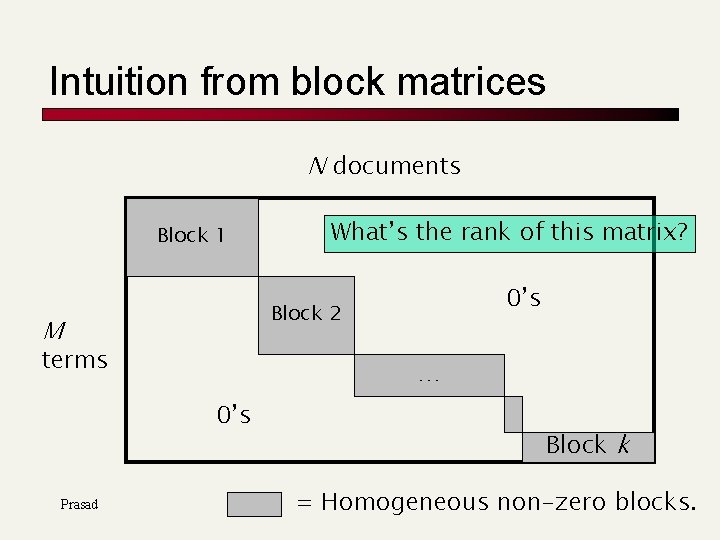
Intuition from block matrices N documents Block 1 0’s Block 2 M terms … 0’s Prasad What’s the rank of this matrix? Block k = Homogeneous non-zero blocks.
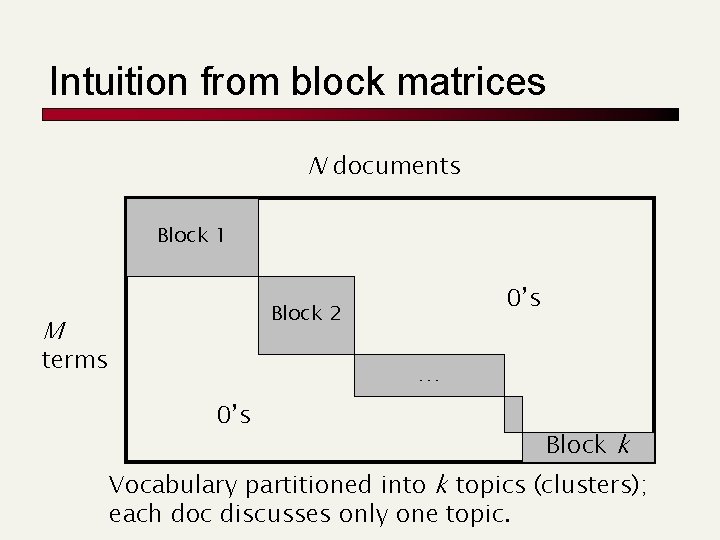
Intuition from block matrices N documents Block 1 0’s Block 2 M terms … 0’s Block k Vocabulary partitioned into k topics (clusters); each doc discusses only one topic.
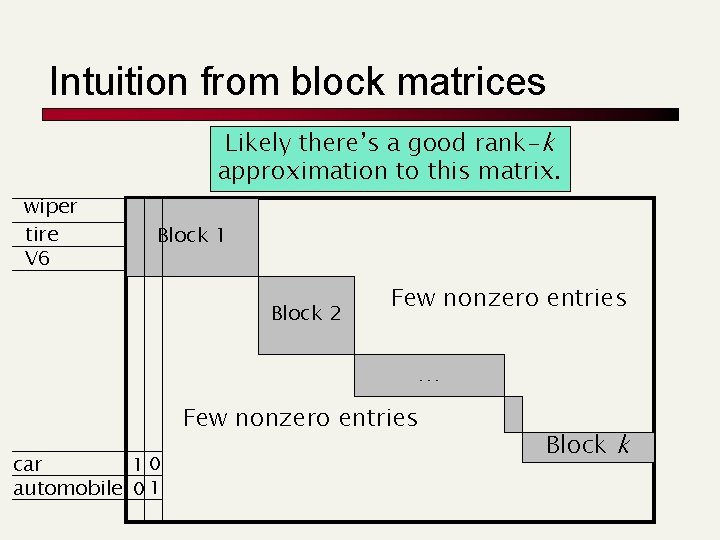
Intuition from block matrices Likely there’s a good rank-k approximation to this matrix. wiper tire V 6 Block 1 Block 2 Few nonzero entries … Few nonzero entries car 10 automobile 0 1 Block k
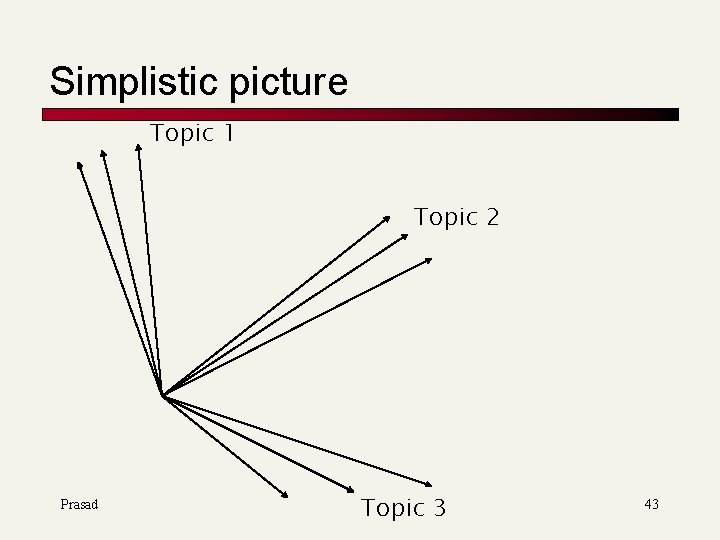
Simplistic picture Topic 1 Topic 2 Prasad Topic 3 43
Some wild extrapolation n n The “dimensionality” of a corpus is the number of distinct topics represented in it. More mathematical wild extrapolation: n Prasad if A has a rank k approximation of low Frobenius error, then there are no more than k distinct topics in the corpus. L 18 LSI 44
LSI has many other applications n In many settings in pattern recognition and retrieval, we have a feature-object matrix. n n n For text, the terms are features and the docs are objects. Could be opinions and users … This matrix may be redundant in dimensionality. Can work with low-rank approximation. If entries are missing (e. g. , users’ opinions), can recover if dimensionality is low. Powerful general analytical technique n Prasad Close, principled analog to clustering methods. 45

Hinrich Schütze and Christina Lioma Latent Semantic Indexing 46
Overview ❶ Latent semantic indexing ❷ Dimensionality reduction ❸ LSI in information retrieval 47
Outline ❶ Latent semantic indexing ❷ Dimensionality reduction ❸ LSI in information retrieval 48
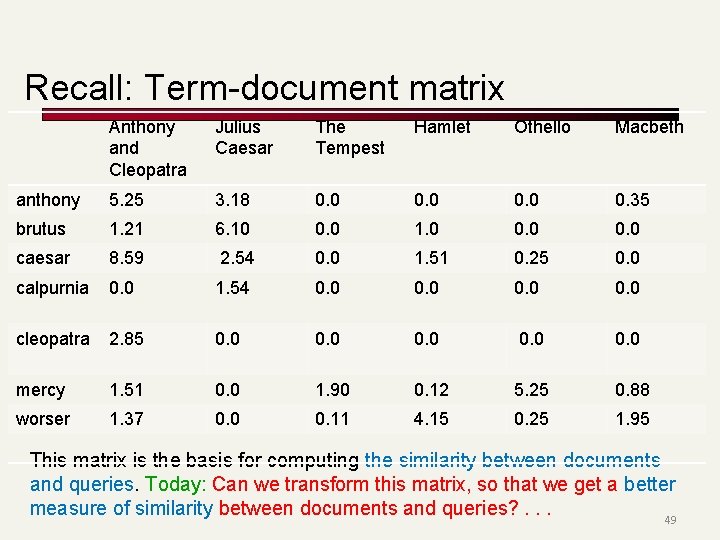
Recall: Term-document matrix Anthony and Cleopatra Julius Caesar The Tempest Hamlet Othello Macbeth anthony 5. 25 3. 18 0. 0 0. 35 brutus 1. 21 6. 10 0. 0 1. 0 0. 0 caesar 8. 59 2. 54 0. 0 1. 51 0. 25 0. 0 calpurnia 0. 0 1. 54 0. 0 cleopatra 2. 85 0. 0 0. 0 mercy 1. 51 0. 0 1. 90 0. 12 5. 25 0. 88 worser 1. 37 0. 0 0. 11 4. 15 0. 25 1. 95 This matrix is the basis for computing the similarity between documents and queries. Today: Can we transform this matrix, so that we get a better measure of similarity between documents and queries? . . . 49
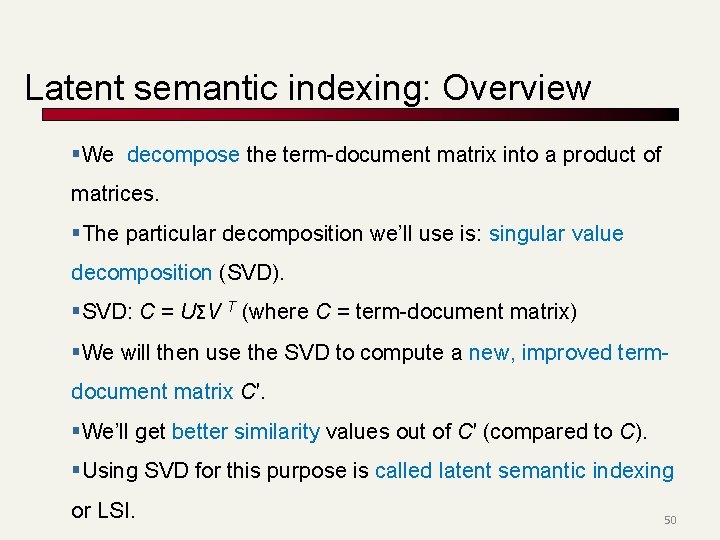
Latent semantic indexing: Overview §We decompose the term-document matrix into a product of matrices. §The particular decomposition we’ll use is: singular value decomposition (SVD). §SVD: C = UΣV T (where C = term-document matrix) §We will then use the SVD to compute a new, improved termdocument matrix C′. §We’ll get better similarity values out of C′ (compared to C). §Using SVD for this purpose is called latent semantic indexing or LSI. 50
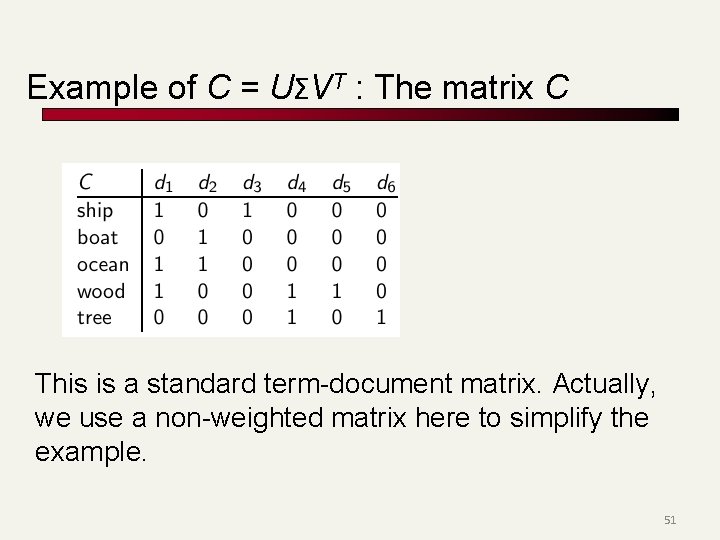
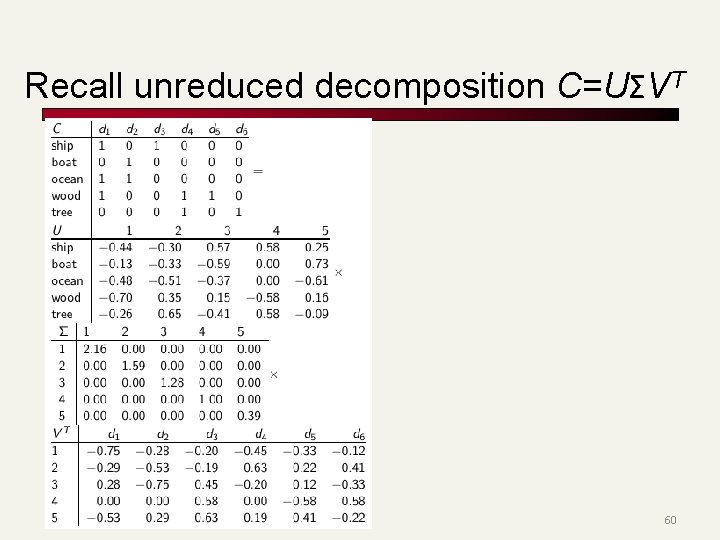
Example of C = UΣVT : The matrix C This is a standard term-document matrix. Actually, we use a non-weighted matrix here to simplify the example. 51
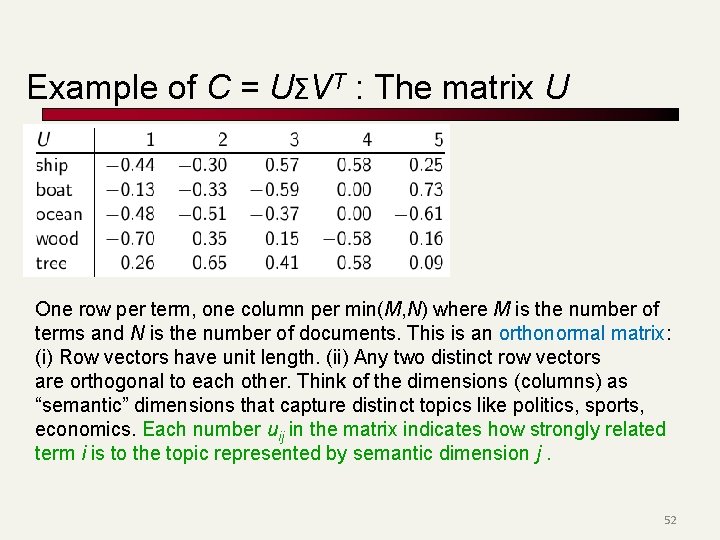
Example of C = UΣVT : The matrix U One row per term, one column per min(M, N) where M is the number of terms and N is the number of documents. This is an orthonormal matrix: (i) Row vectors have unit length. (ii) Any two distinct row vectors are orthogonal to each other. Think of the dimensions (columns) as “semantic” dimensions that capture distinct topics like politics, sports, economics. Each number uij in the matrix indicates how strongly related term i is to the topic represented by semantic dimension j. 52
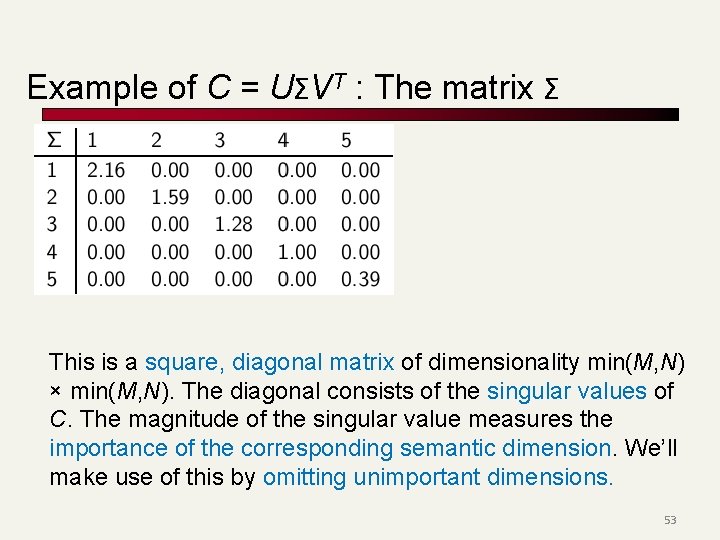
Example of C = UΣVT : The matrix Σ This is a square, diagonal matrix of dimensionality min(M, N) × min(M, N). The diagonal consists of the singular values of C. The magnitude of the singular value measures the importance of the corresponding semantic dimension. We’ll make use of this by omitting unimportant dimensions. 53
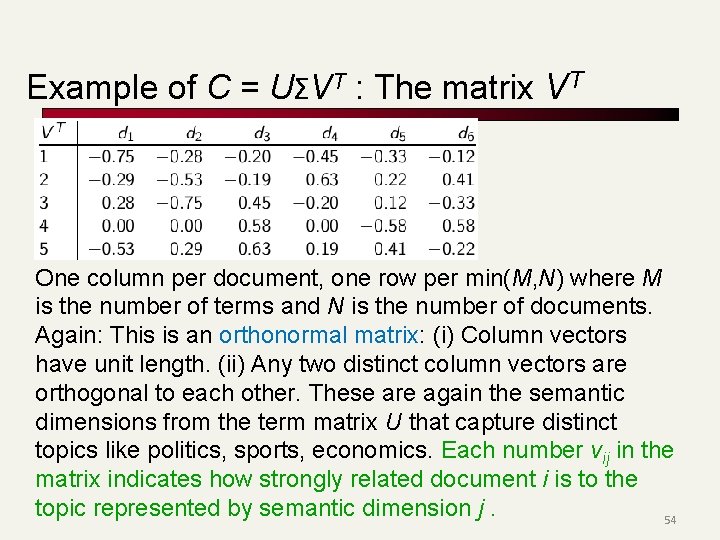
Example of C = UΣVT : The matrix VT One column per document, one row per min(M, N) where M is the number of terms and N is the number of documents. Again: This is an orthonormal matrix: (i) Column vectors have unit length. (ii) Any two distinct column vectors are orthogonal to each other. These are again the semantic dimensions from the term matrix U that capture distinct topics like politics, sports, economics. Each number vij in the matrix indicates how strongly related document i is to the topic represented by semantic dimension j. 54
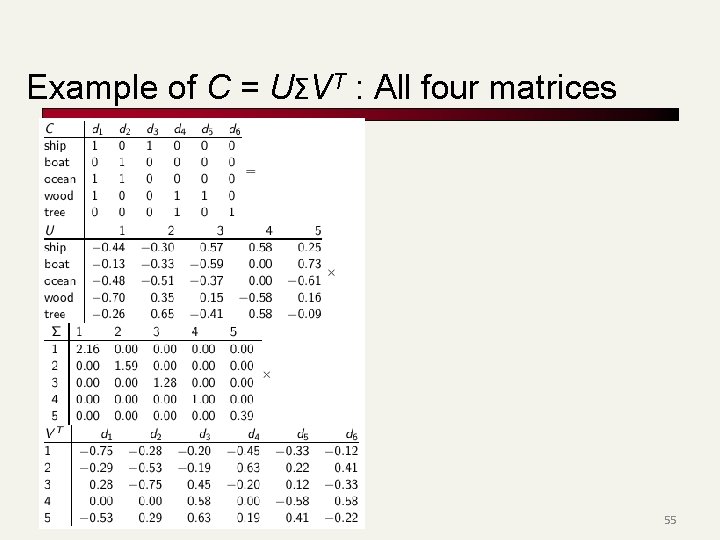
Example of C = UΣVT : All four matrices 55 55
LSI: Summary §We’ve decomposed the term-document matrix C into a product of three matrices. §The term matrix U – consists of one (row) vector for each term §The document matrix VT – consists of one (column) vector for each document §The singular value matrix Σ – diagonal matrix with singular values, reflecting importance of each dimension §Next: Why are we doing this? 56 56
Outline ❶ Latent semantic indexing ❷ Dimensionality reduction ❸ LSI in information retrieval 57
How we use the SVD in LSI §Key property: Each singular value tells us how important its dimension is. §By setting less important dimensions to zero, we keep the important information, but get rid of the “details”. §These details may §be noise – in that case, reduced LSI is a better representation because it is less noisy. §make things dissimilar that should be similar – again reduced LSI is a better representation because it represents similarity better. 58
How we use the SVD in LSI §Analogy for “fewer details is better” §Image of a bright red flower §Image of a black and white flower §Omitting color makes is easier to see similarity 59
Recall unreduced decomposition C=UΣVT 60 60
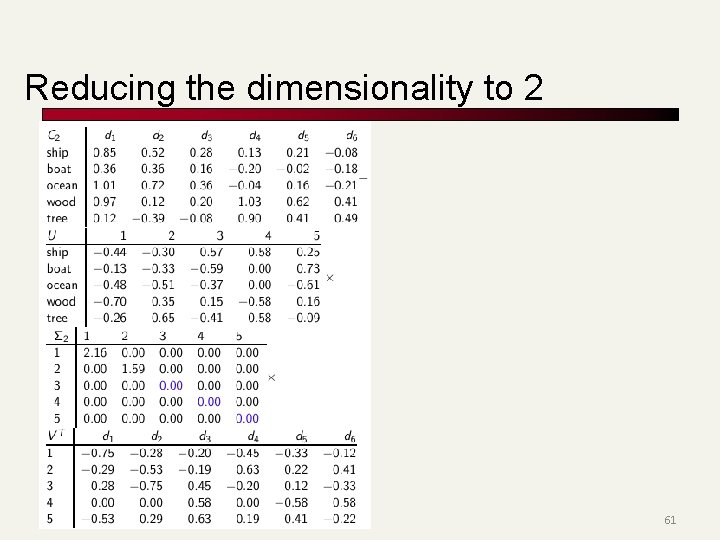
Reducing the dimensionality to 2 61 61
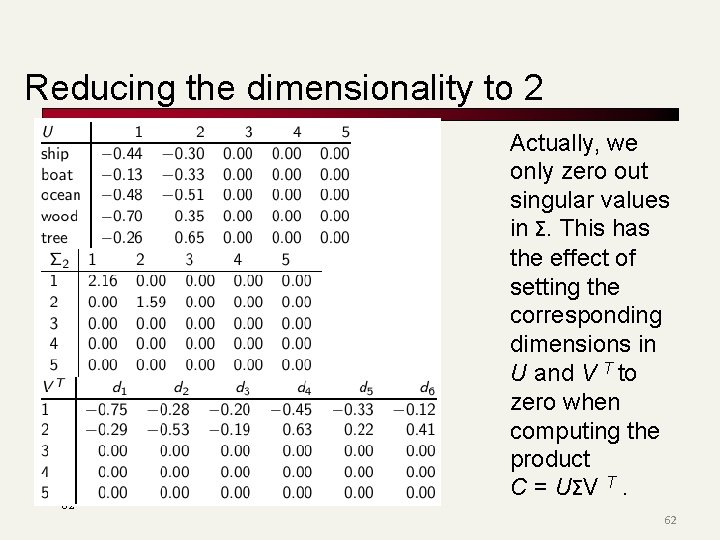
Reducing the dimensionality to 2 62 Actually, we only zero out singular values in Σ. This has the effect of setting the corresponding dimensions in U and V T to zero when computing the product C = UΣV T. 62
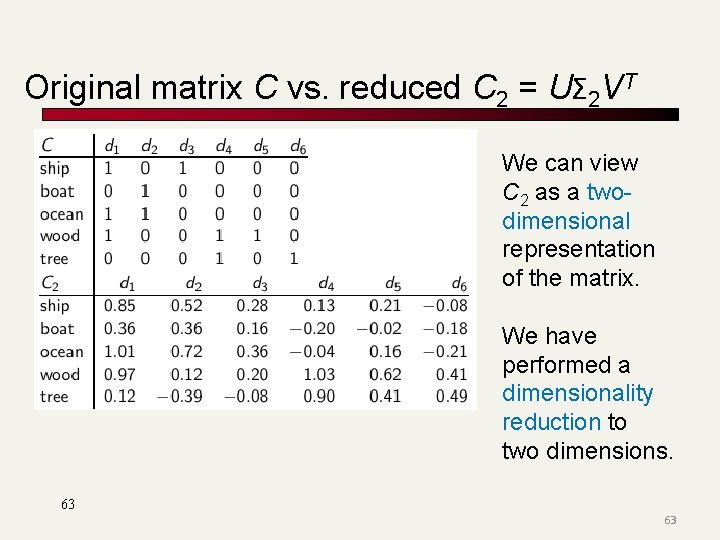
Original matrix C vs. reduced C 2 = UΣ 2 VT We can view C 2 as a twodimensional representation of the matrix. We have performed a dimensionality reduction to two dimensions. 63 63
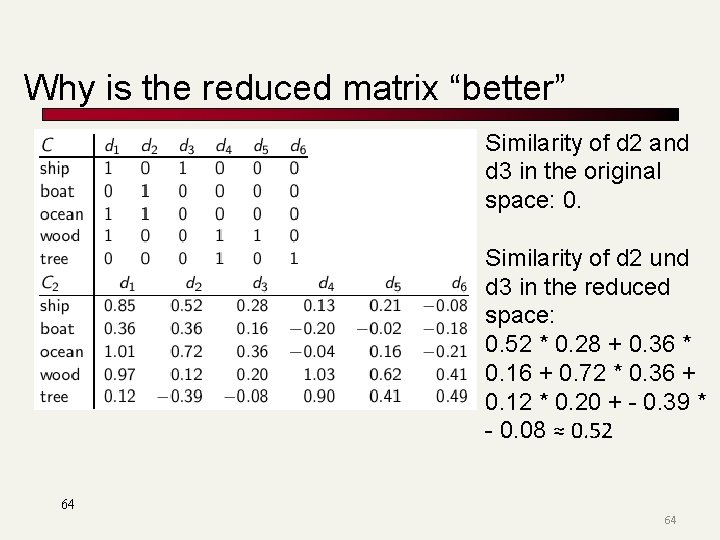
Why is the reduced matrix “better” Similarity of d 2 and d 3 in the original space: 0. Similarity of d 2 und d 3 in the reduced space: 0. 52 * 0. 28 + 0. 36 * 0. 16 + 0. 72 * 0. 36 + 0. 12 * 0. 20 + - 0. 39 * - 0. 08 ≈ 0. 52 64 64
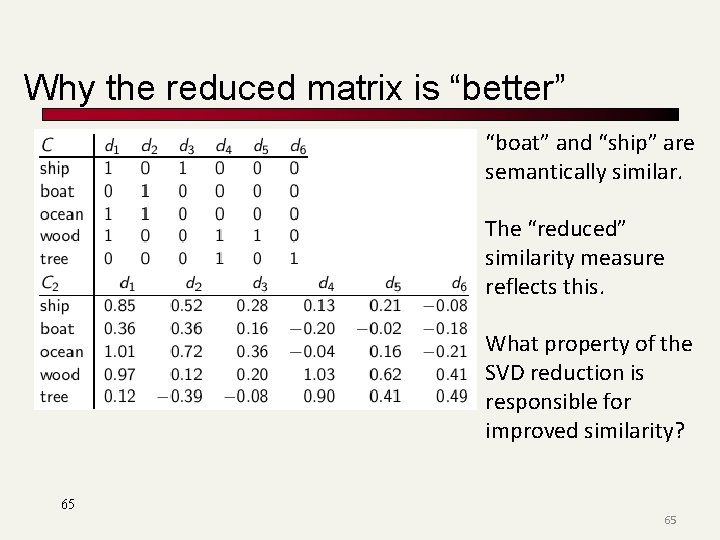
Why the reduced matrix is “better” “boat” and “ship” are semantically similar. The “reduced” similarity measure reflects this. What property of the SVD reduction is responsible for improved similarity? 65 65
Outline ❶ Latent semantic indexing ❷ Dimensionality reduction ❸ LSI in information retrieval 66
Why we use LSI in information retrieval §LSI takes documents that are semantically similar (= talk about the same topics), . . . §. . . but are not similar in the vector space (because they use different words). . . §. . . and re-represent them in a reduced vector space. . §. . . in which they have higher similarity. §Thus, LSI addresses the problems of synonymy and semantic relatedness. §Standard vector space: Synonyms contribute nothing to document similarity. §Desired effect of LSI: Synonyms contribute strongly to document similarity. 67
How LSI addresses synonymy and semantic relatedness §The dimensionality reduction forces us to omit “details”. §We have to map different words (= different dimensions of the full space) to the same dimension in the reduced space. §The “cost” of mapping synonyms to the same dimension is much less than the cost of collapsing unrelated words. §SVD selects the “least costly” mapping (see below). §Thus, it will map synonyms to the same dimension. §But, it will avoid doing that for unrelated words. 68 68
LSI: Comparison to other approaches §Recap: Relevance feedback and query expansion are used to increase recall in IR – if query and documents have (in the extreme case) no terms in common. §LSI increases recall and can hurt precision. §Thus, it addresses the same problems as (pseudo) relevance feedback and query expansion. . . §. . . and it has the same problems. 69 69
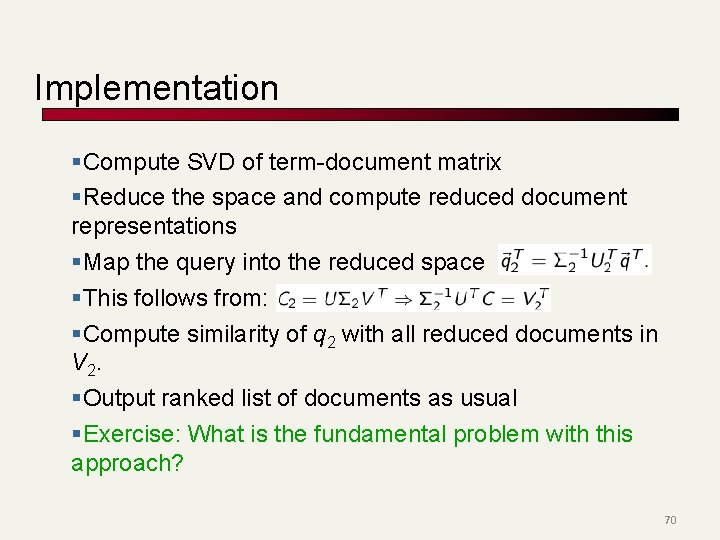
Implementation §Compute SVD of term-document matrix §Reduce the space and compute reduced document representations §Map the query into the reduced space §This follows from: §Compute similarity of q 2 with all reduced documents in V 2. §Output ranked list of documents as usual §Exercise: What is the fundamental problem with this approach? 70
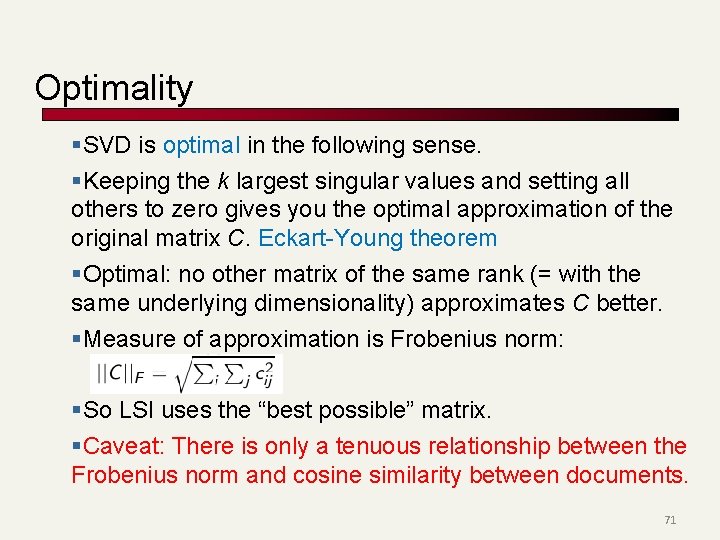
Optimality §SVD is optimal in the following sense. §Keeping the k largest singular values and setting all others to zero gives you the optimal approximation of the original matrix C. Eckart-Young theorem §Optimal: no other matrix of the same rank (= with the same underlying dimensionality) approximates C better. §Measure of approximation is Frobenius norm: §So LSI uses the “best possible” matrix. §Caveat: There is only a tenuous relationship between the Frobenius norm and cosine similarity between documents. 71
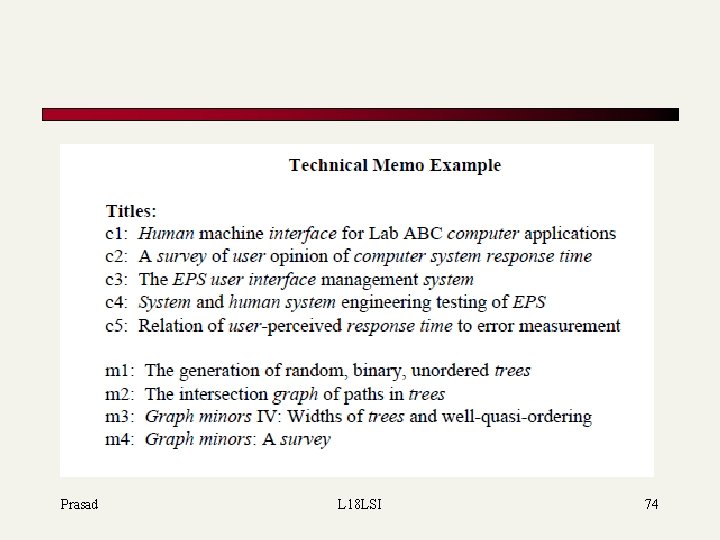
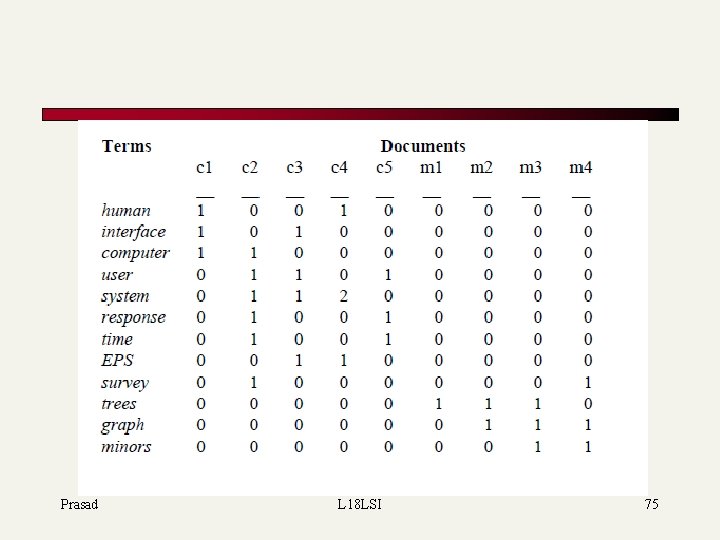
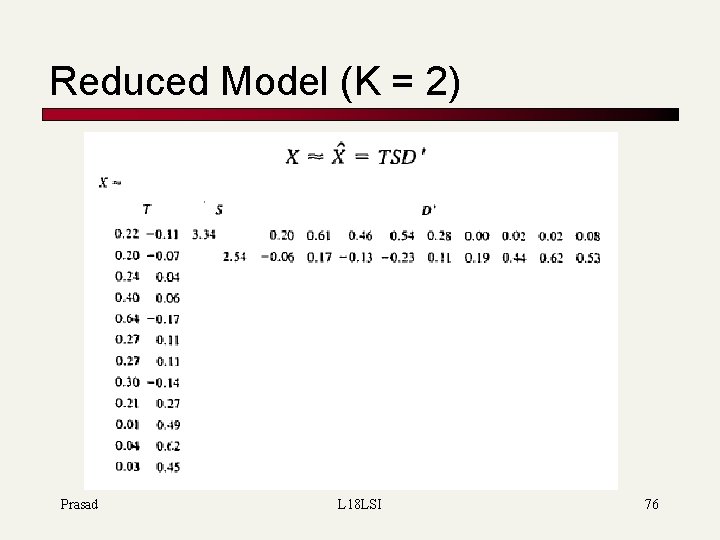
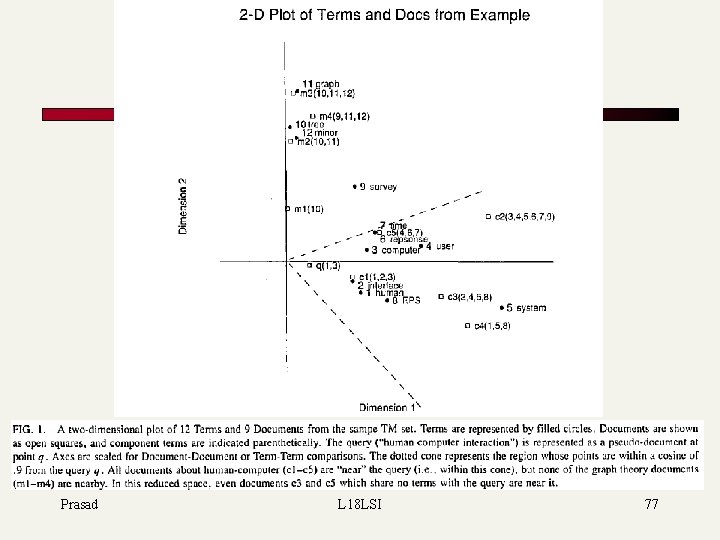
Example from Dumais et al Prasad L 18 LSI 72
Latent Semantic Indexing (LSI)
Prasad L 18 LSI 74
Prasad L 18 LSI 75
Reduced Model (K = 2) Prasad L 18 LSI 76
Prasad L 18 LSI 77
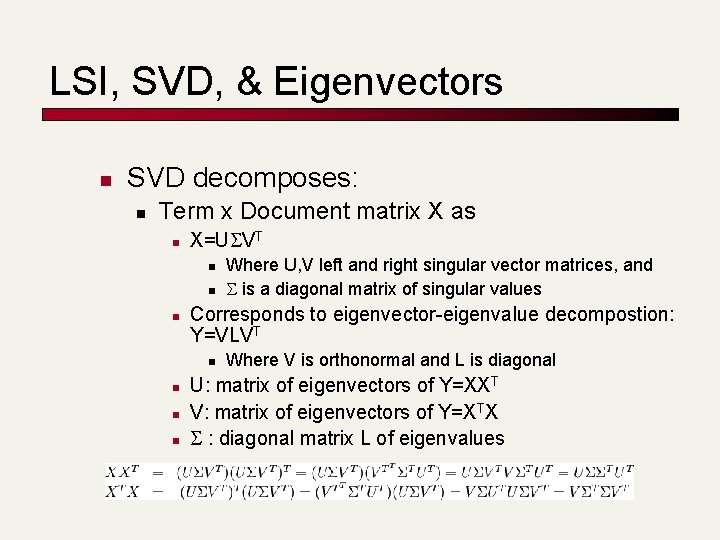
LSI, SVD, & Eigenvectors n SVD decomposes: n Term x Document matrix X as n X=U VT n n n Corresponds to eigenvector-eigenvalue decompostion: Y=VLVT n n Where U, V left and right singular vector matrices, and is a diagonal matrix of singular values Where V is orthonormal and L is diagonal U: matrix of eigenvectors of Y=XXT V: matrix of eigenvectors of Y=XTX : diagonal matrix L of eigenvalues
Computing Similarity in LSI
- Slides: 79