
Latent Class Analysis in Mplus Version 3 Karen
- Slides: 24
Latent Class Analysis in Mplus Version 3 Karen Nylund Social Research Methods Graduate School of Education & Information Studies knylund@ucla. edu
Overview of Session n General description of Latent Class Analysis (LCA) within a hypothetical example n Two examples of LCA analysis using Mplus Version 3 – Anti-Social Behavior – Diabetes Diagnosis n Extensions of the LCA models n Resources and References 2
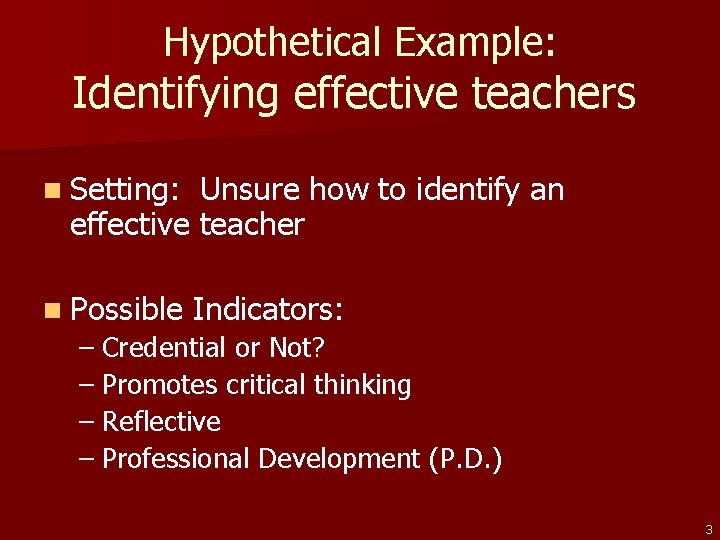
Hypothetical Example: Identifying effective teachers n Setting: Unsure how to identify an effective teacher n Possible Indicators: – Credential or Not? – Promotes critical thinking – Reflective – Professional Development (P. D. ) 3
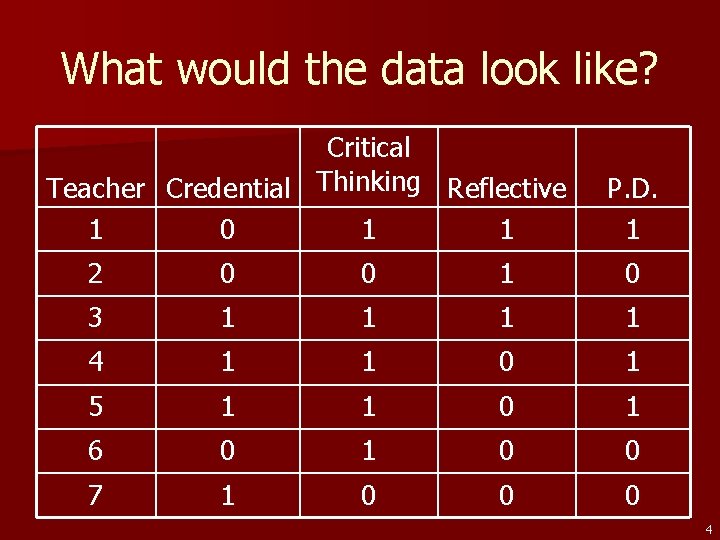
What would the data look like? Critical Teacher Credential Thinking Reflective 1 0 1 1 P. D. 1 2 0 0 1 0 3 1 1 4 1 1 0 1 5 1 1 0 1 6 0 1 0 0 7 1 0 0 0 4
Possible research questions: n Are there specific characteristics that identify an effective teacher? n Given known ideas of what an effective teacher is, what characteristics are important indicators? n Are there background characteristics of the teachers that help classify them as effective? 5
What could LCA tell us? n To find groups of teacher that are similar based on observed characteristics – Identify and accurately enumerate the number of groups of teachers – Identify characteristics that indicate groups well – Estimate the prevalence of the groups – Classify teachers into classes 6
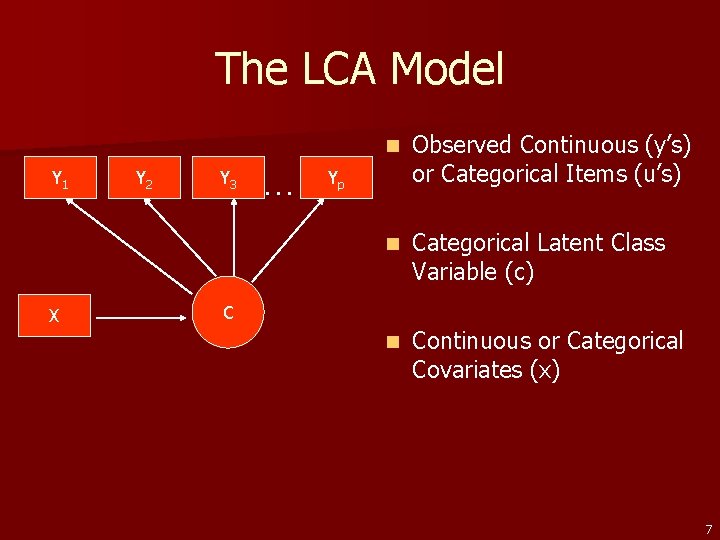
The LCA Model Y 1 X Y 2 Y 3 . . . n Observed Continuous (y’s) or Categorical Items (u’s) n Categorical Latent Class Variable (c) n Continuous or Categorical Covariates (x) Yp C 7
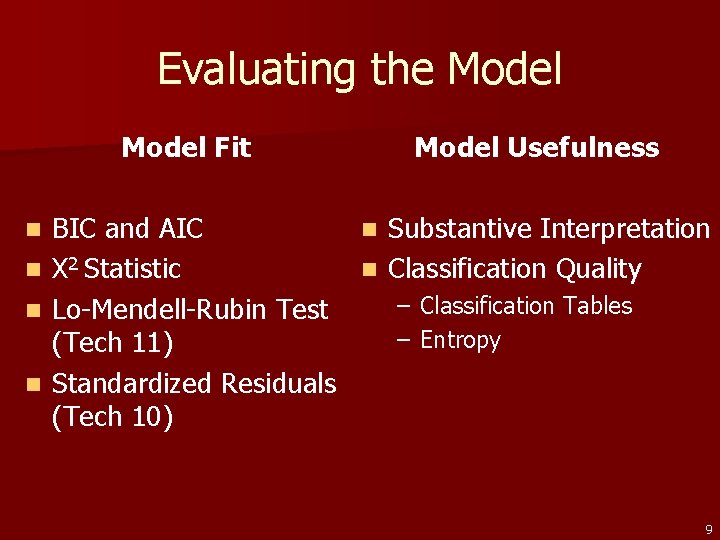
How is this modeling process conducted? n Run through models imposing different numbers of classes n Estimation via the EM algorithm – Start with random split of people into classes. – Reclassify based on a improvement criterion – Reclassify until the best classification of people is found. 8
Evaluating the Model Fit Model Usefulness BIC and AIC n Substantive Interpretation n X 2 Statistic n Classification Quality – Classification Tables n Lo-Mendell-Rubin Test – Entropy (Tech 11) n Standardized Residuals (Tech 10) n 9
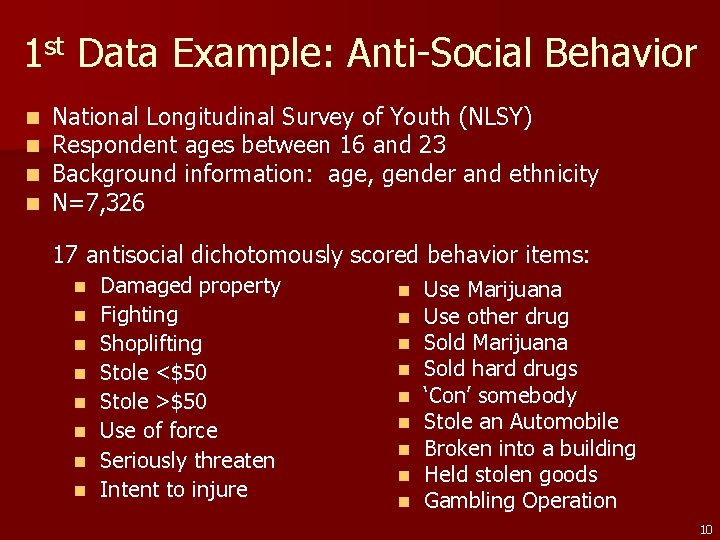
1 st Data Example: Anti-Social Behavior n n National Longitudinal Survey of Youth (NLSY) Respondent ages between 16 and 23 Background information: age, gender and ethnicity N=7, 326 17 antisocial dichotomously scored behavior items: n n n n Damaged property Fighting Shoplifting Stole <$50 Stole >$50 Use of force Seriously threaten Intent to injure n n n n n Use Marijuana Use other drug Sold Marijuana Sold hard drugs ‘Con’ somebody Stole an Automobile Broken into a building Held stolen goods Gambling Operation 10
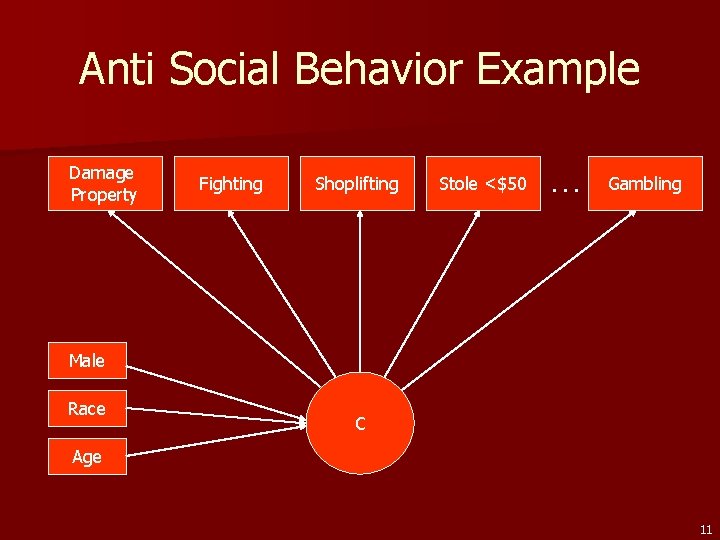
Anti Social Behavior Example Damage Property Fighting Shoplifting Stole <$50 . . . Gambling Male Race C Age 11
Antisocial behavior Example in Mplus Version 3 12
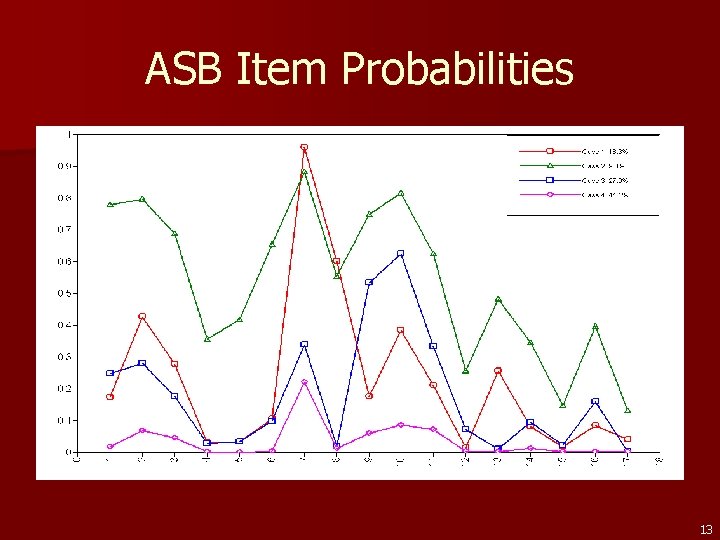
ASB Item Probabilities 13
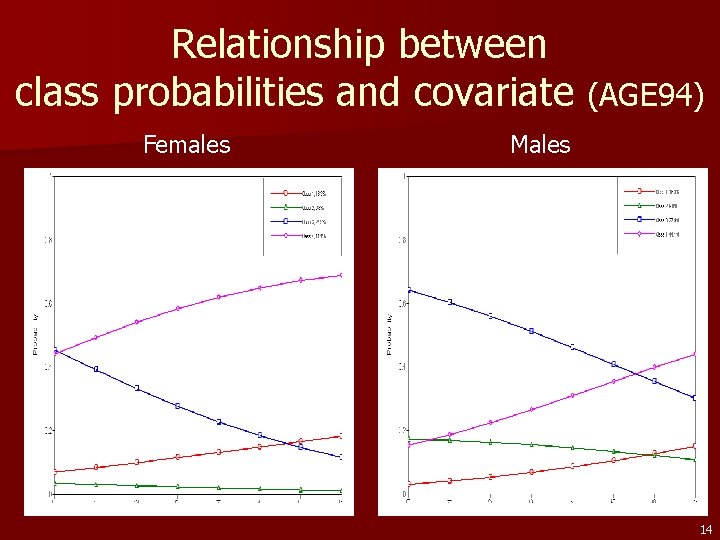
Relationship between class probabilities and covariate (AGE 94) Females Males 14
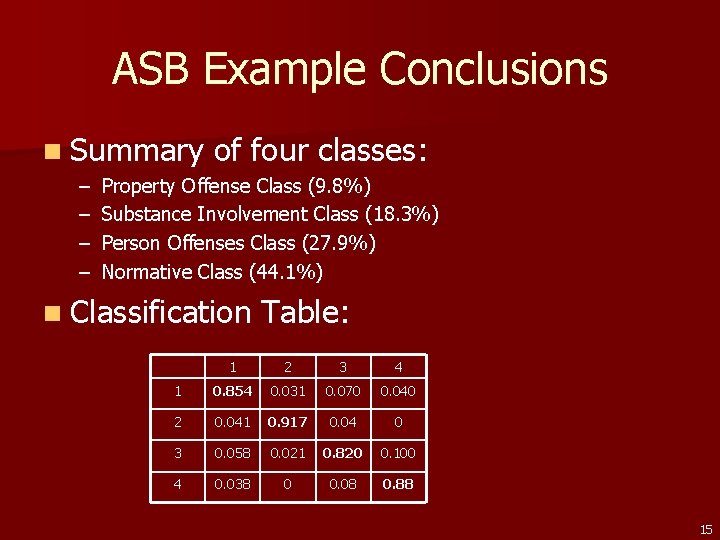
ASB Example Conclusions n Summary of four classes: – – Property Offense Class (9. 8%) Substance Involvement Class (18. 3%) Person Offenses Class (27. 9%) Normative Class (44. 1%) n Classification Table: 1 2 3 4 1 0. 854 0. 031 0. 070 0. 040 2 0. 041 0. 917 0. 04 0 3 0. 058 0. 021 0. 820 0. 100 4 0. 038 0 0. 08 0. 88 15
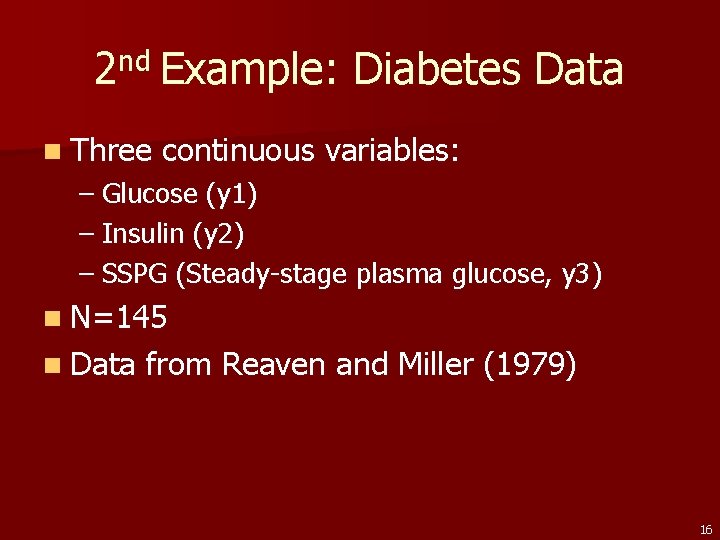
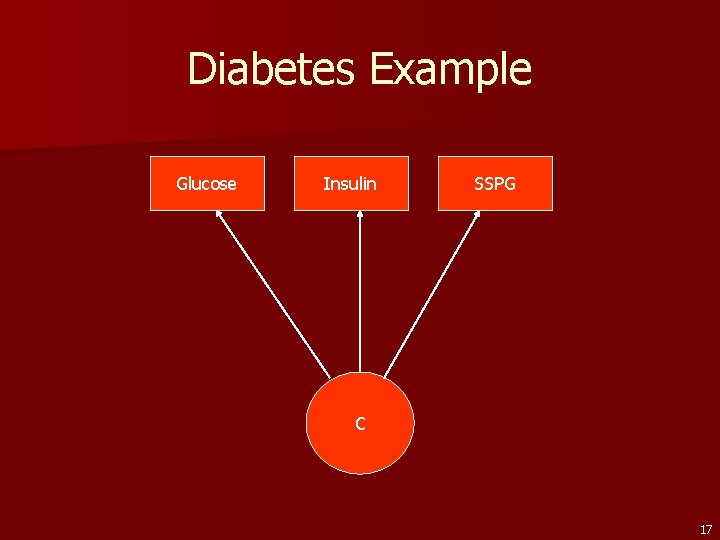
2 nd Example: Diabetes Data n Three continuous variables: – Glucose (y 1) – Insulin (y 2) – SSPG (Steady-stage plasma glucose, y 3) n N=145 n Data from Reaven and Miller (1979) 16
Diabetes Example Glucose Insulin SSPG C 17
Diabetes Example in Mplus Version 3 18
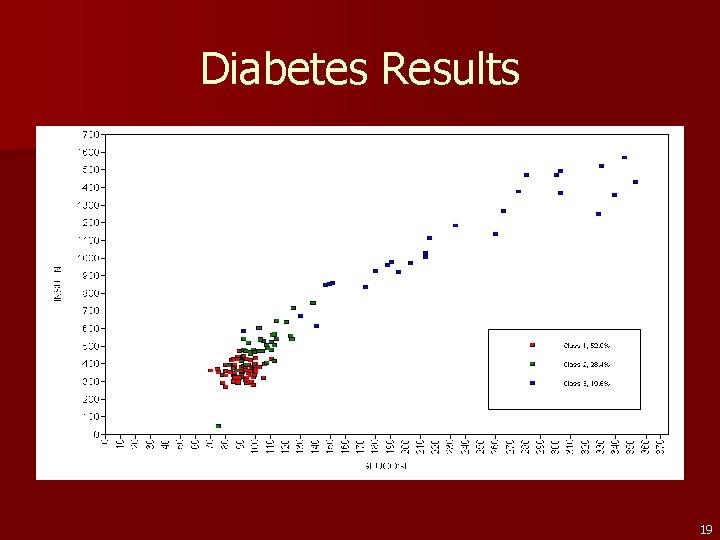
Diabetes Results 19
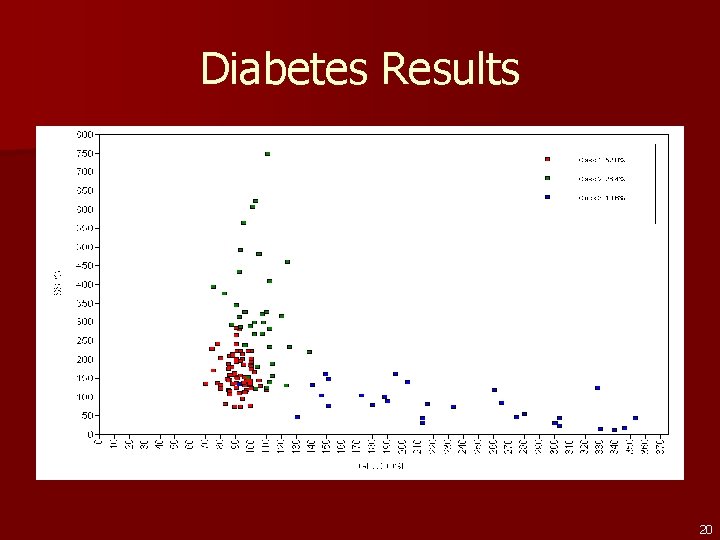
Diabetes Results 20
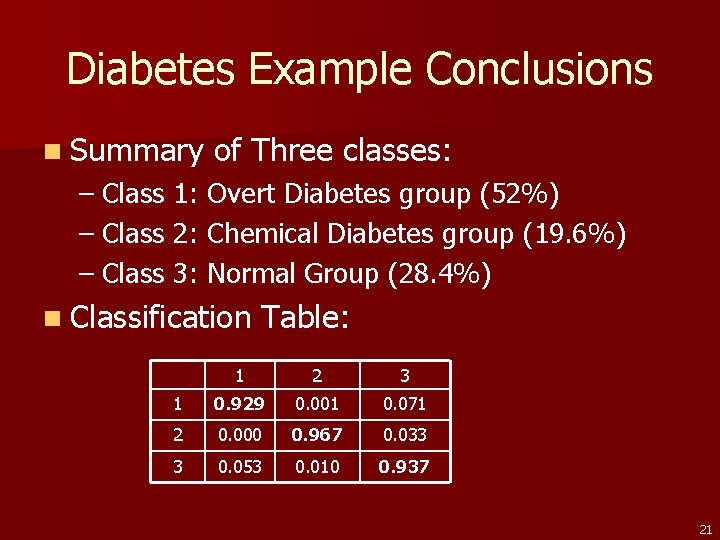
Diabetes Example Conclusions n Summary of Three classes: – Class 1: Overt Diabetes group (52%) – Class 2: Chemical Diabetes group (19. 6%) – Class 3: Normal Group (28. 4%) n Classification Table: 1 2 3 1 0. 929 0. 001 0. 071 2 0. 000 0. 967 0. 033 3 0. 053 0. 010 0. 937 21
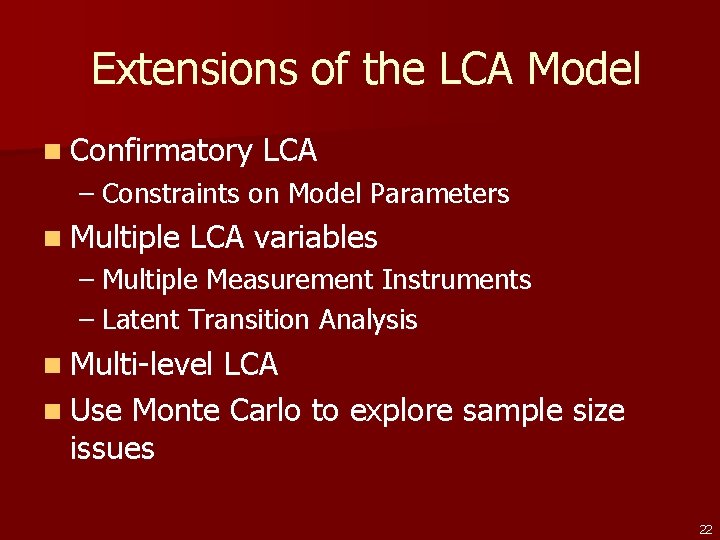
Extensions of the LCA Model n Confirmatory LCA – Constraints on Model Parameters n Multiple LCA variables – Multiple Measurement Instruments – Latent Transition Analysis n Multi-level LCA n Use Monte Carlo to explore sample size issues 22
Resources n Mplus User Guide – http: //www. statmodel. com n ATS Mplus Support – – http: //www. ats. ucla. edu/stat/mplus/ http: //www. ats. ucla. edu/stat/seminars/ed 231 e/ n Applied Latent Class Analysis, Edited by Hagenaars and Mc. Cutcheon (‘ 02) 23
References n Hagenaars, J. A & Mc. Cutcheon, A. (2002). Applied latent class analysis. Cambridge: Cambridge University Press. n Muthén, B. (2001). Latent variable mixture modeling. In G. A. Marcoulides & R. E. Schumacher (eds. ), New Developments and Techniques in Structural Equation Modeling (pp. 1 -33). Lawrence Erlbaum Associates. (#86) n Muthén, L. & Muthén, B. (1998 -2004). Mplus user’s guide. Los Angeles, CA: Muthén & Muthén. n Muthén, B. & Muthén, L. (2000). Integrating person-centered and variablecentered analysis: growth mixture modeling with latent trajectory classes. Alcoholism: Clinical and Experimental Research, 24, 882 -891. n Reaven, G. M. , & Miller. , R. G. (1979). “An attempt to define the nature of chemical diabetes using multidimensional analysis, ” Diabetologica, 16, 1727. 24