
Late Responses Blink Reflex Daniel W Miller M
Late Responses & Blink Reflex Daniel W. Miller, M. D. August 2004
Topic I: Late Responses • • F response (foot) H reflex (Hoffmann) Axon reflex Note that the CMAP, which is not a late response, is also called the M (motor) response.
F response: Physiology • Antidromic, supramaximal stimulation of a motor nerve conduction of impulse to anterior horn cells “back-firing” of a small number of AHCs orthodromic conduction of this small impulse back to recording site “mini-CMAP” (only 1 -5% of the muscle fibers that contribute to the actual CMAP) • Response rather than reflex because no synapse
F response: Physiology (2) • Each F-response varies in morphology and latency because each stimulation causes a different population of AHCs to back-fire • Anodal block: axons depolarize beneath cathode and hyperpolarize beneath anode • Jendrassik maneuver: “primes” anterior horn cells
F response: Technique • Set gain at 200 microvolts/div (small responses); automatic with our machines • Use same stimulation sites and recording electrode positions as median, ulnar, peroneal or tibial motor NCS • Turn stimulator 180°, so cathode (black) is proximal and anode (red) is distal, due to theoretical potential for anodal block
F response: Technique (2) • Use supramaximal current (this is automatically set with our machines after each motor NCS) • Typically 8 -10 stimulations; keep these 1 -2 seconds apart (temporal summation of pain if too closely spaced) • Jendrassik maneuvers as necessary
F response: Technique (3) • Impediments to obtaining F responses: – Unconscious/sedated patient – Muscle artifact (improper relaxation) – Not “primed” (use Jendrassik as necessary) – Low CMAP amplitude – Misinterpretation: axon reflexes (these superimpose perfectly), artifacts
F response: Parameters • Minimal latency – F estimate (calculation) • Persistence (presence or absence) • Chronodispersion • Amplitude is not clinically important
Minimal F wave latency • F wave latency includes time to AHC, turnaround time, and time back to recording site • Minimal latency is the shortest of 8 -10 responses (i. e. , the first deflection) • Some subjectivity in determining this
Minimal F wave latency (2) • Influenced by limb length (hence height), nerve temperature, nerve diameter (larger = faster) • Prolonged by any area(s) of abnormally slowed conduction; recall that F responses assess the entire loop and not just proximal portions
Minimal F wave latency (3) • “Normal” values: </= 32 msec for median or ulnar, </=56 msec for peroneal or tibial • Side-to-side comparison useful (internal control) • F estimate factors in the patient’s height, the distal latency and conduction velocity
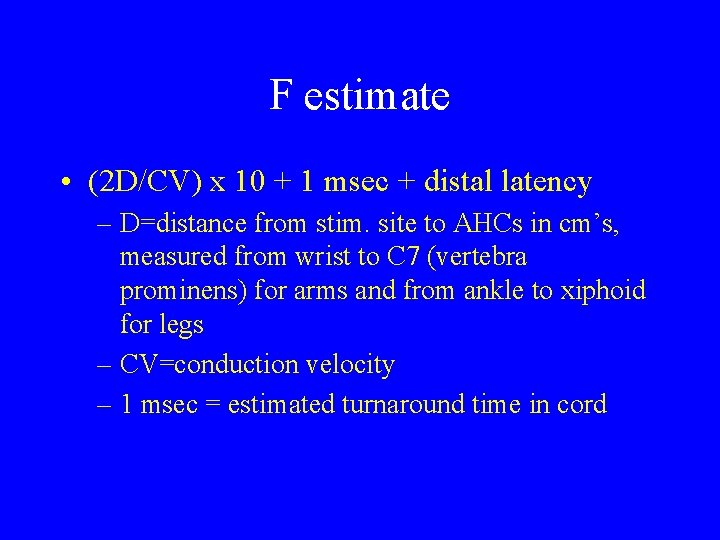
F estimate • (2 D/CV) x 10 + 1 msec + distal latency – D=distance from stim. site to AHCs in cm’s, measured from wrist to C 7 (vertebra prominens) for arms and from ankle to xiphoid for legs – CV=conduction velocity – 1 msec = estimated turnaround time in cord
F estimate (2) • The calculated value is normally slightly longer than measured F latency – CV for the equation is derived from a distal segment, which is cooler and smaller in diameter (thus slower) than much of the nerve involved in the actual loop • Therefore, reversal (measured latency longer than calculated) may be clinically significant
F wave persistence • The percentage of stimulations that generate an F wave response (e. g. , 8 Fs generated from 10 stimulations = 80% persistence) • Normally, always > 50% and usually 80100%; Jendrassik maneuvers may help • Caveats: peroneal nerve (frequently impersistent or absent Fs), sedation
F wave chronodispersion • The spread between minimal and maximal F -wave latencies • Mark both latencies from the initial deflection from baseline • Normal values: <4 msec in arm, <6 msec in leg
F waves: Applications • Debated, since abnormalities may localize anywhere in the long loop • Early polyradiculopathy (Guillain-Barre): abnormalities beginning in roots prolonged, impersistent or absent Fs with otherwise normal NCS
F waves: Applications (2) • Monoradiculopathy? Not unless the lesion involves (1) part of the F loop (which also implies motor fibers) and (2) most or all of the fibers in the loop • “F wave reversal” in CTS: Ulnar min. latency normal slightly longer than median; this often reverses in CTS and supports the dx but this doesn’t come close to being either necessary or sufficient for the electrophysiologic dx of CTS
F waves: Applications (3) • In summary: – (1) F wave testing has low sensitivity in most clinical scenarios, with the exception of early demyelinating polyradiculopathy – (2) F wave abnormalities have low specificity as they may originate anywhere in a long circuit – (3) Clinical decisions are seldom made on the basis of isolated F wave abnormalities
H reflex: Physiology (1) • Unlike the F response, this is a true reflex: – Ia muscle spindle is the (sensory) afferent limb – Synapse in spinal cord – Alpha motor neuron/projecting motor axon is the efferent limb • H reflex is the electrophysiologic correlate of the ankle jerk
H reflex: Physiology (2) • Ia fibers are selectively activated when a long duration (1 msec as opposed to the usual 0. 2 msec), low current stimulus is applied • As stimulus intensity (current) is gradually increased, a triphasic H response appears, grows briefly in amplitude, and then diminishes as the M response emerges
H reflex: Physiology (3) • While Ia fibers are initially selectively activated, as current is gradually increased motor fibers are activated as well • Motor fiber activation results in: – (1) appearance of an M response (CMAP), which has a shorter latency than the H response – (2) gradual disappearance of the H response
H reflex: Physiology (4) • Basis for disappearance of the H response is collision: – Stimulus results in both orthodromic and antidromic conduction in motor fibers – Orthodromic conduction CMAP – Antidromic conduction collision with efferent signal of the H reflex (which travels via the same motor fibers) H response diminishes and disappears
H reflex: Technique • Practically, only elicited from the tibial nerve – Recording (G 1) 2 -3 cm distal to crux of soleus and the 2 heads of gastrocnemius – Reference (G 2) on Achilles tendon • Stimulus duration 1 msec, gain 200 -500 microvolts/division
H reflex: Technique (2) • Stimulate tibial nerve in popliteal fossa (patient supine) • Stimulator reversed 180° as for F responses, so cathode is proximal, due to anodal block • Start with very low current and very gradually increase
H reflex: Technique (3) • A triphasic H response should be seen, before an M response appears, at latency of 25 -34 msec • H response should gradually increase in amplitude as current is increased • As M response emerges, H response should then wane in amplitude and disappear
H reflex: Technique (4) • Jendrassik maneuver may help to “prime” anterior horn cells, as with F responses • If (percussed) ankle jerk is present, yet H reflex cannot be elicited, the cause is technical (operator error or other artifactual problem) • Avoid ramping up current too rapidly, as the H response may be missed altogether
H reflex: Parameters • Latency • H/M (amplitude) ratio
H reflex latency • Normal values derived from tables based on age and leg length (or height) • A person of “average” height with normal tibial motor CV should have H latency of 34 msec or less • Side-to-side comparison: difference of more than 1. 5 msec is significant
H/M ratio • Ratio of peak-to-peak amplitudes of the maximal H amplitude to the maximal M amplitude • Rough gauge of excitability of the anterior horn cells • Normal ratio is 0. 5 (50%) or less; if increased, may indicate UMN lesion
H reflex: Applications • Focal lesions: S 1 radiculopathy, sciatic neuropathy, or lumbosacral plexopathy • Early demyelinating polyradiculopathy (assessment of proximal segments) • H/M ratio for UMN lesions (though NCS is not modality of choice to assess UMNs)
H reflex: Applications (2) • Real utility of H reflex is debatable: – Percussing the ankles typically provides as much information and less discomfort to patient – In demyelinating polyradiculopathy, prolonged H latency is rarely if ever the only abnormality – S 1 radiculopathy or L-S plexopathy seldom diagnosed in absence of needle EMG findings – H/M ratio a very crude and indirect way of diagnosing a UMN lesion
Axon reflex • Not actually a reflex but a mini-CMAP, occurring after the M response • Basis is a terminal axon sprout originating at an unusually proximal point on the main nerve trunk, due to reinnervation (collateral sprouting)
Axon reflex (2) • Typically, terminal sprouts come off the nerve trunk distal to the stimulation (cathode) site, close to the recorded muscle • If, however, reinnervation results in a terminal sprout originating proximal to the stimulation site, then there can be antidromic conduction to and through that sprout to the muscle fibers it innervates
Axon reflex (3) • Thus, a single stimulus propagates orthodromically to produce the M response, and antidromically, taking a longer route (hence “late”response) to produce the axon reflex • Axon reflex is seen with submaximal current and disappears as current increases, due to collision (as with the H reflex)
Axon reflex (4) • Unlike F responses, the axon reflex represents a fixed anatomic/physiologic pathway; thus, unlike F responses, axon reflexes are uniform in morphology and latency (they superimpose perfectly) • Generally occurs prior to F response, but may come after depending on how slowly the collateral sprout conducts
Axon reflex (5) • Clinical utility: – Indicator of reinnervation – Indicator that supramaximal stimulation has not been achieved
Topic II: Blink reflex • A true reflex, specifically the anatomic correlate of the bedside corneal reflex: – Corneal reflex: the cornea is brushed with gauze and blinking is observed bilaterally – Blink reflex: current is applied to supraorbital nerve and responses are recorded with electrodes at both orbicularis oculi muscles
Blink reflex: Physiology • In both instances, sensory fibers of V 1 (first division of the trigeminal nerve) comprise the afferent limb, and motor fibers of the facial nerve comprise the efferent limb • In keeping with the definition of a true reflex, there are intervening synapses in the brainstem
Blink reflex: Physiology (2) • Stimulus applied to the supraorbital nerve propagates (via parallel, not sequential pathways) to two structures in the brainstem: – Main sensory nucleus of V (mid-pons) – Spinal trigeminal nucleus (low pons/medulla)
Blink reflex: Physiology (3) • Main sensory nucleus of V ipsilateral facial nucleus (via a disynaptic pathway); this produces an ipsilateral response (R 1) • Spinal trigeminal nucleus both ipsilateral and contralateral facial nuclei (via polysynaptic pathways); this produces both ipsilateral and contralateral responses (R 2)
Blink reflex: Physiology (4) • Blink reflex testing is thus potentially informative about: – Trigeminal nerve function – Facial nerve function – Pontine lesions – Medullary lesions
Blink reflex: Technique • Sweep speed at 5 -10 msec/div, sensitivity at 100 -200 microvolts/div (because these are small responses with long latencies) • Patient supine and relaxed • Recording (G 1) electrodes placed over both inferior orbicularis oculi muscles; reference (G 2) electrodes just lateral to each lateral canthus; ground on forehead or chin
Blink reflex: Technique (2) • Palpate eyebrow (ridge) for the depression that indicates site of supraorbital nerve • Use low initial current and small increments • Responses should be obtained at < 25 m. A • As with Fs, multiple responses are obtained to determine a minimal latency
Blink reflex: Latency norms • R 1 < 13 msec (side-to-side < 1. 2 msec) • Ipsilateral R 2 < 41 msec (side-to-side < 5 msec) • Contralateral R 2 < 44 msec (side-to-side < 7 msec)
Blink reflex: Patterns • In general, a lesion in part of the blink reflex circuit results in delay or loss of the response(s) dependent on that portion of the circuit • There are six responses to consider: R 1, ipsilateral R 2 and contralateral R 2 with stimulation of one side and then the other side
Blink reflex: Patterns (2) • Abnormalities are expected in all responses obtained by: – Stimulating through an afferent limb (trigeminal nerve) lesion – Recording on the side of an efferent limb (facial nerve) lesion – Testing in some patients with demyelinating polyneuropathies (prolongation of all latencies)
Blink reflex: Patterns (3) • Conversely, normal responses are expected to result from: – Stimulating contralateral to an afferent limb lesion – Recording contralateral to an efferent limb lesion
Blink reflex: Patterns (4) • Unilateral pontine lesion affects ipsilateral R 1 pathway: main sensory nucleus of V and/or its connections to the VII nucleus; R 2 s are spared • Unilateral medullary lesions affects ipsilateral R 2 pathway: spinal trigeminal nucleus/tract and/or its connections to VII nucleus; more extensive lesions also affect contralateral R 2 (involvement of connections to contralateral VII nucleus)
Blink reflex: Applications • Bell’s palsy/other peripheral facial palsies • Trigeminal sensory neuropathy (commonly associated with connective tissue diseases) • GBS/ “cranial polyneuritis”/MFS • Brainstem: demyelinating disease, infiltrative processes, etc. (though expect a lawyer letter if you only do blinks instead of an MRI here!)
References • This slide presentation borrows liberally from: – Late responses: Chapter 4, Preston & Shapiro – Blink reflex: Chapter 5, Preston & Shapiro – The same information condensed in chapter 7, Neuromuscular Disorders in Clinical Practice
- Slides: 50