
Late life depression David Thimons D O C

- Slides: 20
Late life depression David Thimons, D. O. , C. M. D. January 26, 2016
CASE REVIEW Mrs. Smith is an 88 year old female you are seeing as an initial visit. She was referred to us from the case manager at Allegheny General Hospital as the patient was recently discharged home after an 8 day hospital stay for acute systolic CHF. This is her 3 rd admission for CHF over the past 7 months. Mrs. Smith admits to feeling depressed over the past few years, but it has really worsened since her husband passed away 6 months ago. She is lethargic and sad about being alone and her current health status. She has sleep disturbance with frequent awakenings, and has been very lethargic. She is not eating well. She also has been isolating herself, no longer going to bingo or church, and not wanting to go to her weekly dinner with her daughter. She spends her days on the couch, lethargic and alone. She denies suicidal thoughts PMH: CAD S/P CABG, VHD S/P AVR, Systolic CHF with last EF of 35%, HTN, hypothyroid, GERD, OA, Breast cancer S/P left lumpectomy and radiation 7 years ago, anxiety, and peripheral neuropathy
CASE REVIEW PSH: CABG x 4, AVR, left breast lumpectomy, appendectomy Meds: Coreg 6. 25 bid, Synthroid 0. 088 mg qd, Prilosec 40 mg bid, Naprosyn 500 mg bid, Evista 60 mg qd, Lisinopril 10 mg qd, Plavix 75 mg qd, Aspirin 81 mg qd, Neurontin 600 mg tid, Xanax 0. 5 mg bid ALL: NKDA FH: Mom died from metastatic breast cancer, dad died from an acute MI SH: Widowed and lives alone in 1 story home. No tobacco or alcohol use. Daughter lives 1 mile away and is involved in care. Used to be very involved in church and played bingo 2 days/week. PCP is Dr. Jones, whom she hasn’t seen in 6 months Advanced Care Planning: POLST filled out showing DNR / Limited Intervention status. Never completed a living will or thought about or talked about end of life wishes before and says doesn’t want anything heroic, but got choked up thinking about husband terminated the conversation
Epidemiology Late Life Depression associated with: 1. Increased comorbidities 2. Decreased function 3. Increased mortality 4. Excessive use of health care resources Undertreated and inadequately treated in the elderly Prevalence: -10% in patients over age 65 -30% in hospitalized patients -40% in patients with MI, CVA, Cancers
Risk Factors Female Social isolation Widowed Lower socioeconomic status Multiple medical comorbidities Uncontrolled pain Insomnia Functional impairment Cognitive impairment
Late Life Depression Facts Increased risk with medical comorbidity: -Depression, AMI 4 times increased incidence -CVA 3. 5 times increased incidence -Increased risk of dementia (1. 6 – 1. 7 times) 2 Question Screen: 1. During the past month, have you been bothered by feeling down, depressed or hopeless? 2. During the past month, have you been bothered by little interest or pleasure in doing things? Treatment: 1 st episode 6 -12 months after achieving remission; 2 nd episode or more, treat lifelong
Antidepressant Medications: Celexa / Lexapro Least stimulating SSRI’s Minimal initial sedation Most selective SSRI’s Some evidence that Lexapro may be most efficacious SSRI in elderly Most Likely to benefit: Elderly with agitated depression Least Likely to benefit: Elderly with excessive sleep and apathy Dosing
Antidepressant Medications: Prozac Most stimulating SSRI More initial nervousness and arousal than others Very long half life, so least likely to cause withdrawal on abrupt dc Least selective receptor blocker Most likely to benefit: Depressed patients with excessive fatigue Least likely to benefit: Patients on several medications, or medication changes pending (high drug-drug interactions)
Antidepressant Medications: Zoloft Patients initially experience increased alertness 3 rd most selective SSRI (behind Lexapro and Celexa) Low drug – drug interactions Most likely to benefit: med / surg patients on multiple medications; when initial activation and increased alertness is desired Least likely to benefit: Patients sensitive to meds that increase arousal
Antidepressant Medications: Paxil Most potent neurotransmitter blocker, but least selective for serotonin (muscarinic, cholinergic, H 1, cytochrome p 450, etc) Anticholinergic side effects Most likely to benefit: Patients who would be benefit from medication that is least likely to produce initial anxiety Least likely to benefit: Elderly
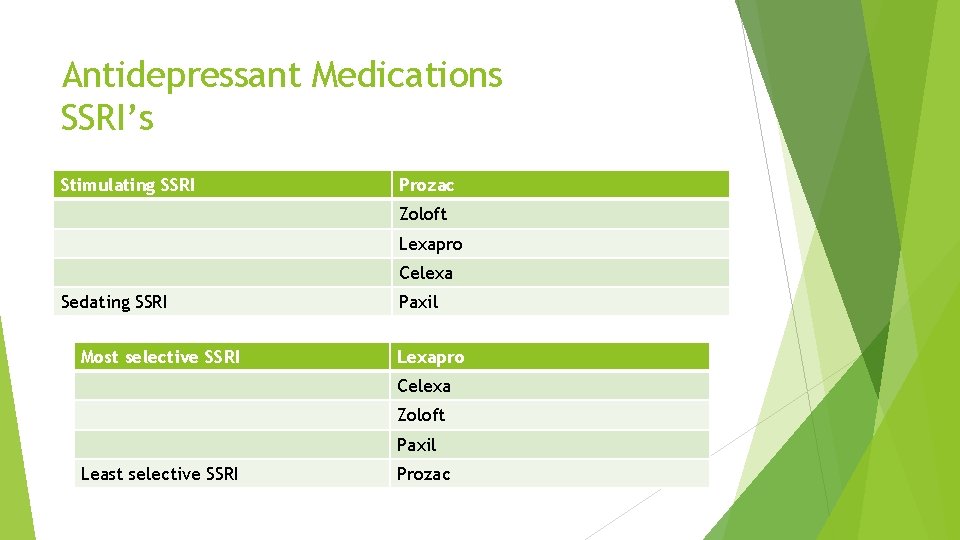
Antidepressant Medications SSRI’s Stimulating SSRI Prozac Zoloft Lexapro Celexa Sedating SSRI Most selective SSRI Paxil Lexapro Celexa Zoloft Paxil Least selective SSRI Prozac
Antidepressant Medications: Effexor SNRI Blood Pressure elevation in 3% of patients at doses > or = 300 mg/day Discontinuation difficult and requires slow wean Most likely to benefit: Depressed patients with menopausal symptoms, chronic pain, or failed SSRI’s Least likely to benefit: patients with unstable BP, GI sensitive patients
Antidepressant Medications: Cymbalta SNRI BP elevation in 4% of patients Most likely to benefit: Depressed patients with chronic pain (pain benefit is dose dependent), and those who have filed SSRI’s Least likely to benefit: patients with anorexia, constipation, GI symptoms
Antidepressant Medications: Remeron Serotonin and alpha-2 receptor blocker (increases release of both serotonin and norepinephrine) Causes lethargy and weight gain Antiemetic properties (blocks 5 HT 3 receptor as does Zofran) Side effects dose dependent Risk of neutropenia 1. 5% Most likely to benefit: Depressed patients with weight loss, insomnia, nausea Least likely to benefit: patients who are obese, lethargic, neutropenic
Antidepressant Medications: Wellbutrin Increases dopamine and norepinephrine Most activating antidepressant DO NOT USE if history of seizure, head trauma, substance abuse, anorexia, bulimia, electrolyte abnormalities Most likely to benefit: apathetic, low energy, smoking cessation, and helps with ADHD Least likely to benefit: agitated, anxious, panicky, risks for seizure
Antidepressant Medications: Ritalin Beneficial as additive agent in some situations Rapid benefit Cardiac side effects, etc…
Antidepressant Medications: SSRI Side Effects Nausea (Paxil, Zoloft worst) Sexual dysfunction Weight gain Sleep – Zoloft only one to improve sleep efficiency and decrease nocturnal wakefulness time. Good for depressed patients with sleep disturbances Anticholinegic effects: Paxil Diarrhea: Zoloft big culprit here, also Prozac Dry mouth: Paxil, Celexa Headache: Zoloft, Prozac QTC Prolongation: Celexa Drowsiness / fatigue: Paxil
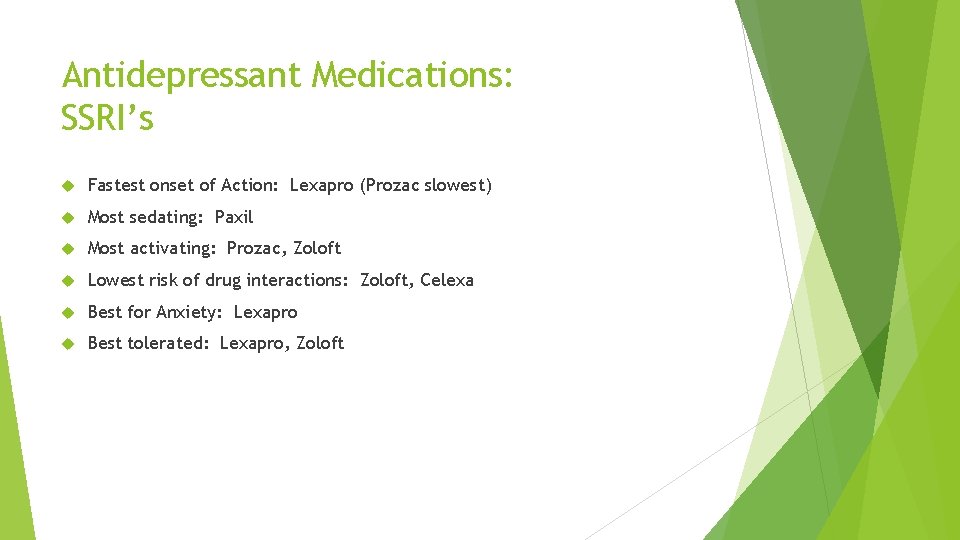
Antidepressant Medications: SSRI’s Fastest onset of Action: Lexapro (Prozac slowest) Most sedating: Paxil Most activating: Prozac, Zoloft Lowest risk of drug interactions: Zoloft, Celexa Best for Anxiety: Lexapro Best tolerated: Lexapro, Zoloft
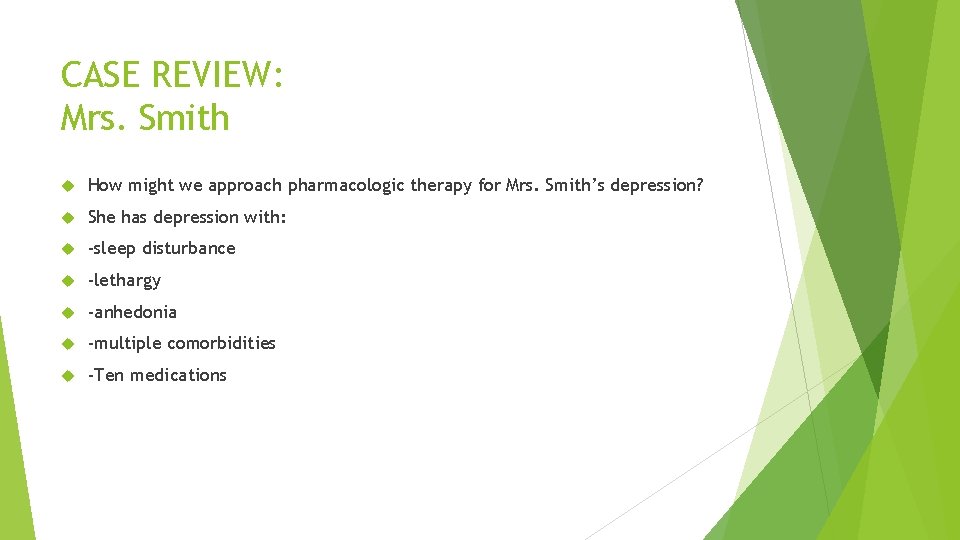
CASE REVIEW: Mrs. Smith How might we approach pharmacologic therapy for Mrs. Smith’s depression? She has depression with: -sleep disturbance -lethargy -anhedonia -multiple comorbidities -Ten medications
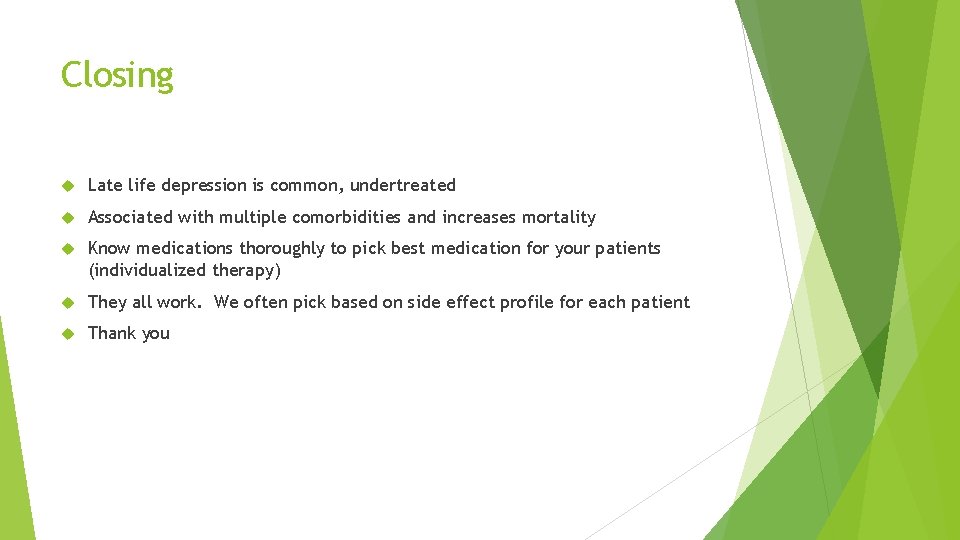
Closing Late life depression is common, undertreated Associated with multiple comorbidities and increases mortality Know medications thoroughly to pick best medication for your patients (individualized therapy) They all work. We often pick based on side effect profile for each patient Thank you