
LATE AGE SILKWORM REARING Dr Mahesha H B
LATE AGE SILKWORM REARING Dr. Mahesha H B Associate Professor Department of Sericulture Yuvaraja’s College, University of Mysore, Mysuru, India 27 February 2021 www. hbmahesh. weebly. com 1
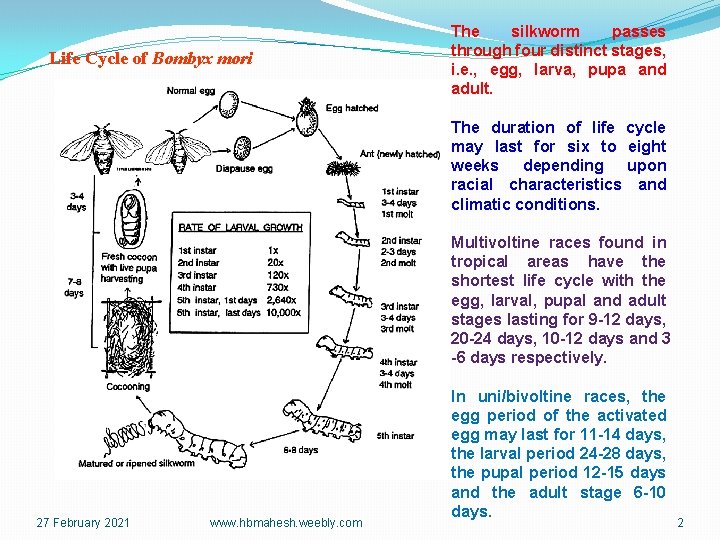
Life Cycle of Bombyx mori The silkworm passes through four distinct stages, i. e. , egg, larva, pupa and adult. The duration of life cycle may last for six to eight weeks depending upon racial characteristics and climatic conditions. Multivoltine races found in tropical areas have the shortest life cycle with the egg, larval, pupal and adult stages lasting for 9 -12 days, 20 -24 days, 10 -12 days and 3 -6 days respectively. 27 February 2021 www. hbmahesh. weebly. com In uni/bivoltine races, the egg period of the activated egg may last for 11 -14 days, the larval period 24 -28 days, the pupal period 12 -15 days and the adult stage 6 -10 days. 2
Silkworms consume about 90 -95% of the total feed. This is necessasary because it develop silk glands & secrete silk and also for metamorphosis from the larval to the pupal condition and finally to moth. From the 4 th age onwards entire leaf/chopped shoots may be fed to the worms. So, the leaves remain fresh for a longer period and therefore, only 3 -4 feedings/day. It would however, be advisable to give large feed at night. 27 February 2021 www. hbmahesh. weebly. com 3

Silkworm Rearing Methods �Shelf rearing �Floor rearing �Shoot rearing 27 February 2021 www. hbmahesh. weebly. com 4
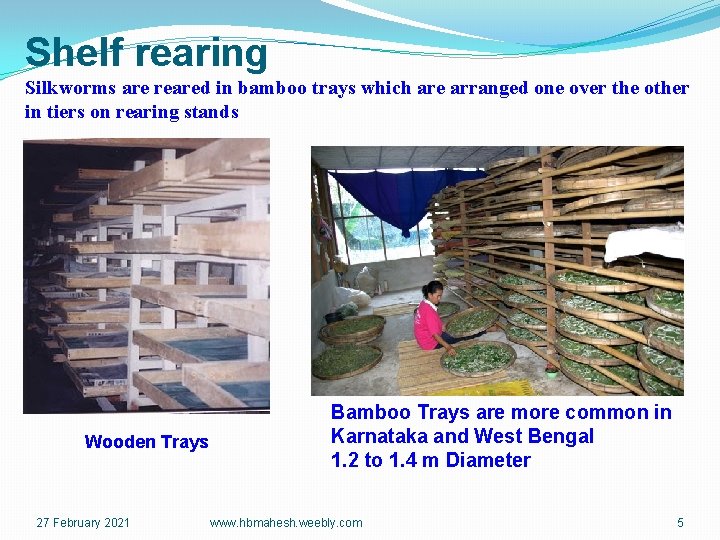
Shelf rearing Silkworms are reared in bamboo trays which are arranged one over the other in tiers on rearing stands Wooden Trays 27 February 2021 Bamboo Trays are more common in Karnataka and West Bengal 1. 2 to 1. 4 m Diameter www. hbmahesh. weebly. com 5
Advantages and disadvantages of Shelf Rearing Advantages This methods accommodates more silkworms in a limited area 27 February 2021 www. hbmahesh. weebly. com Disadvantages More labour is required for feeding and cleaning 6
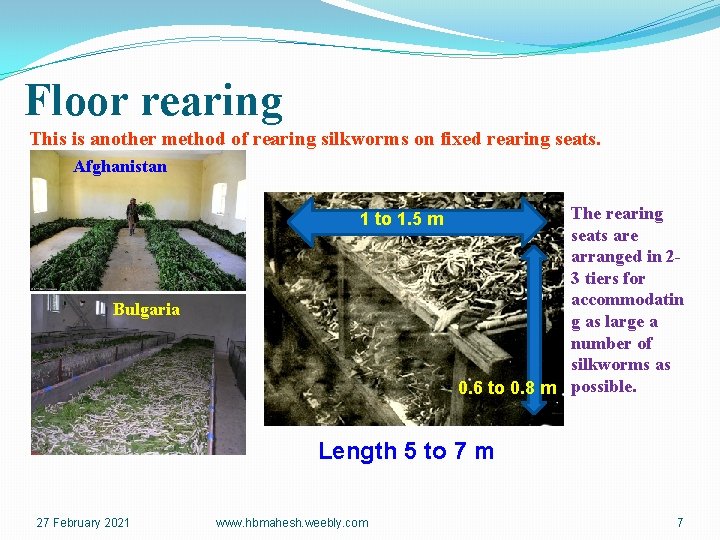
Floor rearing This is another method of rearing silkworms on fixed rearing seats. Afghanistan 1 to 1. 5 m Bulgaria The rearing seats are arranged in 23 tiers for accommodatin g as large a number of silkworms as 0. 6 to 0. 8 m possible. Length 5 to 7 m 27 February 2021 www. hbmahesh. weebly. com 7
Advantages Floor Rearing Advantages This methods needs less labour as feeding and cleaning processes do not involve the handling of innumerable trays as in case of shelf rearing 27 February 2021 www. hbmahesh. weebly. com 8
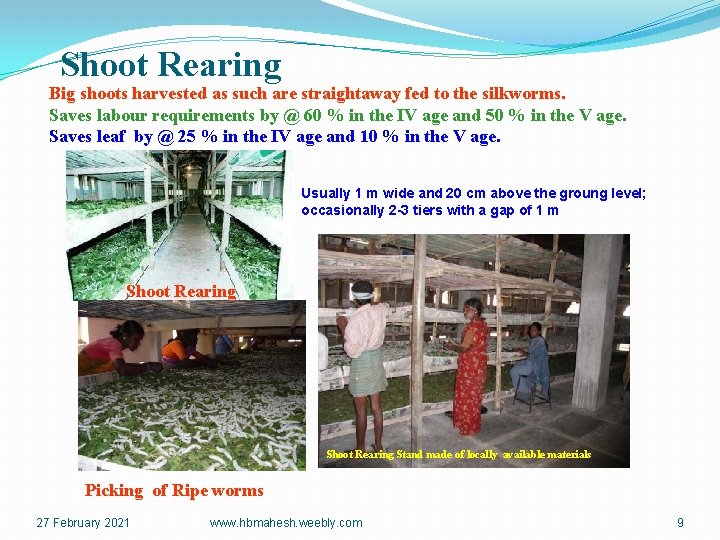
Shoot Rearing Big shoots harvested as such are straightaway fed to the silkworms. Saves labour requirements by @ 60 % in the IV age and 50 % in the V age. Saves leaf by @ 25 % in the IV age and 10 % in the V age. Usually 1 m wide and 20 cm above the groung level; occasionally 2 -3 tiers with a gap of 1 m Shoot Rearing Stand made of locally available materials Picking of Ripe worms 27 February 2021 www. hbmahesh. weebly. com 9
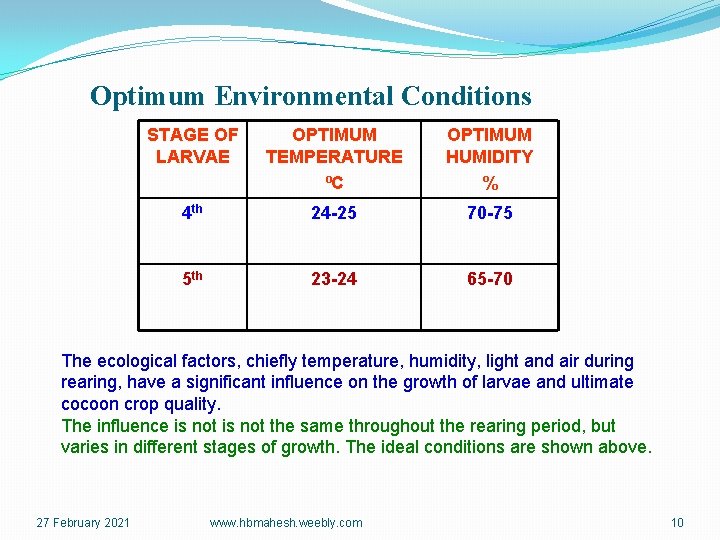
Optimum Environmental Conditions STAGE OF LARVAE OPTIMUM TEMPERATURE ºC OPTIMUM HUMIDITY % 4 th 24 -25 70 -75 5 th 23 -24 65 -70 The ecological factors, chiefly temperature, humidity, light and air during rearing, have a significant influence on the growth of larvae and ultimate cocoon crop quality. The influence is not the same throughout the rearing period, but varies in different stages of growth. The ideal conditions are shown above. 27 February 2021 www. hbmahesh. weebly. com 10
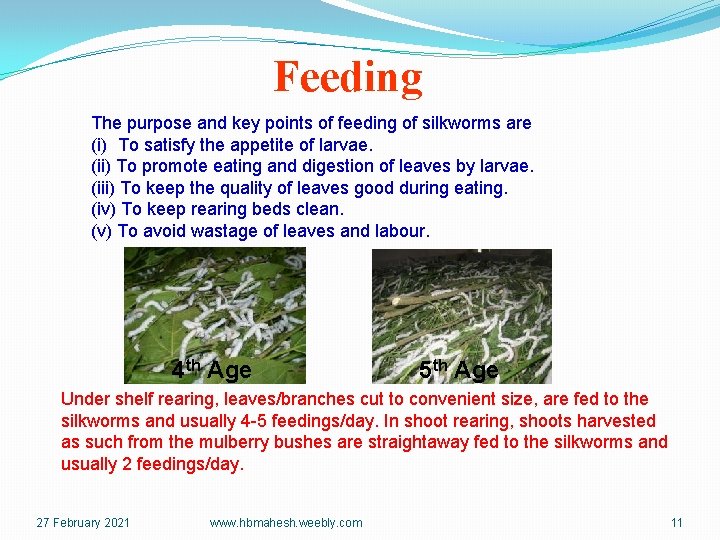
Feeding The purpose and key points of feeding of silkworms are (i) To satisfy the appetite of larvae. (ii) To promote eating and digestion of leaves by larvae. (iii) To keep the quality of leaves good during eating. (iv) To keep rearing beds clean. (v) To avoid wastage of leaves and labour. 4 th Age 5 th Age Under shelf rearing, leaves/branches cut to convenient size, are fed to the silkworms and usually 4 -5 feedings/day. In shoot rearing, shoots harvested as such from the mulberry bushes are straightaway fed to the silkworms and usually 2 feedings/day. 27 February 2021 www. hbmahesh. weebly. com 11

Cleaning The litter piled on rearing beds together with waste mulberry leaves, etc. , should be periodically removed. This process is called "Bed cleaning". �With Husk �With Nets �With Husk & Nets 27 February 2021 www. hbmahesh. weebly. com 12
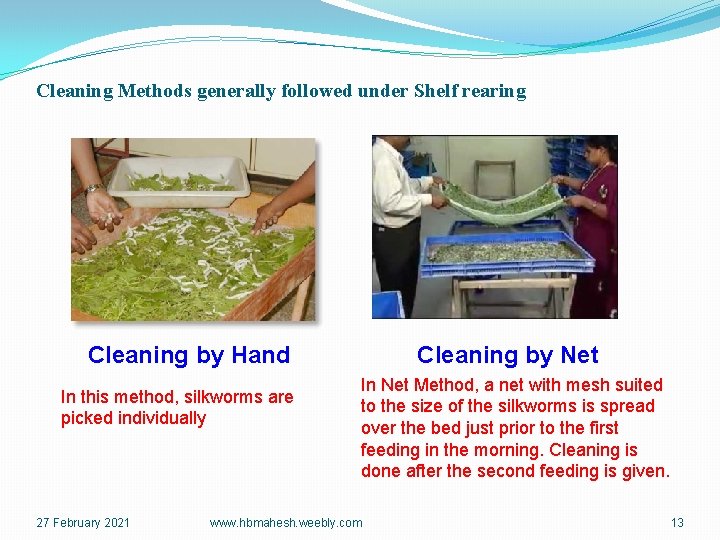
Cleaning Methods generally followed under Shelf rearing Cleaning by Hand In this method, silkworms are picked individually 27 February 2021 Cleaning by Net In Net Method, a net with mesh suited to the size of the silkworms is spread over the bed just prior to the first feeding in the morning. Cleaning is done after the second feeding is given. www. hbmahesh. weebly. com 13
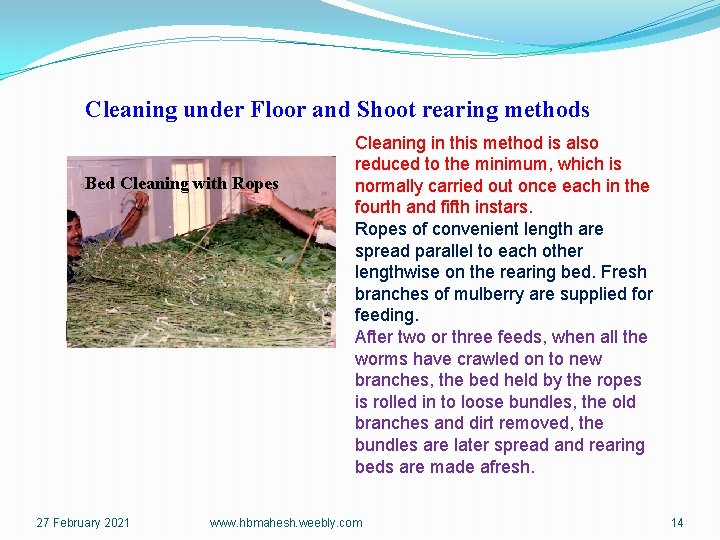
Cleaning under Floor and Shoot rearing methods Bed Cleaning with Ropes 27 February 2021 Cleaning in this method is also reduced to the minimum, which is normally carried out once each in the fourth and fifth instars. Ropes of convenient length are spread parallel to each other lengthwise on the rearing bed. Fresh branches of mulberry are supplied for feeding. After two or three feeds, when all the worms have crawled on to new branches, the bed held by the ropes is rolled in to loose bundles, the old branches and dirt removed, the bundles are later spread and rearing beds are made afresh. www. hbmahesh. weebly. com 14
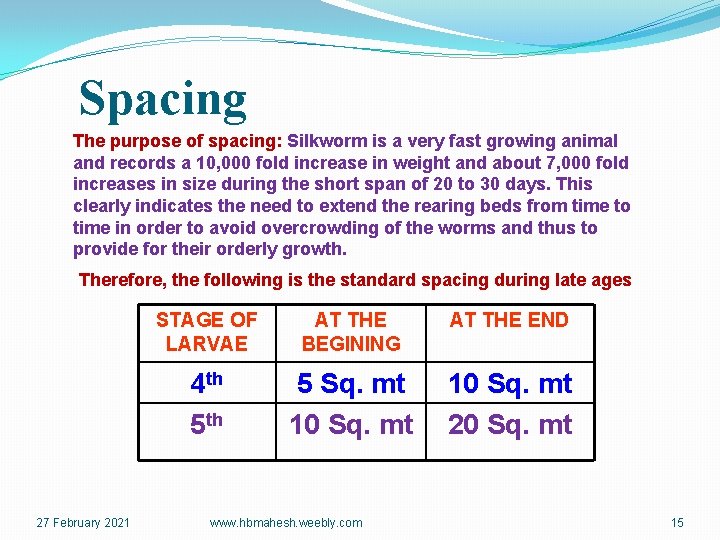
Spacing The purpose of spacing: Silkworm is a very fast growing animal and records a 10, 000 fold increase in weight and about 7, 000 fold increases in size during the short span of 20 to 30 days. This clearly indicates the need to extend the rearing beds from time to time in order to avoid overcrowding of the worms and thus to provide for their orderly growth. Therefore, the following is the standard spacing during late ages 27 February 2021 STAGE OF LARVAE AT THE BEGINING AT THE END 4 th 5 Sq. mt 10 Sq. mt 20 Sq. mt www. hbmahesh. weebly. com 15
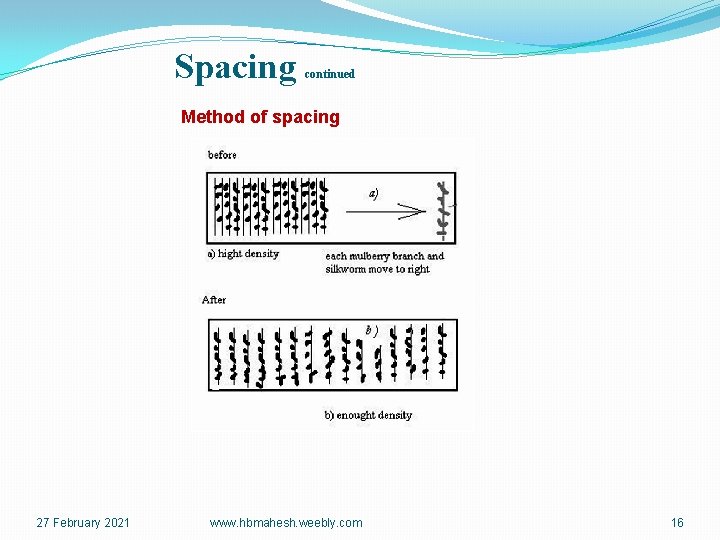
Spacing continued Method of spacing 27 February 2021 www. hbmahesh. weebly. com 16
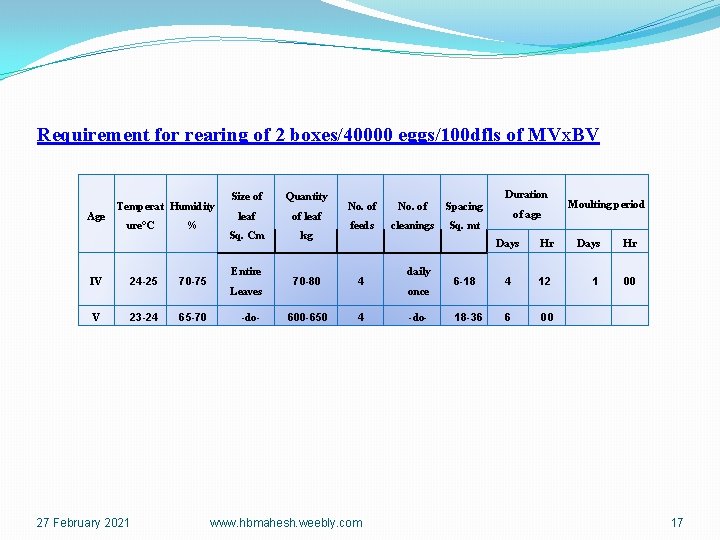
Requirement for rearing of 2 boxes/40000 eggs/100 dfls of MVx. BV Age Temperat Humidity ure°C % IV 24 -25 70 -75 V 23 -24 65 -70 27 February 2021 Size of Quantity leaf of leaf Sq. Cm kg Entire Leaves -do- No. of Spacing feeds cleanings Sq. mt 70 -80 4 600 -650 4 www. hbmahesh. weebly. com daily once -do- Duration of age Moulting period Days Hr 6 -18 4 12 1 00 18 -36 6 00 17
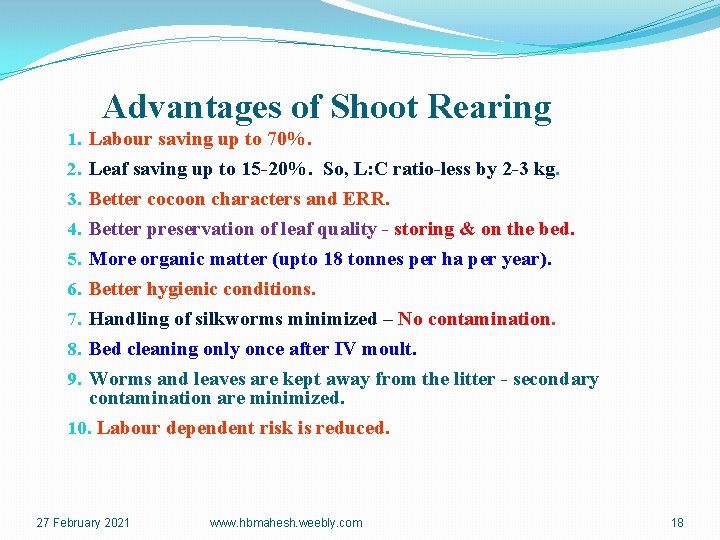
Advantages of Shoot Rearing 1. Labour saving up to 70%. 2. Leaf saving up to 15 -20%. So, L: C ratio-less by 2 -3 kg. 3. Better cocoon characters and ERR. 4. Better preservation of leaf quality - storing & on the bed. 5. More organic matter (upto 18 tonnes per ha per year). 6. Better hygienic conditions. 7. Handling of silkworms minimized – No contamination. 8. Bed cleaning only once after IV moult. 9. Worms and leaves are kept away from the litter - secondary contamination are minimized. 10. Labour dependent risk is reduced. 27 February 2021 www. hbmahesh. weebly. com 18
Disadvantages of Shoot Rearing � Required rearing room floor area is more (by 30%). � Bed refusals will not be available as a cattle feed. � Planting materials (cuttings) will not be available. 27 February 2021 www. hbmahesh. weebly. com 19

Acknowledgements/References to 1. Internet 2. Sericulture Manual II, FAO, Rome. 27 February 2021 www. hbmahesh. weebly. com 20
- Slides: 20