
Late Adulthood Unit 9 Physical Changes Gerontology Loss

- Slides: 14
Late Adulthood Unit 9
Physical Changes Gerontology Loss of height Gray hair Thin skin that is prone to bleeding Same sleep requirements, but lighter sleep patterns lead to less overall rest : Loss of muscle mass and bone density Loss of fat reserves Reduction in the efficiency of heart and lungs Reduction in sexual interest and responsiveness
Physical Changes Vision ◦ Cataracts ◦ Glaucoma ◦ Senile Macular Degeneration Hearing ◦ High-pitch loss first due to cochlear structure Other Illnesses ◦ Huntington’s Disease ◦ Parkinson’s Disease ◦ Multiple Sclerosis Psychological Illnesses ◦ Depression
Aging & Disease 1900: Leading cause of death pathenogenic 2000: Leading cause of death chronic
Aging & Disease Theories of Aging: ◦ Wear & Tear ◦ Cellular Theory Error Catastrophe: Errors build up Hayflick Limit: A cell is only able to divide a certain number of times before dying. ◦ Free Radicals Antioxidants ◦ Immune Decline
Dementia Dementia: A category of several disorders characterized by memory loss
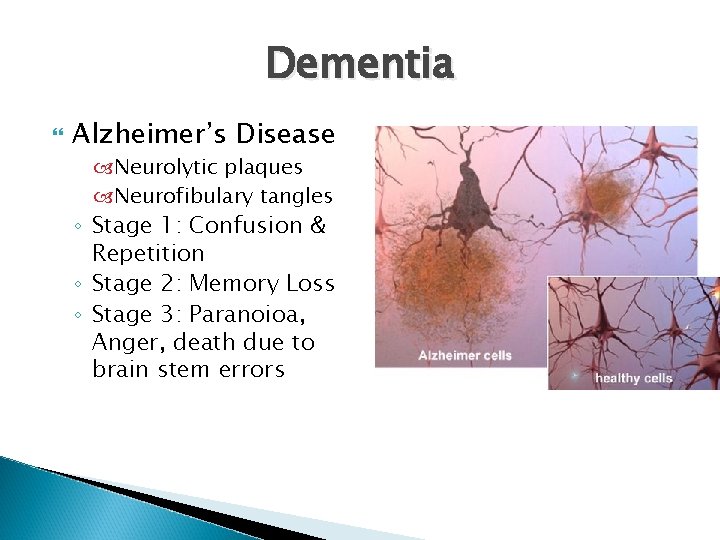
Dementia Alzheimer’s Disease Neurolytic plaques Neurofibulary tangles ◦ Stage 1: Confusion & Repetition ◦ Stage 2: Memory Loss ◦ Stage 3: Paranoioa, Anger, death due to brain stem errors
Dementia Non-Alzheimer’s Dementia ◦ Subcortical Dementia: Brain changes in the subcortical regions ◦ Korskoff’s Syndrome: Brain changes and dementia due to chronic alcohol abuse
Healthcare Medicare Medicaid Drug costs Prescription & Non-Prescription Drug Abuse
Psychosocial Development Self-Theory: Core self is critical to maintaining one’s identity Stratification Theory: Social forces and limitations effect functioning and psychological health Dynamic Theory: Change and readjustments throughout life impact adult experiences Continuity Theory: The individual continues to express the same behaviors as earlier in life
Psychosocial Development Erikson’s Psychosocial Development ◦ Integrity vs. Despair ◦ Immortality vs. Mortality Disengagement Theory: Social circles narrow as the person disengages from life
Psychosocial Development Erikson’s Psychosocial Development ◦ Integrity vs. Despair ◦ Immortality vs. Mortality Disengagement Theory: Social circles narrow as the person disengages from life
Work Ageism Retirement Poverty
Family & Friends Marriage Widowhood Friendship Development