
LASTFIRE Large Atmospheric Storage Tank Fires An industry
- Slides: 13
LASTFIRE Large Atmospheric Storage Tank Fires
An industry consortium of international oil companies
LASTFIRE Objectives of original study • Determine current levels of risk • Establish Design & Operational Practice & make knowledge available throughout industry • Establish techniques to determine site- specific levels of risk and identify appropriate & cost-effective risk reduction measures
LASTFIRE Objectives of update study To continue LASTFIRE’s role as the established recognised international oil companies forum on best practices of Fire Hazard Management of Storage Tanks
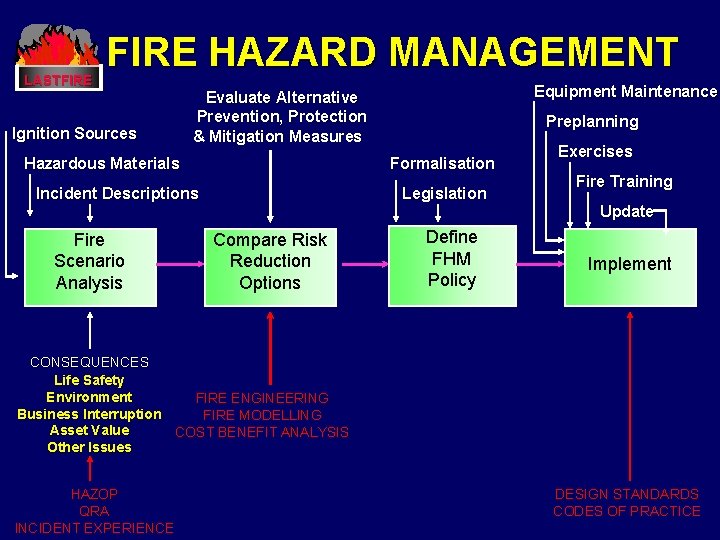
LASTFIRE HAZARD MANAGEMENT Ignition Sources Hazardous Materials Preplanning Formalisation Incident Descriptions Fire Scenario Analysis Equipment Maintenance Evaluate Alternative Prevention, Protection & Mitigation Measures Legislation Compare Risk Reduction Options Define FHM Policy Exercises Fire Training Update Implement CONSEQUENCES Life Safety Environment FIRE ENGINEERING Business Interruption FIRE MODELLING Asset Value COST BENEFIT ANALYSIS Other Issues HAZOP QRA INCIDENT EXPERIENCE DESIGN STANDARDS CODES OF PRACTICE
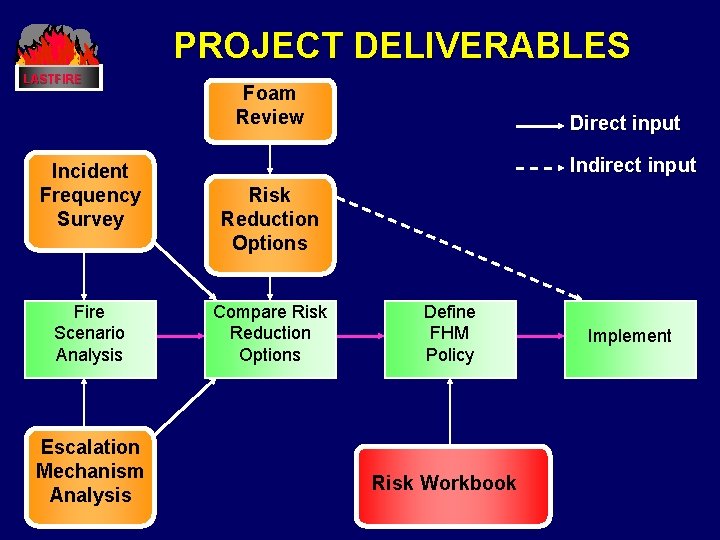
PROJECT DELIVERABLES LASTFIRE Incident Frequency Survey Fire Scenario Analysis Escalation Mechanism Analysis Foam Review Direct input Indirect input Risk Reduction Options Compare Risk Reduction Options Define FHM Policy Risk Workbook Implement
LASTFIRE Involvement - Existing and Future Benefits
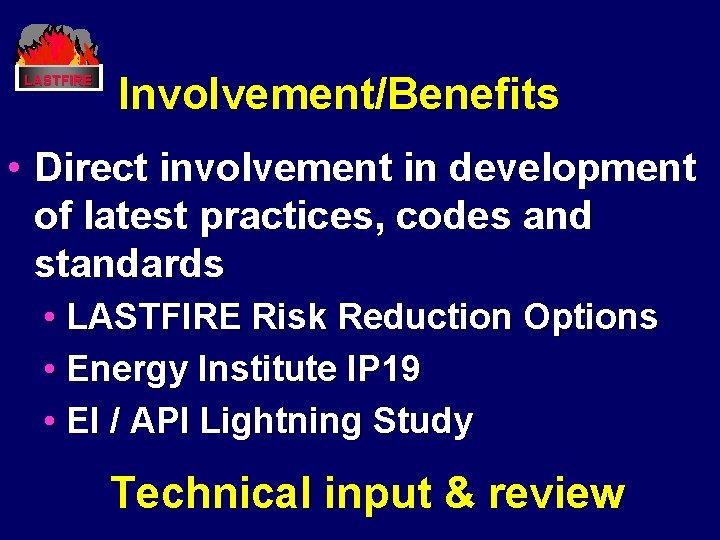
LASTFIRE Involvement/Benefits • Direct involvement in development of latest practices, codes and standards • LASTFIRE Risk Reduction Options • Energy Institute IP 19 • EI / API Lightning Study Technical input & review
LASTFIRE Involvement/Benefits • Contribution to LASTFIRE Incident database (anonymously) • Most comprehensive statistical database for tank fires and tank related incidents • Used for input into safety cases and hazard assessments Database continually updated
LASTFIRE Involvement/Benefits • Practical guidance on implementation of FEHM Measures • Risk Reduction Options Document • What are the cost effective FEHM measures • What are typical & best practices Incident prevention, detection, protection and response
LASTFIRE For Example: • Linear Heat Detection • Pneumatic vs. Electrical • Specification considerations • Practical experience based guidance • New developments in detection
LASTFIRE members participate in an International forum for tank Fire Hazard Management and related issues and receive the latest technical information on fire prevention, detection, protection and response measures, as well as that relating to international codes and standards. These include the latest foam standards and Fire Hazard Management codes of practice. Through LASTFIRE, members also actively participate in the latest research into extreme tank fire events such as Boilover, and current issues such as fires in internal floating roof tanks.
LASTFIRE Research – Boilovers • Access to boilover study data and analyses – largest database on BO • Access to information on boilover probability/consequences • Development of safe, cost-effective practical guidance on boilover prevention, mitigation and fire fighting strategies