
Last Week Mass Movements Downhill creep is diffusive







- Slides: 28
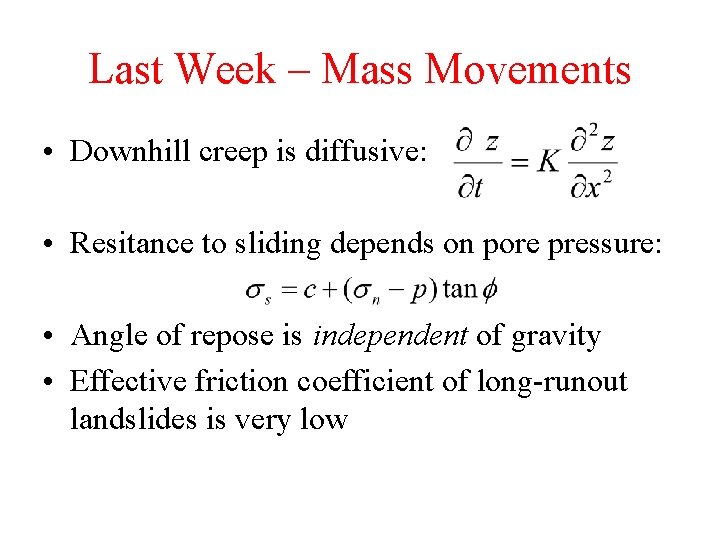
Last Week – Mass Movements • Downhill creep is diffusive: • Resitance to sliding depends on pore pressure: • Angle of repose is independent of gravity • Effective friction coefficient of long-runout landslides is very low
This week - Wind • Sediment transport – Initiation of motion – Sinking (terminal velocity) – Motion of sand-grains • Aeolian landforms and what they tell us • WARNING: many of the relationships shown here are empirical and not theoretically derived
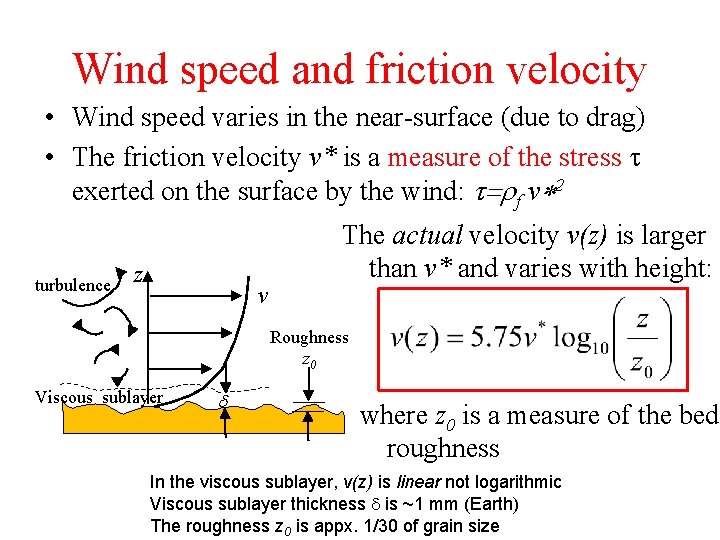
Wind speed and friction velocity • Wind speed varies in the near-surface (due to drag) • The friction velocity v* is a measure of the stress t exerted on the surface by the wind: t=rf v*2 turbulence z v The actual velocity v(z) is larger than v* and varies with height: Roughness z 0 Viscous sublayer d where z 0 is a measure of the bed roughness In the viscous sublayer, v(z) is linear not logarithmic Viscous sublayer thickness d is ~1 mm (Earth) The roughness z 0 is appx. 1/30 of grain size
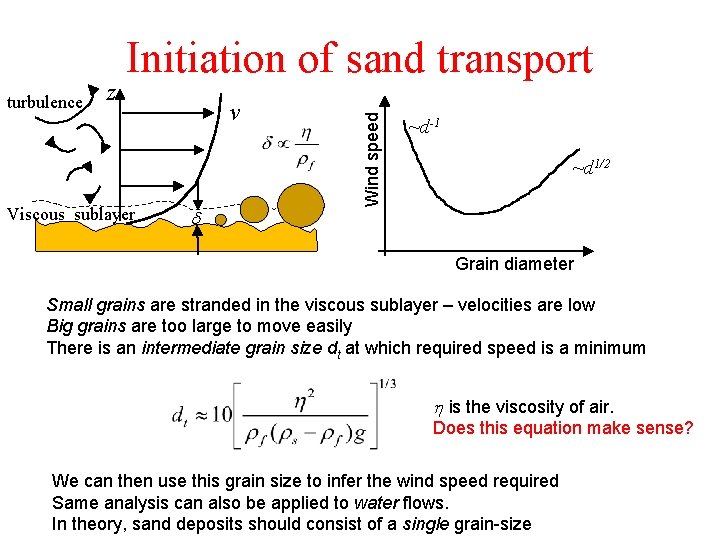
z Viscous sublayer v d Wind speed turbulence Initiation of sand transport ~d-1 ~d 1/2 Grain diameter Small grains are stranded in the viscous sublayer – velocities are low Big grains are too large to move easily There is an intermediate grain size dt at which required speed is a minimum h is the viscosity of air. Does this equation make sense? We can then use this grain size to infer the wind speed required Same analysis can also be applied to water flows. In theory, sand deposits should consist of a single grain-size
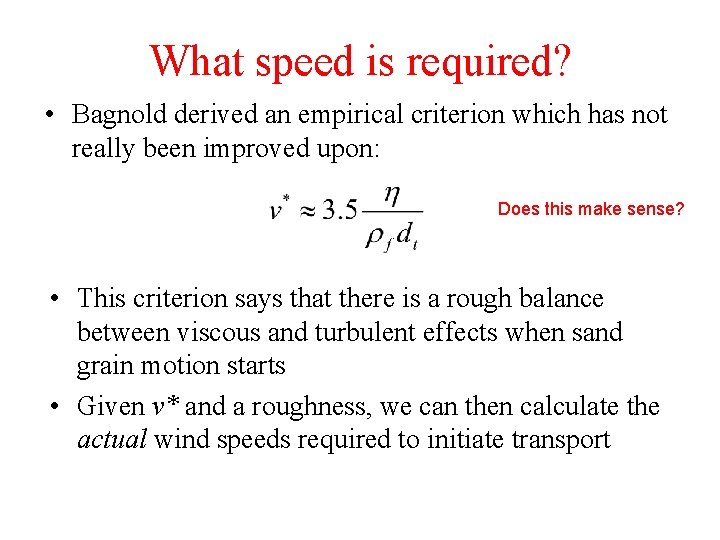
What speed is required? • Bagnold derived an empirical criterion which has not really been improved upon: Does this make sense? • This criterion says that there is a rough balance between viscous and turbulent effects when sand grain motion starts • Given v* and a roughness, we can then calculate the actual wind speeds required to initiate transport
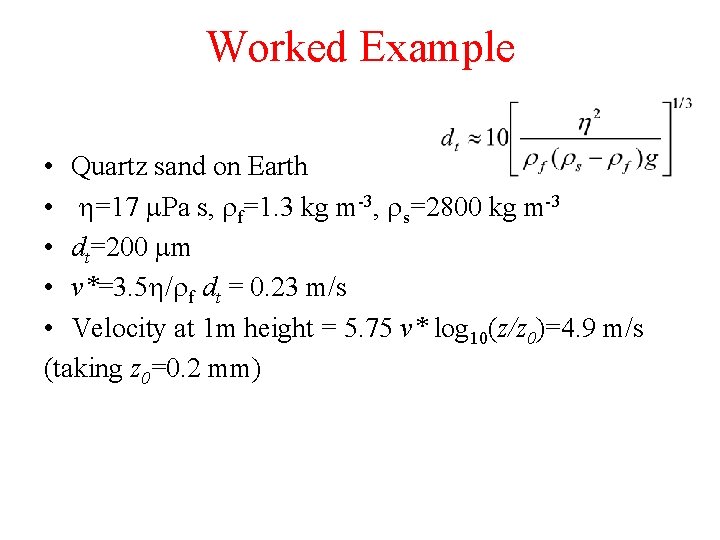
Worked Example • Quartz sand on Earth • h=17 m. Pa s, rf=1. 3 kg m-3, rs=2800 kg m-3 • dt=200 mm • v*=3. 5 h/rf dt = 0. 23 m/s • Velocity at 1 m height = 5. 75 v* log 10(z/z 0)=4. 9 m/s (taking z 0=0. 2 mm)
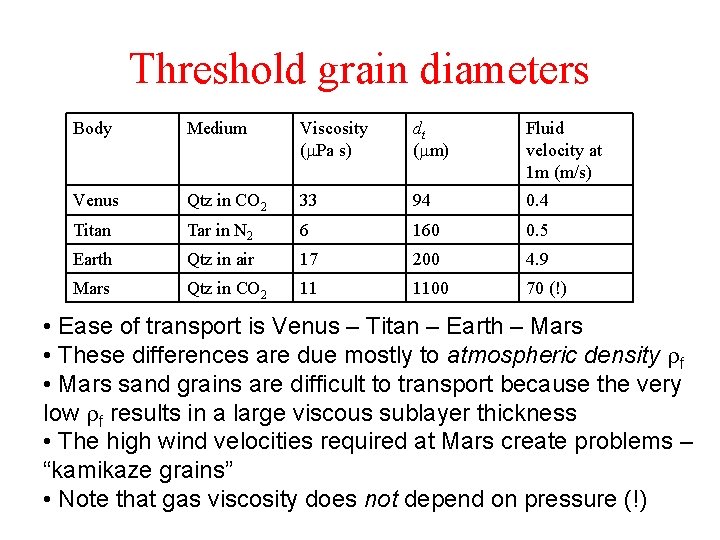
Threshold grain diameters Body Medium Viscosity (m. Pa s) dt (mm) Fluid velocity at 1 m (m/s) Venus Qtz in CO 2 33 94 0. 4 Titan Tar in N 2 6 160 0. 5 Earth Qtz in air 17 200 4. 9 Mars Qtz in CO 2 11 1100 70 (!) • Ease of transport is Venus – Titan – Earth – Mars • These differences are due mostly to atmospheric density rf • Mars sand grains are difficult to transport because the very low rf results in a large viscous sublayer thickness • The high wind velocities required at Mars create problems – “kamikaze grains” • Note that gas viscosity does not depend on pressure (!)
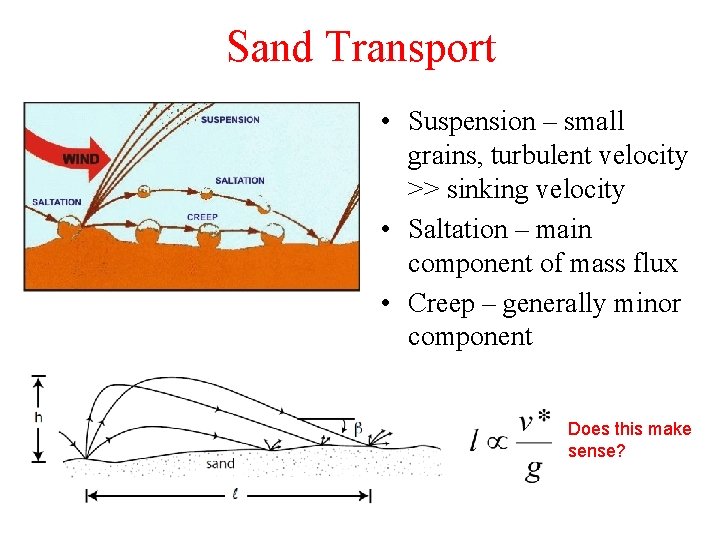
Sand Transport • Suspension – small grains, turbulent velocity >> sinking velocity • Saltation – main component of mass flux • Creep – generally minor component Does this make sense?
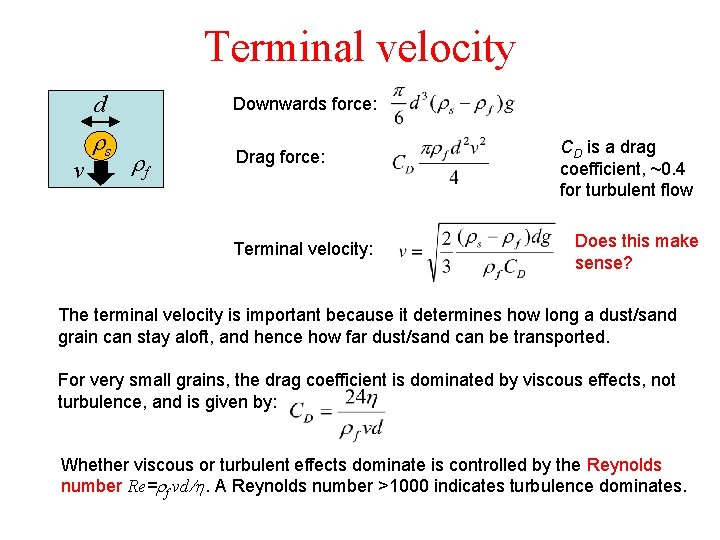
Terminal velocity d v rs Downwards force: rf Drag force: Terminal velocity: CD is a drag coefficient, ~0. 4 for turbulent flow Does this make sense? The terminal velocity is important because it determines how long a dust/sand grain can stay aloft, and hence how far dust/sand can be transported. For very small grains, the drag coefficient is dominated by viscous effects, not turbulence, and is given by: Whether viscous or turbulent effects dominate is controlled by the Reynolds number Re=rf vd/h. A Reynolds number >1000 indicates turbulence dominates.
Sand Fluxes Another empirical expression from Bagnold – the mass flux (kg s-1 m-1) of (saltating) sand grains: C is a constant Note that the sand flux goes as the friction velocity cubed – sand is mostly moved by rare, high wind-speed events. This makes predicting long-term fluxes from short-term records difficult.
Dune Motion Sand flux qs Dune speed vd a h Dx Does this equation make sense? Large dunes move slower than small dunes. What are some of the consequences of this? Dune modification timescale: l = length: height ratio (~10)
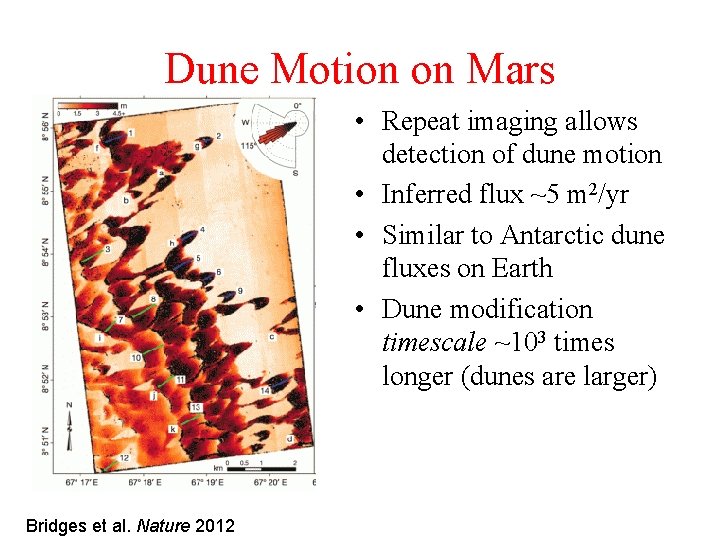
Dune Motion on Mars • Repeat imaging allows detection of dune motion • Inferred flux ~5 m 2/yr • Similar to Antarctic dune fluxes on Earth • Dune modification timescale ~103 times longer (dunes are larger) Bridges et al. Nature 2012
Aeolian Landforms • Known on Earth, Venus, Mars and Titan • Provide information on wind speed & direction, availability of sediment • One of the few time-variable features
Aeolian Features (Mars) • Wind is an important process on Mars at the present day (e. g. Viking seismometers. . . ) • Dust re-deposited over a very wide area (so the surface of Mars appears to have a very homogenous composition) • Occasionally get global dust-storms (hazardous for spacecraft) • Rates of deposition/erosion (almost) unknown Martian dune features Image of a dust devil caught in the act 30 km
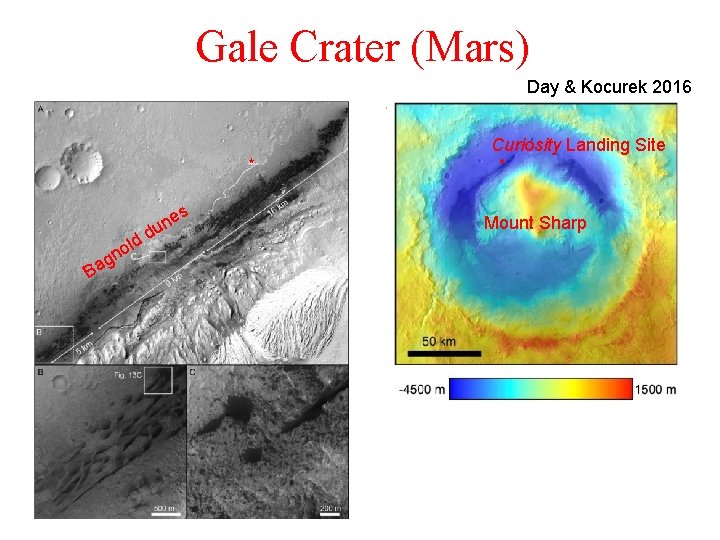
Gale Crater (Mars) Day & Kocurek 2016 Curiosity Landing Site s l dd Ba o gn e un Mount Sharp
Mount Sharp and Bagnold dunes
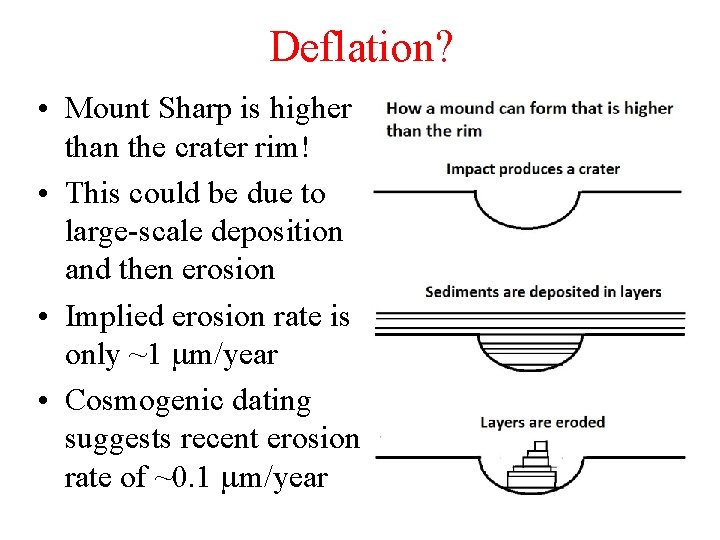
Deflation? • Mount Sharp is higher than the crater rim! • This could be due to large-scale deposition and then erosion • Implied erosion rate is only ~1 mm/year • Cosmogenic dating suggests recent erosion rate of ~0. 1 mm/year
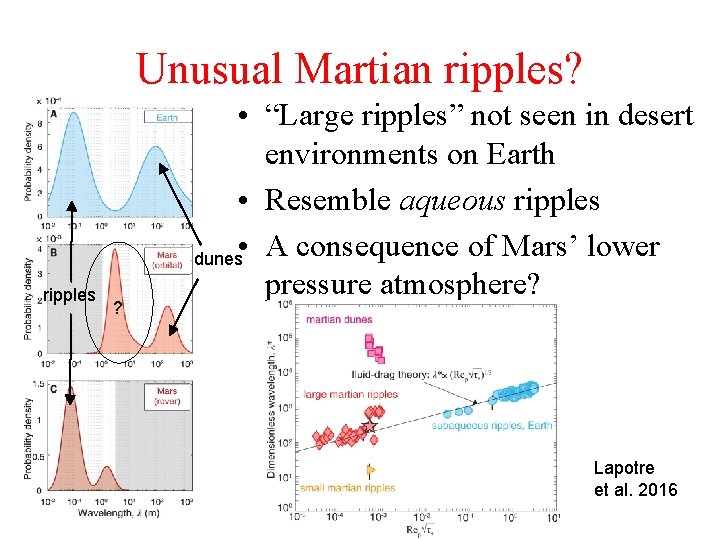
Unusual Martian ripples? ripples ? • “Large ripples” not seen in desert environments on Earth • Resemble aqueous ripples • A consequence of Mars’ lower dunes pressure atmosphere? Lapotre et al. 2016
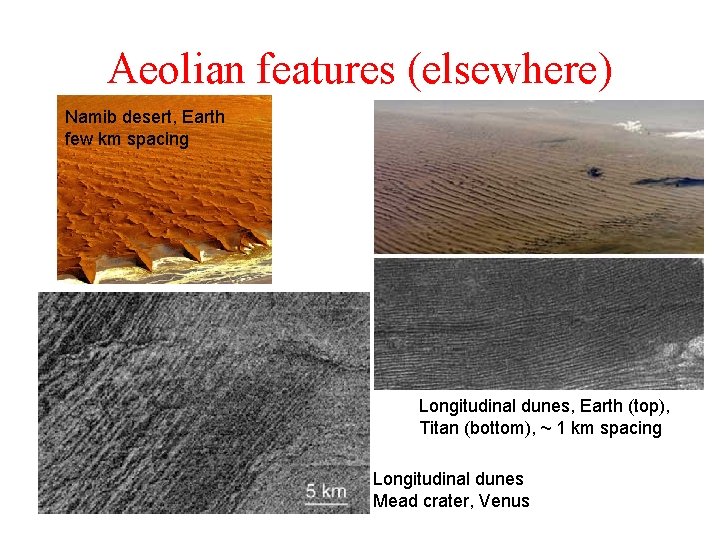
Aeolian features (elsewhere) Namib desert, Earth few km spacing Longitudinal dunes, Earth (top), Titan (bottom), ~ 1 km spacing Longitudinal dunes Mead crater, Venus
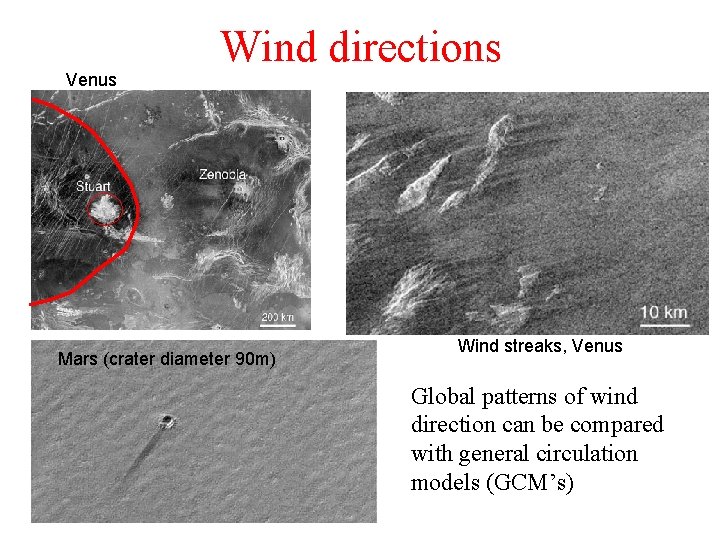
Venus Wind directions Mars (crater diameter 90 m) Wind streaks, Venus Global patterns of wind direction can be compared with general circulation models (GCM’s)
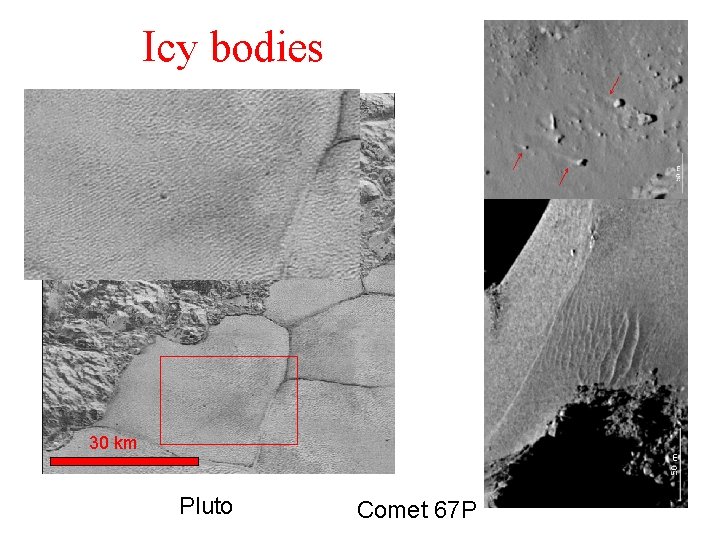
Icy bodies 30 km Pluto Comet 67 P
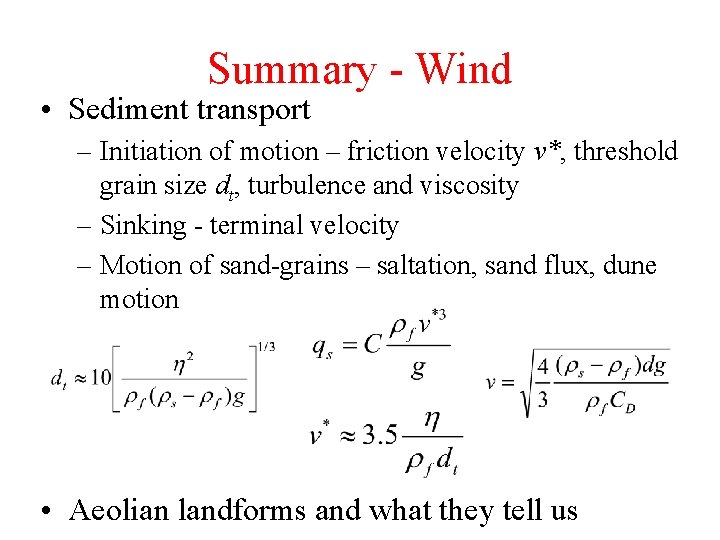
Summary - Wind • Sediment transport – Initiation of motion – friction velocity v*, threshold grain size dt, turbulence and viscosity – Sinking - terminal velocity – Motion of sand-grains – saltation, sand flux, dune motion • Aeolian landforms and what they tell us
Remainder of the quarter • • Tues 28 th - Ice Thurs 30 th - Fluvial Tues 4 th - Recap; PS#7 due Thurs 6 th - No lecture (office hours) • Weds 13 th – Final Exam
Wind speed Grain diameter
Dunes on C-G • “Lebanon” 2 m wide iron meteorite on Mars 1 km tall cliffs on C-G
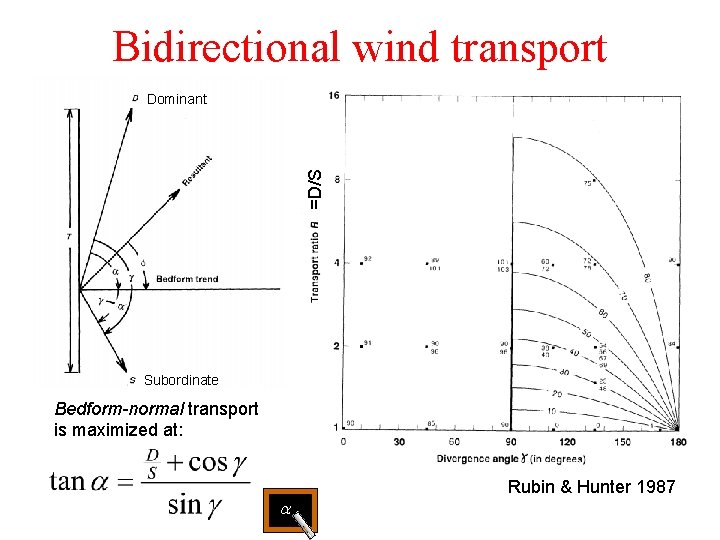
Bidirectional wind transport =D/S Dominant Subordinate Bedform-normal transport is maximized at: a Rubin & Hunter 1987
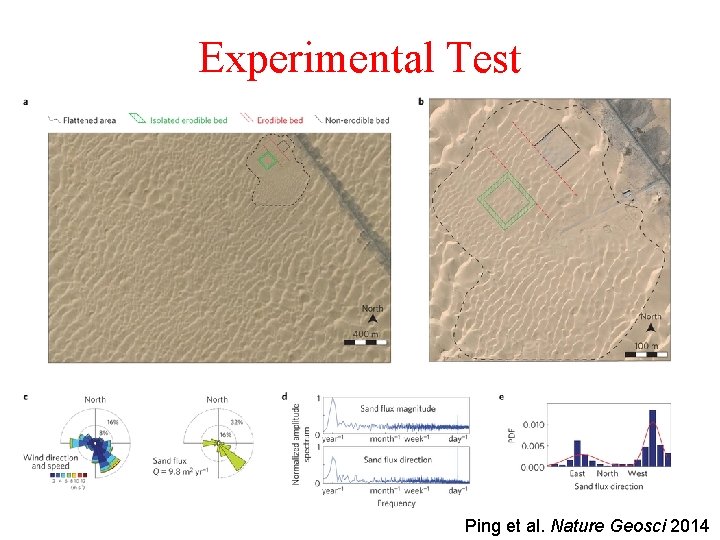
Experimental Test Ping et al. Nature Geosci 2014