
LAST TWO DIGITS OF A NUMBER b Number

LAST TWO DIGITS OF A NUMBER b) Number Ending with 3, 7 & 9 Remember 34 = 81 74 = 2401 92 = 81 :
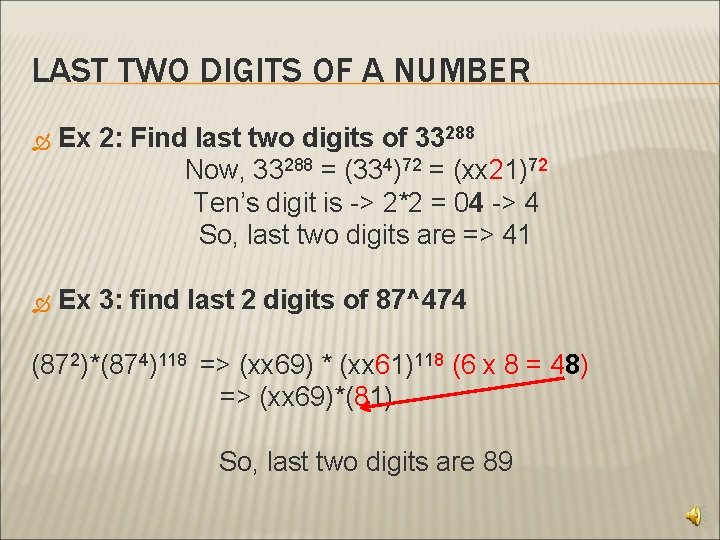
LAST TWO DIGITS OF A NUMBER Ex 2: Find last two digits of 33288 Now, 33288 = (334)72 = (xx 21)72 Ten’s digit is -> 2*2 = 04 -> 4 So, last two digits are => 41 Ex 3: find last 2 digits of 87^474 (872)*(874)118 => (xx 69) * (xx 61)118 (6 x 8 = 48) => (xx 69)*(81) So, last two digits are 89
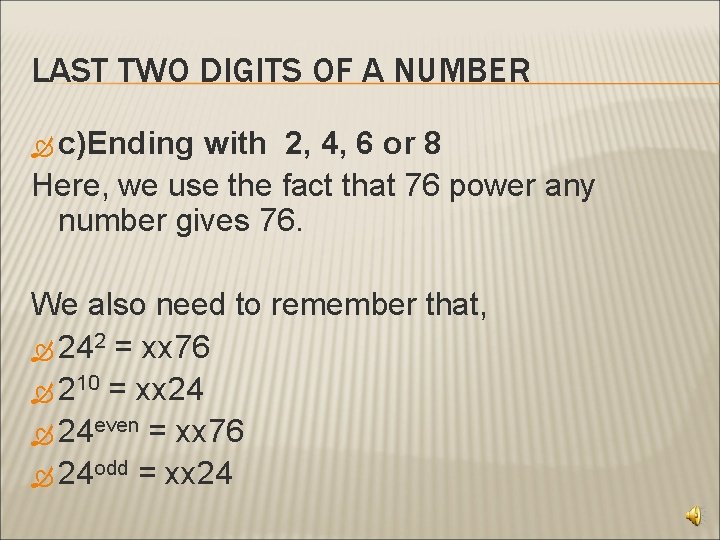
LAST TWO DIGITS OF A NUMBER c)Ending with 2, 4, 6 or 8 Here, we use the fact that 76 power any number gives 76. We also need to remember that, 242 = xx 76 210 = xx 24 24 even = xx 76 24 odd = xx 24

LAST TWO DIGITS OF A NUMBER Ex: Find the last two digits of 2543 = ((210)54) * (23) = ((xx 24)54)* 8 = ((xx 76)27)*8 76 power any number is 76 Which gives last digits as => 76 * 8 = 608 So last two digits are : 08
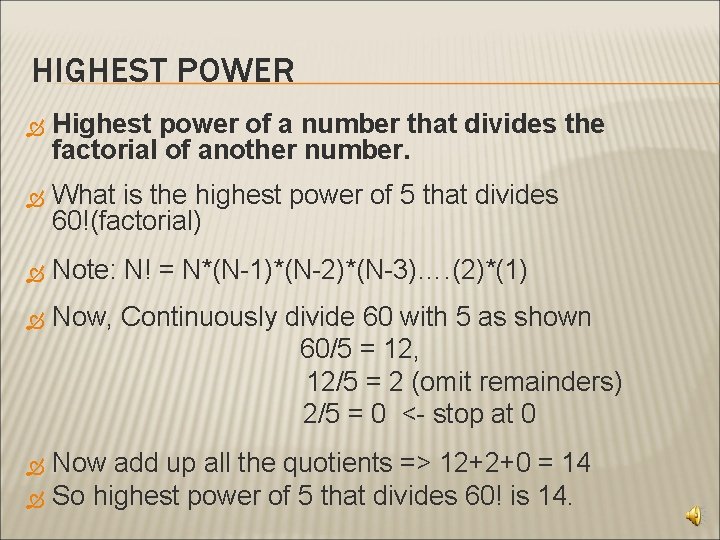
HIGHEST POWER Highest power of a number that divides the factorial of another number. What is the highest power of 5 that divides 60!(factorial) Note: N! = N*(N-1)*(N-2)*(N-3)…. (2)*(1) Now, Continuously divide 60 with 5 as shown 60/5 = 12, 12/5 = 2 (omit remainders) 2/5 = 0 <- stop at 0 Now add up all the quotients => 12+2+0 = 14 So highest power of 5 that divides 60! is 14.
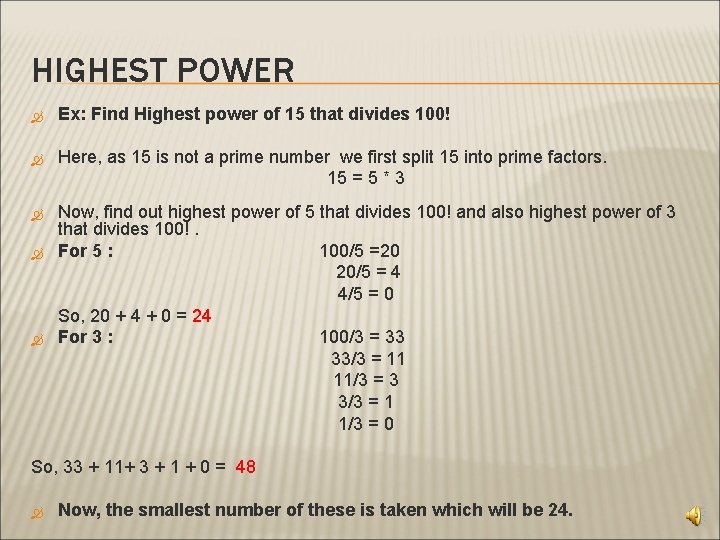
HIGHEST POWER Ex: Find Highest power of 15 that divides 100! Here, as 15 is not a prime number we first split 15 into prime factors. 15 = 5 * 3 Now, find out highest power of 5 that divides 100! and also highest power of 3 that divides 100!. For 5 : 100/5 =20 20/5 = 4 4/5 = 0 So, 20 + 4 + 0 = 24 For 3 : 100/3 = 33 33/3 = 11 11/3 = 3 3/3 = 1 1/3 = 0 So, 33 + 11+ 3 + 1 + 0 = 48 Now, the smallest number of these is taken which will be 24.
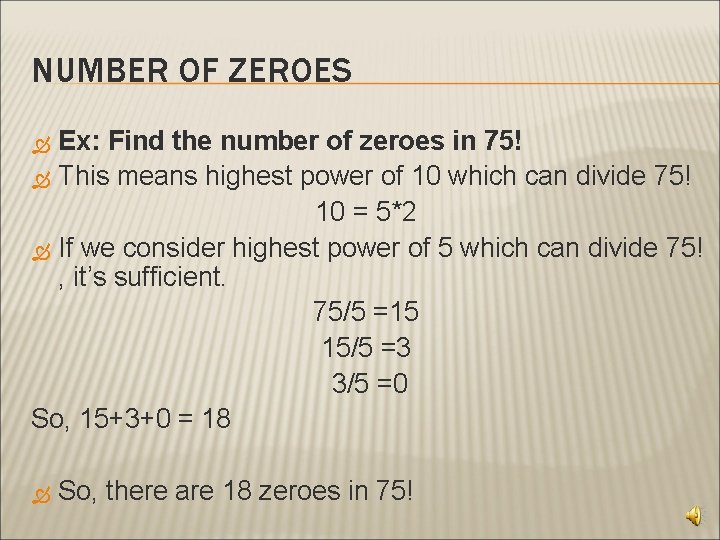
NUMBER OF ZEROES Ex: Find the number of zeroes in 75! This means highest power of 10 which can divide 75! 10 = 5*2 If we consider highest power of 5 which can divide 75! , it’s sufficient. 75/5 =15 15/5 =3 3/5 =0 So, 15+3+0 = 18 So, there are 18 zeroes in 75!
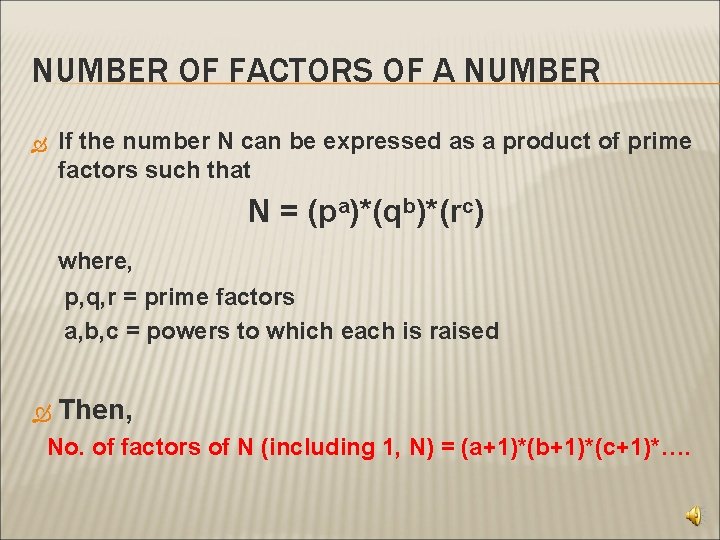
NUMBER OF FACTORS OF A NUMBER If the number N can be expressed as a product of prime factors such that N = (pa)*(qb)*(rc) where, p, q, r = prime factors a, b, c = powers to which each is raised Then, No. of factors of N (including 1, N) = (a+1)*(b+1)*(c+1)*….
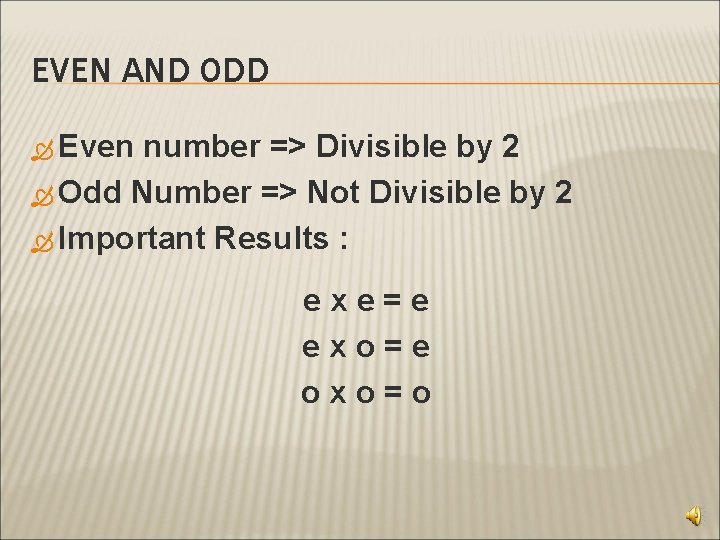
EVEN AND ODD Even number => Divisible by 2 Odd Number => Not Divisible by 2 Important Results : exe=e exo=e oxo=o
EXERCISE Download the related exercise here Exercise 1 - Number Systems

LET ME KNOW!!! If you liked this presentation, do comment on http: //nov 15. wordpress. com or write to Nicky at nickyswetha 20@yahoo. com

THANK YOU!
- Slides: 12