
Last Time Sources of Magnetic Field due to




- Slides: 35
Last Time • • Sources of Magnetic Field due to Moving Charges Cross Products: Right-hand Rule (Cross Products: Mathematically) 1
Today • (Cross Products: Mathematically) • Electron Current and Conventional Current • Calculating the Electron Current • True vs. Useful • Biot-Savart Law in a Wire • Relativity? ? 2
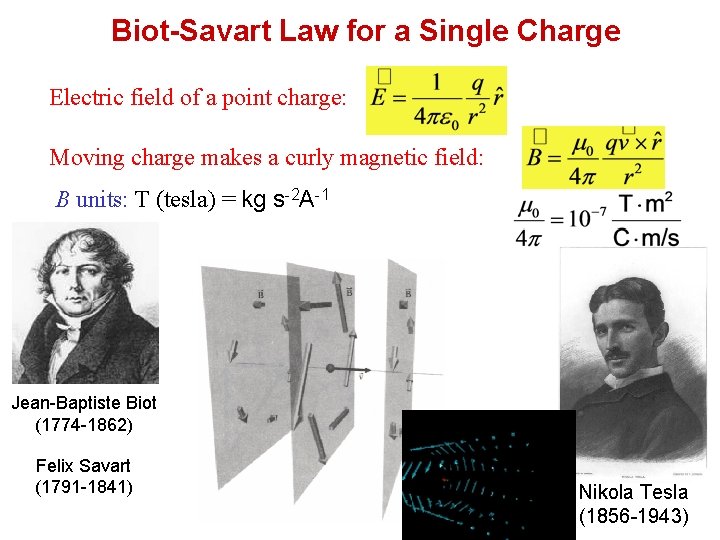
Biot-Savart Law for a Single Charge Electric field of a point charge: Moving charge makes a curly magnetic field: B units: T (tesla) = kg s-2 A-1 Jean-Baptiste Biot (1774 -1862) Felix Savart (1791 -1841) Nikola Tesla (1856 -1943)
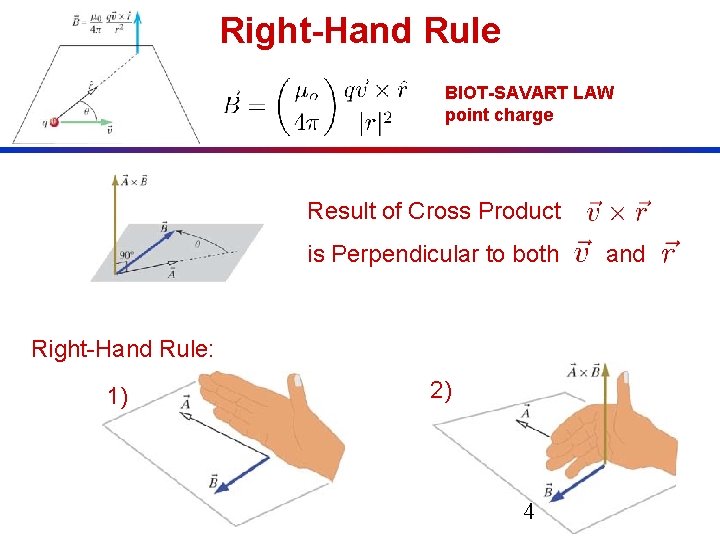
Right-Hand Rule BIOT-SAVART LAW point charge Result of Cross Product is Perpendicular to both Right-Hand Rule: 1) 2) 4 and
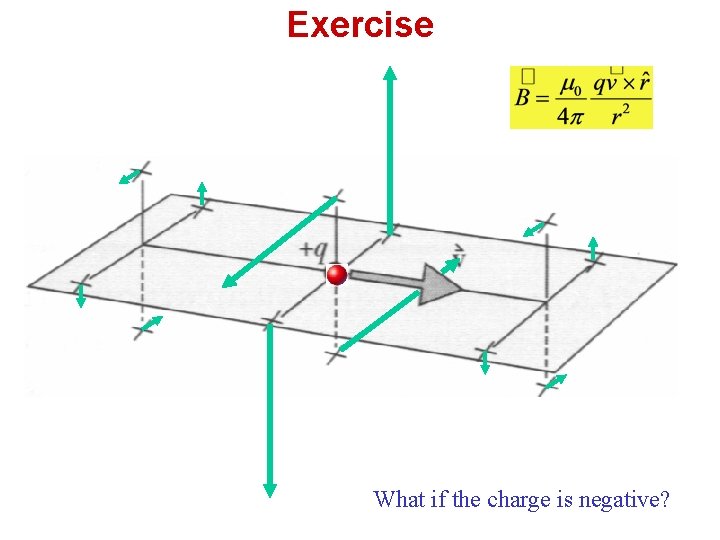
Exercise What if the charge is negative?
i. Clicker Question An electron passing through the origin is traveling at a constant velocity in the negative y direction. What is the direction of the magnetic field at a point on the positive z axis? y A) B) C) D) E) -x +x -z +z No magnetic field x v z
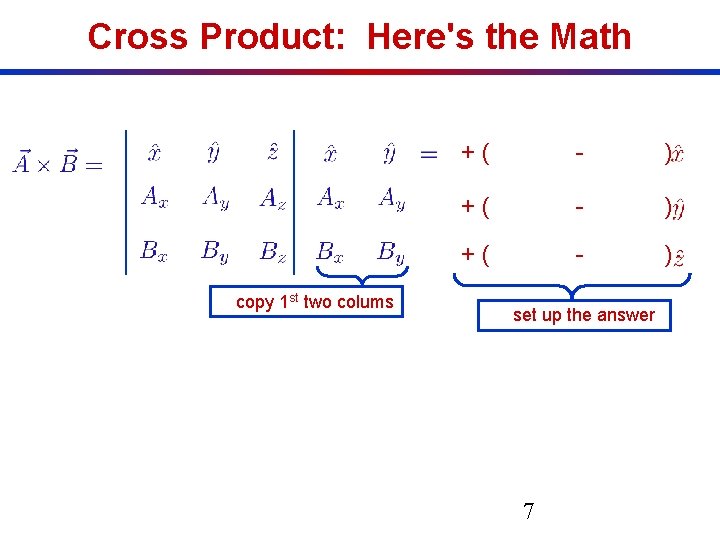
Cross Product: Here's the Math copy 1 st two colums +( - ) set up the answer 7
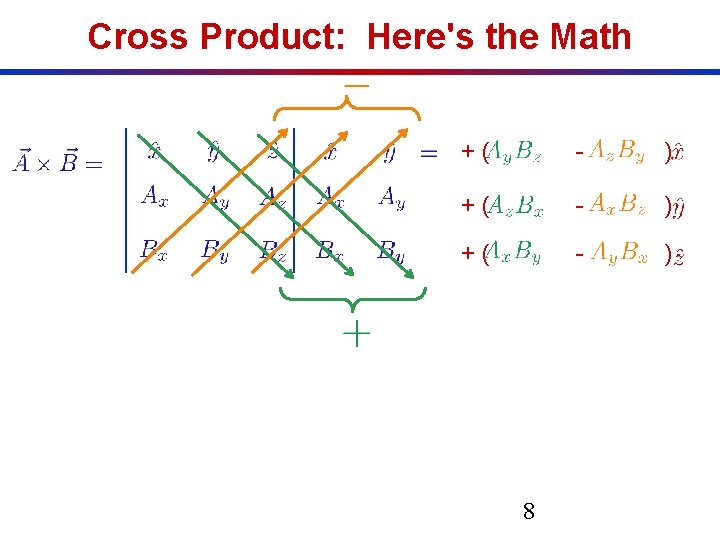
Cross Product: Here's the Math +( - ) 8
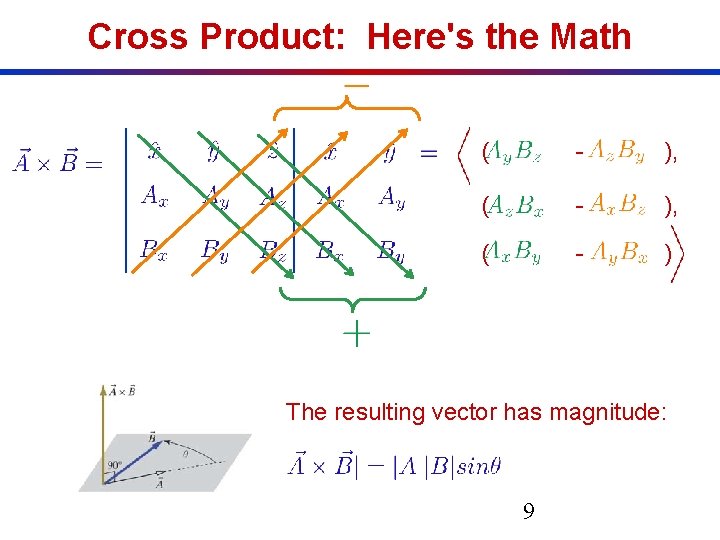
Cross Product: Here's the Math ( - ), ( - ) The resulting vector has magnitude: 9
Question What is the direction of < 0, 0, 3> x < 0, 4, 0>? A) +x B) –x C) +y D) –y E) zero magnitude
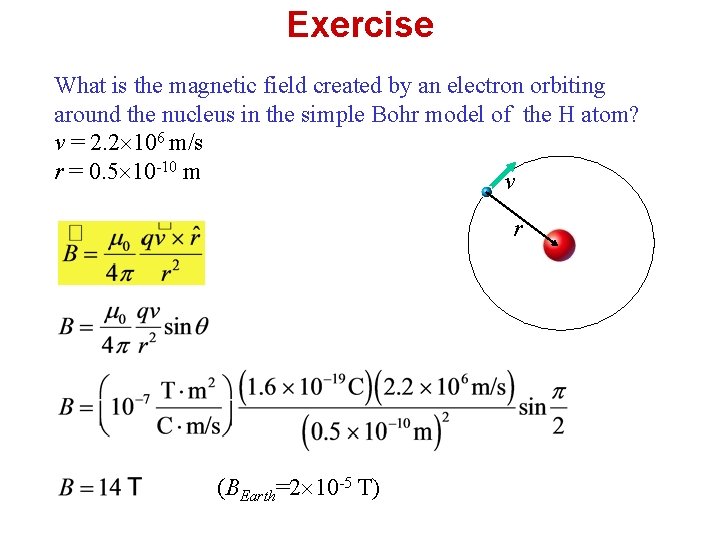
Exercise What is the magnetic field created by an electron orbiting around the nucleus in the simple Bohr model of the H atom? v = 2. 2 106 m/s r = 0. 5 10 -10 m v r (BEarth=2 10 -5 T)
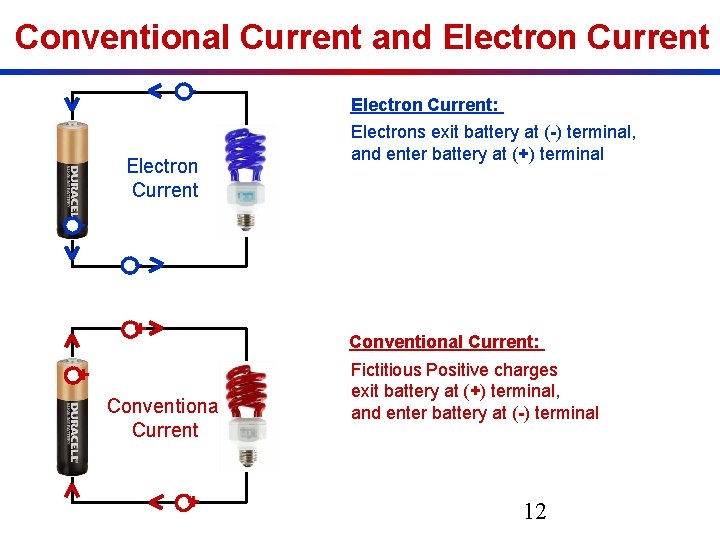
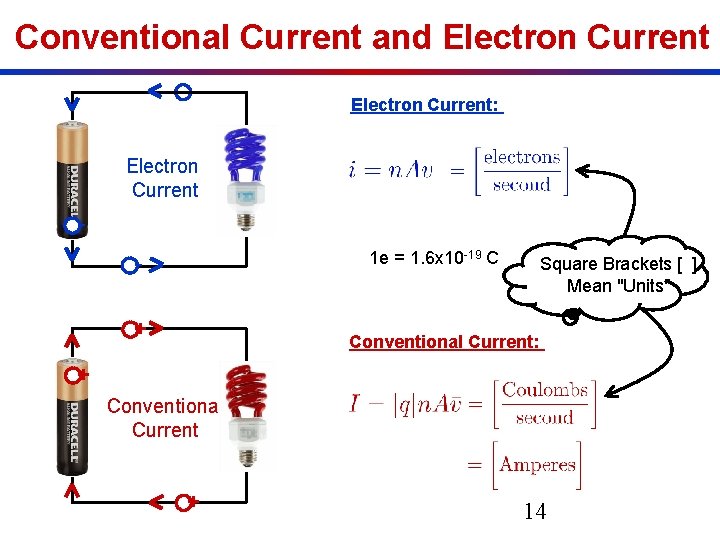
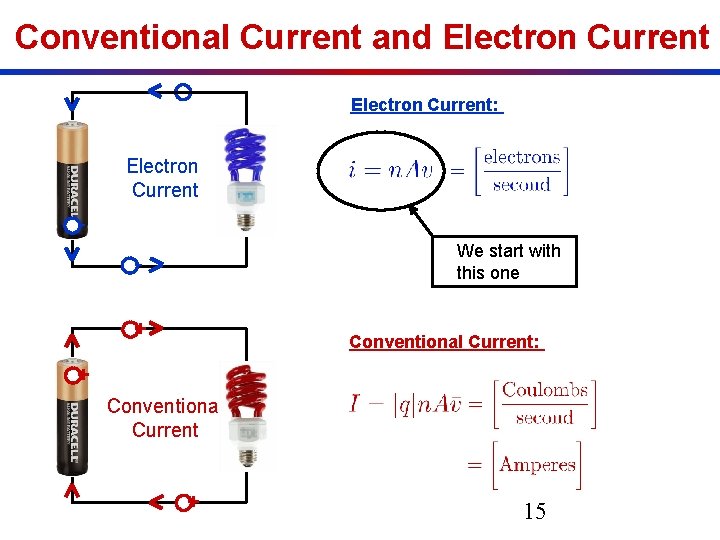
Conventional Current and Electron Current: Electrons exit battery at (-) terminal, and enter battery at (+) terminal + Conventional Current: + Conventional C Current + Fictitious Positive charges exit battery at (+) terminal, and enter battery at (-) terminal 12
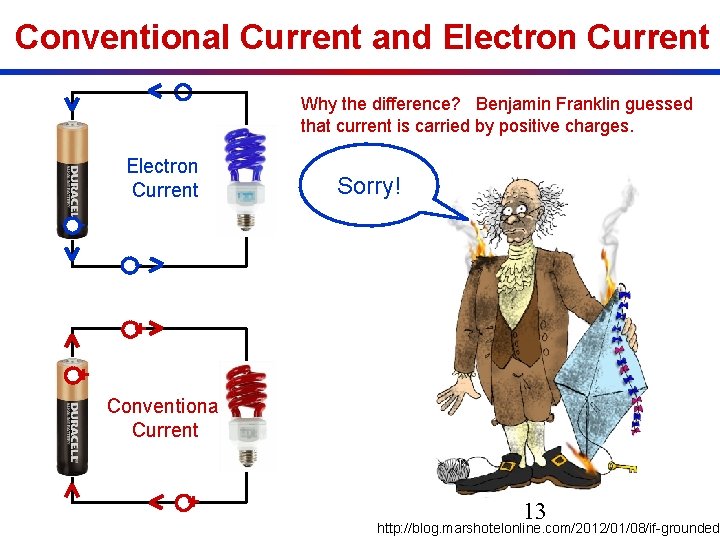
Conventional Current and Electron Current Electron C Current Why the difference? Benjamin Franklin guessed that current is carried by positive charges. Sorry! + + Conventional C Current + 13 http: //blog. marshotelonline. com/2012/01/08/if-grounded
Conventional Current and Electron Current - Electron Current: Electron C Current - 1 e = 1. 6 x 10 -19 C + Square Brackets [ ] Mean "Units" Conventional Current: + Conventional C Current + 14
Conventional Current and Electron Current - Electron Current: Electron C Current We start with this one + Conventional Current: + Conventional C Current + 15
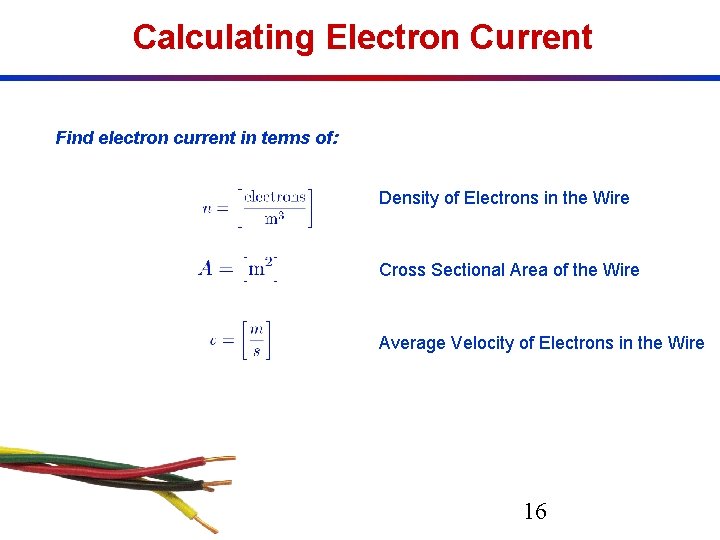
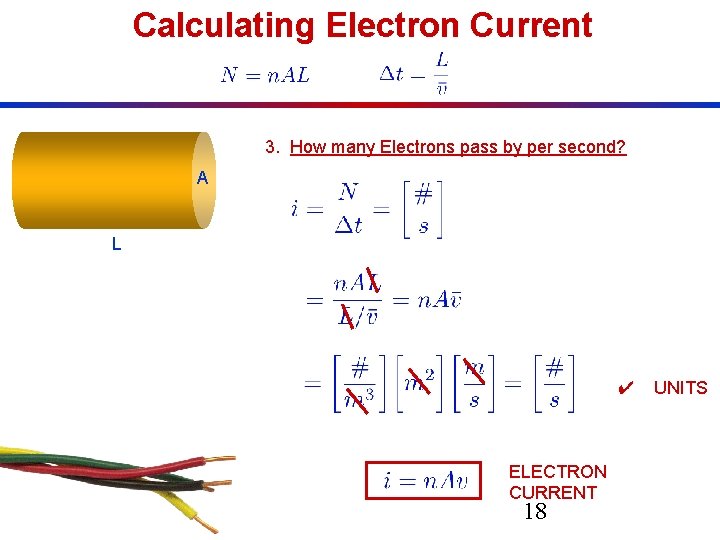
Calculating Electron Current Find electron current in terms of: Density of Electrons in the Wire Cross Sectional Area of the Wire Average Velocity of Electrons in the Wire 16
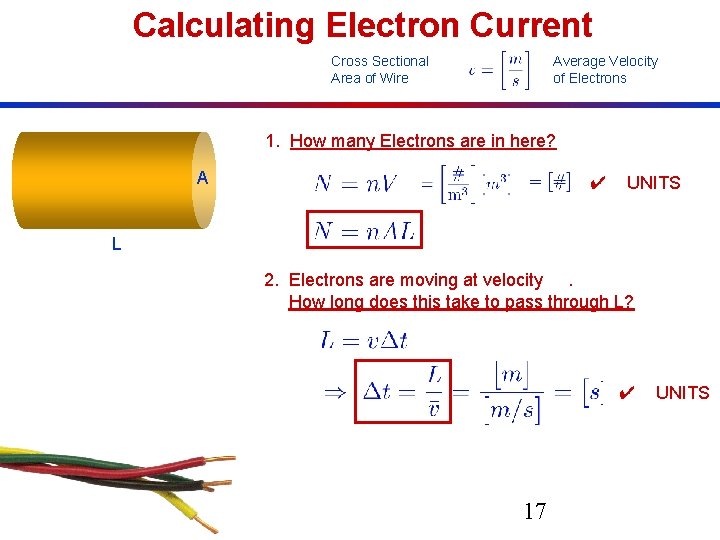
Calculating Electron Current Cross Sectional Area of Wire Average Velocity of Electrons 1. How many Electrons are in here? A ✔ UNITS L 2. Electrons are moving at velocity. How long does this take to pass through L? ✔ 17 UNITS
Calculating Electron Current 3. How many Electrons pass by per second? A L ✔ ELECTRON CURRENT 18 UNITS
i. Clicker Question A typical electron current in a circuit is 1018 electrons/s. What is the conventional current? A. B. C. D. E. 1. 6 A 16 A 32 A 0. 16 A Unknown
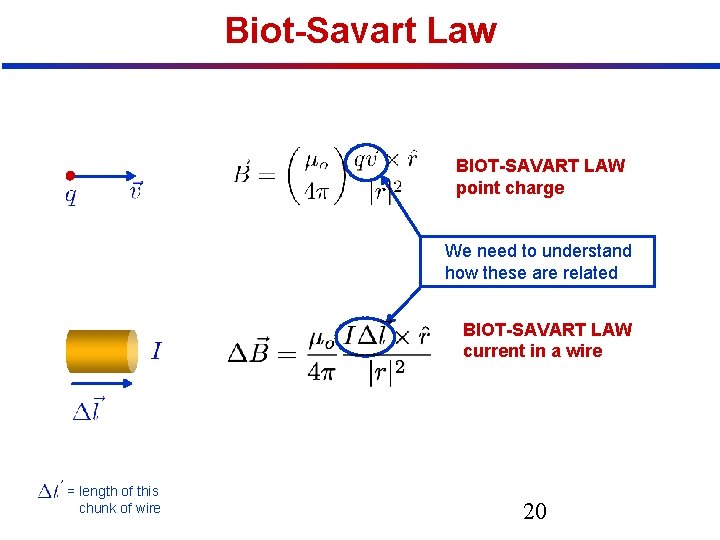
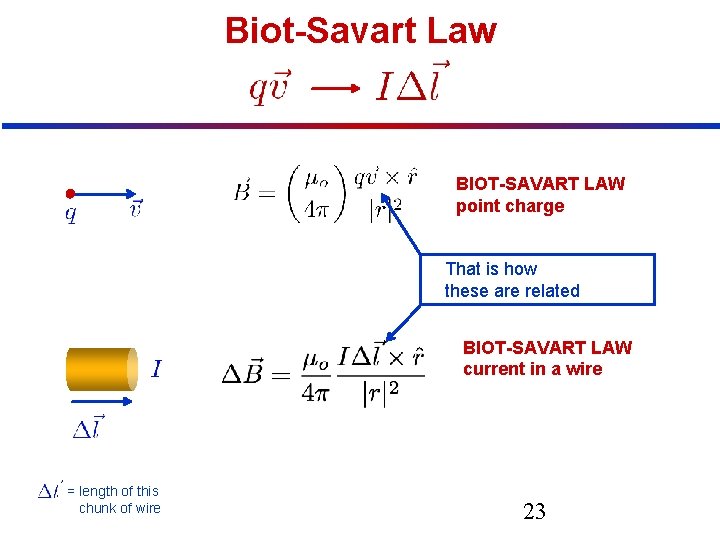
Biot-Savart Law BIOT-SAVART LAW point charge We need to understand how these are related BIOT-SAVART LAW current in a wire = length of this chunk of wire 20
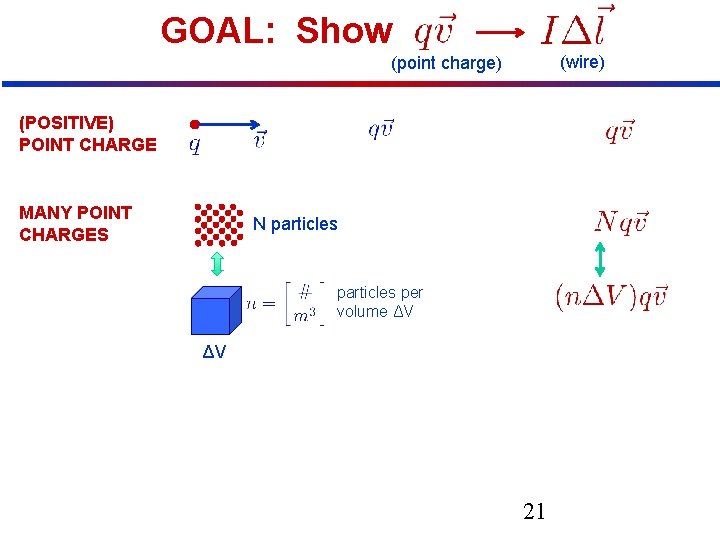
GOAL: Show (wire) (point charge) (POSITIVE) POINT CHARGE MANY POINT CHARGES N particles per volume ΔV ΔV 21
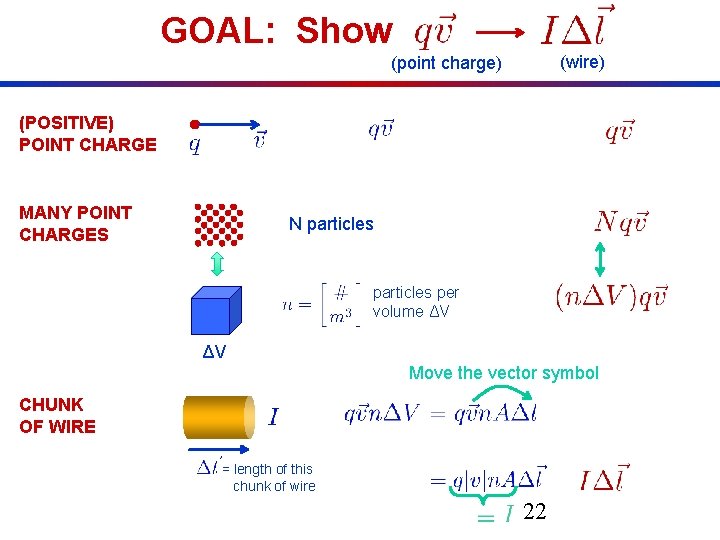
GOAL: Show (wire) (point charge) (POSITIVE) POINT CHARGE MANY POINT CHARGES N particles per volume ΔV ΔV Move the vector symbol CHUNK OF WIRE = length of this chunk of wire 22
Biot-Savart Law BIOT-SAVART LAW point charge That is how these are related BIOT-SAVART LAW current in a wire = length of this chunk of wire 23
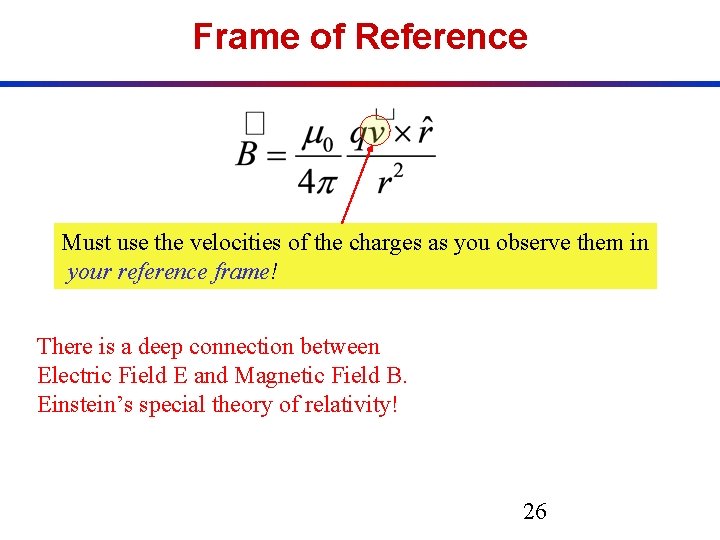
i. Clicker Question Jessie Bob and his classmates are motionless w. r. t. a charged object on table. Jessie is running nearby. Both of them measure the B field produced by the charged object. Which of the following is correct: A. B(Bob) = 0, B(Jessie) = 0 B. B(Bob) != 0, B(Jessie) != 0 C. B(Bob) = 0, B(Jessie) != 0 charged tape Bob 24
i. Clicker Question Biot-Savart Law is an Approximation Electric fields: produced by charges Magnetic fields: produced by moving charges Any magnetic field? charged tape 25
Frame of Reference Must use the velocities of the charges as you observe them in your reference frame! There is a deep connection between Electric Field E and Magnetic Field B. Einstein’s special theory of relativity! 26
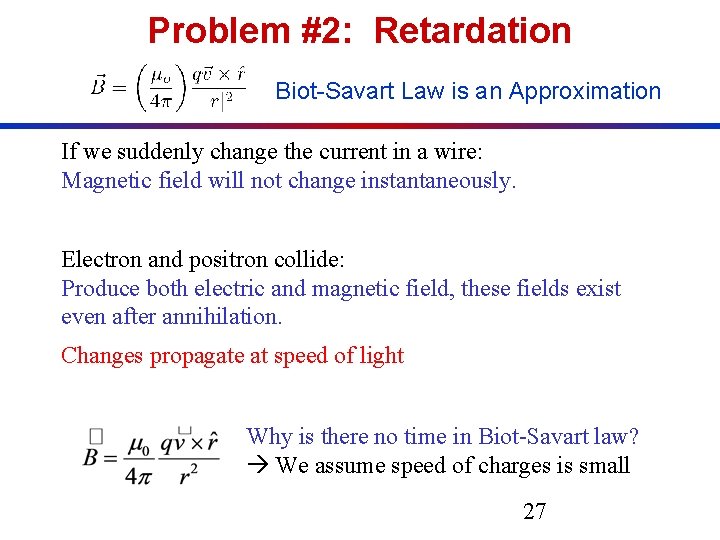
Problem #2: Retardation Biot-Savart Law is an Approximation If we suddenly change the current in a wire: Magnetic field will not change instantaneously. Electron and positron collide: Produce both electric and magnetic field, these fields exist even after annihilation. Changes propagate at speed of light Why is there no time in Biot-Savart law? We assume speed of charges is small 27
Today • (Cross Products: Mathematically) • Electron Current and Conventional Current • Calculating the Electron Current • True vs. Useful • Biot-Savart Law in a Wire • Relativity!! 28
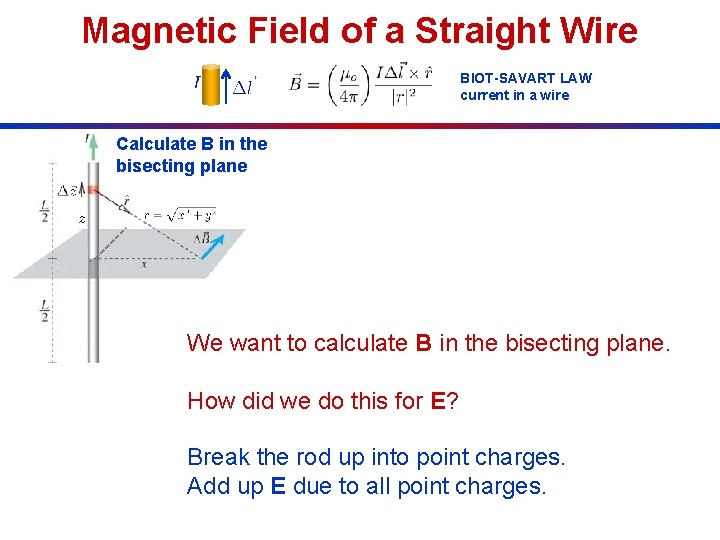
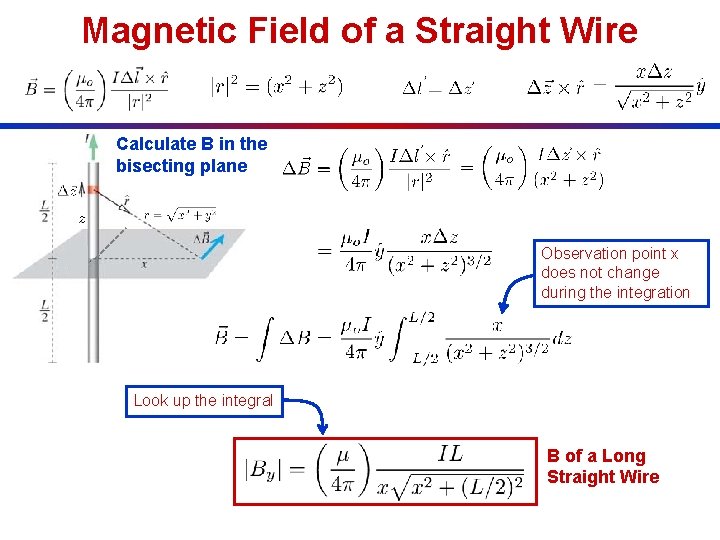
Magnetic Field of a Straight Wire BIOT-SAVART LAW current in a wire Calculate B in the bisecting plane We want to calculate B in the bisecting plane. How did we do this for E? Break the rod up into point charges. Add up E due to all point charges.
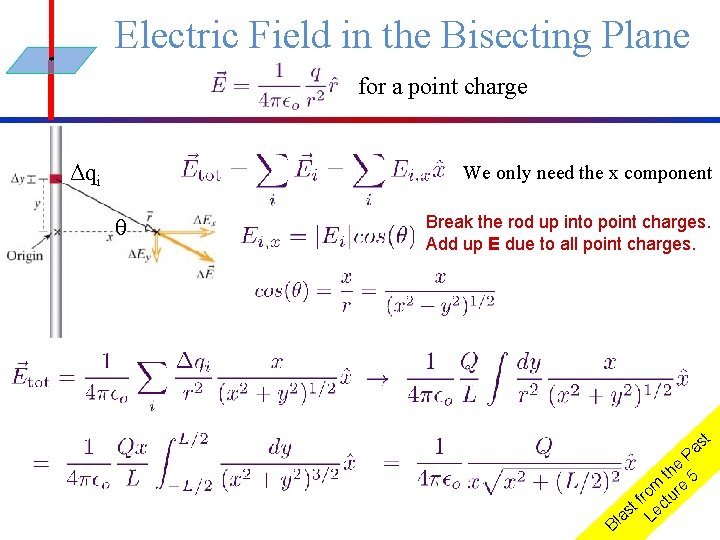
Electric Field in the Bisecting Plane for a point charge Δqi We only need the x component θ Break the rod up into point charges. Add up E due to all point charges. t s Pa B e th 5 m e rf o tur st Lec a l
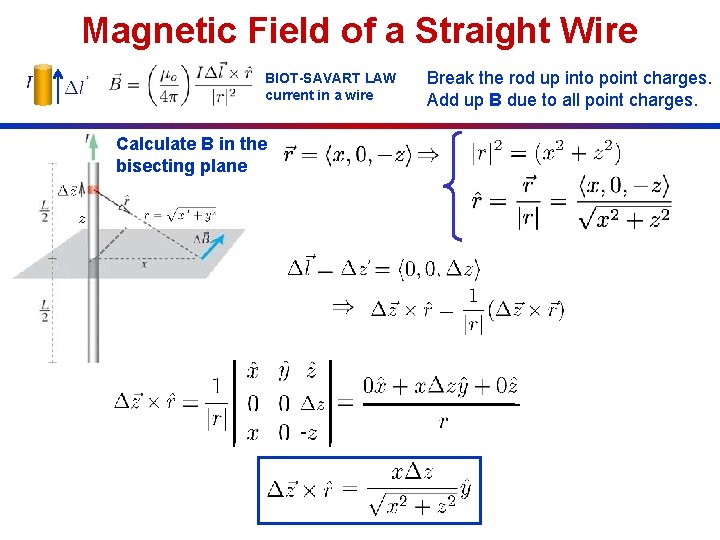
Magnetic Field of a Straight Wire BIOT-SAVART LAW current in a wire Calculate B in the bisecting plane - Break the rod up into point charges. Add up B due to all point charges.
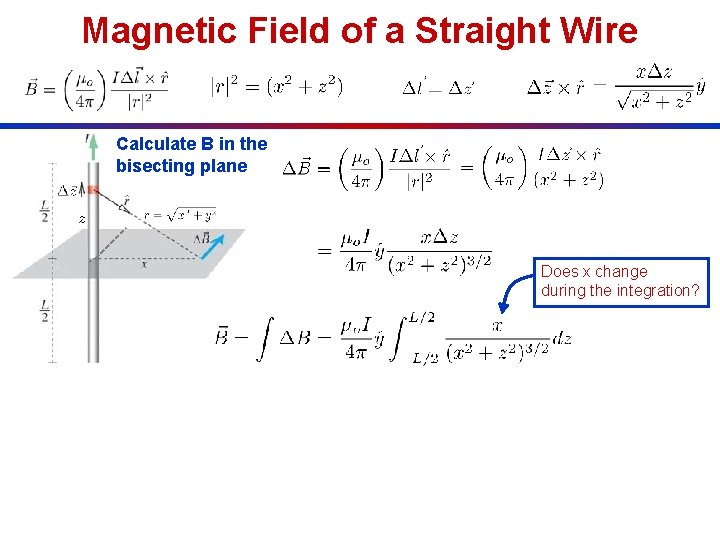
Magnetic Field of a Straight Wire Calculate B in the bisecting plane Does x change during the integration?
Magnetic Field of a Straight Wire Calculate B in the bisecting plane Observation point x does not change during the integration Look up the integral B of a Long Straight Wire
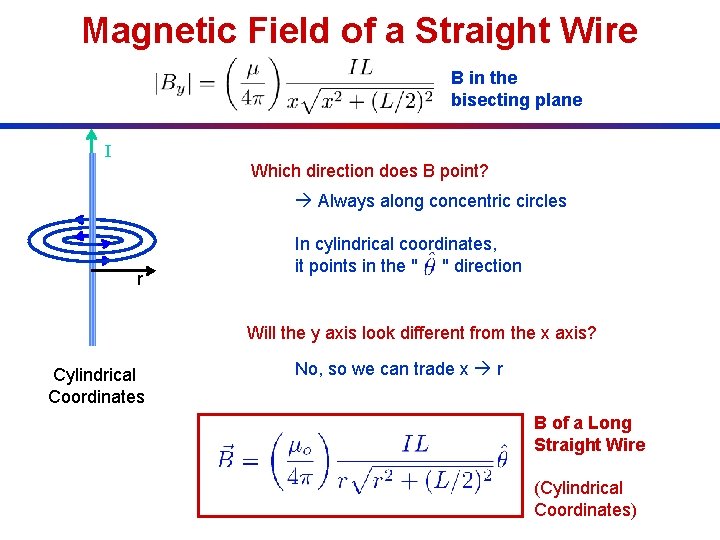
Magnetic Field of a Straight Wire B in the bisecting plane I Which direction does B point? Always along concentric circles r In cylindrical coordinates, it points in the " " direction Will the y axis look different from the x axis? Cylindrical Coordinates No, so we can trade x r B of a Long Straight Wire (Cylindrical Coordinates)
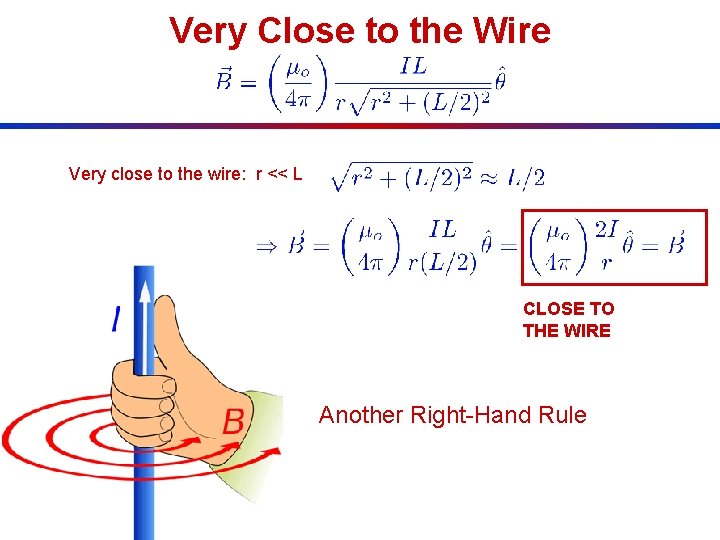
Very Close to the Wire Very close to the wire: r << L CLOSE TO THE WIRE Another Right-Hand Rule