
Last Time Signal Processing Filtering basics Homework 2
Last Time • • Signal Processing Filtering basics Homework 2 Project 1 09/24/02 (c) 2002 University of Wisconsin, CS 559
Today • More Filters • Sampling and Reconstruct • Image warping 09/24/02 (c) 2002 University of Wisconsin, CS 559
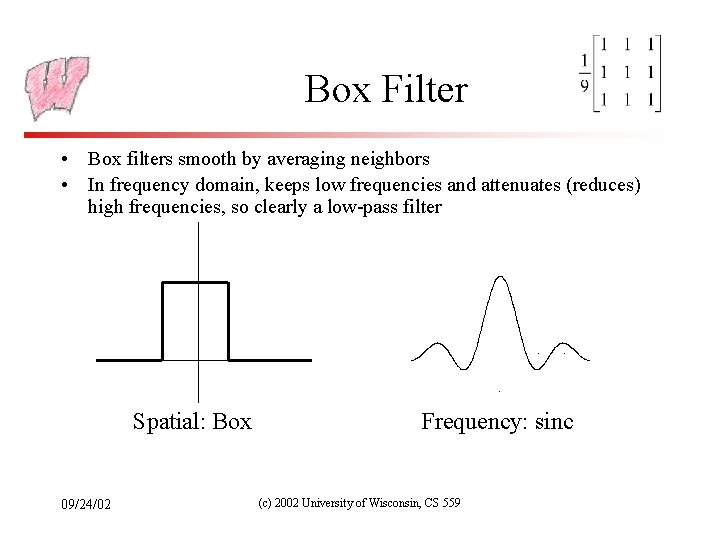
Box Filter • Box filters smooth by averaging neighbors • In frequency domain, keeps low frequencies and attenuates (reduces) high frequencies, so clearly a low-pass filter Spatial: Box 09/24/02 Frequency: sinc (c) 2002 University of Wisconsin, CS 559
Box Filter 09/24/02 (c) 2002 University of Wisconsin, CS 559
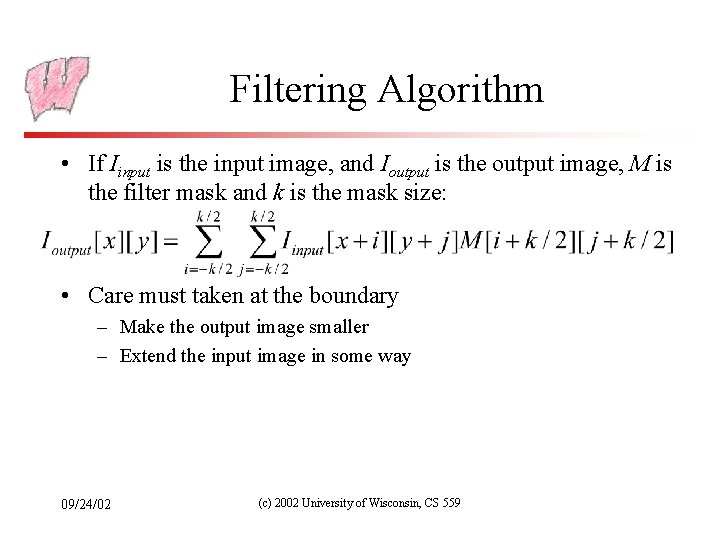
Filtering Algorithm • If Iinput is the input image, and Ioutput is the output image, M is the filter mask and k is the mask size: • Care must taken at the boundary – Make the output image smaller – Extend the input image in some way 09/24/02 (c) 2002 University of Wisconsin, CS 559

Bartlett Filter • Triangle shaped filter in spatial domain • In frequency domain, product of two box filters, so attenuates high frequencies more than a box Spatial: Triangle (Box Box) 09/24/02 Frequency: sinc 2 (c) 2002 University of Wisconsin, CS 559
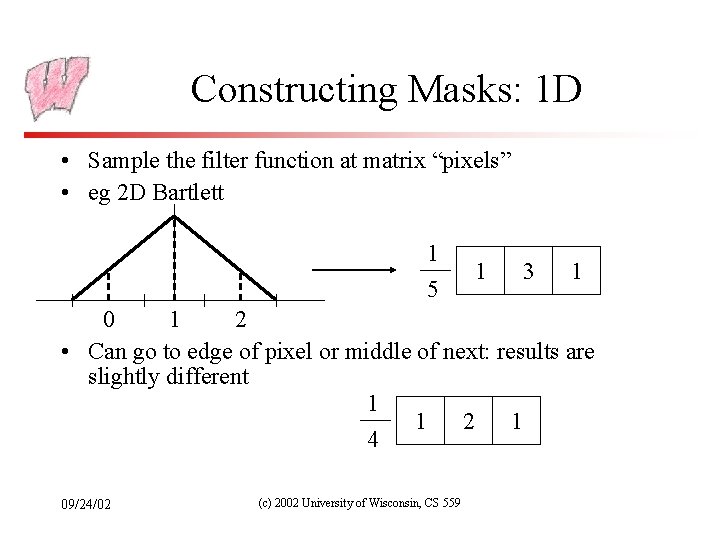
Constructing Masks: 1 D • Sample the filter function at matrix “pixels” • eg 2 D Bartlett 1 5 1 3 1 0 1 2 • Can go to edge of pixel or middle of next: results are slightly different 1 1 2 1 4 09/24/02 (c) 2002 University of Wisconsin, CS 559
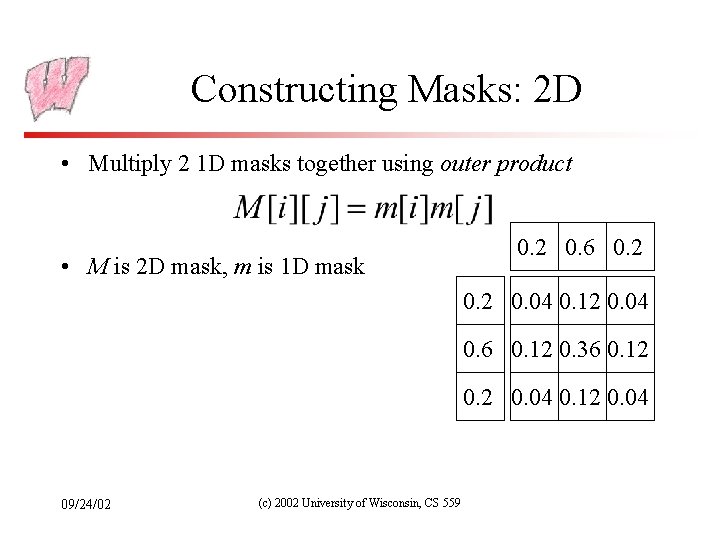
Constructing Masks: 2 D • Multiply 2 1 D masks together using outer product • M is 2 D mask, m is 1 D mask 0. 2 0. 6 0. 2 0. 04 0. 12 0. 04 0. 6 0. 12 0. 36 0. 12 0. 04 09/24/02 (c) 2002 University of Wisconsin, CS 559
Bartlett Filter 09/24/02 (c) 2002 University of Wisconsin, CS 559
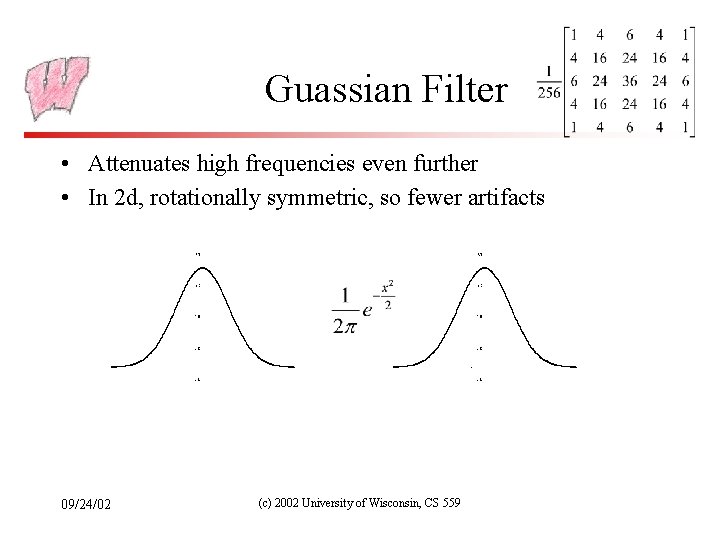
Guassian Filter • Attenuates high frequencies even further • In 2 d, rotationally symmetric, so fewer artifacts 09/24/02 (c) 2002 University of Wisconsin, CS 559
Gaussian Filter 09/24/02 (c) 2002 University of Wisconsin, CS 559
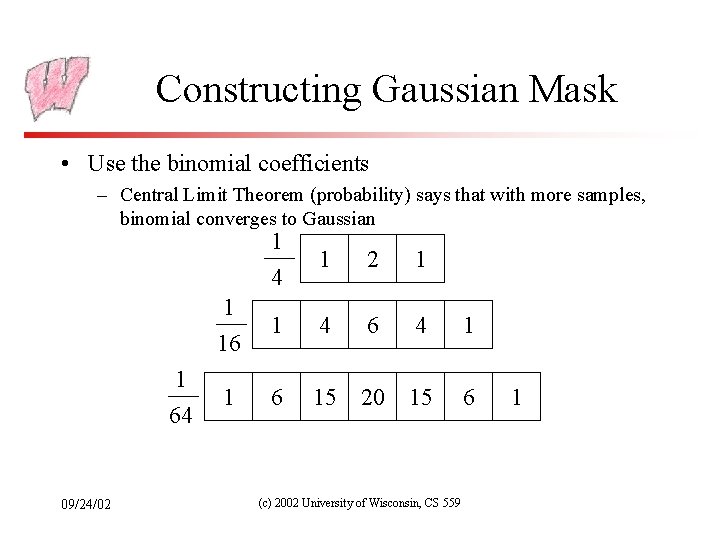
Constructing Gaussian Mask • Use the binomial coefficients – Central Limit Theorem (probability) says that with more samples, binomial converges to Gaussian 1 64 09/24/02 1 4 1 2 1 1 16 1 4 6 4 1 1 6 15 20 15 6 (c) 2002 University of Wisconsin, CS 559 1
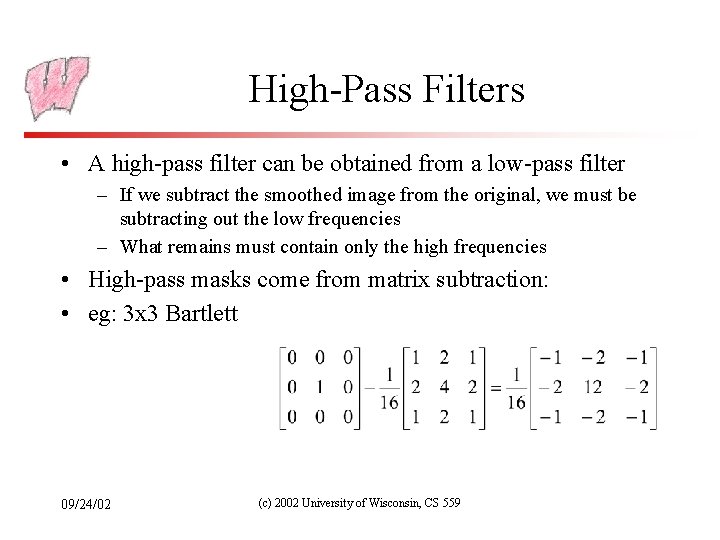
High-Pass Filters • A high-pass filter can be obtained from a low-pass filter – If we subtract the smoothed image from the original, we must be subtracting out the low frequencies – What remains must contain only the high frequencies • High-pass masks come from matrix subtraction: • eg: 3 x 3 Bartlett 09/24/02 (c) 2002 University of Wisconsin, CS 559
High-Pass Filter 09/24/02 (c) 2002 University of Wisconsin, CS 559
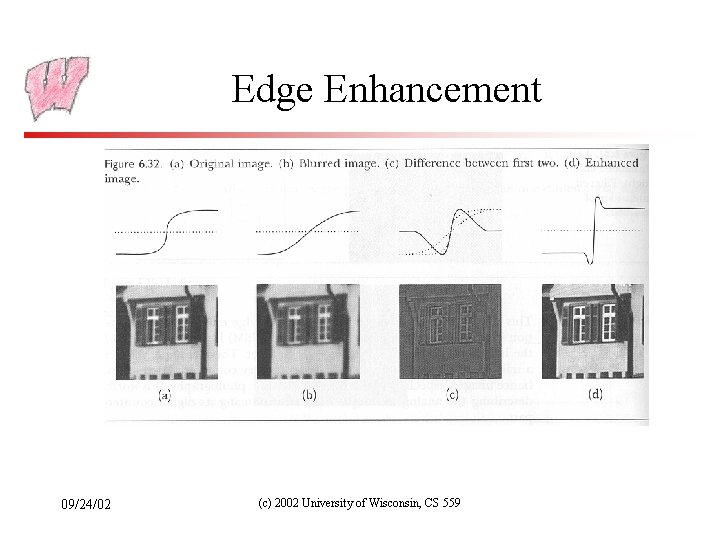
Edge Enhancement • High-pass filters give high values at edges, low values in constant regions • Adding high frequencies back into the image enhances edges • One approach: – Image = Image + [Image – smooth(Image)] Low-pass High-pass 09/24/02 (c) 2002 University of Wisconsin, CS 559
Edge-Enhance Filter 09/24/02 (c) 2002 University of Wisconsin, CS 559
Edge Enhancement 09/24/02 (c) 2002 University of Wisconsin, CS 559
Fixing Negative Values • The negative values in high-pass filters can lead to negative image values – Most image formats don’t support this • Solutions: – Truncate: Chop off values below min or above max – Offset: Add a constant to move the min value to 0 – Re-scale: Rescale the image values to fill the range (0, max) 09/24/02 (c) 2002 University of Wisconsin, CS 559
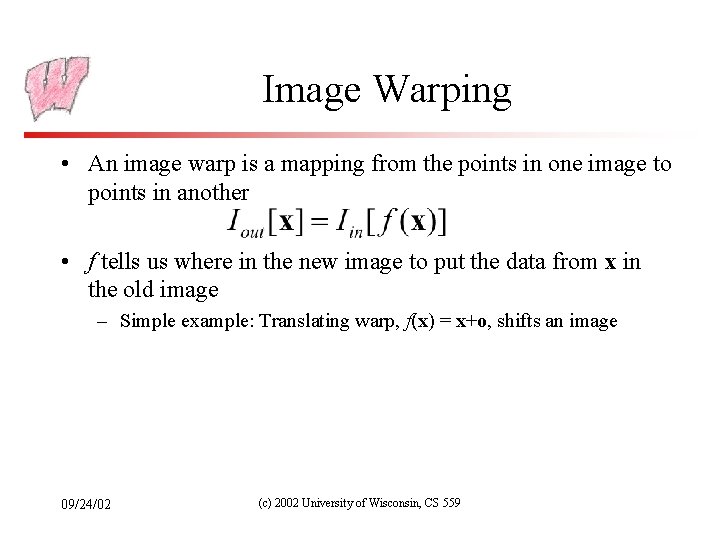
Image Warping • An image warp is a mapping from the points in one image to points in another • f tells us where in the new image to put the data from x in the old image – Simple example: Translating warp, f(x) = x+o, shifts an image 09/24/02 (c) 2002 University of Wisconsin, CS 559
Reducing Image Size • Warp function: f(x)=kx, k > 1 • Problem: More than one input pixel maps to each output pixel • Solution: Filter down to smaller size – Apply the filter, but not at every pixel, only at desired output locations – eg: To get half image size, only apply filter at every second pixel 09/24/02 (c) 2002 University of Wisconsin, CS 559
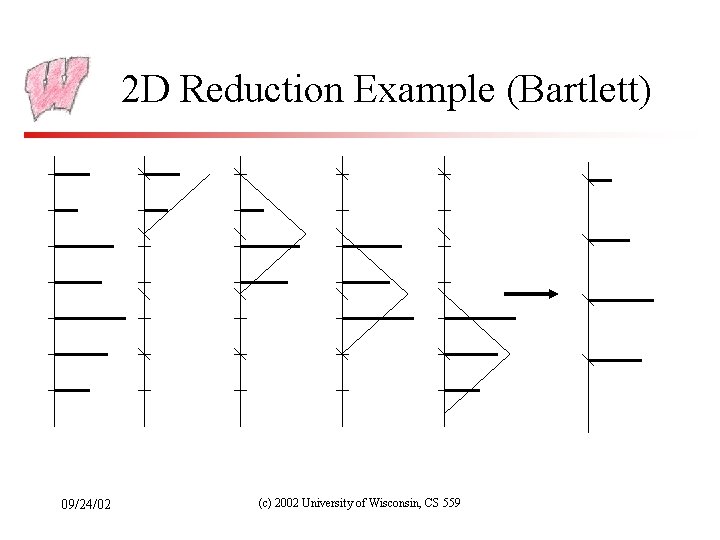
2 D Reduction Example (Bartlett) 09/24/02 (c) 2002 University of Wisconsin, CS 559
Ideal Image Size Reduction • Reconstruct original function using reconstruction filter • Resample at new resolution (lower frequency) – Clearly demonstrates that shrinking removes detail • Expensive, and not possible to do perfectly in the spatial domain… 09/24/02 (c) 2002 University of Wisconsin, CS 559
Enlarging Images • Warp function: f(x)=kx, k < 1 • Problem: Have to create pixel data – More pixels in output than in input • Solution: Filter up to larger size – Apply the filter at intermediate pixel locations – eg: To get double image size, apply filter at every pixel and every half pixel • New pixels are interpolated from old ones – Filter encodes interpolation function 09/24/02 (c) 2002 University of Wisconsin, CS 559
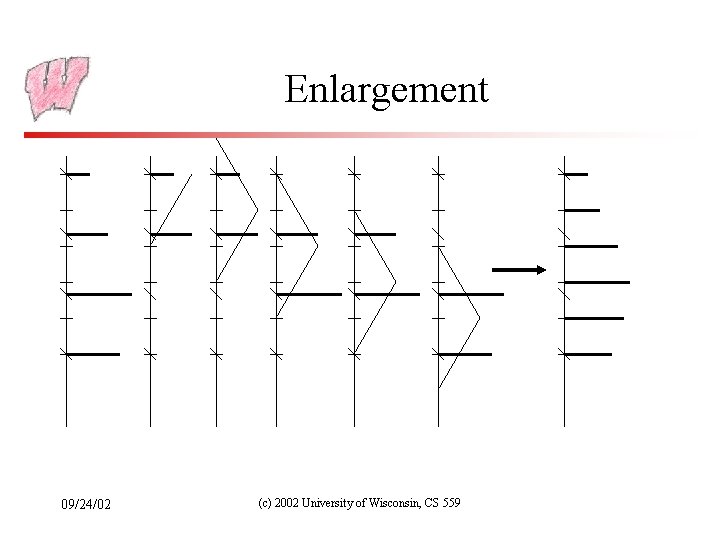
Enlargement 09/24/02 (c) 2002 University of Wisconsin, CS 559
Ideal Enlargement • Reconstruct original function • Resample at higher frequency • Original function was band-limited, so re-sampling does not add any extra frequency information 09/24/02 (c) 2002 University of Wisconsin, CS 559
- Slides: 25