
Last Homework before Exam HW4 is due Friday
• Last Homework before Exam (HW#4) is due Friday at 11: 50 am. • Nighttime observing has 8 more nights. Check the webpage. • 1 st exam is October 10 th, less than 2 weeks away! • Justin will have extra office hour Thursday before exam– 4: 00 to 5: 00 pm. • I will have extra office hour Wednesday before exam – 10: 30 to 11: 30 am. Sept 29, 2003 Astronomy 100 Fall 2003
#5 Sept 29, 2003 Astronomy 100 Fall 2003
#10 Sept 29, 2003 Astronomy 100 Fall 2003
#14 Sept 29, 2003 Astronomy 100 Fall 2003
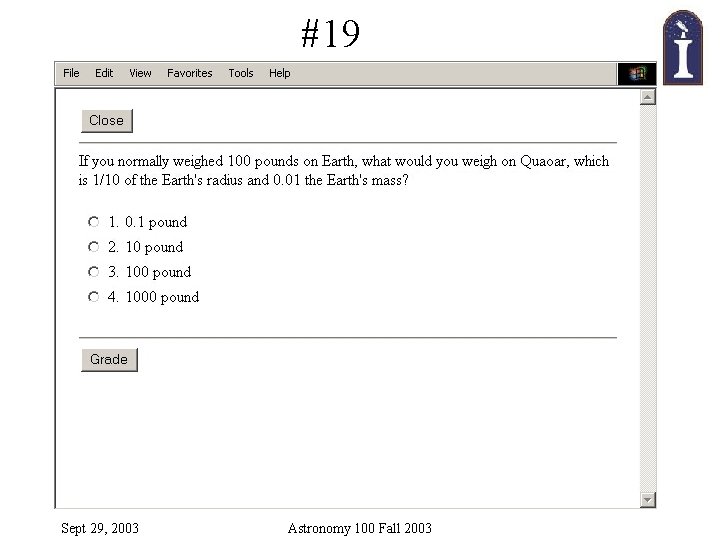
#19 Sept 29, 2003 Astronomy 100 Fall 2003
Moon weight Sept 29, 2003 Astronomy 100 Fall 2003
Quaoar weight Sept 29, 2003 Astronomy 100 Fall 2003
Outline • Mercury – Shortest year – Tenuous atmosphere • Venus – Hottest Planet and longest day – Greenhouse Effect • Mars – Weather – Water – Life? Sept 29, 2003 Astronomy 100 Fall 2003
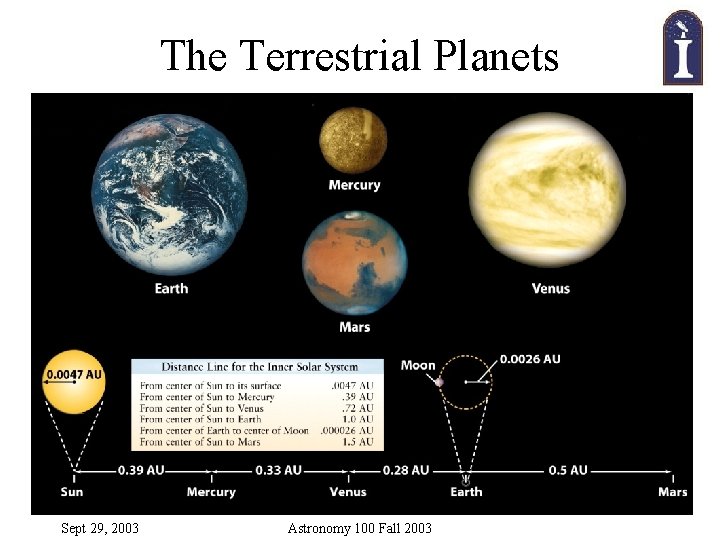
The Terrestrial Planets Sept 29, 2003 Astronomy 100 Fall 2003
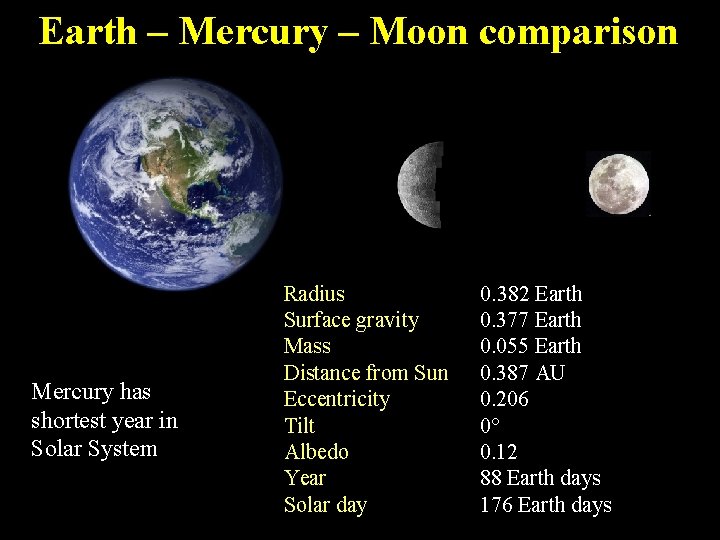
Earth – Mercury – Moon comparison Mercury has shortest year in Solar System Sept 29, 2003 Radius Surface gravity Mass Distance from Sun Eccentricity Tilt Albedo Year Solar day Astronomy 100 Fall 2003 0. 382 Earth 0. 377 Earth 0. 055 Earth 0. 387 AU 0. 206 0° 0. 12 88 Earth days 176 Earth days
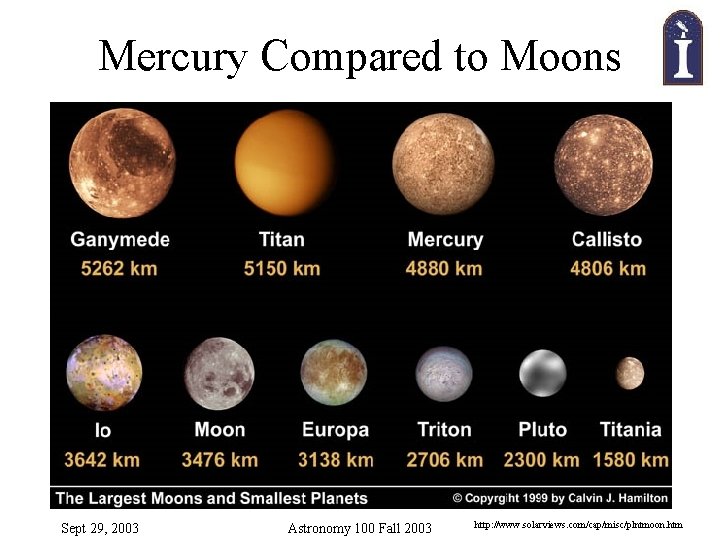
Mercury Compared to Moons Sept 29, 2003 Astronomy 100 Fall 2003 http: //www. solarviews. com/cap/misc/plntmoon. htm
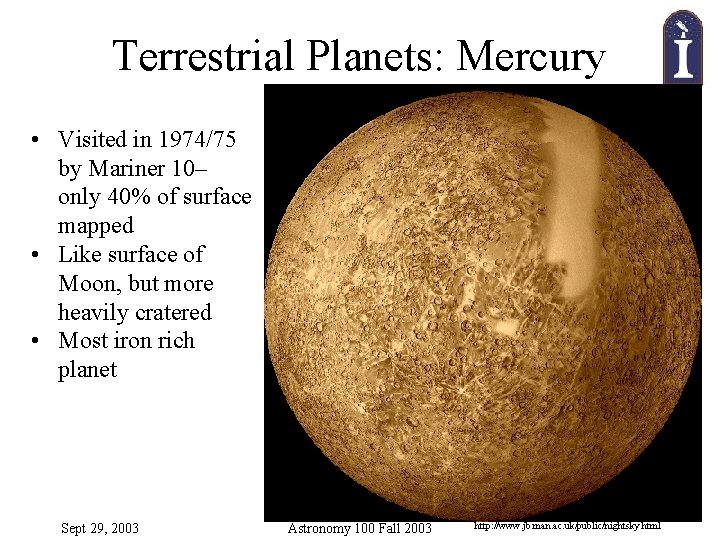
Terrestrial Planets: Mercury • Visited in 1974/75 by Mariner 10– only 40% of surface mapped • Like surface of Moon, but more heavily cratered • Most iron rich planet Sept 29, 2003 Astronomy 100 Fall 2003 http: //www. jb. man. ac. uk/public/nightsky. html
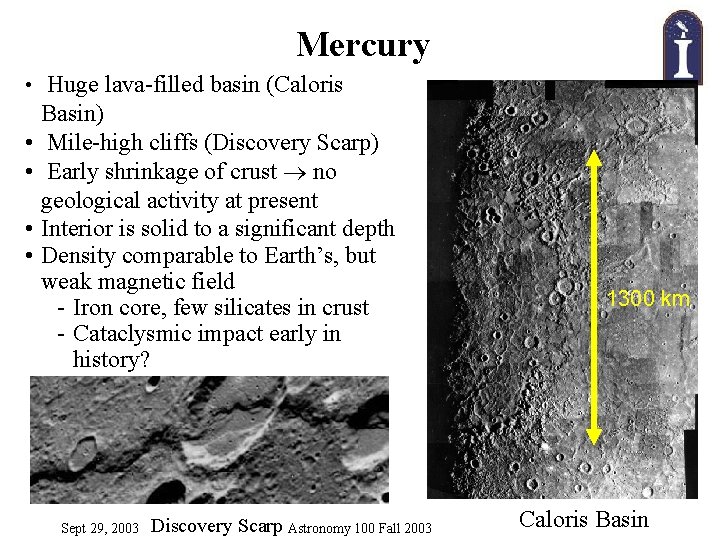
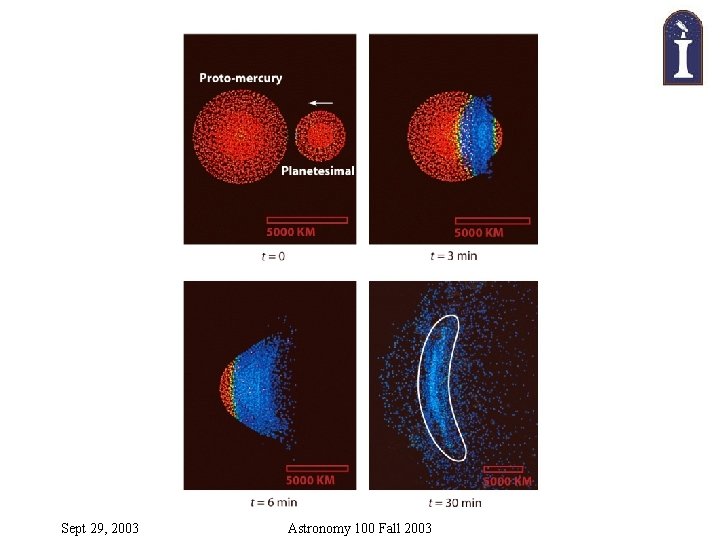
Mercury • Huge lava-filled basin (Caloris • • Basin) Mile-high cliffs (Discovery Scarp) Early shrinkage of crust no geological activity at present Interior is solid to a significant depth Density comparable to Earth’s, but weak magnetic field - Iron core, few silicates in crust - Cataclysmic impact early in history? Sept 29, 2003 Discovery Scarp Astronomy 100 Fall 2003 1300 km Caloris Basin
Sept 29, 2003 Astronomy 100 Fall 2003
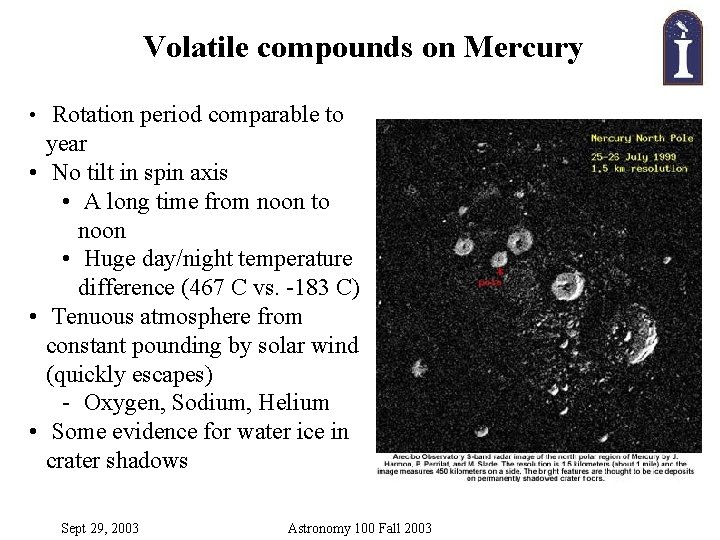
Volatile compounds on Mercury • Rotation period comparable to year • No tilt in spin axis • A long time from noon to noon • Huge day/night temperature difference (467 C vs. -183 C) • Tenuous atmosphere from constant pounding by solar wind (quickly escapes) - Oxygen, Sodium, Helium • Some evidence for water ice in crater shadows Sept 29, 2003 Astronomy 100 Fall 2003
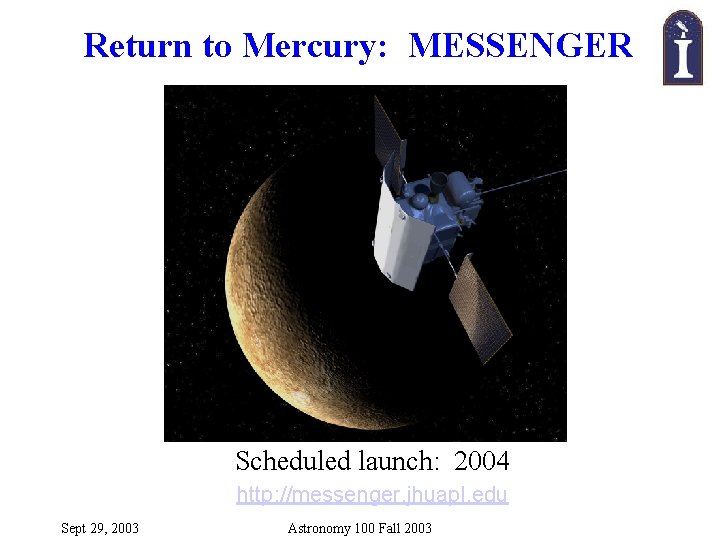
Return to Mercury: MESSENGER Scheduled launch: 2004 http: //messenger. jhuapl. edu Sept 29, 2003 Astronomy 100 Fall 2003
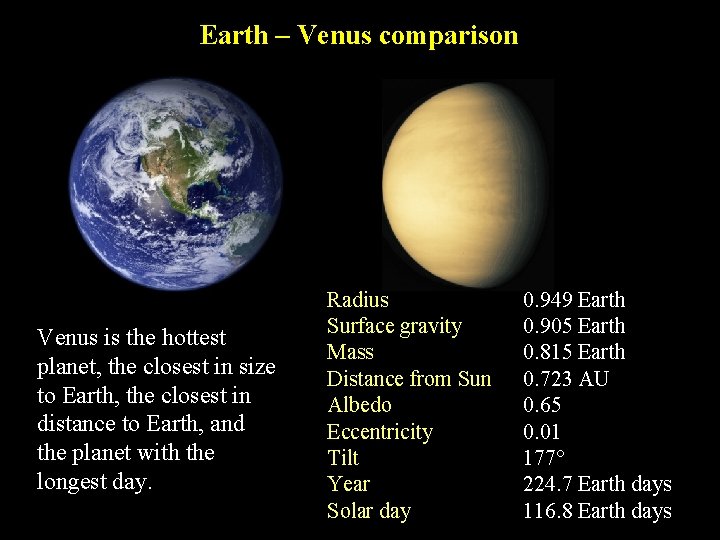
Earth – Venus comparison Venus is the hottest planet, the closest in size to Earth, the closest in distance to Earth, and the planet with the longest day. Sept 29, 2003 Radius Surface gravity Mass Distance from Sun Albedo Eccentricity Tilt Year Solar day Astronomy 100 Fall 2003 0. 949 Earth 0. 905 Earth 0. 815 Earth 0. 723 AU 0. 65 0. 01 177° 224. 7 Earth days 116. 8 Earth days
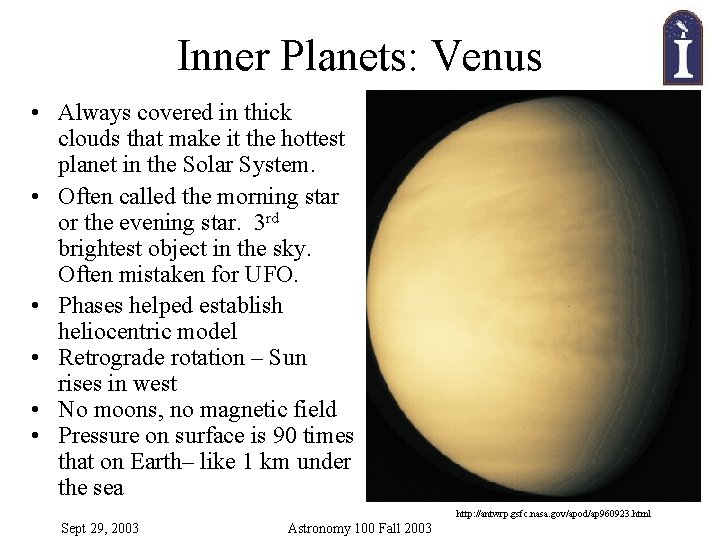
Inner Planets: Venus • Always covered in thick clouds that make it the hottest planet in the Solar System. • Often called the morning star or the evening star. 3 rd brightest object in the sky. Often mistaken for UFO. • Phases helped establish heliocentric model • Retrograde rotation – Sun rises in west • No moons, no magnetic field • Pressure on surface is 90 times that on Earth– like 1 km under the sea http: //antwrp. gsfc. nasa. gov/apod/ap 960923. html Sept 29, 2003 Astronomy 100 Fall 2003
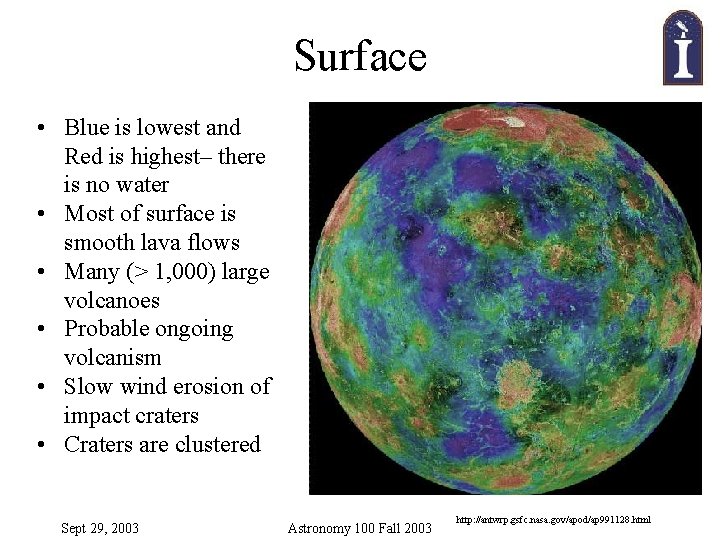
Surface • Blue is lowest and Red is highest– there is no water • Most of surface is smooth lava flows • Many (> 1, 000) large volcanoes • Probable ongoing volcanism • Slow wind erosion of impact craters • Craters are clustered Sept 29, 2003 Astronomy 100 Fall 2003 http: //antwrp. gsfc. nasa. gov/apod/ap 991128. html
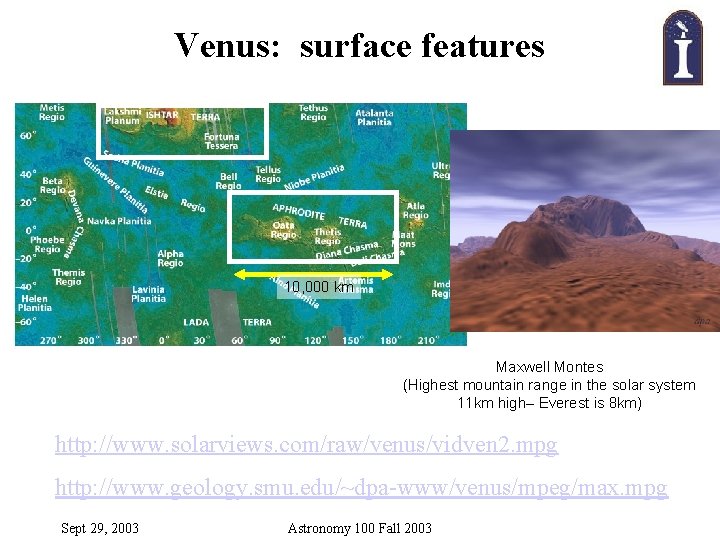
Venus: surface features 10, 000 km Maxwell Montes (Highest mountain range in the solar system 11 km high– Everest is 8 km) http: //www. solarviews. com/raw/venus/vidven 2. mpg http: //www. geology. smu. edu/~dpa-www/venus/mpeg/max. mpg Sept 29, 2003 Astronomy 100 Fall 2003
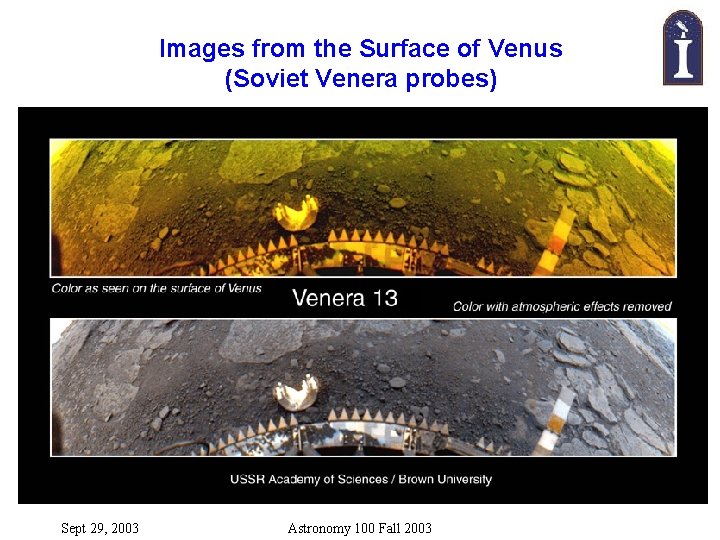
Images from the Surface of Venus (Soviet Venera probes) Sept 29, 2003 Astronomy 100 Fall 2003

Greenhouse Effect You get into your car in the summer, and it’s much hotter inside the car as compared to outside the car. Why? Sept 29, 2003 Astronomy 100 Fall 2003
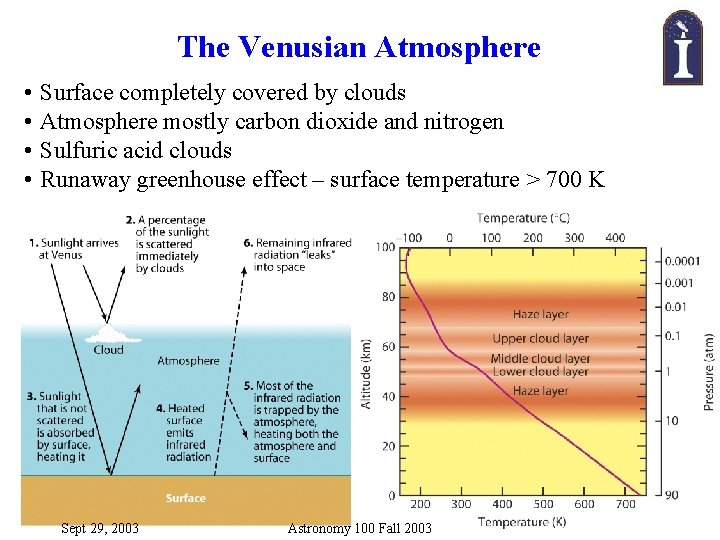
The Venusian Atmosphere • • Surface completely covered by clouds Atmosphere mostly carbon dioxide and nitrogen Sulfuric acid clouds Runaway greenhouse effect – surface temperature > 700 K Sept 29, 2003 Astronomy 100 Fall 2003
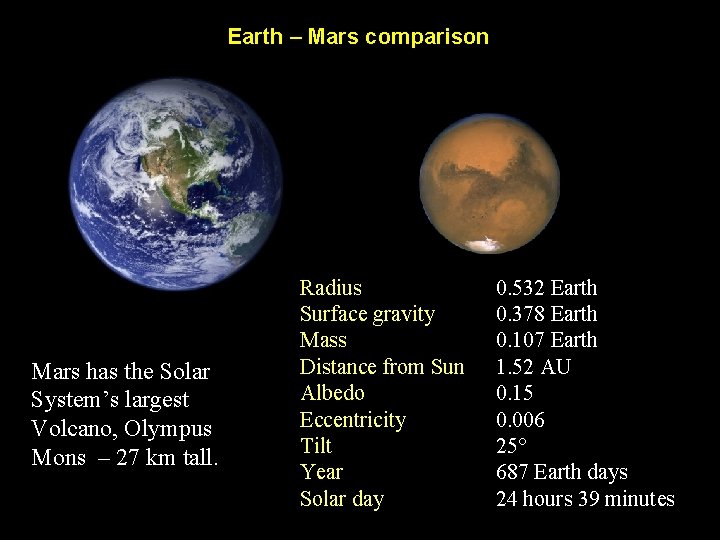
Earth – Mars comparison Mars has the Solar System’s largest Volcano, Olympus Mons – 27 km tall. Sept 29, 2003 Radius Surface gravity Mass Distance from Sun Albedo Eccentricity Tilt Year Solar day Astronomy 100 Fall 2003 0. 532 Earth 0. 378 Earth 0. 107 Earth 1. 52 AU 0. 15 0. 006 25° 687 Earth days 24 hours 39 minutes
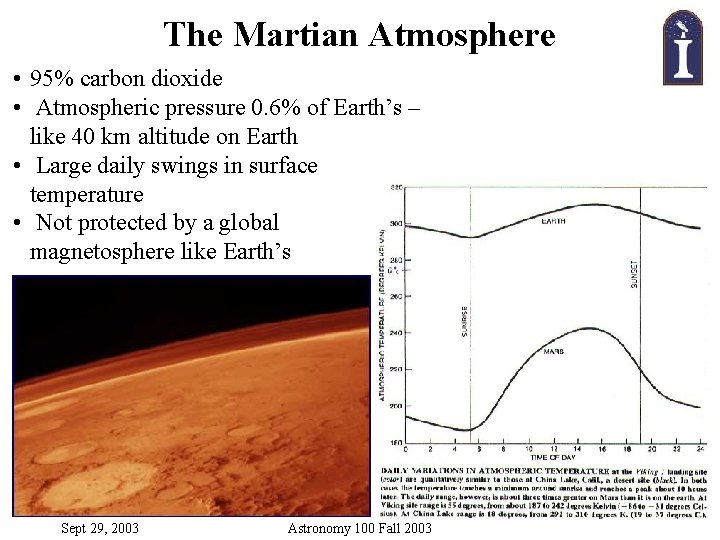
The Martian Atmosphere • 95% carbon dioxide • Atmospheric pressure 0. 6% of Earth’s – like 40 km altitude on Earth • Large daily swings in surface temperature • Not protected by a global magnetosphere like Earth’s Sept 29, 2003 Astronomy 100 Fall 2003
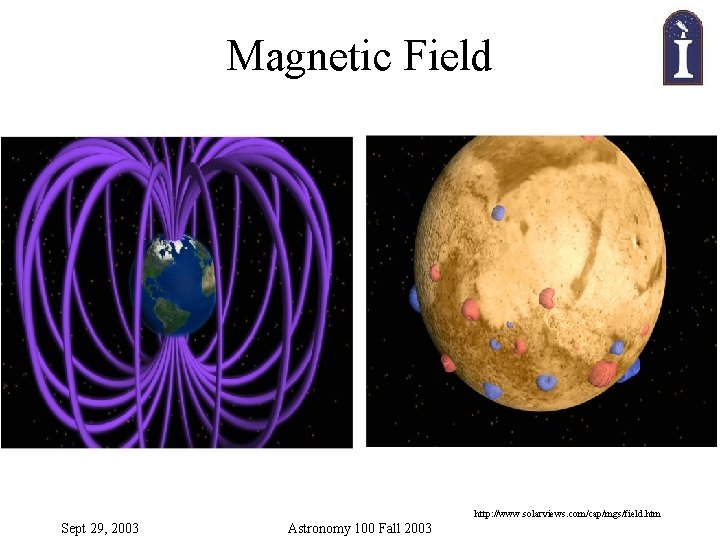
Magnetic Field http: //www. solarviews. com/cap/mgs/field. htm Sept 29, 2003 Astronomy 100 Fall 2003
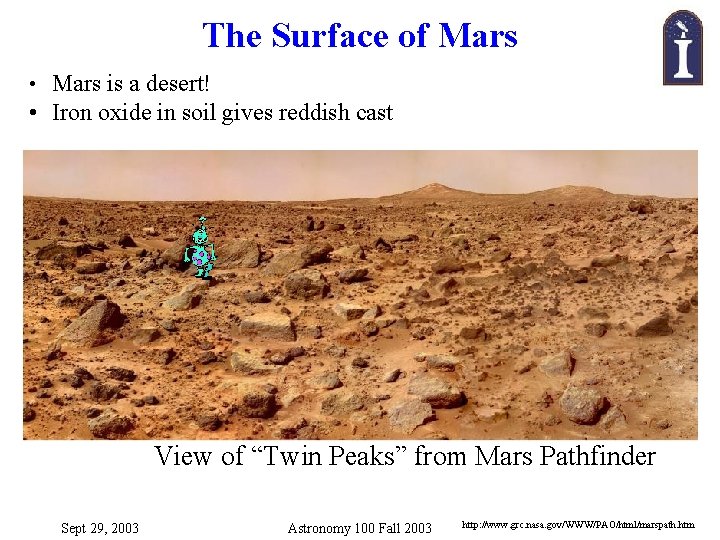
The Surface of Mars • Mars is a desert! • Iron oxide in soil gives reddish cast View of “Twin Peaks” from Mars Pathfinder Sept 29, 2003 Astronomy 100 Fall 2003 http: //www. grc. nasa. gov/WWW/PAO/html/marspath. htm
The Surface of Mars Sept 29, 2003 Astronomy 100 Fall 2003 http: //mpfwww. jpl. nasa. gov/MPF/ops/81696_full. jpg
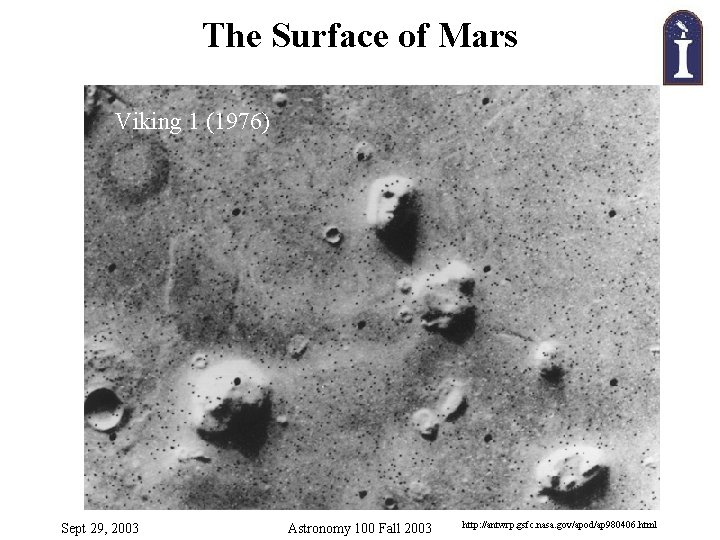
The Surface of Mars Viking 1 (1976) Sept 29, 2003 Astronomy 100 Fall 2003 http: //antwrp. gsfc. nasa. gov/apod/ap 980406. html
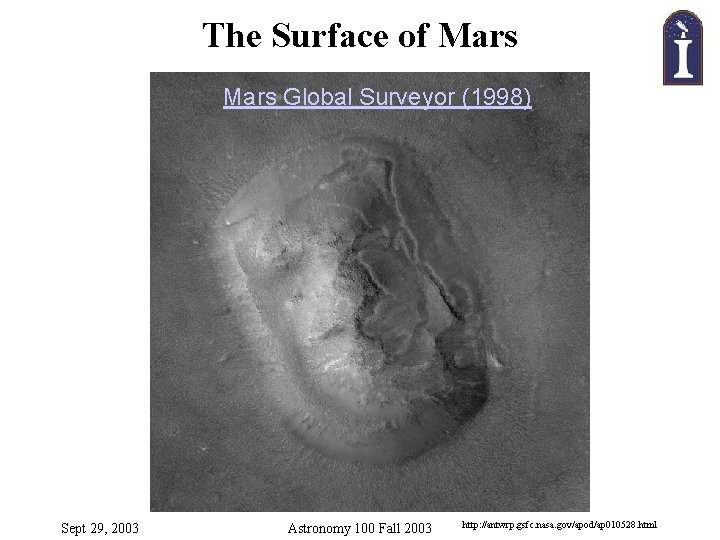
The Surface of Mars Global Surveyor (1998) Sept 29, 2003 Astronomy 100 Fall 2003 http: //antwrp. gsfc. nasa. gov/apod/ap 010528. html
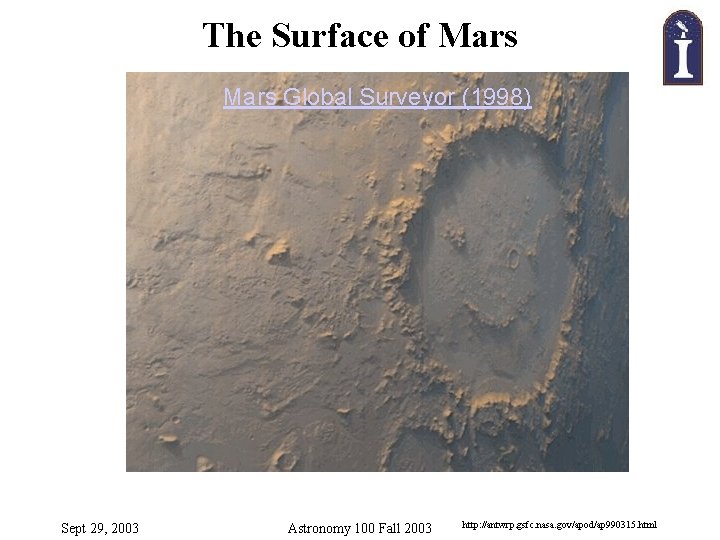
The Surface of Mars Global Surveyor (1998) Sept 29, 2003 Astronomy 100 Fall 2003 http: //antwrp. gsfc. nasa. gov/apod/ap 990315. html
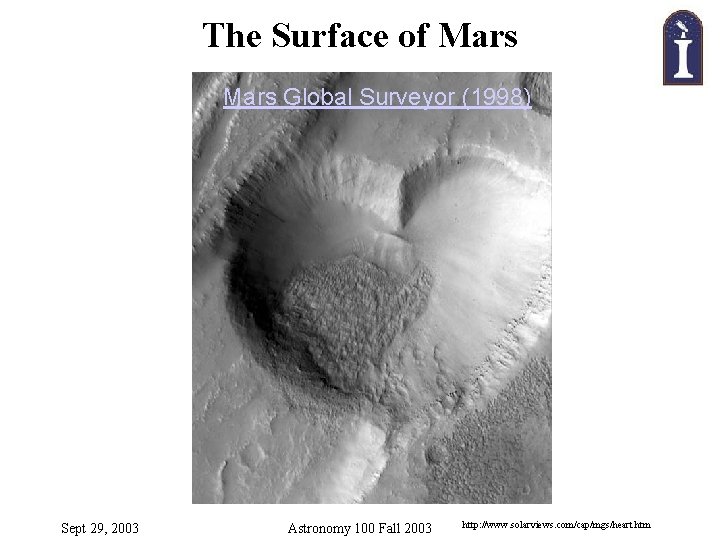
The Surface of Mars Global Surveyor (1998) Sept 29, 2003 Astronomy 100 Fall 2003 http: //www. solarviews. com/cap/mgs/heart. htm
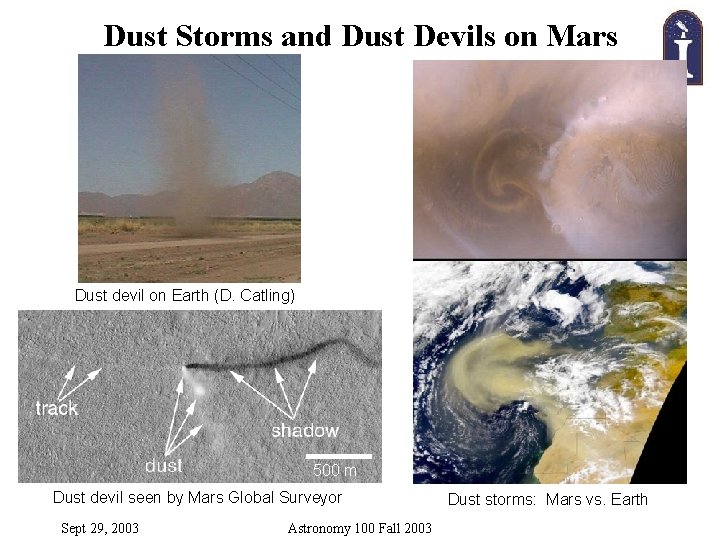
Dust Storms and Dust Devils on Mars Dust devil on Earth (D. Catling) 500 m Dust devil seen by Mars Global Surveyor Sept 29, 2003 Astronomy 100 Fall 2003 Dust storms: Mars vs. Earth
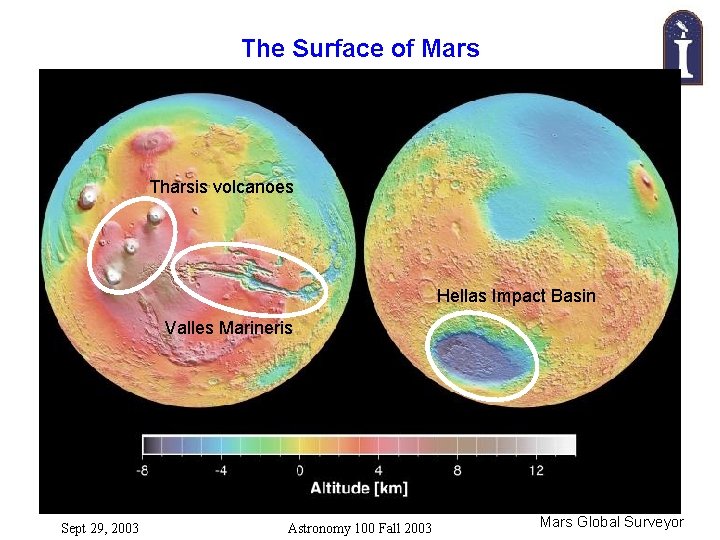
The Surface of Mars Tharsis volcanoes Hellas Impact Basin Valles Marineris Sept 29, 2003 Astronomy 100 Fall 2003 Mars Global Surveyor
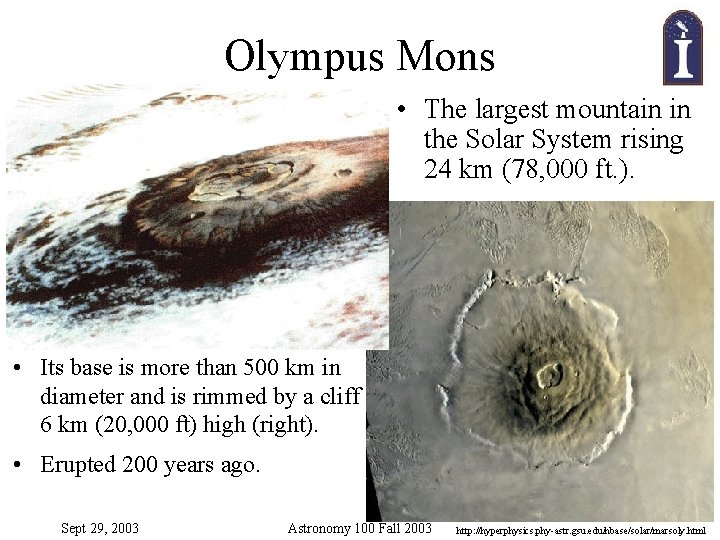
Olympus Mons • The largest mountain in the Solar System rising 24 km (78, 000 ft. ). • Its base is more than 500 km in diameter and is rimmed by a cliff 6 km (20, 000 ft) high (right). • Erupted 200 years ago. Sept 29, 2003 Astronomy 100 Fall 2003 http: //hyperphysics. phy-astr. gsu. edu/hbase/solar/marsoly. html
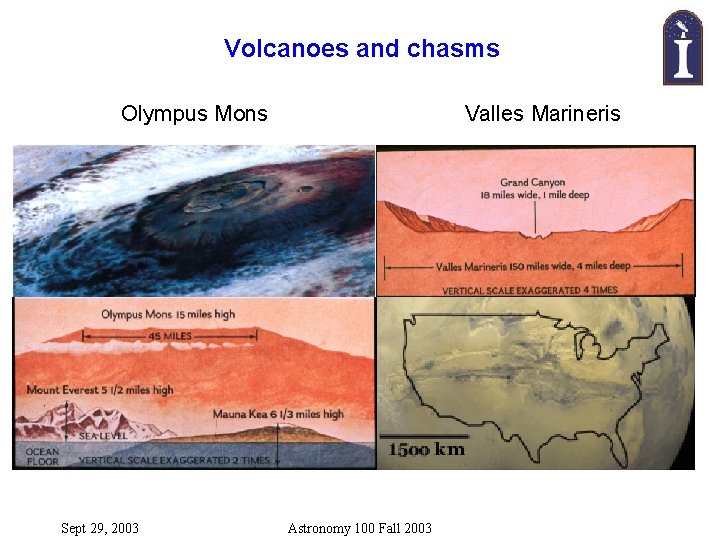
Volcanoes and chasms Olympus Mons Sept 29, 2003 Valles Marineris Astronomy 100 Fall 2003
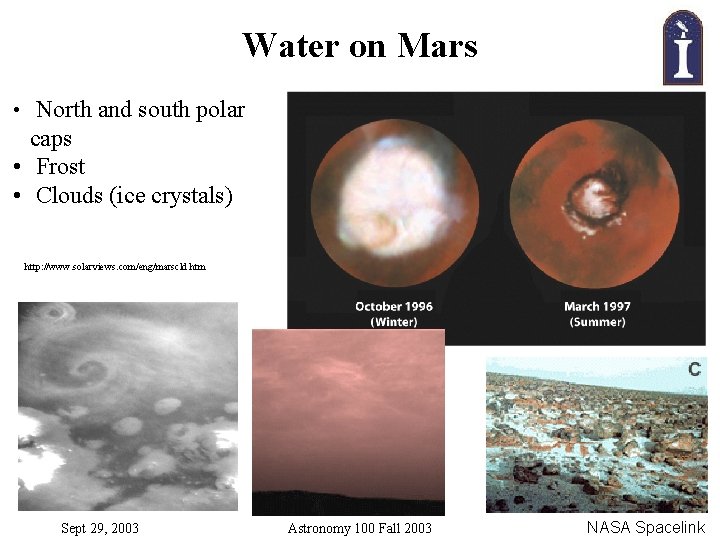
Water on Mars • North and south polar caps • Frost • Clouds (ice crystals) http: //www. solarviews. com/eng/marscld. htm Sept 29, 2003 Astronomy 100 Fall 2003 NASA Spacelink
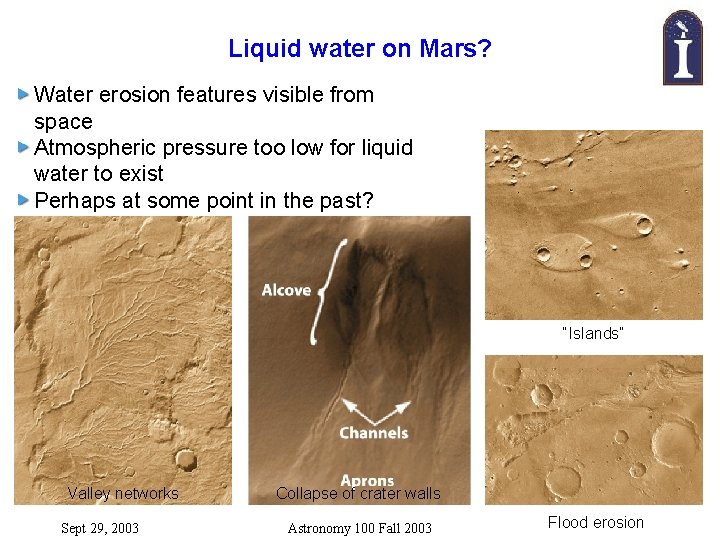
Liquid water on Mars? Water erosion features visible from space Atmospheric pressure too low for liquid water to exist Perhaps at some point in the past? “Islands” Valley networks Sept 29, 2003 Collapse of crater walls Astronomy 100 Fall 2003 Flood erosion
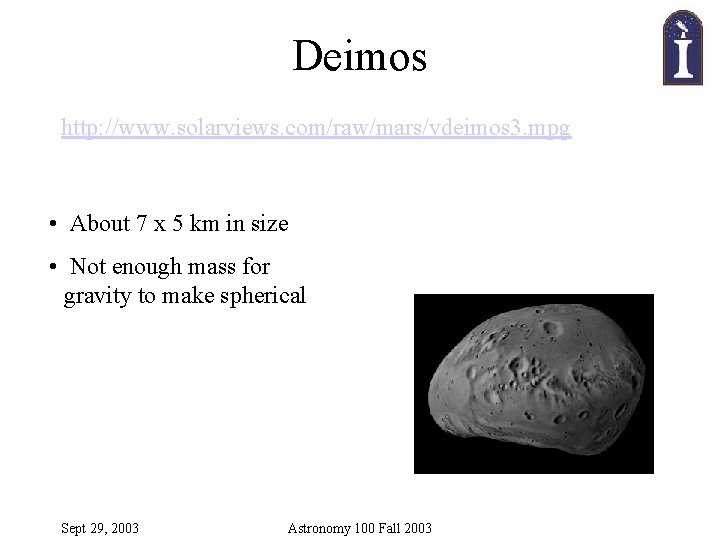
Deimos http: //www. solarviews. com/raw/mars/vdeimos 3. mpg • About 7 x 5 km in size • Not enough mass for gravity to make spherical Sept 29, 2003 Astronomy 100 Fall 2003
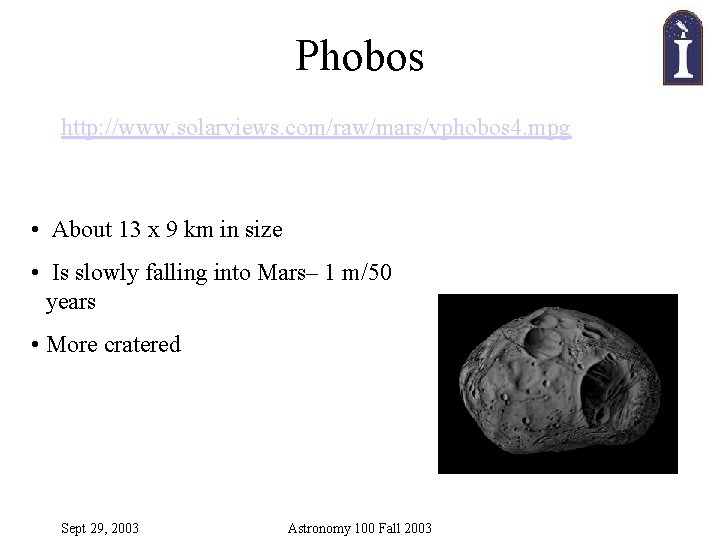
Phobos http: //www. solarviews. com/raw/mars/vphobos 4. mpg • About 13 x 9 km in size • Is slowly falling into Mars– 1 m/50 years • More cratered Sept 29, 2003 Astronomy 100 Fall 2003
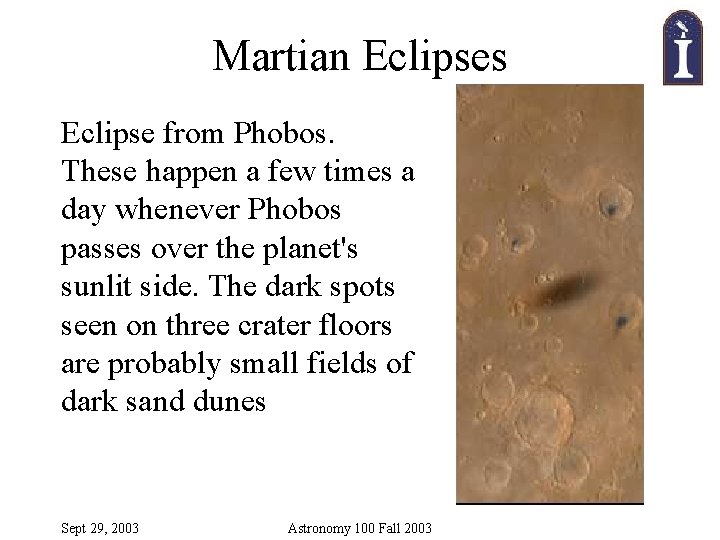
Martian Eclipses Eclipse from Phobos. These happen a few times a day whenever Phobos passes over the planet's sunlit side. The dark spots seen on three crater floors are probably small fields of dark sand dunes Sept 29, 2003 Astronomy 100 Fall 2003
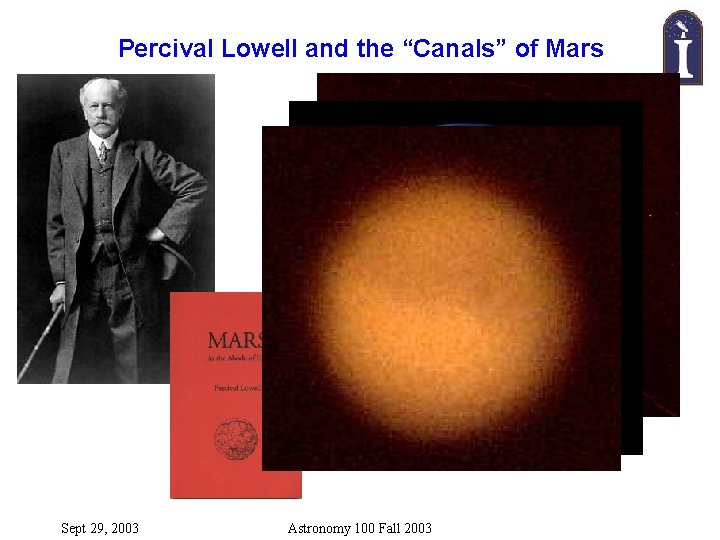
Percival Lowell and the “Canals” of Mars Sept 29, 2003 Astronomy 100 Fall 2003
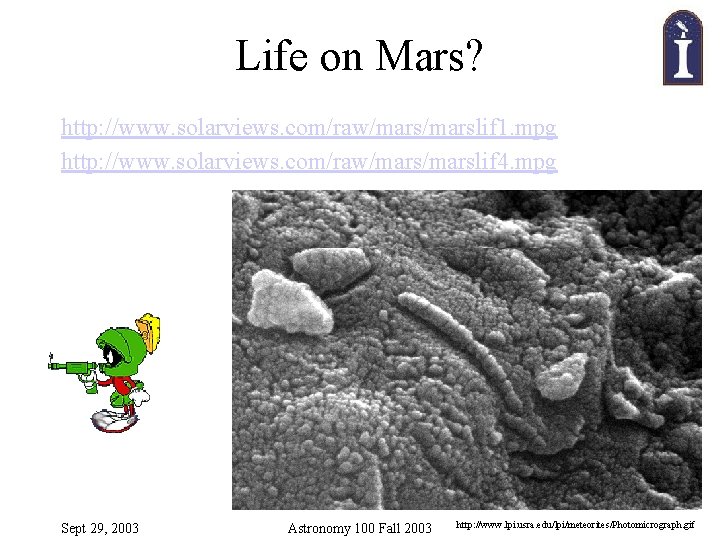
Life on Mars? http: //www. solarviews. com/raw/marslif 1. mpg http: //www. solarviews. com/raw/marslif 4. mpg Sept 29, 2003 Astronomy 100 Fall 2003 http: //www. lpi. usra. edu/lpi/meteorites/Photomicrograph. gif
- Slides: 43