
Lasik decentration with the VISX Active Trak System

- Slides: 10
Lasik decentration with the VISX Active. Trak™ System Mark Edmund Johnston MD FRCSC johnston@nebraskaeye. com Authors have no financial interest.
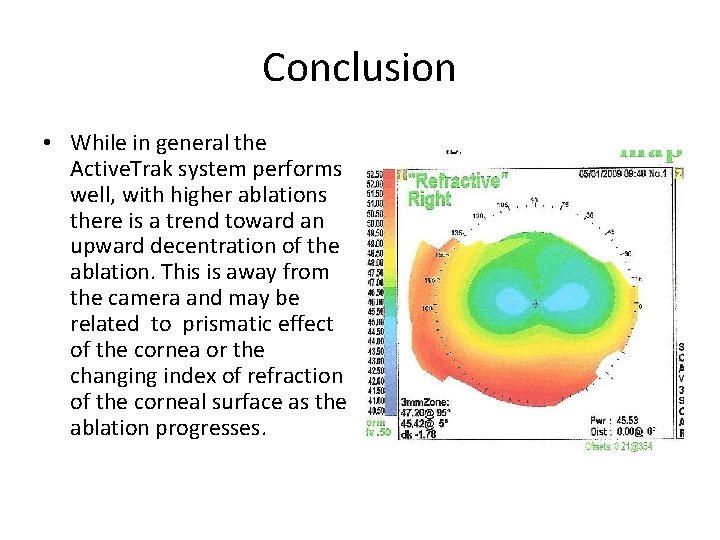
Direction of Decentration (Coma) pre-op enhancement • A subset of patients presenting for enhancement following LASIK with the VISX Active. Trak system had superior de-centration. • The purpose of this study was to document this clinical impression and understand the mechanism.
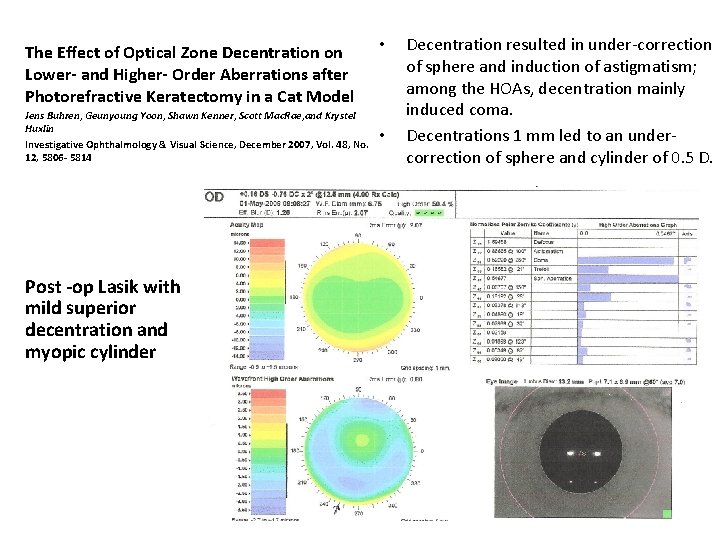
The Effect of Optical Zone Decentration on Lower- and Higher- Order Aberrations after Photorefractive Keratectomy in a Cat Model Jens Buhren, Geunyoung Yoon, Shawn Kenner, Scott Mac. Rae, and Krystel Huxlin Investigative Ophthalmology & Visual Science, December 2007, Vol. 48, No. 12, 5806 - 5814 Post -op Lasik with mild superior decentration and myopic cylinder • • Decentration resulted in under-correction of sphere and induction of astigmatism; among the HOAs, decentration mainly induced coma. Decentrations 1 mm led to an undercorrection of sphere and cylinder of 0. 5 D.
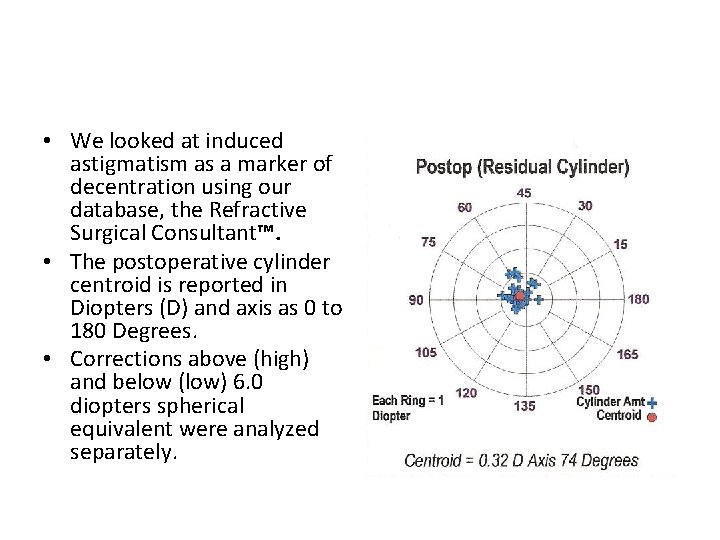
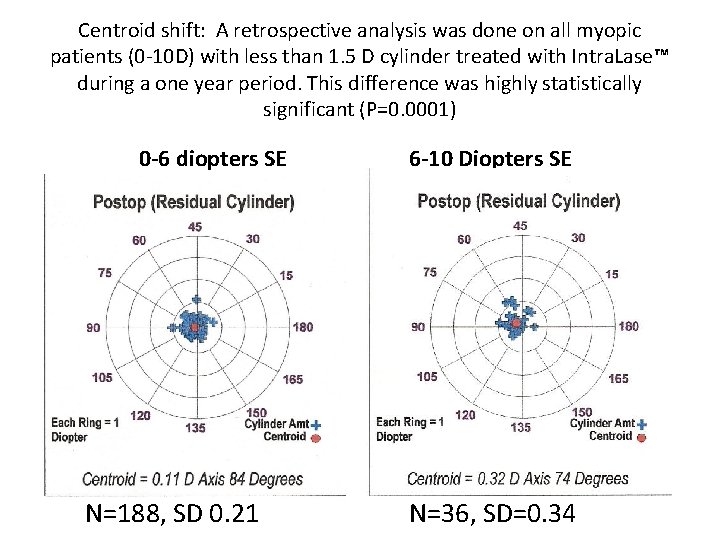
• We looked at induced astigmatism as a marker of decentration using our database, the Refractive Surgical Consultant™. • The postoperative cylinder centroid is reported in Diopters (D) and axis as 0 to 180 Degrees. • Corrections above (high) and below (low) 6. 0 diopters spherical equivalent were analyzed separately.
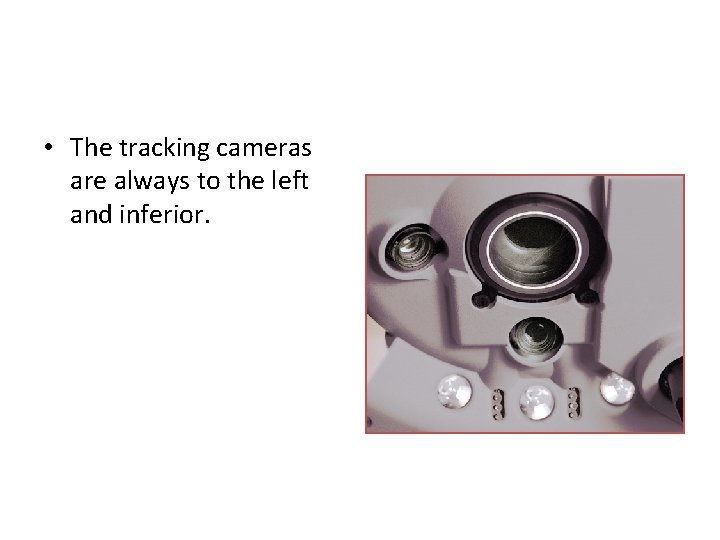
• The tracking cameras are always to the left and inferior.
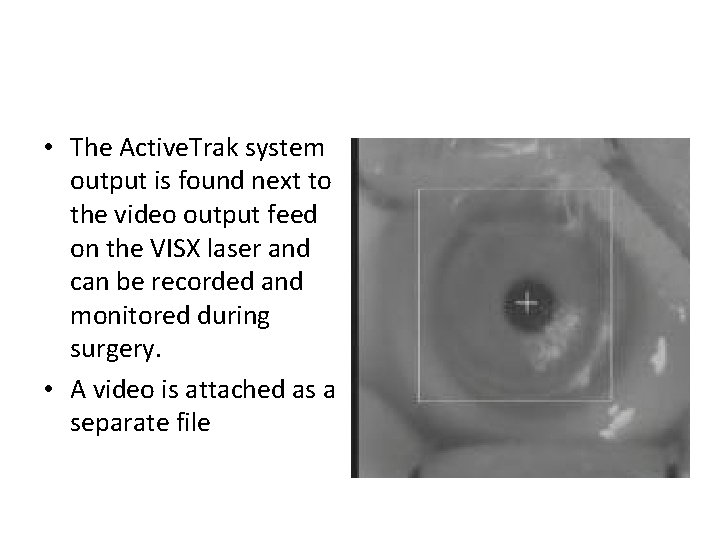
• The Active. Trak system output is found next to the video output feed on the VISX laser and can be recorded and monitored during surgery. • A video is attached as a separate file
Centroid shift: A retrospective analysis was done on all myopic patients (0 -10 D) with less than 1. 5 D cylinder treated with Intra. Lase™ during a one year period. This difference was highly statistically significant (P=0. 0001) 0 -6 diopters SE N=188, SD 0. 21 6 -10 Diopters SE N=36, SD=0. 34
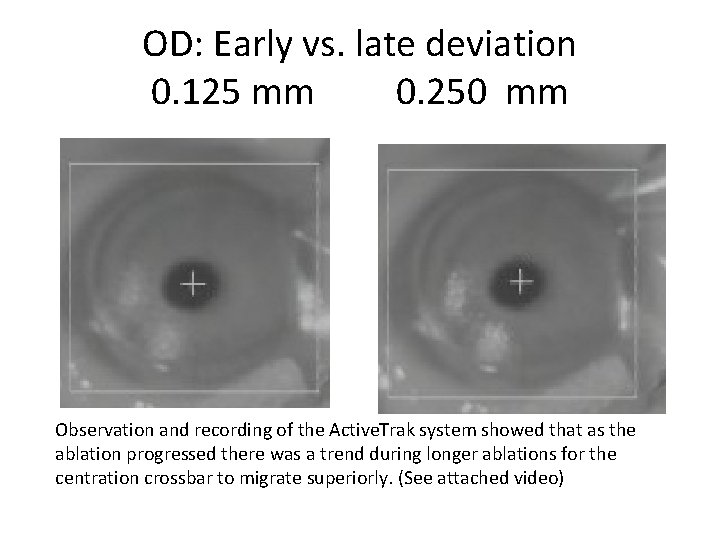
OD: Early vs. late deviation 0. 125 mm 0. 250 mm Observation and recording of the Active. Trak system showed that as the ablation progressed there was a trend during longer ablations for the centration crossbar to migrate superiorly. (See attached video)
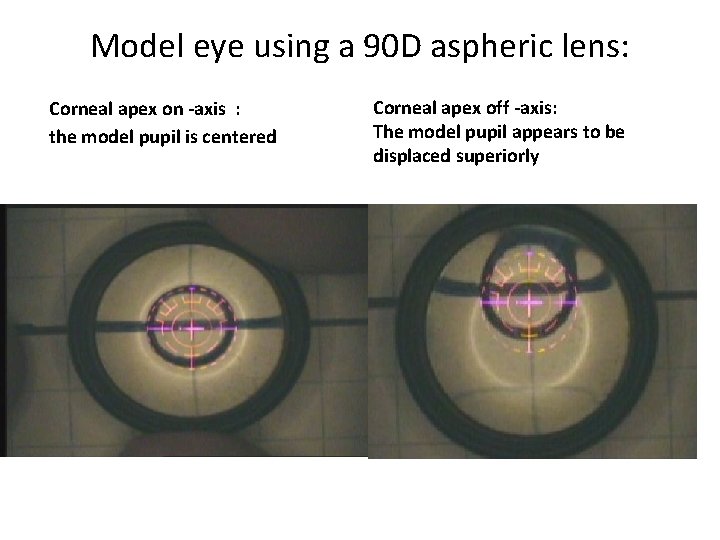
Model eye using a 90 D aspheric lens: Corneal apex on -axis : the model pupil is centered Corneal apex off -axis: The model pupil appears to be displaced superiorly
Conclusion • While in general the Active. Trak system performs well, with higher ablations there is a trend toward an upward decentration of the ablation. This is away from the camera and may be related to prismatic effect of the cornea or the changing index of refraction of the corneal surface as the ablation progresses.